
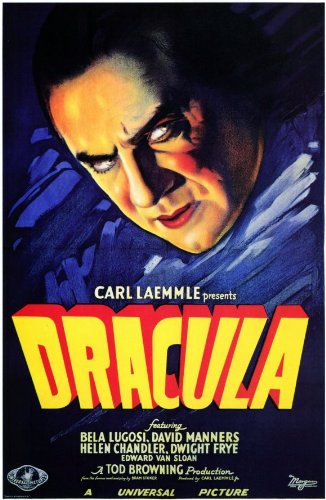
Dracula (1931)

DRACULA (1931) ****
I remember being first disappointed by the 1931 Dracula and that disappointment carried over for more than two decades.

Around the turn of the 21st Century, I bought the 1999 VHS release and that’s what I first watched, the one with Classic Monster Collection across the top and then New Music by Philip Glass and Performed by Kronos Quartet immediately below. Of course, I thought Bela Lugosi as Dracula and Dwight Frye as Renfield were absolutely incredible, David Manners as Jonathan Harker and Edward Van Sloan as Professor Van Helsing and Helen Chandler as Mina Harker less so, and I loved director Tod Browning’s 1932 Freaks at first sight contemporaneous with Dracula. Freaks remains one of my absolute favorite movies, so obviously some movies hit people right from the start and others just simply take more time or sometimes they never make that deep, personal connection others do.

For the longest time, at least a decade if not longer, I thought Dracula was overrated and paled in comparison against Freaks, Frankenstein, The Bride of Frankenstein, and The Wolf Man, all of which I first saw around the same time as Dracula and I loved, absolutely loved, and still do love all of them. At the time, I also loved Abbott and Costello Meet Frankenstein more than Dracula.

It was that darn Philip Glass / Kronos Quartet score that stank up Dracula and I still get a big kick out of the Triumph the Insult Comic Dog couplet, Philip Glass, atonal ass, you’re not immune / Write a song with a fucking tune. I remember my wife complained about Glass’ score for the experimental non-narrative film Koyaanisqatsi and I bristled at his score for Candyman upon revisiting that 1992 film for the first time in several years.

Revisiting the 1931 Dracula in recent years, without the Glass / Kronos score and back closer to how it first appeared in theaters on Feb. 14, 1931, it’s risen in stock from three to three-and-a-half and finally four stars. I cannot deny that it still has a fair share of faults, like those performances I mentioned earlier and the stage-bound production quality since it’s based off the 1924 stage play adapted from Bram Stoker’s 1897 novel, but I’ve grown appreciation for everything that works from the opening scenes in Transylvania to Lugosi (1882-1956) and Frye (1899-1943), who inspired later songs from Bauhaus (Bela Lugosi’s Dead) and Alice Cooper (The Ballad of Dwight Fry).

It also helps one to catch up with the Spanish language Dracula from the same year and the same sets but a different cast, a different language, and a different director. This Spanish version, rediscovered first in 1978 and then later on video in 1992, lasts 30 minutes longer and it’s better in almost every respect than its famous counterpart. Better shot and better looking, vastly superior cleavage and far sexier women (Lupita Tovar over Helen Chandler any day of the millennium), and less wimpy men in the Spanish version, but Lugosi still prevails against Carlos Villarias.

Several lines had already entered the lexicon decades before I first watched Dracula: I never drink … wine. For one who has not lived even a single lifetime, you’re a wise man, Van Helsing. Listen to them. Children of the night. What music they make. Even I am Dracula belongs somewhere in the pantheon near Bond, James Bond. Lugosi’s ability or lack thereof speaking the English language actually benefits the otherworldly nature of his Dracula and I hold his performance in high regard alongside Max Schreck in Nosferatu, Christopher Lee in Dracula, and Gary Oldman in Dracula.

I have a long relationship with vampires.

I remember the 1985 Fright Night being the highlight of a boy slumber party circa 1988 and third or fourth grade.

I must have been 11 or 12 years old and in the fifth or sixth grade when reading the Stoker novel. Right around that point in time, I also read Sir Arthur Conan Doyle’s The Hound of the Baskervilles and Roald Dahl’s Charlie and the Chocolate Factory. I loved all three of them and they each fired up my imagination and creative spirit.

A few years later, I caught up with the Francis Ford Coppola version and talk about a movie that wowed a 14-year-old boy. I remember staying up late and sneaking around (somewhat) to watch this Dracula on my bedroom TV, captivated by all the nudity and sexuality and violence and Winona Ryder and Sadie Frost and it recalled some of what I liked about the novel all while becoming a cinematic extravaganza. I know critics of the 1992 Dracula blasted the film for being all style, no substance and for being overblown, but I think it’s overflowing with creativity and sheer cinematic beauty. I rate it right up there with F.W. Murnau’s Nosferatu as one of the best vampire films ever.

Some things simply transcend Keanu Reeves’ horrible accent and Dracula’s at one point beehive hairdo.

The vampire genre itself transcends such duds as Dracula 2000 and New Moon.
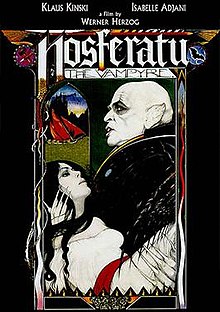
Nosferatu (1979)

NOSFERATU

NOSFERATU (1979) ***1/2

German director Werner Herzog’s NOSFERATU THE VAMPYRE has often been described as a “slow burn” horror film and every critic seems to want to sound a fire alarm that it’s not the average “creature feature” with cheap thrills every few minutes and that it will disappoint most horror movie fans.

The former is certainly true and I cannot speak for the latter except to say this horror movie fan liked it. I’ll be honest, I did not much enjoy it the first time watching it a good 20 years before my return viewing. I remember having a more neutral reaction that first time. Not sure why.

Looking up “slow burn,” I find that it means “a filmmaking style, usually in narrative productions, wherein plot, action, and scenes develop slowly, methodically toward a (usually) explosive boiling point.”

NOSFERATU definitely fits methodical and perhaps only slow to viewers raised on Attention Deficit Cinema. I’d rather say that Herzog’s remake and F.W. Murnau’s original 1922 masterpiece subtitled A SYMPHONY OF HORROR both move at their own leisurely pace. They play more like fever dreams than the average horror movie.

NOSFERATU does not fit the back end of that slow burn definition, because there’s not an explosive boiling point. Certainly not anything resembling the stereotypical big bang grand finale to a standard Hammer Dracula picture.

Herzog marches to the beat of his own drum. That’s for sure and thank God for that, just as we should be thankful for every great director. I consider his AGUIRRE, THE WRATH OF GOD to be the best film I have seen from 1972 and I would put it on a list of the greatest films ever made. LITTLE DIETER NEEDS TO FLY and GRIZZLY MAN are on my top 10 lists for 1997 and 2005, respectively. Les Blank’s documentary BURDEN OF DREAMS, which chronicles Herzog’s great adventure making FITZCARRALDO, also makes my top 10 list for 1982. Ramin Bahrani’s 18-minute PLASTIC BAG, a top 10 entry for 2010, utilizes Herzog as its narrator.

I know that NOSFERATU was my first time watching a Herzog movie and I believe I had not yet seen the Murnau original. To be sure, I was more equipped watching NOSFERATU for a second time.

More than anything else, images stand out. Brilliant images are the heart of both the 1922 and 1979 films and both Murnau’s and Herzog’s filmography.

Musophobes should not watch NOSFERATU, because rats take over the screen at crucial points late in the picture. The rats are the source of some legendary stories: Herzog said the rats were better behaved during the shoot than star Klaus Kinski and since real grey rats proved to be unavailable, white rats were given a grey makeover, for example.

The rats call to mind the monkeys from AGUIRRE.

Of course, there’s every time Dracula (Kinski) is on the screen. Since copyright was not a concern for Herzog like it had been in 1922 for the first NOSFERATU, Herzog returned names like Dracula, Jonathan Harker, and Lucy to his version. Dracula’s look echoes Max Schreck’s iconic Count Orlok and both vampires are radically different from the classic bloodsuckers played by Bela Lugosi and Christopher Lee, as well as just about every other vampire in cinematic history. Herzog and Murnau both show how it is more of a curse to be a vampire and make it far less of a power trip. Herzog’s Dracula and Count Orlok are not suave and debonair, and their striking physical appearances echo vampire folklore. We also have far more complex reactions to the vampires played by Schreck and Kinski, since we feel more empathy for them.

Around her mid-20s at the time she made NOSFERATU, French actress Isabelle Adjani already had a strong claim on the title of most beautiful woman in the world. NOSFERATU did nothing to refute that.

Thinking about the various Jonathan Harkers over time, Bruno Ganz’s performance ranks better than David Manners in the 1931 DRACULA and Keanu Reeves in the 1992 DRACULA. He certainly goes through a wider emotional range than either Manners or Reeves, who are both “mannered” in their performances.

Ultimately, NOSFERATU leaves one with feelings different from how we normally react to a vampire picture. There’s not the standard euphoria that we experience, for example, when Lee’s Dracula spectacularly bites the dust. Instead, we are more pensive and melancholic than excited and thrilled.

Shrek (2001)

SHREK (2001) Four stars

I recently watched SHREK for the who knows how many times and it was every bit as fun as it was the first time all those years ago.

Watching it was just like catching up with an old friend who you have not seen in a long time. Sometimes, that’s a delightful experience as two people do not miss a beat despite the passing of time. Once in a while, it’s just two people in a room who have nothing to say to each other one way or the other. I connected with SHREK all over again.

There’s so many great characters, old friends if you will, in SHREK and I think that, more than anything else, is the secret to its success.

We might as well as start with the title character. The name Shrek itself calls to mind the surname Schreck, the German actor who played Dracula in the F.W. Murnau silent classic NOSFERATU (1922). Schreck means “a feeling of fear or alarm.” Ogre means a man-eating giant in folklore and a cruel or terrifying person in reality. None of those definitions fit the title character in SHREK, who thankfully is more of an ogre with a heart of gold than a man-eating giant. Granted, Shrek would just rather be left alone in his swamp, at least at the beginning of the picture. His privacy’s besieged upon first by a single annoyance and then by a slew of fairy tale characters who have been driven from their kingdom. Eventually, he takes on the assignment of slaying a dragon and rescuing a princess from an outsourcing overlord.

Princess Fiona is not the average princess and, for that matter, Dragon is not the average dragon. Of course, this is not a Disney picture, it’s a DreamWorks extravaganza, and the scene where Fiona unleashes her inner martial artist on Monsieur Robin Hood and his Merry Men proved to be a game changer for animated princesses. I could have lived without the MATRIX reference, since it seemed like every other picture made in the early 2000s referenced THE MATRIX, but it was a pleasant surprise to see her kick ass. She has even more surprises in store, especially for Shrek.

Surprises are SHREK in a nutshell, which puts entertaining and fresh spins and variations on durable storytelling traditions or that’s just another way of saying that SHREK breathed fresh life into fairy tale stories. It will remind viewers of THE PRINCESS BRIDE.

In other words, at times, SHREK absolutely skewers fairy tales. I mean, there’s the delightful scene where antagonist Lord Farquaad tortures the Gingerbread Man for information about the whereabouts of all his fellow fairy tale brothers and sisters. What will it take to make him crack? Lord Farquaad makes a move toward the Gingerbread Man’s gumdrop buttons and that’s going way, way, way too far. That’s a fun scene, and there’s probably about 50 more fun scenes in SHREK.

Children and adults both enjoy SHREK, and that’s because there’s jokes only more experienced viewers will understand. For example, when Shrek observes that Lord Farquaad must be overcompensating for something, we adults know what’s that something. SHREK is a film truly for the entire family, capable of placating the smart ass teenager, the lover of fairy tales and/or musicals, and the grumpy old man to name three demographics.

We have mentioned Lord Farquaad a couple times already in this review, and he makes for a great villain. He’s voiced by John Lithgow, who brings his expertise from live-action villainous roles in BLOW OUT, RAISING CAIN, and CLIFFHANGER. He’s one of those actors who we love to hate. This is also the same Lithgow, by the way, who released “John Lithgow’s Kid-Size Concert” on VHS in 1990, advertised on the box as “Award winning actor JOHN LITHGOW sings and strums his favorite songs for kids.”

If there’s a hero (and a leading lady and a villain), invariably there must be a loyal sidekick for the hero and that’s filled in SHREK by Donkey, voiced by Eddie Murphy. Donkey, of course, exists in sharp contrast to Shrek, meaning that he’s a motormouth who eventually wears down the resistance of the big ogre. Donkey even finds himself a very unlikely love interest.

Until now, I have skipped Mike Myers and Cameron Diaz, who voice Shrek and Princess Fiona. They were not the original choices. Nicolas Cage passed on the title character at one point and Chris Farley recorded nearly all of his lines as Shrek, but Farley died of a drug overdose before he could finish. SHREK paired Farley with Janeane Garofalo as Princess Fiona, but she was fired without an explanation after his death. Shrek and Fiona each received a rewrite and personality changes after the personnel changes to Myers and Diaz, and Myers finally decided upon his trademark Scottish accent for one of his three iconic characters (Wayne and Austin Powers the other two) … hard to imagine Shrek without one at this point. In fact, it’s hard to imagine Myers, Diaz, Murphy, and Lithgow not voicing their respective characters.

SHREK spawned a new wave of computer animated pictures built upon pop-culture references and just being too darn clever for their own darn good, including its own increasingly lackluster sequels (I stopped at SHREK THE TURD, er, SHREK THE THIRD). Apparently, there’s a reboot or sequel named SHREK 5 slated for 2022.