
Happy Birthday to Me (1981)

HAPPY BIRTHDAY TO ME (1981) ***
Happy Birthday to Me stands out from the early ’80s slasher film craze pack because a) it has superior production values with a name director (J. Lee Thompson, who directed The Guns of Navarone and Cape Fear) and a good cast including an unhappy Glenn Ford, b) it has a longer running time than the average 85- and 90-minute slasher film, and c) it has one of the most bizarre twist endings this side of Sleepaway Camp.

Just like fellow 1981 Canadian slasher My Bloody Valentine, also produced by John Dunning and André Link with distinctive elements for a slasher, Happy Birthday to Me calls to mind a prestigious Academy Award for Best Picture winner, 1980’s Ordinary People. (My Bloody Valentine recalled The Deer Hunter from the coal mine setting and overall working-class milieu, the prodigious beer drinking, and the more adult-like plot and romantic triangle.)

Let’s see, Happy Birthday to Me and Ordinary People both have the same elite upper middle class suburban prep school environment, traumatic events in the past, troubled teenagers, and a therapist who works with our troubled teen protagonist.

Happy Birthday to Me plays more like a glossy, lurid soap opera at times punctuated with some creative, gruesome murder set pieces.

Melissa Sue Anderson makes her motion picture feature debut in Happy Birthday to Me as protagonist Virginia Wainwright. She had nearly a decade of experience on TV by that point, though, most notably as Mary Ingalls / Mary Ingalls Kendall on the hit show Little House on the Prairie. You can bet playing a blind Mary for a number of seasons prepared an 18-year-old Anderson for her flashbacks, brain operation, therapy sessions, memory loss, and traumatic blackouts throughout Happy Birthday to Me.

Slasher films often pursued at least one name actor for their cast: Betsy Palmer (Friday the 13th), Ben Johnson (Terror Train), Leslie Nielsen (Prom Night), Lauren Bacall, James Garner, and Maureen Stapleton (The Fan), and Farley Granger (The Prowler).

Glenn Ford accumulated 110 acting credits from 1937 through 1991, highlighted by Gilda, The Big Heat, Blackboard Jungle, 3:10 to Yuma, Midway, and Superman. Ford (1916-2006) wouldn’t have wanted to be remembered for Happy Birthday to Me and he was reportedly a very unhappy camper making the film, heavily drinking throughout and hitting the assistant director after he called for a lunch break during the middle of one of Ford’s scenes.

He’s not all that big a role in Happy Birthday to Me.

Ginny Wainwright attends the snobby Crawford Academy and she’s a member of the school’s Top 10 clique, only the best and brightest. They are systematically eliminated apparently by Ginny, and we find out that none of the Top Ten attended Ginny’s birthday party four years before the start of the movie. They attended instead another party for a Top 10 member and Ginny and her mother are then involved with an auto accident that kills Ginny’s mother and leaves the surviving Ginny needing her experimental brain tissue restoration.

Ginny was originally planned to be revealed as the killer possessed by the spirit of her dead mother, but the film instead chose a shocking twist ending that remains the main reason why fans of the film remember it so fondly 40 years later.

Thompson (1914-2002) reportedly got so much into the spirit of the enterprise that he was throwing around buckets of blood on set. The final 40 minutes pile up the corpses.

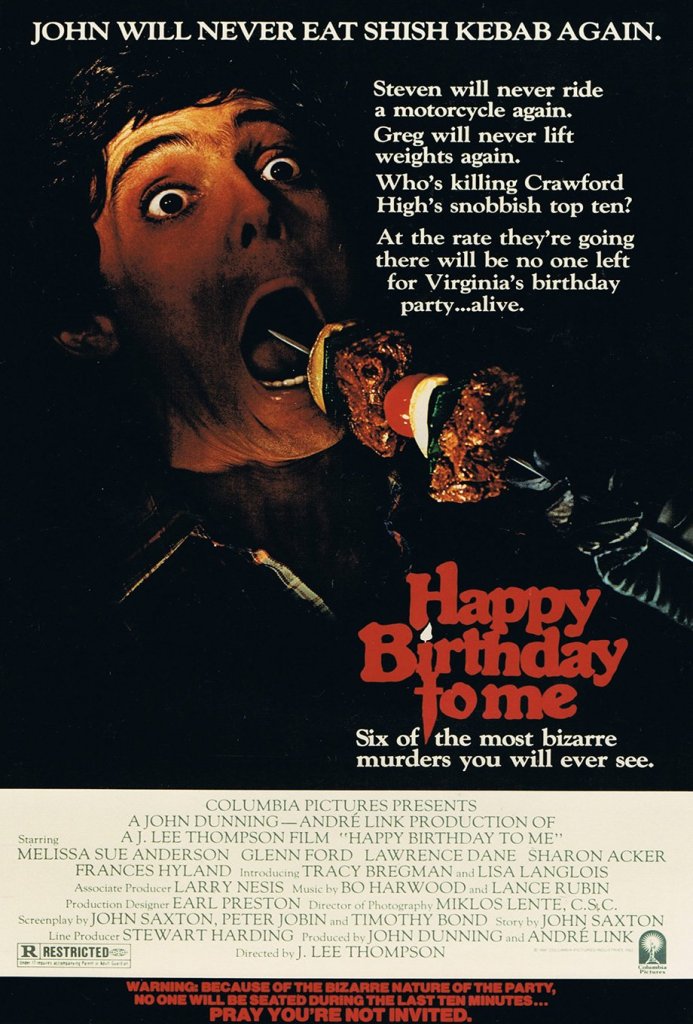
Columbia Pictures went for both the bloody and bizarre in promoting Happy Birthday to Me, a minor hit in the summer of 1981.

The poster has an image of the most famous murder set piece of the movie.

JOHN WILL NEVER EAT SHISH KEBAB AGAIN.

Steven will never ride a motorcycle again.

Greg will never lift weights again.

Who’s killing Crawford High’s snobbish top ten?

At the rate they’re going there will be no one left for Virginia’s birthday party … alive.

Happy Birthday to Me … Six of the most bizarre murders you will ever see.

WARNING: BECAUSE OF THE BIZARRE NATURE OF THE PARTY, NO ONE WILL BE SEATED DURING THE LAST TEN MINUTES … PRAY YOU’RE NOT INVITED.

Factual accuracy is not this poster’s strong suit, since there’s nine deaths in the movie, there’s no John character in the movie, Steven’s the one killed by kebab, and Etienne’s the one done in by a motorcycle.
Auto Pilot Cinema: The Airport Movies

AUTO PILOT CINEMA: THE AIRPORT MOVIES
When thinking of the worst series in movie history, I am tempted to start with Saw and Fast and the Furious then move back through time with The Omen and Amityville Horror and finally go way way way back to the Dead End Kids, er, Bowery Boys.

In piecing through all this cinematic carnage, I should not leave behind the four Airport movies that were churned out by Universal Pictures from 1970 to 1979. Maybe I should leave them behind.

Airport, based on Arthur Hailey’s 1968 novel of the same name, made a killing at the box office upon its late May release in 1970 and it even received 10, yes, believe it or not, 10 Academy Award nominations, including Best Picture, and 70-year-old Helen Hayes won Best Supporting Actress.

The three subsequent films — helpfully labeled 1975, ’77, and ’79 — got worse and worse, naturally, and the last film in the series, The Concorde … Airport ’79, is so bad (and so aggressively stupid) in fact that it could kill off any series. That’s despite the fact that it reportedly made $65 million, a much better take than, for example, Irwin Allen productions The Swarm ($7.7 million), Beyond the Poseidon Adventure ($2.1 million), and When Time Ran Out ($3.8 million). Regardless, Universal stopped making Airport movies after The Concorde and I’m almost dumbfounded why there’s not been a remake or a reboot loaded with today’s stars.

Hey, wait, did somebody mention stars? Yes, stars, that’s what these Airport movies were about — speculating which ones would emerge at the end of the picture relatively intact and which ones would die spectacularly. Grand Hotel in the sky, not exactly, since none of the careers in the Airport movies were at their peak like the ones in Grand Hotel, but the idea of stuffing the screen with stars in every scene applies just the same.

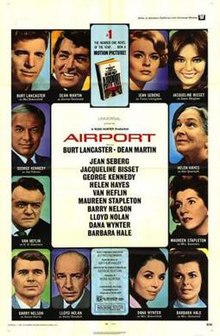
Airport: Burt Lancaster, Dean Martin, Jean Seberg, Jacqueline Bisset, George Kennedy, Hayes, Van Heflin, Maureen Stapleton, Barry Nelson, Dana Wynter, Lloyd Nolan.

Airport 1975: Charlton Heston, Karen Black, Kennedy, Efrem Zimbalist Jr., Susan Clark, Helen Reddy, Linda Blair, Dana Andrews, Roy Thinnes, Sid Caesar, Myrna Loy, Gloria Swanson.

Airport ’77: Jack Lemmon, Lee Grant, Branda Vaccaro, Joseph Cotten, Olivia de Havilland, Darren McGavin, Christopher Lee, Robert Foxworth, Kathleen Quinlan, James Stewart.

Airport ’79: Alain Delon, Susan Blakely, Robert Wagner, Sylvia Kristel, Kennedy, Eddie Albert, Bibi Andersson, Charo, John Davidson, Andrea Marcovicci, Martha Raye, Cicely Tyson, Jimmie Walker, David Warner, Mercedes McCambridge.

More like Hollywood Squares in the Sky? Yeah, believe so, especially since Davidson hosted a Hollywood Squares revival in the late ’80s.

Beside Airport in the titles, Kennedy (1925-2016) proved to be the connective tissue between all four pictures, meaning he’s the inverse of the Brody boys (Jaws) and the Griswold children (Vacation). Kennedy played Joe Patroni — first as mechanic, then as vice president of operations (1975), a consultant (’77), and finally an experienced pilot (’79). Regardless of position or rank, the character got worse and worse over the course of the films, not that he or the films started out all that hot. I found even his cigar was guilty of overacting in the original film and Patroni was so odiously obnoxious in the fourth film, especially after he utters the line that articulates the sexism of the entire series, They don’t call it the cockpit for nothing, honey. George Kennedy as sex symbol? Sure, I’ll believe anything, nearly anything except for, oh, the entire plot of The Concorde.

I’ll talk more about The Concorde and the original because they’re fresher in my memory. To be honest, though, I probably won’t even feel like discussing the original because …

Movies rarely come any dumber than The Concorde: Let’s see, this is going to be fun, not really, anyway TV reporter Susan Blakely comes across some highly incriminating evidence against defense contractor (and covert arms dealer) Robert Wagner. Wagner decides that he’s going to attempt to blow up real good the plane she’s on en route from Washington to Paris. Okay, okay, his plot to blow up the Concorde real good fails and they have dinner together in Paris during the middle section of the movie, because, you know, they have a history together and they still love each other. She still has this incriminating evidence, naturally, she’s going to eventually go public with it, of course, and what does he do? Kill her? He lets her walk away safe and unharmed, so he’ll have to go after the plane again. That’s right, she gets back on the Concorde for the final leg of the flight from Paris to Moscow. Guilt stricken, Wagner commits suicide very late in the picture and I believe it’s not because his secret’s been discovered and will be exposed regardless of whether he’s alive or not, but more that he’s one of the worst villains in cinematic history.

The Concorde is so laughable in so many ways, as if that whole plot discussed in the last paragraph wasn’t enough. The Concorde stops over in Paris for a night, and every single passenger gets back on the plane the next morning. They all seem way too calm and collected after the events of the first half of the movie. I would love to have just heard one character say ‘Hell no, I’m not getting back on that damn plane!’ They all deserved to die, but we know that’s not happening.

At one critical point during the first attack on the Concorde, the Übermensch George Kennedy proves that he’s truly The Übermensch by sticking his hand out the window of the Concorde and throwing a flare. Unbelievable, utterly unbelievable even in this preposterous movie. If only the first Airport had been the in-flight movie on The Concorde, especially that scene where Patroni discusses the effects of a bomb on a 707 and concludes, When I was a mechanic in the Air Force, I was being transferred on a MATS plane. At 20,000 feet, one of the windows shattered. The guy sitting next to it was about 170 pounds. He went through that little space like a hunk of hamburger going down a disposal, and right after him coats, pillows, blankets, cups, saucers. That was just a MATS plane, not the fastest plane in the universe.

I’m done, I can’t take it anymore, and I’m bailing out on the Airport movies.

Airport (1970) **; Airport 1975 (1974) **1/2; Airport ’77 (1977) *; The Concorde: Airport ’79 (1979) 1/2*