Calling All Cars, We Have a 412! Calling All Cars!

CALLING ALL CARS, WE HAVE A 412! CALLING ALL CARS!
I watched Chu Chu and the Philly Flash on March 7 and 18 days later, I can still hear it, that’s for sure, especially co-stars Alan Arkin and Carol Burnett and supporting player Danny Aiello.

Burnett plays Chu Chu, or Emily as only her dearest friends know her, who performs this Carmen Miranda routine out in the streets. Her performance gives one all the maracas needed for at least one year, perhaps even one lifetime. Emily used to be a successful entertainer, before the booze got to her. We all know the story by now.

Arkin, meanwhile, plays the Philly Flash, given that name not because of his ability to shed his raincoat but his former ability turning double plays at second base for the Philadelphia Phillies. Was he named the Philly Flash just because the real-life Phillies won the World Series in 1980? Anyway, just like Emily, booze got to Flash, not Grandmaster Flash (think I’d rather watch The Adventures of Grandmaster Flash on the Wheels of Steel than Chu Chu and the Philly Flash) or Flash Gordon (who just had a movie, a much better one believe it or not, come out in 1980) or The Flash. No, the Philly Flash’s power, like Chu Chu’s, seems to be that he can scream and carry on a whole lot. In fact, that’s about both all they ever do in Chu Chu and the Philly Flash.

Not sure that it even matters or not if Burnett played the Philly Flash and Arkin drew Chu Chu. They could have made him a former professional golfer and her a former burlesque entertainer or something. Yeah, like Bill Murray said in Meatballs, it doesn’t even matter.

Government secrets fall, yes, literally fall into the hands of Philly Flash and Chu Chu. Well, technically, not right into their hands, I mean they did have to walk over and pick up the briefcase. By the way, the briefcase gives the best performance in Chu Chu and the Philly Flash, since even the maracas overact.

Rating: One-half star.

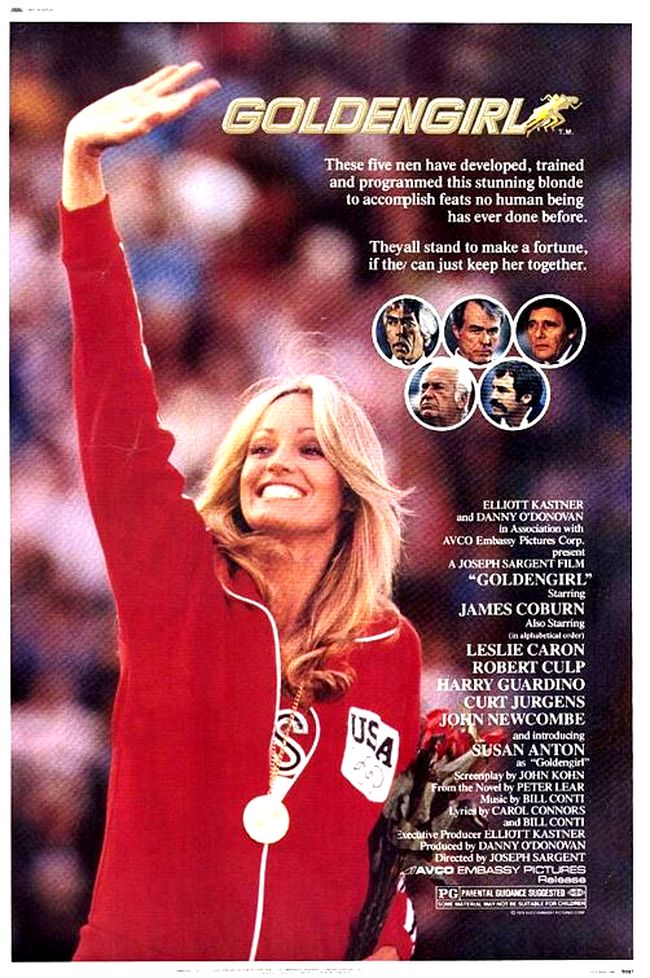
— Earlier in the same day I watched Chu Chu and the Philly Flash, I endured Goldengirl about basically a genetically engineered super female runner and it co-stars James Coburn, Robert Culp, Curt Jurgens, Leslie Caron, Jessica Walter, Michael Lerner, and Harry Guardino.

They’re all fine and dandy, more or less, but it’s star Susan Anton who ruins Goldengirl every single time she expresses any emotion. Guess they can’t genetically engineer the ability to act and the ability to not wreck an entire movie, because Anton can’t act and she absolutely obliterates Goldengirl every single time I wanted to give it another chance.

Give her one thing, though, because just like Donny and Marie Osmond in their motion picture debut and finale Goin’ Coconuts, Anton does have a great set of teeth. Outside her canines, incisors, premolars, and molars, though, Anton sucks in Goldengirl and despite the speeded up and slowed down footage, she’s not the least bit convincing as this incredible champion runner.

Anton and Coburn do have one of the great dialogue exchanges in motion picture history, one that could be played right alongside Fini can water you from Yes, Giorgio. She just set a new Olympic record and doesn’t she even deserve a kiss? Coburn works his way toward her magical lips and Anton moves the goalposts. She insists that he kisses her feet, then laughs maniacally, while Coburn, well, maybe he’s wishing that he could get hit upside the head by his old friend Bruce Lee’s one-hit punch again. Lee died in 1973 and Coburn was one of the pallbearers at Lee’s funeral.

The IMDb trivia entry starts out promisingly for Goldengirl, “Produced and theatrically released in 1979 prior to the 1980 Olympics boycott, this film depicts American athletes competing at the Moscow games. In reality, the boycott meant that the USA did not perform there, making the picture post-release anachronistic and historically inaccurate.”

Blame the boycott on Goldengirl.

Rating: One star.

— I watched Under the Rainbow between opener Goldengirl and closer Chu Chu and the Philly Flash.

That’s right, one of the worst movie-watching nights of a lifetime.

Under the Rainbow, like Goldengirl, has at least a far more interesting plot summary than anything else associated with the finished product.

Okay, to be honest, only the part about the 150 little people descending upon Hollywood for a part in The Wizard of Oz (and a wild and crazy party) sounds interesting, then it gets all mucked up when federal agents, fat cats, and Nazi and Japanese spies enter the picture. Anyway, doesn’t 1938 seem too early for Nazi and Japanese spies? I mean, the Nazis didn’t invade Poland until Sept. 1939 and the United States officially remained neutral until late 1941.

Regardless of social class and nationality and historical accuracy, though, all the characters get run through the cinematic claptrap blender at maximum speed with broad, inane slapstick and would-be wacky hijinks the settings. Despite the maximum speed, Under the Rainbow still feels like it takes forever to be done and over. That’s because it’s all played as loudly as possible, of course, with so much mugging on display that it’s another one of those movies where you feel the back of your head for lumps and bruises and then check for your wallet after watching it.

Chevy Chase and Carrie Fisher are the nominal stars, but they’re lost in the crowd because they play it too cool for school. Meanwhile, Billy Barty acts like he’s in three movies simultaneously and Japanese-American actor Mako settles for only two, and their terminal mugging calls to mind the 1942 propaganda comedy short The Devil with Hitler. The Devil with Hitler is better than Under the Rainbow, and I should just leave it at that statement, though I want to end this review with one last cheap shot at three lousy pictures that I wish I would have left buried inside their time capsules.

Stan Freberg would have charged the casts of Chu Chu and the Philly Flash, Goldengirl, and Under the Rainbow with one heinous crime against humanity: a 412. What’s a 412? Over-acting.

Rating: One star.

An Eye for an Eye (1981)

AN EYE FOR AN EYE (1981) ***
An Eye for an Eye is one of the better Chuck Norris movies and that’s because it fits the bill for what helps define a better Chuck Norris movie — the quality of the supporting cast, something it has in common with Lone Wolf McQuade, Code of Silence, The Delta Force, and Silent Rage.

Let’s see, we have Christopher Lee, Richard Roundtree, Matt Clark, Mako, Maggie Cooper, Rosalind Chao, Professor Toru Tanaka, Stuart Pankin, Terry Kiser and Mel Novak, and they’re basically all good in their standard hero and villain roles.

Lee (1922-2015) enjoyed a truly marvelous career that intersected with Sherlock Holmes, Dracula, James Bond, Star Wars, Ichabod Crane, Kharis, Victor Frankenstein, Gandalf, and Hercules. Never mind acting alongside Slim Pickens and Toshiro Mifune in Steven Spielberg’s 1941. Often playing the villain, Lee had the ability to maximize his minimal screen time and An Eye for an Eye benefits from his presence.

Roundtree made his fame as the title character in Shaft and sequels Shaft’s Big Score and Shaft in Africa, and so I must admit to being somewhat amused that he’s played a cop so often throughout his career. It was both amusing and frustrating to watch his police superior character bust Norris’ chops. I told my wife during An Eye for an Eye, ‘At least he’s not killed by a winged serpent in this movie.’

Cooper plays Norris’ obligatory romantic interest and she gets a rare female nude scene in a Norris movie. Writing on Silent Rage, I noted that it was refreshing to see somebody’s chest other than Norris and I second that emotion after An Eye for an Eye.

Tanaka’s dossier begins, ‘Was an American professional wrestler, professional boxer, college football player, soldier, actor, and martial artist.’ What did the Professor earn his degree in? Judging by An Eye for an Eye and the vast majority of his filmography and his professions, it’s safe to say Tanaka earned a doctorate in pain. Like others in the An Eye for an Eye cast, he’s good at maximizing minimal screen time and in his case, minimal dialogue. Norris vs. Tanaka proved to be one of the film’s greatest highlights.

Before she went to sleep, I told my wife that Norris’ partner will be dead very shortly and it did not help the character’s survival odds being played by Terry Kiser, an actor best known for playing a corpse. Bernie from Weekend at Bernie’s and Weekend at Bernie’s II ring any bells? Yeah, I still argue that dead Bernie still shows more life than nominal leads Andrew McCarthy and Jonathan Silverman. For a man later hacked and whacked by Jason Voorhees, Kiser’s character died spectacularly in An Eye for an Eye — shot in the chest, crushed between not one but two cars, and caught on fire. His death haunts Norris’ Sean Kane during two flashback scenes.

An Eye for an Eye director Steve Carver died in January 2021 of complications from COVID-19 and he was 75. Carver also directed arguably Norris’ best picture, Lone Wolf McQuade, and the infamous 1974 Roger Corman / New World Productions films The Arena and Big Bad Mama. No doubt that Pam Grier and Angie Dickinson, as well as William Shatner, prepared Carver for Chuck Norris.

Conan the Barbarian (1982)

CONAN THE BARBARIAN

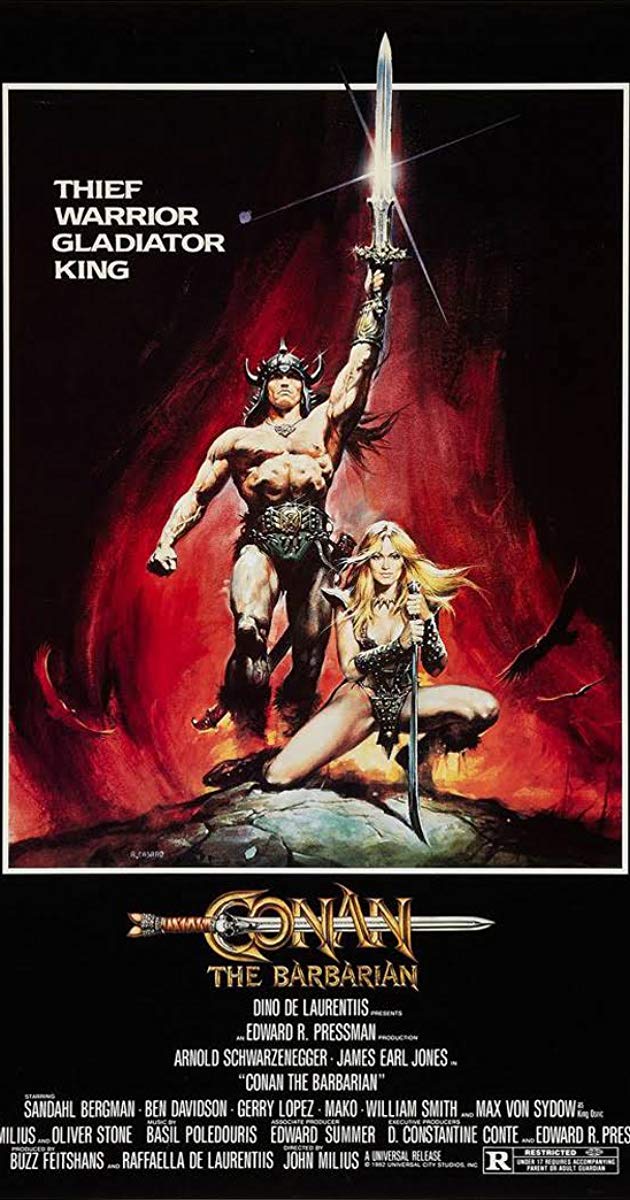
CONAN THE BARBARIAN (1982) Three stars

For the longest time, at least since Al Gore invented the Internets, I have thought the ultimate version of CONAN THE BARBARIAN is the 3-minute, 52-second version on YouTube that scores select scenes from the movie with Iron Maiden’s “Run to the Hills.”

As I watched CONAN THE BARBARIAN again, I kept hoping that Basil Poledouris’ score would be replaced by Bruce Dickinson’s wail and the soaring guitars of Dave Murray and Adrian Smith. Alas, it was not to be.

Lyrically, though, it’s not a perfect fit, since Conan seeks revenge against Thulsa Doom, who’s played by none other than James Earl Jones.

Iron Maiden released “Run to the Hills” on February 12, 1982 and THE NUMBER OF THE BEAST album on March 22.

CONAN THE BARBARIAN came out on May 14, 1982.

Both works proved to be controversial.

Critics thought CONAN THE BARBARIAN was either too violent or that it fell too short of the violence in the source material. That was the biggest controversy for John Milius’ film.

Of course, with an album title like THE NUMBER OF THE BEAST, Iron Maiden were called Satanists and boycotts, record burning, and demonstrations were organized by religious groups in the United States. Just picture old women smashing hundreds of copies of THE NUMBER OF THE BEAST to bits with their hammers.

“The Number of the Beast,” though, is not 867-5309.

Sword and sorcery films were big in the 1980s, a fantasy sub-genre defined as “sword-wielding heroes engaged in exciting and violent adventures. An element of romance is often present, as is an element of magic and the supernatural.”

CONAN THE BARBARIAN inspired a steady stream of imitations and knockoffs, like the DEATHSTALKER series: A big man with a big sword, busty women, and plenty of sex, violence, and head-splitting gore. Not that there’s anything wrong with that.

I had forgotten (shame on me) the amount of nudity during the first hour of CONAN and here I thought that I never forget a nude scene. (For what it’s worth, I remembered Sandahl Bergman’s shining moments in CONAN.)

Then, down the home stretch, CONAN turns up the violence to an operatic level. There’s also an orgy late in the picture.

Arnold Schwarzenegger was born to play Conan and he played him twice, less effectively though a second time. Arnold also played supporting role Lord Kalidor in RED SONJA, so three of his four films made for sultan of schlock producer Dino DeLaurentiis were sword and sorcery. Ed Pressman and fellow producer Edward Summer had considered Charles Bronson, Sylvester Stallone, and William Smith for the Conan role, but they found Arnold to be the embodiment of Conan the Barbarian after they watched a rough cut of PUMPING IRON. The success of both CONAN and THE TERMINATOR made Arnold a star.

Before CONAN, Arnold found mixed success in the motion picture business. In his 1969 debut HERCULES IN NEW YORK, Arnold’s thick Austrian accent required a dub job and the film credits him as “Arnold Strong ‘Mr. Universe’” partly to play against the name of co-star Arnold Stang. If you watch HERCULES IN NEW YORK, you will be amazed that Arnold ever had a motion picture career. I’ve seen it several times and it gets me every single time.

Other than PUMPING IRON, Arnold’s best early career role is Joe Santo in STAY HUNGRY, where he played alongside Jeff Bridges and Sally Field in a supporting role. This is a role that stands alone in a Schwarzenegger filmography populated with action and comedy.

CONAN started Arnold’s decade long run of solid action movies. Why did this seemingly muscle-bound guy with a ridiculous accent become at one point the biggest movie star in the world? Siskel & Ebert pondered that very question in an entire show dedicated to Arnold called “Arnold Schwarzenegger: The Unlikeliest Star.”

A joy of performance is the one element that Arnold exudes in all his best films and it’s what separates him from his competition.

Arnold meets his match in Broadway dancer Sandahl Bergman and when she and Arnold pair up, CONAN truly kicks into gear. The 6-foot tall Bergman (this Shawnee Mission East High graduate liked to say that she’s 5-12 rather than 6-0 because no girl should have to be 6-0) possesses an impressive physicality that’s not dwarfed by Arnold or any of her male co-stars and she exudes the same joy of performance as Arnold.

There’s certainly not been another woman, not Grace Jones in CONAN THE DESTROYER or Brigitte Nielsen in RED SONJA, paired more effectively on screen with Arnold than Bergman.

James Earl Jones became a popular villain after STAR WARS came out in 1977; Jones lent his voice to Darth Vader because director George Lucas did not want David Prowse’s English accent for Vader. Never mind Jones’ role as the older Kokumo in EXORCIST II: THE HERETIC, which was released not long after STAR WARS during the summer of ‘77. Just imagine the collection Jones possibly built from his villainous roles in the STAR WARS films, THE HERETIC, and CONAN. Not only Darth Vader’s helmet, but also his locust costume from THE HERETIC and possibly the snake from CONAN after his transformation. Later in the 1980s, Jones began playing kindly older men and that’s where he’s been ever since.

In addition to Jones, Max von Sydow (most famous for his work with Ingmar Bergman and THE EXORCIST) and Mako (Academy Award nomination for Best Supporting Actor for THE SAND PEBBLES) also lend their gravitas to the proceedings.

When he was the Governor of California, did Arnold read the following dialogue, “To crush your enemies, to see them driven before you, and to hear the lamentations of their women,” or say the following prayer, “Crom, I have never prayed to you before. I have no tongue for it. No one, not even you, will remember if we were good men or bad. Why we fought, or why we died. All that matters is that two stood against many. That’s what’s important! Valor pleases you, Crom … so grant me one request. Grant me revenge! And if you do not listen, then to HELL with you!”

Let’s hope there’s a soundboard with Arnold’s CONAN dialogue out there somewhere. This would restore a smidgen of my faith in humanity.