Grand Theft Auto (1977)

GRAND THEFT AUTO

GRAND THEFT AUTO (1977) Three stars

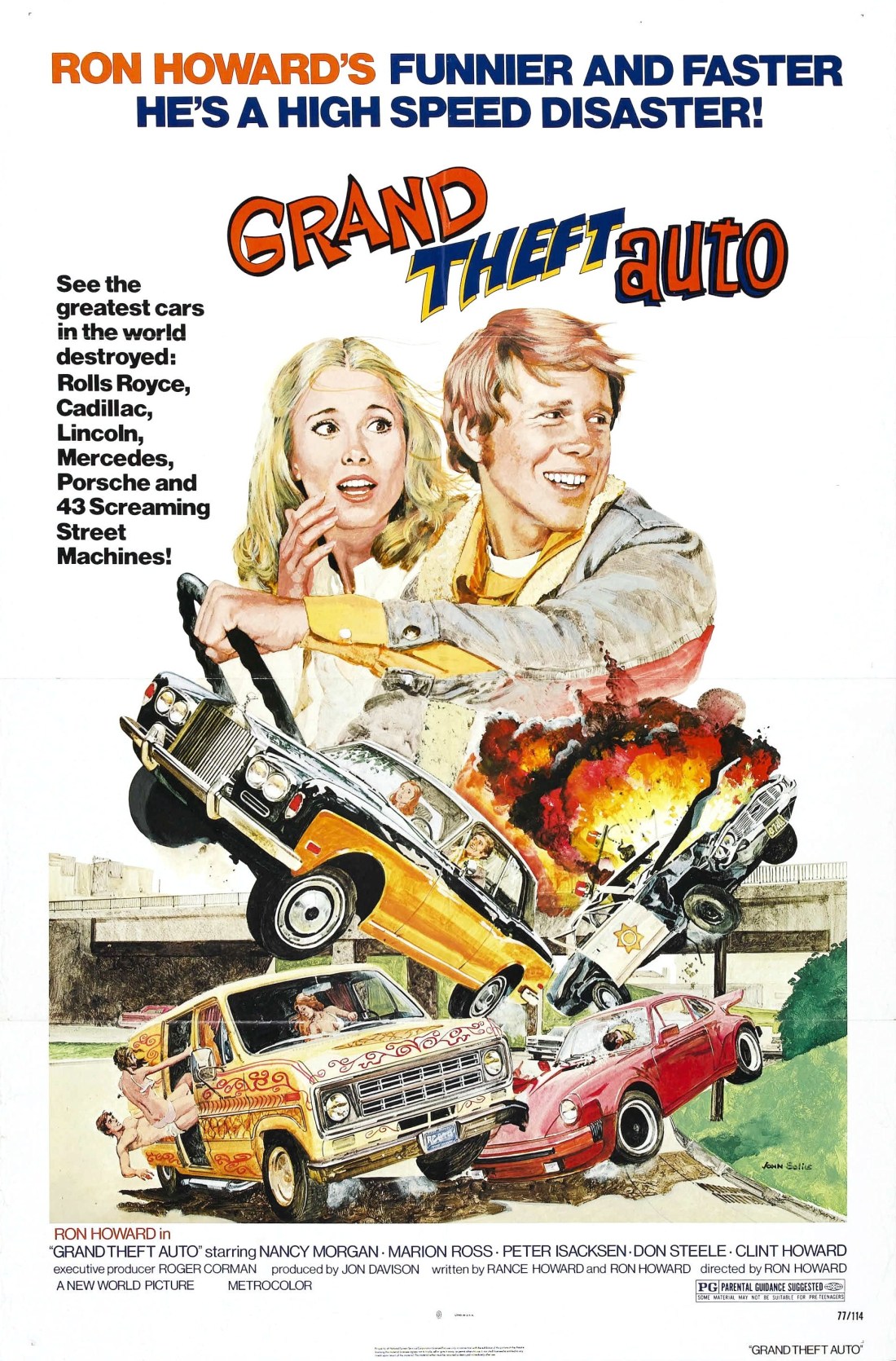
I just love the poster for GRAND THEFT AUTO, Ron Howard’s feature debut as director.

It advertises “See the greatest cars in the world destroyed: Rolls Royce, Cadillac, Lincoln, Mercedes, Porsche and 43 Screaming Street Machines.”

Sounds like my kind of picture.

RON HOWARD’S FUNNIER AND FASTER

HE’S A HIGH SPEED DISASTER!

A drawing of Nancy Morgan aghast and Howard with that All-American smile on his face and his left hand on the steering wheel. Below the young lovebirds are flames and crashes. Sure does resemble a drive-in movie from 1977.

Howard directed, starred in, and co-wrote this picture for New World, produced by Jon Davison and executive produced by Roger Corman. Howard kept some of GRAND THEFT AUTO in the family with father Rance a co-star and co-writer and brother Clint a co-star. It’s no small wonder that Howard earned a reputation for being one of the nicest guys in Hollywood.

Howard did not sell his soul to the Devil to get the picture made. No, instead, he made a deal with Mr. Corman. Howard agreed to star in EAT MY DUST! from 1976 if he could have a crack at directing. The rest is history and Howard’s directorial credits number 32, including Academy Award for Best Picture winner A BEAUTIFUL MIND. His other credits include NIGHT SHIFT, SPLASH, PARENTHOOD, FAR AND AWAY, THE PAPER, APOLLO 13, and FROST/NIXON.

Made for a reported $600,000 on down time for Howard from “Happy Days” (No. 1 show on TV in 1976-77 and No. 2 in 1977-78), GRAND THEFT AUTO tells a simple story.

Paula Powers (Morgan) loves her boyfriend Sam Freeman (Howard) and they want to get married, but her wealthy parents, especially her gubernatorial candidate father, oppose this pairing, taking Mr. Freeman for a gold digger. Paula’s parents want her to marry the wealthy Collins Hedgeworth (Paul Linke), who’s such a blasted tool he spends the movie in his jockey outfit. Paula steals her father’s Rolls Royce and Sam, and they plan to get married in Vegas. There ends up being a $25,000 reward for Paula and then a $25,000 price tag for Collins.

Seemingly all of California (and Nevada) pursues Paula and Sam, as well as Collins.

Collins alone goes through at least three cars in his first few minutes of screen time. What a schmuck! His overprotective mother, played by America’s Sweetheart and Howard’s TV mother Marion Ross, is the one responsible for the reward for Collins and it is one of the undeniable highlights of the movie to hear Marion Ross say “Piss off!” Even a preacher (Hoke Howell) goes after the money. Sleazy DJ Curly Q. Brown (Don Steele) eventually takes to the air in a whirlybird and he tells Mr. Freeman on the air, “Well, if you have it, I’m going to report it. Because every time you turn around and fart, it’s news.” The film especially picks up once Curly Q. Brown starts his play-by-play of the chase across California and Nevada.

The plot also includes a Helicopter vs. Rolls Royce showdown, a bridge blown up real good, and a Demolition Derby. The 1970s were the glory days for the car chase and GRAND THEFT AUTO belongs alongside DUEL, MAD MAX, CONVOY (both movie and song), SMOKEY AND THE BANDIT, THE FRENCH CONNECTION (chase scene), and several other pics.

Do Paula and Sam get married (and live happily ever after)? Well, I would never dream of revealing such an ending, although I told my wife after she asked me if they got married. I will compromise, though, and duly note GRAND THEFT AUTO saves its best demolition for last.

Mad Max (1979)

MAD MAX

MAD MAX (1979) Four stars
12 weeks. $350,000. Guerrilla style filmmaking in and around Melbourne, Australia. A first-time feature film director and a largely unknown cast. A legitimate motorcycle gang. A refurbished 35mm camera somehow left behind from Sam Peckinpah’s THE GETAWAY.

You just read a success story.

Part of the Australian New Wave that invaded American theaters in the late 1970s and early 1980s, George Miller’s MAD MAX plays like a ripped, twisted cross between an American Western like HIGH NOON, Sergio Leone Westerns, Jack Kerouac’s “On the Road” and Hunter S. Thompson’s “Hell’s Angels,” American International biker pics, dystopian science fiction, horror films, good old-fashioned hyperkinetic action, and ultra-violent vigilante justice like DEATH WISH and TAXI DRIVER.

When good old American International Pictures released MAD MAX in America in 1980, they played up the film’s action content in promotion since lead actor Mel Gibson was not yet the international star that he would soon become and they Americanized the language with a new dub replacing the original Australian dialogue. (I own both versions, and I prefer the original Australian dub.)

After the prerequisite title card (Miller said the film’s low budget created the need for a post apocalyptic world), MAD MAX wisely jumps straight into the action with a fantastic, slam-bang chase scene that lasts 10 minutes. I rate this chase among the very best during an era that included many great chase scenes, like BULLITT and THE FRENCH CONNECTION.

In those chases, you feel like anything could happen at any given time. They look real. They feel real. Real cars, real danger.

Understatement: MAD MAX starts on a high note.

The setup for the chase: A ripped, twisted individual named “The Nightrider” kills a Main Force Patrol rookie officer and takes off in the officer’s Pursuit Special. MFP officers are in hot pursuit and the Nightrider eludes them until he meets his match in Max Rockatansky (Gibson).

Vincent Gil plays the Nightrider and his brief appearance proves to be absolutely essential in establishing the entire MAD MAX series.

He’s crazy, yeah, crazier than a shit house rat. I believe one of the officers calls him a terminal psychotic. He’s got verbal style, though, and this is one of the elements that defines MAD MAX, although words became fewer over time.

Max asks his best friend Goose (Steve Bisley) “Much damage?” over the radio and the Nightrider gives one of the great responses, helped out by a quote from Australian hard rock band AC/DC: “You should see the damage, bronze. Huh? Metal damage, brain damage. Heheheh. Are you listening, bronze? I am the Nightrider. I’m a fuel injected suicide machine. I am a rocker, I am a roller, I am a out-of-controller! I’m the Nightrider, baby!”

It’s an indelible sight as the Nightrider turns from brashness to sheer terror in his final moments.

The Nightrider’s motorcycle gang brethren, namely the Toecutter (Hugh Keays-Byrne), Bubba Zanetti (Geoff Parry), and Johnny the Boy (Tim Burns), pursue their revenge and enact their reign of terror on the Australian countryside.

Max loses his faith in justice, his best friend, and his family, his wife Jessie (Joanne Samuel) and his infant son.

At one point, Max tells his boss, “Any longer out on that road and I’m one of them, you know? A terminal crazy … only I got a bronze badge to say I’m one of the good guys.”

Max goes AWOL from the MFP, steals their Pursuit Special, and he stalks and kills the Toecutter, Bubba Zanetti, and finally Johnny the Boy.

Max drives off into the wasteland, a shell of his former self. We’re unsure of the future of this man.

I favor MAD MAX over both THE ROAD WARRIOR and MAD MAX: FURY ROAD because of a greater emotional investment. It shows us everything Max lost, and it’s less spectacle than the later films, obviously due to the difference in budget constraints. (FURY ROAD, for example, cost a cool $150 million. That’s 428.571428571 times the budget of the original.)

Miller, whose credits include BABE: PIG IN THE CITY and THE WITCHES OF EASTWICK in addition to the Mad Max films, is a former medical doctor and that profession informs MAD MAX.

Miller worked as an emergency room doctor to earn funds to make MAD MAX.

The surname “Rockatansky” derives from 19th century Bohemian pathologist Carl von Rokitansky, who originated a procedure that became the most common method for the removal of internal organs during an autopsy.

Miller’s experiences in the emergency room with motorcycle and automobile accidents are played out in MAD MAX.

Five great Australian New Wave films:
— PICNIC AT HANGING ROCK (1975)
— THE LAST WAVE (1977)
— THE CHANT OF JIMMIE BLACKSMITH (1978)
— MAD MAX (1979)
— BREAKER MORANT (1980)