
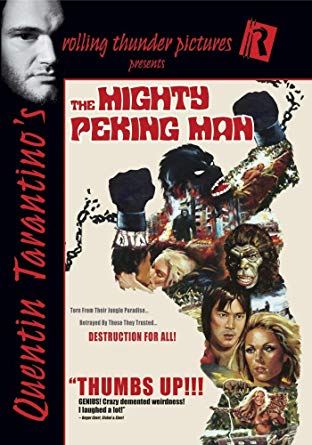
The Mighty Peking Man (1977)

THE MIGHTY PEKING MAN

THE MIGHTY PEKING MAN (1977) ***

The Shaw Brothers (Runme 1901-85 and Run Run 1907-2014) have rarely ever let me down and they provided some of the greatest entertainments of all-time, like THE ONE-ARMED SWORDSMAN, FIVE FINGERS OF DEATH, INFRA-MAN, THE 36TH CHAMBER OF SHAOLIN, and CLAN OF THE WHITE LOTUS.

The Shaw Brothers did not (and still do not, in death) cheat us.

For example, in THE MIGHTY PEKING MAN, their 1977 spin on King Kong, Mighty Joe Young, and Tarzan (not to mention Godzilla) that’s not quite peak but still good Shaw Brothers, we don’t have to wait very long whatsoever to see the title character. No, life is short, time is precious, so director Ho Meng-hua gives us our first monster encounter in the first minute of screen time. Okay, to be exact, it’s 1:45 into the movie, but that still beats most every other entry in this distinguished genre.

That establishes a tone for a very generous entertainment package. Find a copy and buy it for somebody, and it’s the gift that keeps on giving.

THE MIGHTY PEKING MAN not only provides a sympathetic monster in the grand tradition, but also (in no particular order) a plucky explorer hero (Danny Lee) who’s been betrayed by his lover with his playboy brother so he’s drowning his sorrows in booze when he’s recruited for a jungle mission, a scantily-clad leading lady (Evelyne Kraft, a regular Swedish Fay Wray) who’s grown up with the animals in the jungle after her parents died in a plane crash (she’s been raised by the Mighty Peking Man, in fact), an earthquake, elephants, tigers and leopards (oh my!), a fight between a leopard and a snake, quicksand, vine swinging, flashbacks to key moments in both the hero’s and the leading lady’s life, callous and shady businessmen, heartless authority figures, mucho destruction of miniatures galore, and a grand finale that boggles the mind even after everything that came before.

My favorite scene, however, begins around the 33-minute mark.

It involves the Semi-Obligatory Lyrical Interlude, a term made famous by the late Roger Ebert. Here’s the definition from Ebert: “Scene in which soft focus and slow motion are used while a would-be hit song is performed on the sound track and the lovers run through a pastoral setting. Common from the mid-1960s to the mid-1970s; replaced in 1980s with the Semi-Obligatory Music Video.”

The Simon and Garfunkel songs in THE GRADUATE epitomize the Semi-OLI.

The one in THE MIGHTY PEKING MAN rates below Louis Armstrong singing “We Have All the Time in the World” over George Lazenby and Diane Rigg in ON HER MAJESTY’S SECRET SERVICE and the foreboding use of Roberta Flack’s “The First Time Ever I Saw Your Face” in Clint Eastwood’s PLAY MISTY FOR ME. Ebert himself said Eastwood filmed the first Semi-OLI that works.

In THE MIGHTY PEKING MAN, our hero and leading lady embrace and lock lips for the first time (watch her eyes after this first kiss) and they unleash the awesomely banal love song “Could It Be I’m in Love, Maybe.”

This is one helluva old-fashioned love song and one helluva Semi-OLI.

I mean, I believe it’s the only Semi-OLI in the history of motion pictures to incorporate a leopard.

Not only that, but the leading lady seems more interested in the leopard than our poor, poor hero. You really sympathize for this guy even more after this scene.

Let’s get back to those lyrics for a second here.

“The love you gave me then showed me a thing or two / I guess I saw it in your eyes / And the look of love upon your face is too hard to disguise / Maybe just a smile will say [cannot make out, even after watching this scene 500 times] / Could it be I’m in love (Maybe? Baby?)” (To hell with it, I already chose “Maybe.” Why does life have to be so difficult?)

“I can’t begin to say what makes me feel like this / I never knew what love could do / But if this is love, it’s here to stay / [Don’t want to make this part out] / So all I have to hear is I’ll give it all to you.”

There’s more lyrics, but we all catch the drift and there’s not any need to drown in banality.

It all totals about 3:30 of pure junk food cinema bliss.

I definitely love it because it’s so utterly ridiculous.

Then again, utterly ridiculous describes THE MIGHTY PEKING MAN.

I should end this review with a consideration of the ending of THE MIGHTY PEKING MAN. Just imagine the ending of KING KONG times 10 times 10.

Good Morning, Vietnam (1987)

GOOD MORNING, VIETNAM.jpg

GOOD MORNING, VIETNAM (1987) Three-and-a-half stars

GOOD MORNING, VIETNAM director Barry Levinson knew that Louis Armstrong’s “What A Wonderful World” came out in 1967 and that his movie was set in 1965, but he overlooked that because Satchmo’s song fit the scene best.

Thus, Levinson created an anachronism or a chronological inconsistency.

Adrian Cronauer (1938-2018), played by Robin Williams (1951-2014) in GOOD MORNING, said that he liked the movie based on his time on Armed Forces Radio in Vietnam well enough, as far as it went, but that it was more about Williams and what suited him than it was about Cronauer and what actually happened. File GOOD MORNING in the “loosely based” category.

Cronauer added that Levinson did not allow Cronauer and Williams to meet each other until after filming completed, because the director did not want Williams impersonating the former disc jockey.

GOOD MORNING is the first Robin Williams movie I ever watched and it’s one of the few I watched again in the immediate aftermath of his 2014 suicide. Just this last time I watched it, though, early in 2020, I paid less attention to Williams and more to a dynamite supporting cast surrounding Williams: Bruno Kirby (1949-2006), J.T. Walsh (1943-98), Noble Willingham (1931-2004), Forest Whitaker, Robert Wuhl, and Richard Edson, as well as the various Vietnamese actors and actresses. I know Williams received most of the acclaim for his performance, a Golden Globe victory and an Academy Award nomination for Best Actor, but it’s the work of that deep supporting cast that makes GOOD MORNING a very good movie rather than merely a good one or at least if nothing else a one-man show.

Kirby plays some of the same notes as he did seven years before in WHERE THE BUFFALO ROAM with Bill Murray’s Hunter S. Thompson his adversary in that earlier film. In GOOD MORNING, Kirby plays Lt. Steven Hauk, who fails to see the humor in Cronauer and who finally bombs on the air when he replaces Cronauer for a brief spell. We patiently wait for that failure to happen, and we are rewarded. We laugh at Hauk’s failure, and the vast disconnect between his ego and his actual ability to make people laugh is the joke.

Walsh put together a decade of memorable supporting performances and he earned that memorability because he plays characters that we love to hate. Quite frankly, he played a dick better than most anybody in show business and thus, it’s no surprise that Walsh plays a character named Sgt. Major Dickerson in GOOD MORNING, because, yes, he’s a major dick. Many of us miss Walsh, a love to hate figure even after his death with both THE NEGOTIATOR and PLEASANTVILLE posthumously released.

Williams and Whitaker especially seem like they have genuine chemistry and their byplay from early in the movie all the way until the end rewards us with both laughter and emotions.

Cronauer teaches English to South Vietnamese students during some of his spare time, initially because he sets his sights on a pretty young woman. Cronauer’s friendship with her brother earns him a flight out of Vietnam, one that’s long overdue given all his trouble from the first time Cronauer shouted “Good morning, Vietnam” on the air.

In short, the soldiers love Cronauer and the brass, especially Dickerson, hate him.

Cronauer plays by his own rules, especially on-air, as he favors that Devil’s music rock and soul over that Easy Listening jive preferred by Hauk and Dickerson. That’s his first sin of many, but it all starts with that playing by one’s own rules.

Probably about half of the movie gives itself over to Williams’ manic free-form ad-libs and Cronauer is one of the few characters played by Williams where his patented comic anarchy fits and does not break away from the fabric of the movie to the point that we forget the character and only see Robin Williams being stand-up comedian Robin Williams. Williams’ anything-for-a-laugh shtick also worked for The Genie in ALADDIN.

In all honesty, I find more humor in Williams’ scenes with the supporting actors, both his fellow military men and his Vietnamese students, than I do his solo flights of fancy on his popular radio show.

GOOD MORNING is not all comedy, though, and it does thankfully give the Vietnamese more of a voice than we normally get in Hollywood films about Vietnam and the war. Cronauer’s friend Tuan (Tung Thanh Tran) expresses it during their confrontation scene late in the movie, “ENEMY? What is enemy? You killing my own people so many miles from your home. We not the enemy! You the enemy! … My mother is dead. And my older brother, who be 29 years old, he dead! Shot by Americans! My neighbor, dead! His wife, dead. WHY? Because we’re not human to them! We’re only Vietnamese.”

The film does lay it on a little too thick with sentimentality and showing that Cronauer’s a good guy at heart performing a noble service for the troops and humanity in general through humor. Critics have accused movie comedians of that weakness for sentimentality ever since the glory days of Charlie Chaplin. Williams definitely fell prey to sentimentality often throughout his career, and it works better in some films than others.

Finally, GOOD MORNING goes on a little too long and it could have been tightened, but I doubt that Levinson and gang wanted to lose any of Williams’ improvisation. Remember that moment in ANIMAL HOUSE when Tim Matheson’s Otter looks at Peter Riegert’s Boon and asks “Germans?” after Bluto says the Germans bombed Pearl Harbor. Boon quite simply and beautifully says, “Forget it, he’s rolling.” Bet that’s what they said every day on the set of GOOD MORNING, VIETNAM about Robin Williams.