Frankenstein Meets the Wolf Man (1943)

FRANKENSTEIN MEETS THE WOLF MAN (1943) ***1/2
Frankenstein Meets the Wolf Man starts with an absolute big bang and we have possibly the greatest five minutes in any classic Universal monster movie.

That includes such immortal movies as Frankenstein, The Bride of Frankenstein, Son of Frankenstein, Dracula, The Mummy, The Invisible Man, and The Creature from the Black Lagoon, all stone cold classics essential to every horror movie lover.

The opening gets everything absolutely right: two grave robbers, a cemetery in the middle of the night, Larry The Wolf Man Talbot’s crypt, a full moon, a whole bunch of wolfbane, the revived Wolf Man’s hand, and enough overall spooky atmosphere for approximately 50 scary movie scenes. Yeah, it’s such a phenomenal sequence that director Tom McLoughlin revived it for his opening in Jason Lives, the one film during that long-running series most influenced by classic monster movies.

The rest of Frankenstein Meets the Wolf Man does not quite measure up, especially once Frankenstein’s Monster enters the picture, but it’s still a great deal of fun.

Of course, it doesn’t hurt any that Lon Chaney Jr. (1906-73) returns as Larry Talbot, one of the greatest horror movie characters. Chaney Jr. played Talbot five times from 1941 through 1948 — the original Wolf Man, Frankenstein Meets the Wolf Man, House of Frankenstein, House of Dracula, and Abbott and Costello Meet Frankenstein.

Talbot’s a tortured soul — in fact, mondoshop.com hypes its Wolf Man poster, The most tortured soul in the Universal Monsters universe is unquestionably that suffering bastard Larry Talbot, a.k.a. The Wolf Man — and we feel great empathy for this character because he essentially doesn’t want any damn part of being the Wolf Man. Your own son Bela was a werewolf. He attacked me. He changed me into a werewolf. He’s the one that put this curse on me. You watched over him until he was permitted to die. Well, now I want to die to. Won’t you show me the way?

In that way, he’s different from Dracula, Frankenstein’s Monster, the Mummy, and the Invisible Man. Lon Chaney’s Phantom in the 1925 classic The Phantom of the Opera inspires similar feelings as Talbot and the Wolf Man. To his enduring credit, Boris Karloff (1887-1969) worked some pathos into Frankenstein’s Monster, especially in Frankenstein and The Bride of Frankenstein. Still, Talbot stands apart from most cinematic monsters and maybe it’s because he’s the most explicitly human.

Bela Lugosi (1882-1956) passed on Frankenstein’s Monster in Frankenstein, much to his eternal regret, and so he signed on for the Monster in Frankenstein Meets the Wolf Man after playing Ygor in Son of Frankenstein and The Ghost of Frankenstein. During the latter film, one might remember that Dr. Ludwig Frankenstein accidentally put Ygor’s brain into the Monster’s head — he speaks poetically at one point in the film, I am Ygor. In a series that paid minuscule attention to continuity from one film to the next, the Monster originally spoke and explained his plight in Frankenstein Meets the Wolf Man, but Universal studio heads apparently laughed their heads off at Lugosi’s dialogue and demanded it be excised from the final cut, rendering the monster absolutely ridiculous and his scenes basically a washout. I am not sure why Lugosi’s voice suddenly became laughable. Lugosi’s stunt double stands in for the 61-year-old man in many scenes. Ironically, though, whenever people imitate Frankenstein’s Monster, it’s the Lugosi version from Frankenstein Meets the Wolf Man. (Lugosi played Bela in The Wolf Man and Chaney Jr. was Frankenstein’s Monster in The Ghost of Frankenstein after Karloff bowed out.)

We’re not sure exactly why the Monster’s encased in ice or why there’s a production number that must have moseyed on over from MGM. The second half of Frankenstein Meets the Wolf Man often leaves us feeling awful perplexed.

Frankenstein Meets the Wolf Man finishes strong, thankfully, and we do see our titular monsters slug it out, though it presents an internal struggle because while we’d love more battle royale between the monsters we do love the 90 seconds they give us. This movie paved the highway for King Kong vs. Godzilla and Freddy vs. Jason.

In most every way possible, Frankenstein Meets the Wolf Man proves to be a red hot mess, but a lovable and thoroughly entertaining one nonetheless.

Werewolf of London (1935)

WEREWOLF OF LONDON (1935) ***
Werewolf of London — Hollywood’s first werewolf picture — must be one of the most overlooked horror films in the history of overlooked horror films, for obvious reasons.

During the 1930s, Universal Studios released Werewolf of London among the following group of horror films: Dracula, Dracula (Spanish version), Frankenstein, The Mummy, The Invisible Man, The Bride of Frankenstein, Dracula’s Daughter, and Son of Frankenstein, over half of them landmark productions that spawned multiple imitations and sequels. Werewolf of London came out nearly a month after The Bride of Frankenstein in the spring of 1935 and The Bride of Frankenstein became a big hit and developed a reputation for being a sequel that arguably betters the original.

Late in 1941, Universal’s second werewolf film appeared, The Wolf Man, and it quickly became the quintessential werewolf film, leaving Werewolf of London behind in the dustbins of cinematic history. Lon Chaney Jr. joined his late father Lon Chaney (Phantom of the Opera), Boris Karloff (Frankenstein), and Bela Lugosi (Dracula) in becoming a horror movie icon just from a single performance. Chaney Jr. revisited Larry Talbot / The Wolf Man in Frankenstein Meets the Wolf Man, The House of Frankenstein, House of Dracula, and Abbott and Costello Meets Frankenstein, and he displayed his versatility by portraying Dracula, Frankenstein’s Monster, and the Mummy.

In addition to Chaney Jr., The Wolf Man cast includes Claude Rains and Ralph Bellamy and many horror films love it for its mood and first-rate atmosphere.

By contrast, Werewolf of London stars veteran character actor Henry Hull and that’s unfortunately not a name that rolls off the tongue like, say, Lon Chaney Jr. Warren Zevon name checked both Chaneys in “Werewolves of London” — Well, I saw Lon Chaney walking with the Queen / Doing the Werewolves of London / I saw Lon Chaney Jr. walking with the Queen / Doing the Werewolves of London / I saw a werewolf drinking a piña colada at Trader Vic’s / And his hair was perfect — but, alas, no direct mention of Hull.

Werewolf of London definitely holds its most value as curiosity (and conversational) piece and not only for its place as the most overlooked film within the Universal canon and for its overall historical standing. After all, when’s the last time any protagonist in a film counted botany for their career or a horror film started with a prologue in Tibet. It also holds considerable fascination comparing and contrasting Jack Pierce’s makeup work between Werewolf of London and The Wolf Man, as well as how this earlier film handled the essential transformation scenes. The werewolf seems to have inspired Eddie Munster, so Werewolf of London does have that going for it.

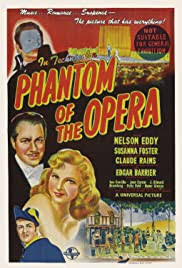
Phantom of the Opera (1943)

PHANTOM OF THE OPERA (1943) **
I put off watching a sound version of Phantom of the Opera for the longest time and the 1943 Phantom of the Opera only confirmed that suspicion and doubt.

Claude Rains did not even remotely approach what Lon Chaney accomplished in the 1925 silent version and I have to face the fact that I am definitely not the world’s biggest opera fan.

Yes, I do realize that I made it through A Night at the Opera and Opera with relative ease, but predominantly because I am big fans of both the Marx Brothers and Dario Argento, not opera.

Allan Jones’ production numbers in both A Night at the Opera and A Day at the Races, as well as James Whale’s Show Boat, are why they invented the fast-forward and skip buttons. The Marx Brothers’ numbers are infinitely better on the ears.

As for Argento, he goes so far over the top (especially in the murder sequences) that I find his operatic excess in Opera enjoyable.

Universal Studios invested $1.75 million on Phantom of the Opera (both Phantom and fellow 1943 release Frankenstein Meets the Wolf Man received much larger production budgets than previous Universal releases, like, for example, the $180,000 Wolf Man from 1941) and the film accomplished something unique for an Universal horror film — win an Academy Award, for Best Art Direction and Best Cinematography, and it was nominated in two more categories.

Phantom of the Opera, the first adaptation of the 1910 Gaston Leroux novel filmed in Technicolor, became a hit, especially in France.

Sorry to say, though, it’s not deserving of classic status.

Universal released 25 horror films from 1931’s Dracula through 1948’s Abbott and Costello Meet Frankenstein that are grouped together in the Classic Monsters series and I rank Phantom of the Opera only ahead of The Mummy’s Ghost, The Mummy’s Curse, and The Invisible Woman.

Lon Chaney Jr. (1906-73) felt slighted Universal did not consider him for his father’s most legendary role. Granted, he was an incredibly busy actor. Chaney Jr. had starring roles in the three films immediately surrounding Phantom of the Opera in 1942 and 1943 — his first time playing Kharis in The Mummy’s Hand, his second time as Larry Talbot / The Wolf Man in Frankenstein Meets the Wolf Man, and his first and only time as Dracula in Son of Dracula. Chaney Jr. previously took on Frankenstein’s Monster in The Ghost of Frankenstein (1942) and he proved himself Universal’s most versatile monster thespian, only missing the Invisible Man and the Phantom from his credits.

Chaney Jr. especially worked as Larry Talbot / The Wolf Man, and I am imagining what he could have done in Phantom of the Opera.

Rains killed it as Dr. Jack Griffin in the 1933 James Whale classic The Invisible Man. In Phantom of the Opera, not so much, because he’s just not scary, even without his ridiculous mask when his mutilated face is revealed in the laughable grand finale. He’s not the film’s main problem, though, believe it or not.

I mean, Rains plays the freaking title character in Phantom of the Opera and he’s third-billed, for crying out loud, behind our singing leads Nelson Eddy and Susanna Foster. This never happened to Lon Chaney, who’s billed above both Mary Philbin and Norman Kerry. Rains’ Phantom becomes less of a factor and that just about sums up the failure of this particular Phantom of the Opera — too heavy on the opera and too light on the phantom.

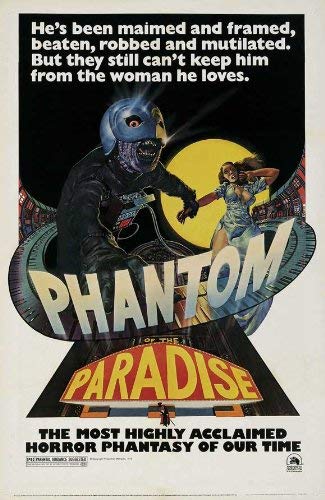
Phantom of the Paradise (1974)

PHANTOM OF THE PARADISE

PHANTOM OF THE PARADISE (1974) **

Brian De Palma’s PHANTOM OF THE PARADISE, a great big flop during its original release, is another cult film where I have to say, “I am glad you love this movie, but I don’t.” Big deal, it happens both ways on a regular basis.

It’s also one of those movies where I liked it less and less the more it was on, until I simply just wanted it to be over.

PHANTOM OF THE PARADISE gets called a “rock opera” and compared with THE ROCKY HORROR PICTURE SHOW, which came out about one year later.

Now, we’re getting to the heart of the problem. Both PHANTOM OF THE PARADISE and ROCKY HORROR are limp-wristed rock if they are in fact rock at all. Paul Williams, the songwriter and star of PHANTOM, he’s best known for writing Three Dog Night’s “An Old Fashioned Love Song,” the Carpenters’ “Rainy Days and Mondays,” Barbra Streisand’s “Evergreen” from A STAR IS BORN, and Kermit the Frog’s “Rainbow Connection” from THE MUPPET MOVIE. Not exactly the most rocking credentials.

Singer-songwriter and show tunes, with a little Sha Na Na and Meatloaf thrown in for extra measure, are not my idea of rock and that’s what PHANTOM and ROCKY HORROR offer listeners and viewers.

I already wrote a review comparing ROCKY HORROR against ROCK ‘N’ ROLL HIGH SCHOOL, a 1979 film that centers around the music of the Ramones.

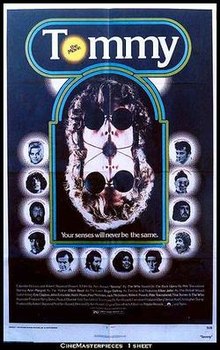
This whole rock opera angle initiated my brilliantly engineered mind to recall Ken Russell’s TOMMY from 1975, another musical contemporaneous with both PHANTOM and ROCKY HORROR that’s far more deserving of being called a “rock opera.” That’s definitely true, because at one time The Who — the band responsible for the music for both the 1969 album and 1975 movie — owned the rights on “loudest rock band in the world.” They lived rock, long before they wrote a song like “Long Live Rock,” “Be it dead or alive.”

Russell, who’s every bit as good as De Palma at capturing wretched excess on celluloid, gives us non-singers Oliver Reed and Jack Nicholson, natural born entertainers Ann-Margret and Tina Turner, a Marilyn Monroe-themed cult led by “The Preacher” (Eric Clapton), and Elton John’s centerpiece “Pinball Wizard” number, taking advantage of a $5 million budget. Hell to the yes, I love me some pinball and Sir Elton’s melodramatic demise. Never mind what Ann-Margret does with champagne, beans, chocolates, and bubbles. What’s that Beach Boys line about excitation?

PHANTOM OF THE PARADISE (reportedly made for $1.3 million) takes on classic novels “Phantom of the Opera,” “The Picture of Dorian Gray,” and “Faust.” It also predates the Black Sabbath compilation album “We Sold Our Soul for Rock ‘N’ Roll.”

I prefer the 1925 silent PHANTOM OF THE OPERA because of Lon Chaney’s brilliant performance (his 1974 counterpart William Finley gives the best performance in the movie), the fact that melodrama works better in silent rather than sound films, and the fact that we do not hear the opera music. Yeah, that’s right, I do not particularly care for opera, rock or not. PHANTOM OF THE PARADISE does not rock enough.

I would have greatly preferred Robert Johnson’s music over Paul Williams’ tunes. Here I am and I can’t remember any of Williams’ songs from the film. Not a good sign.

I would not be surprised, though, to find out that Dario Argento cast Jessica Harper in SUSPIRIA (1977) because of her performance in PHANTOM OF THE PARADISE.

I’ll take SUSPIRIA.

TOMMY (1975) ***

TOMMY