
Auto Pilot Cinema: The Airport Movies

AUTO PILOT CINEMA: THE AIRPORT MOVIES
When thinking of the worst series in movie history, I am tempted to start with Saw and Fast and the Furious then move back through time with The Omen and Amityville Horror and finally go way way way back to the Dead End Kids, er, Bowery Boys.

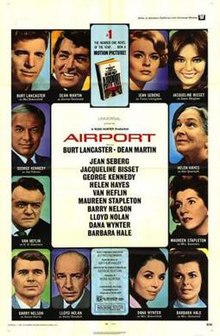
In piecing through all this cinematic carnage, I should not leave behind the four Airport movies that were churned out by Universal Pictures from 1970 to 1979. Maybe I should leave them behind.

Airport, based on Arthur Hailey’s 1968 novel of the same name, made a killing at the box office upon its late May release in 1970 and it even received 10, yes, believe it or not, 10 Academy Award nominations, including Best Picture, and 70-year-old Helen Hayes won Best Supporting Actress.

The three subsequent films — helpfully labeled 1975, ’77, and ’79 — got worse and worse, naturally, and the last film in the series, The Concorde … Airport ’79, is so bad (and so aggressively stupid) in fact that it could kill off any series. That’s despite the fact that it reportedly made $65 million, a much better take than, for example, Irwin Allen productions The Swarm ($7.7 million), Beyond the Poseidon Adventure ($2.1 million), and When Time Ran Out ($3.8 million). Regardless, Universal stopped making Airport movies after The Concorde and I’m almost dumbfounded why there’s not been a remake or a reboot loaded with today’s stars.

Hey, wait, did somebody mention stars? Yes, stars, that’s what these Airport movies were about — speculating which ones would emerge at the end of the picture relatively intact and which ones would die spectacularly. Grand Hotel in the sky, not exactly, since none of the careers in the Airport movies were at their peak like the ones in Grand Hotel, but the idea of stuffing the screen with stars in every scene applies just the same.

Airport: Burt Lancaster, Dean Martin, Jean Seberg, Jacqueline Bisset, George Kennedy, Hayes, Van Heflin, Maureen Stapleton, Barry Nelson, Dana Wynter, Lloyd Nolan.

Airport 1975: Charlton Heston, Karen Black, Kennedy, Efrem Zimbalist Jr., Susan Clark, Helen Reddy, Linda Blair, Dana Andrews, Roy Thinnes, Sid Caesar, Myrna Loy, Gloria Swanson.

Airport ’77: Jack Lemmon, Lee Grant, Branda Vaccaro, Joseph Cotten, Olivia de Havilland, Darren McGavin, Christopher Lee, Robert Foxworth, Kathleen Quinlan, James Stewart.

Airport ’79: Alain Delon, Susan Blakely, Robert Wagner, Sylvia Kristel, Kennedy, Eddie Albert, Bibi Andersson, Charo, John Davidson, Andrea Marcovicci, Martha Raye, Cicely Tyson, Jimmie Walker, David Warner, Mercedes McCambridge.

More like Hollywood Squares in the Sky? Yeah, believe so, especially since Davidson hosted a Hollywood Squares revival in the late ’80s.

Beside Airport in the titles, Kennedy (1925-2016) proved to be the connective tissue between all four pictures, meaning he’s the inverse of the Brody boys (Jaws) and the Griswold children (Vacation). Kennedy played Joe Patroni — first as mechanic, then as vice president of operations (1975), a consultant (’77), and finally an experienced pilot (’79). Regardless of position or rank, the character got worse and worse over the course of the films, not that he or the films started out all that hot. I found even his cigar was guilty of overacting in the original film and Patroni was so odiously obnoxious in the fourth film, especially after he utters the line that articulates the sexism of the entire series, They don’t call it the cockpit for nothing, honey. George Kennedy as sex symbol? Sure, I’ll believe anything, nearly anything except for, oh, the entire plot of The Concorde.

I’ll talk more about The Concorde and the original because they’re fresher in my memory. To be honest, though, I probably won’t even feel like discussing the original because …

Movies rarely come any dumber than The Concorde: Let’s see, this is going to be fun, not really, anyway TV reporter Susan Blakely comes across some highly incriminating evidence against defense contractor (and covert arms dealer) Robert Wagner. Wagner decides that he’s going to attempt to blow up real good the plane she’s on en route from Washington to Paris. Okay, okay, his plot to blow up the Concorde real good fails and they have dinner together in Paris during the middle section of the movie, because, you know, they have a history together and they still love each other. She still has this incriminating evidence, naturally, she’s going to eventually go public with it, of course, and what does he do? Kill her? He lets her walk away safe and unharmed, so he’ll have to go after the plane again. That’s right, she gets back on the Concorde for the final leg of the flight from Paris to Moscow. Guilt stricken, Wagner commits suicide very late in the picture and I believe it’s not because his secret’s been discovered and will be exposed regardless of whether he’s alive or not, but more that he’s one of the worst villains in cinematic history.

The Concorde is so laughable in so many ways, as if that whole plot discussed in the last paragraph wasn’t enough. The Concorde stops over in Paris for a night, and every single passenger gets back on the plane the next morning. They all seem way too calm and collected after the events of the first half of the movie. I would love to have just heard one character say ‘Hell no, I’m not getting back on that damn plane!’ They all deserved to die, but we know that’s not happening.

At one critical point during the first attack on the Concorde, the Übermensch George Kennedy proves that he’s truly The Übermensch by sticking his hand out the window of the Concorde and throwing a flare. Unbelievable, utterly unbelievable even in this preposterous movie. If only the first Airport had been the in-flight movie on The Concorde, especially that scene where Patroni discusses the effects of a bomb on a 707 and concludes, When I was a mechanic in the Air Force, I was being transferred on a MATS plane. At 20,000 feet, one of the windows shattered. The guy sitting next to it was about 170 pounds. He went through that little space like a hunk of hamburger going down a disposal, and right after him coats, pillows, blankets, cups, saucers. That was just a MATS plane, not the fastest plane in the universe.

I’m done, I can’t take it anymore, and I’m bailing out on the Airport movies.

Airport (1970) **; Airport 1975 (1974) **1/2; Airport ’77 (1977) *; The Concorde: Airport ’79 (1979) 1/2*

Roller Boogie (1979)

ROLLER BOOGIE

ROLLER BOOGIE (1979) *1/2

Hot on the heels of reviewing THANK GOD IT’S FRIDAY, here’s another one where it’s a soundtrack in search of a movie.

Or, in other words, a gimmick in search of a movie. ROLLER BOOGIE belongs to a specific time and place of quickie exploitation flick: post-SATURDAY NIGHT FEVER boogie down and roller skating, hence that genius title.

ROLLER BOOGIE should have been a better film. I mean, director Mark L. Lester went on to make CLASS OF 1984 and COMMANDO, two films that go above-and-beyond in going over-the-top and that’s both films’ best virtue by far.

Not in ROLLER BOOGIE, though, which earns a ‘PG’ from the MPAA. It should have been ‘R.’

I’ll give one example.

Early on in the picture, we’re talking first few minutes here, our female lead Terry Barkley (Linda Blair) gets dressed and we sense there’s a missing nude scene, like they filmed one but left it on the cutting room floor. This early scene establishes the awkwardness that we sense around Blair’s character all movie.

We find Blair, who was in her late teens when she made ROLLER BOOGIE, in her transition period, between her breakout in THE EXORCIST (1973) and later exploitation films like CHAINED HEAT and SAVAGE STREETS. Maybe it’s because I watched ROLLER BOOGIE after her later films that I felt like the 1979 film teases us with possibilities that it ultimately did not want to pursue, undoubtedly for commercial reasons. The one song that should have been written for Blair: “I’m Not a Girl, Not Yet a Woman,” which was instead written for Britney Spears at the turn of the 21st Century. Rick James wrote “Cold Blooded” (title song for his 1983 album) about his relationship with Blair. “Cold Blooded” hit No. 40 on the Billboard Hot 100.

Upon further reflection, ROLLER BOOGIE does go above-and-beyond in recycling grand old cliches and stereotypes, pilfering from both the Mickey Rooney-Judy Garland “Let’s put on a show” movies of the late 1930s and early ‘40s and the Frankie Avalon-Annette Funicello BEACH PARTY movies of the early ‘60s in addition to SATURDAY NIGHT FEVER and the disco and roller skating fads more contemporaneous with ROLLER BOOGIE.

Like THANK GOD IT’S FRIDAY, ROLLER BOOGIE rattles off characters and scenes we have seen many times before.

Terry develops a romance with roller boogie master Bobby James (Jim Bray), who, get this, comes from another socioeconomic class than rich girl and musical genius Terry. Bray makes both his film debut and finale, basically playing a fictional version of himself … not all that well. He does skate convincingly, of course, and he does possess a great smile, but in any scene that requires any emotion whatsoever Bray absolutely falls flat on his face. Bray apparently had already earned 275 trophies for his skating before he made ROLLER BOOGIE. For his acting, though, Bray received “Dishonourable Mention” from the Stinkers Bad Movie Awards; Robby Benson won “Worst Actor” for WALK PROUD. Blair lost “Worst Actress” to Barbra Streisand in THE MAIN EVENT.

Then we have Franklin (Christopher S. Nelson), who’s this hopeless rich snob always lusting after Terry’s bod. We’ve seen this character archetype before, like Collins Hedgeworth (Paul Linke) in GRAND THEFT AUTO and Spaulding Smails (John F. Barmon Jr.) in CADDYSHACK. You remember Spaulding? He’s the snotty but spectacularly slobby grandson of Judge Smails (Ted Knight). In a classic scene, Spaulding wants a hamburger, no, a cheeseburger, a hot dog, and a milkshake … before Judge Smails sets the impetuous lad straight, “You’ll get nothing, and like it.” Well, there’s nothing that funny or worthwhile in ROLLER BOOGIE. Franklin’s scenes drag ROLLER BOOGIE down.

Cartoon gangsters lean on Jammer Delaney (Sean McClory), the owner of roller boogie rink Jammers. Nobody would ever believe this plot thread, but this here old Jammer, why he’s the last property owner holding out. Jammer’s sitting on a relative gold mine and he’s standing in the way of progress. We have seen this old cinematic war horse trotted out for everything ranging from BLACK BELT JONES (where property owner Scatman Crothers died from the weakest punch in cinematic history) to WHO’S THE MAN? Cartoon gangsters rarely ever bode well for a motion picture spread and they do not for ROLLER BOOGIE. I do not want to write another word on the plot.

Kimberly Beck’s next screen credit would be as final girl Trish Jarvis in 1984’s FRIDAY THE 13TH: THE FINAL CHAPTER. She famously said of the FRIDAY THE 13TH series: “I had never seen any of the FRIDAY films. And I didn’t want to see any of them. I still have never seen any of them. I just don’t like that kind of genre at all. And this was not even a B-movie, it was really just a C-movie.” Unfortunately, we do not have a quote from Beck detailing her experience playing Terry’s best friend Lana, who does really fill out her outfits rather nicely in ROLLER BOOGIE. She provides one of the fleeting pleasures of the movie. Sometimes, you take it wherever you can find it and ask questions never.

Exorcist II: The Heretic (1977)

day 100, exorcist ii the heretic

EXORCIST II: THE HERETIC (1977) Three-and-a-half stars
There’s movies that are hated and then there’s EXORCIST II: THE HERETIC, a movie that received hate on an epic, violent level since it’s considered the worst sequel ever made and one of the worst films ever.

Sequels are often penalized for being too much like the original and then ironically enough, EXORCIST II has been lambasted for being nothing like the original mass phenomenon known as THE EXORCIST.

EXORCIST II director John Boorman admitted to not even liking the original film and his sequel is a direct challenge to the film that came before it.

I just want to know, did Boorman and fellow director William Friedkin ever get into a shouting match that degenerated into fisticuffs?

In a 2017 interview with IndieWire, Friedkin said, “I saw a few minutes of EXORCIST II, but that was only because I was in the Technicolor lab timing a film that I had directed — I forget which one — and one of the color timers at Technicolor said, ‘Hey, we just made a a print of EXORCIST II, would you like to have a look at it?’ I said OK. I went in, and after five minutes, it just blasted me. I couldn’t take it. I thought it was just ridiculous and stupid. But that was only five minutes, so I can’t make an ultimate judgement about it. It just seemed to me to have nothing to do with THE EXORCIST.”

Friedkin was also famously quoted, “And I looked at half an hour of it and I thought it was as bad as seeing a traffic accident in the street. It was horrible. It’s just a stupid mess made by a dumb guy — John Boorman by name, somebody who should be nameless, but in this case should be named. Scurrilous. A horrible picture.”

Boorman articulated on EXORCIST II in a 2005 interview with Film Freak Central, “The film that I made, I saw as a kind of riposte to the ugliness and darkness of THE EXORCIST — I wanted a film about journeys that was positive, about good, essentially. And I think that audiences, in hindsight, were right. I denied them what they wanted and they were pissed off about it — quite rightly, I knew I wasn’t giving them what they wanted and it was a really foolish choice. The film itself, I think, is an interesting one ­— there’s some good work in it — but when they came to me with it I told John Calley, who was running Warners then, that I didn’t want it. ‘Look,’ I said, ‘I have daughters, I don’t want to make a film about torturing a child,’ which is how I saw the original film. But then I read a three-page treatment for a sequel written by a man named William Goodhart and I was really intrigued by it because it was about goodness. I saw it then as a chance to film a riposte to the first picture. But it had one of the most disastrous openings ever — there were riots! And we recut the actual prints in the theatres, about six a day, but it didn’t help of course and I couldn’t bear to talk about it, or look at it, for years.”

Boorman lived out the Jean-Luc Godard quote “In order to criticize a movie, you have to make another movie.”

The critical (and audience) reaction to EXORCIST II seems based on whether or not you liked or hated THE EXORCIST. If you liked it, you hated EXORCIST II; if you hated it, you liked EXORCIST II.

For example, BBC critic Mark Kermode called EXORCIST II the worst film ever made because it trashed the greatest film ever made (THE EXORCIST). Leonard Maltin called it a “preposterous sequel” and Gene Siskel, who rated it no stars, chimed in with “the worst major motion picture I’ve seen in almost eight years on the job.” Siskel ranked THE EXORCIST No. 3 on his Top 10 list for 1973, behind only THE EMIGRANTS / THE NEW LAND and LAST TANGO IN PARIS.

Pauline Kael, a fan of Boorman and a Friedkin detractor, wrote of the original, “The demonic possession of a child, treated with shallow seriousness. The picture is designed to scare people, and it does so by mechanical means: levitations, swivelling heads, vomit being spewed in people’s faces. A viewer can become glumly anesthetized by the brackish color and the senseless ugliness of the conception. Neither the producer-writer, William Peter Blatty, nor the director, William Friedkin, show any feeling for the little girl’s helplessness and suffering, or for her mother’s. It would be sheer insanity to take children.”

Kael on the sequel, “This picture has a visionary crazy grandeur (like that of Fritz Lang’s loony METROPOLIS). Some of its telepathic sequences are golden-toned and lyrical, and the film has a swirling, hallucinogenic, apocalyptic quality; it might have been a horror classic if it had had a simpler, less ritzy script. But, along with flying demons and theology inspired by Teilhard de Chardin, the movie has Richard Burton, with his precise diction, helplessly and inevitably turning his lines into camp, just as the cultivated, stage-trained actors in early-30s horror films did. … But it’s winged camp — a horror fairy tale gone wild, another in the long history of moviemakers’ king-size follies. There’s enough visual magic in it for a dozen good movies; what it lacks is judgment — the first casualty of the moviemaking obsession.”

When I finally caught up with EXORCIST II in the late ’00s, I liked it and liked it enough that it held a spot on my top 10 list for 1977 for a few years. Yeah, I seem to be one of those crazy, wacky people who likes both THE EXORCIST and EXORCIST II. I’ll go ahead and be a heretic, and I’ll step up in defense of THE HERETIC.

— First and foremost, I have never seen a dull or non-visually captivating and compelling John Boorman film. His credits include POINT BLANK, DELIVERANCE, ZARDOZ, EXORCIST II, EXCALIBUR, and THE EMERALD FOREST. As Kael said in her review, EXORCIST II has enough visual magic in it for a dozen good movies. I mostly enjoy EXORCIST II on the level of a first-rate sound and light show. I see the film’s looniness as a virtue, but I can see where that would be a problem with viewers who love the Friedkin picture. Never even on a dare (let alone a review) do I hope to have to explain the plot of EXORCIST II.

— Boorman’s beef with THE EXORCIST centered on its treatment of Regan. Blair earned an Academy Award nomination for Best Supporting Actress for her work in THE EXORCIST, although credit should be given to stunt double Eileen Dietz and actress Mercedes McCambridge, who performed the most controversial scenes (Dietz) and provided the voice of the demon (McCambridge). EXORCIST II gives us a Blair in a transitional period between her child star past and her exploitation film future. She’s absolutely radiant, glowing even in EXORCIST II.

“Finally, one day, the script appears,” Blair said of EXORCIST II. “And I felt like, ‘Wow, this project is amazing, it’s perfect, it’s fabulous.’ They presented a really good next step, for the film, for the project, for Regan. You give me these amazing actors. Richard Burton, for me, that was what got me. To work with Richard Burton, that’s still, to this day, is one of the highlights of my life.”

— Ah yes, Burton (1925-84), an actor reputed to be one of the best actors on his best days and one of the worst actors on his worst days. You can virtually smell the alcohol on Burton during EXORCIST II, so you can guess which end of the Burton performance spectrum covers EXORCIST II. However, I’ll take a Burton train wreck performance over Sir Laurence Olivier’s later “take the money and run” career work in, for example, MARATHON MAN, THE BOYS FROM BRAZIL, and DRACULA, where Olivier (1907-89) stands out for his mannered (tortured) accent.

— I am fascinated by sequels that go in the opposite direction or even comment and criticize the previous entry, like BACK TO THE FUTURE 2 and GREMLINS 2: THE NEW BATCH. They’re far more interesting than sequels that are more or less just inferior copies of the original film, like, for example, JAWS 2 and OMEN II and many, many, many others.

I would even say that EXORCIST II has a more original, more daring vision than THE EXORCIST.