
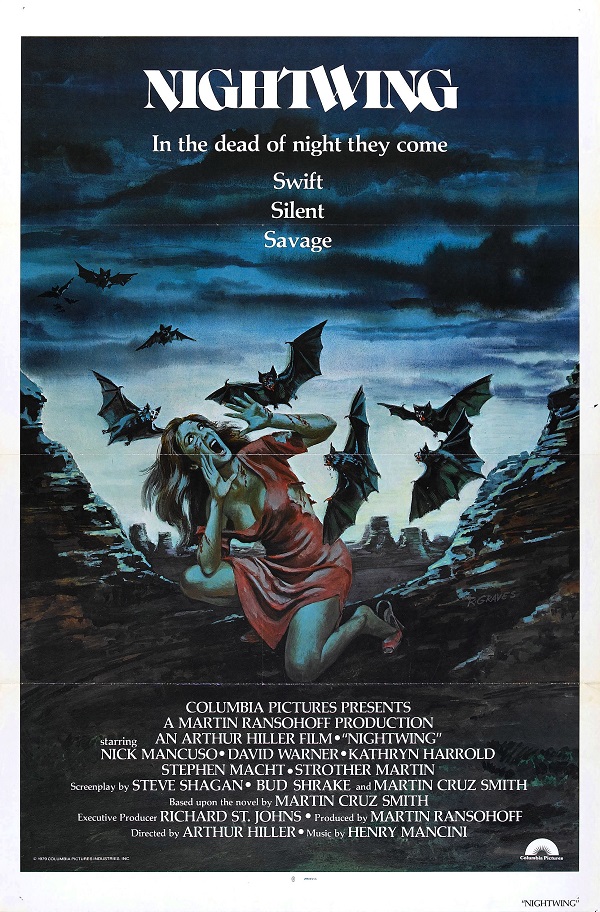
Bats, Bats, Bats & Jaws with Claws: Nightwing, Prophecy, Grizzly

BATS, BATS, BATS & JAWS WITH CLAWS: NIGHTWING, PROPHECY, GRIZZLY
Distinguished character actor David Warner (1941-2022) almost redeems large portions of the 1979 killer vampire bat picture Nightwing, and he’s the reason that it rates out around two stars rather than one or possibly even worse.

Pardon the pun, but Warner truly bites into his dialogue and his monologues are the best moments in Nightwing. Phillip Payne comes across a little batty himself, more often delightfully so than not, and that batty quality would seem to come naturally with the territory of studying and killing plague-infested vampire bats.

The film’s best moments are definitely not the special effects and the vampire bat attack scenes, which almost had me laughing as much as The Bat People or Prophecy or perhaps the ultimate cinematic disaster disaster movie The Swarm.

Generally, I love the prerequisite genre scenes where the scientist explains the phenomenon on the rampage within the movie to a slack-jawed authority figure who usually downplays whatever threat it might be and decides to keep the park / town open.

It rarely ever lets me down, and I enjoyed Nightwing every time Phillip Payne goes all Dr. Sam Loomis on us about vampire bats.

Youngman Duran: It just doesn’t seem natural for a man to spend his life, his entire life, killing bats.

Phillip Payne: Not just bats. Vampire bats. I kill them because they’re evil. There’s a mutual grace and violence in all forms of nature; and each specie of live gives something in return for its own existence. All but one. The freak. The vampire bat alone is that specie. Have you ever seen one of their caves?

YD: No.

PP: I killed over 60,000 of them last year in Mexico. You really understand the presence of evil when you go into their caves. The smell of ammonia alone is enough to kill you. The floor of the cave is a foul syrup of digested blood. And the bats: up high, hanging upside down, rustling, fighting, mating, sending constant messages, waiting for the light to fade, hungry for blood, coaxing the big females to wake up and flex their nightwings to lead the colony out across the land, homing in on any living thing; cattle, sheep, dogs, children, anything with warm blood. And they feast, drinking the blood and pissing ammonia. I kill them because they’re the quintessence of evil. To me, nothing else exists. The destruction of vampire bats is what I live for.

Alrighty then.

Almost none of the small pleasures from Nightwing are to be found in Prophecy, films released only a week apart during June 1979.

Prophecy alternates between a serious, more ambitious movie about ecological concerns and land rights in a dispute between Native Americans and the polluting paper mill, domestic scenes involving a husband (Robert Foxworth) and his wife (Talia Shire), and silly monster attack scenes that belong in something like Food of the Gods or Bigfoot, two bad monster movies from earlier in the ’70s.

Rather, I meant laughably bad monster attack scenes.

None of the elements gel well together in Prophecy.

Prophecy gets awful preachy at times, maybe not too much of a surprise given the film’s title, and Foxworth’s Dr. Robert Verne makes for a rather lackluster and thus unlikable protagonist. Foxworth does not give Prophecy a jolt like Warner does in Nightwing, and his scientific explanatory scenes are pedestrian.

Dr. Verne and his wife Maggie do not have the relationship that, let’s see here, pugilist protagonist Rocky Balboa (Sylvester Stallone) and Adrian (Shire) do in Rocky and Rocky II, ironic considering that Rocky II and Prophecy were both released June 15, 1979.

Their domestic scenes are a drag, and I think less of Foxworth’s Dr. Verne from early on because of the way he treats his wife.

Veteran character actor Richard Dysart (1929-2015) gives the best performance in Prophecy, and it’s not even close. Dysart plays the role of the detestable paper mill company man Isely so effectively that it’s one of the film’s greatest disappointments when it cuts away from his graphic dismemberment by mercury mutant bear Katahdin late in the picture. We’ll have to settle instead for Dysart’s grisly death scene in John Carpenter’s The Thing.

The Katahdin we actually get in the finished product and the one in the promotional material (and dialogue) are not exactly one and the same, which hearkens Prophecy back to low-budget precursors like The Giant Claw and The Wasp Woman more than contemporaries like Alien and Dawn of the Dead, but without the fun of any of those movies.

Leonard Maltin described the monster as a giant salami, Isely said that it’s larger than a dragon with the eyes of a cat, Time reportedly said that it’s Smokey the Bear with an advanced acne condition, and Gene Siskel and Roger Ebert called it a cross between an earthworm and a bear (Siskel) and a grizzly bear and Godzilla (Ebert).

Given that it’s Kevin Peter Hall as the man in the monster suit, one might be tempted to call it a cross between Predator and Harry and the Hendersons.

Manbearpig!

Grizzly, a killer bear picture released three years before Prophecy, works a lot better than Prophecy because it succeeds at a much more modest level of ambition.

It’s required by law that every review mention Grizzly is a Jaws rip-off or we can go right on ahead and call it Jaws with Claws.

We have a law enforcement officer (park ranger), a military veteran (helicopter pilot), and a scientist (naturalist) on the hunt for a giant killer animal (grizzly bear). We also have a park supervisor who refuses to close down the national park despite a series of brutal deaths. The park supervisor allows hunters into the forest to hunt and kill the bear, while media converge on the scene for sensational coverage, but eventually our three main characters must try and do the deed themselves.

I honestly don’t mind too much that Grizzly follows the Jaws formula because Christopher George, Richard Jaeckel, and Andrew Prine are good in their roles and I care about them in their battle against a primal beast.

Honestly, it’s as simple as that, whereas I didn’t particularly care about the overwhelming majority of the human characters in Prophecy and did not care one way or another whether they lived or died just as long as the end credits rolled.

Grizzly, thankfully, is also not preachy, it’s endearing and entertaining on a basic level, and it’s a pleasant way to spend 90 minutes.

Granted, the three main actors and characters are not anywhere near the same level as Roy Scheider’s Sheriff Brody, Richard Dreyfuss’ Matt Hooper, and Robert Shaw’s Captain Quint, just like William Girdler’s no Steven Spielberg, but I still think Grizzly has earned a place right alongside such ’70s killer animal staples as Night of the Lepus, Frogs, Squirm, Kingdom of the Spiders, and Piranha.

Nightwing (1979) **; Prophecy (1979) *; Grizzly (1976) ***

Bela Lugosi Meets a Brooklyn Gorilla (1952)

LUGOSI GORILLA 1953 OWENSBORO

BELA LUGOSI MEETS A BROOKLYN GORILLA (1952) Three stars

They don’t make bad movies like BELA LUGOSI MEETS A BROOKLYN GORILLA any more and that should bring sadness to genuine bad movie connoisseurs everywhere.

It was filmed in six days with a mighty mighty production budget of $12,000. (I have read other reports that have the film down for nine days and $50,000.)

William “One Shot” Beaudine (1892-1970) directed BELA LUGOSI MEETS A BROOKLYN GORILLA and his credits between film and TV amounted to a staggering 372 with his final theatrical features JESSE JAMES MEETS FRANKENSTEIN’S DAUGHTER and BILLY THE KID VS. DRACULA both released in 1966. Beaudine’s directorial career began in 1915, the year of D.W. Griffith’s landmark feature THE BIRTH OF A NATION; in fact, Beaudine assisted Griffith on both THE BIRTH OF A NATION and INTOLERANCE (1916).

Beaudine is not the only legendary Hollywood figure associated with BELA LUGOSI MEETS A BROOKLYN GORILLA.

We have, of course, Mr. Lugosi, no stranger to bad movies, especially in the later stages of his career. He always played a good game, though, and never failed in elevating anything that he was in. One of the all-time greats, Lugosi (1882-1956) even gave great performances in death in both the Kinks’ “Celluloid Heroes” (“Avoid stepping on Bela Lugosi / ‘Cause he’s liable to turn and bite”) and especially Bauhaus’ “Bela Lugosi’s Dead.” MEETS A BROOKLYN GORILLA does not represent peak Lugosi, of course, and it’s not even as good Lugosi as Ed Wood’s GLEN OR GLENDA and BRIDE OF THE MONSTER, but any Lugosi is still good Lugosi.

Martin Landau, who earned an Academy Award for portraying Lugosi in ED WOOD, said that he prepared for his role by watching BELA LUGOSI MEETS A BROOKLYN GORILLA three times (hopefully not in a row). Landau said the film was so bad that it made Ed Wood’s films seem like GONE WITH THE WIND by comparison. Now, there’s a pull quote for the ads: “Makes Ed Wood’s films seem like GONE WITH THE WIND.”

Lugosi made THE GORILLA in 1939 with the Ritz Brothers and Lionel Atwill and THE APE MAN in 1943, a film directed by Beaudine. All three ape films are public domain.

No, please wait, we have not even got to the best part yet. There’s nightclub duo Sammy Petrillo and Duke Mitchell, who play themselves in BELA LUGOSI MEETS A BROOKLYN GORILLA. They are really playing Jerry Lewis and Dean Martin, though, and you might be forgiven for mistaking Petrillo for Lewis and Mitchell for Martin if you missed the opening credits.

I raised my grade by at least one star once I found out that Martin and Lewis considered suing Petrillo and Mitchell for appropriating (misappropriating) their act for BELA LUGOSI MEETS A BROOKLYN GORILLA.

From a 1952 story by the United Press’ Aline Mosby, “The latest ‘Martin and Lewis’ are Duke Mitchell and Sammy Petrillo. They look, talk, laugh, and sing like Dean and Jerry, and they’re in the movies now, too. … Mitchell and Petrillo have the same haircuts, expressions, gestures and even ancestries of Martin, who’s Italian, and Lewis, who is Jewish.”

Mitchell and Petrillo insisted they did not see any resemblance. (Despite the film poster, “They look like Martin & Lewis … You’ll not know the difference … but they are really SAMMY PETRILLO DUKE MITCHELL.”)

After stating that Charlie Chaplin was the only original comic and everybody in show business is a combination of everybody else anyway, Petrillo added, “If it wasn’t for Minosha Skulnic, Harry Ritz and Gene Bayless, Jerry Lewis wouldn’t have an act. And that trick he does with his upper lip he got from Huntz Hall.”

“I’m a combination of Billy Daniels, Billy Eckstine and Sarah Vaughn,” Mitchell said. “Sometimes I get up to sing and I feel like Vaughn Monroe. Nothing’s original in show business. Who do you think Martin is? Crosby. Mel Torme’s like Sinatra, and he did all right.”

Mitchell and Petrillo only made BELA LUGOSI MEETS A BROOKLYN GORILLA and Martin and Lewis split in 1956 after 17 films together beginning with MY FRIEND IRMA (1949).

Mitchell died in 1981, Martin 1995, Petrillo 2009, and Lewis 2017.

BELA LUGOSI MEETS A BROOKLYN GORILLA is one of those movies where you can remember Leonard Maltin’s entire review, let’s see here, “BOMB. One of the all-time greats. Mitchell and Petrillo (the very poor man’s Martin and Lewis) are stranded on a jungle island, where Lugosi is conducting strange experiments. Proceed at your own risk.”

After positive reviews for THE TERROR OF TINY TOWN, KING KUNG FU, THE KILLING OF SATAN, and TROLL 2, I see no problem writing one for BELA LUGOSI MEETS A BROOKLYN GORILLA, although I have mentioned that it’s a bad movie several times. C.M.A., that’s all, folks.

Gremlins 2: The New Batch (1990)

GREMLINS 2

GREMLINS 2: THE NEW BATCH (1990) Four stars

I watched GREMLINS 2: THE NEW BATCH for the first time sometime that summer after it first attacked multiplexes on June 15, 1990.

I wanted to see it badly, since I absolutely loved the original GREMLINS and felt hyped up additionally by the TV ads. I saw it at the Pittsburg 8 during a calendar year (1989-90) that brought multiplex trips to BATMAN, BACK TO THE FUTURE PART II, PARENTHOOD, and TEENAGE MUTANT NINJA TURTLES.

GREMLINS 2 did not let me down, I loved it then and I love it now after having seen it several times, and it has remained one of the most pleasurable multiplex experiences of my life. It’s lingered in my head all these years.

For example, every time since watching GREMLINS 2, when I hear Frank Sinatra’s “New York, New York,” I cannot help but replace it with the Gremlins’ grand production number inside my head. Watching the horribly overrated SHAME (2011) quite a few years back, I wished that GREMLINS 2 and SHAME were spliced together and the little beasties would ruin Carey Mulligan’s showcase rendition.

I’ve heard that GREMLINS 2 is an acquired taste and that you have to be in a certain mood to watch it. Well, I can say that I have acquired that taste and I don’t know, I’m always in the mood to watch a good movie.

“Silly rather than scary like the first GREMLINS” is the verdict on GREMLINS 2 and what people really mean when they spew the party line about being in that certain mood.

— GREMLINS 2 is a running commentary on sequels — everything from merchandising to an endless supply of new characters to sharp but affectionate jabs at the rules of the GREMLINS world and movie sequels in general.

It attempts to be an anti-sequel.

“When I was asked to do the sequel, which I originally turned down because it was so hard to make the first one,” director Joe Dante said in a 2015 interview. “The only reason I decided to make the sequel was because years later they had tried to make a sequel and couldn’t figure out how to do it, and they really wanted another one. So they said to me, ‘If you give us a couple of cans of film with gremlins in them next summer, you can do whatever you want.’ And they gave me three times the money we had to make the first one. So I made GREMLINS 2, which was essentially about how there didn’t need to be a sequel to GREMLINS.”

— We all know the three rules from GREMLINS: Don’t get them wet; Don’t expose them to bright light (especially sunlight, it will kill them); Don’t feed them after midnight.

Naturally, in GREMLINS 2, supporting characters in a control room challenge the hero Billy after he shares the rules.

“What if one of them eats something at 11:00, but then he gets something stuck in his teeth?”

“Like a caraway seed or a sesame seed?”

“And after 12:00, it comes out. Now, he didn’t eat that after midnight.”

It goes on.

“Wait, what if they’re eating in an airplane and they cross a time zone? I mean, it’s always midnight somewhere.”

I am sure many of us asked the burning question, “Isn’t it always after midnight?”

— Mr. and Mrs. Murray Futterman, whom we all thought met their demise in GREMLINS, return for the sequel. That guy Dick Miller (1928-2019) and Jackie Joseph (born 1933) reprise their roles, partly because it’s a Joe Dante movie and what’s a Joe Dante movie without Dick Miller.

— GREMLINS sparked much controversy over its ‘PG’ rating and parents complained about the film, a fact incorporated into GREMLINS 2.

From a 1984 article in The Christian Science Monitor, “Recent releases such as INDIANA JONES AND THE TEMPLE OF DOOM and GREMLINS have spurred controversy about their PG ratings. Many parents felt the violent content and some of the special effects warranted a stiffer rating. A significant number of directors, producers, and theater owners agreed and pushed for a change.”

Hence, the PG-13 rating was born and it debuted with the release of RED DAWN on Aug. 10, 1984.

— Film critic Leonard Maltin, a fan of Dante and his work, gave a negative review to GREMLINS.

“A teenager’s unusual new pet spawns a legion of vicious, violent monsters who turn picture-postcard town into living hell. Comic nightmare is a cross between Capra’s IT’S A WONDERFUL LIFE and THE BLOB; full of film-buff in-jokes but negated by too-vivid violence and mayhem.”

Maltin then makes a gratuitous cameo appearance in GREMLINS 2, where he’s mauled by the new batch for his negative review of the original film. Maltin’s famous last words, “Ow. I was just kidding. Ah. It’s a 10. It’s a 10.”

— At one point in GREMLINS 2, the title monsters disrupt their own film and it takes a threat from Hulk Hogan to get the picture back on track. …

“Okay you guys, listen up! People pay good money to see this movie! When they go out to a theater they want cold sodas, hot popcorn, and no monsters in the projection booth! Do I have to come up there myself? Do you think the Gremsters can stand up to the Hulkster? Well, if I were you, I’d run the rest of GREMLINS 2! Right now! Sorry folks, it won’t happen again.”

— Phoebe Cates became famous predominantly for two scenes: doffing her bikini top to the tune of the Cars’ “Moving in Stereo” in FAST TIMES AT RIDGEMONT HIGH and her ‘Why I hate Christmas’ speech in GREMLINS. In GREMLINS 2, Cates’ Kate starts on a speech why she also hates Lincoln’s birthday.

— GREMLINS and GREMLINS 2 main protagonist Billy Peltzer’s inept inventor father Rand (Hoyt Axton) played a pivotal role in the first movie. Rand Peltzer gets an upgrade in GREMLINS 2. We get eccentric billionaire Daniel Clamp (John Glover), a combination of Donald Trump and Ted Turner, whose technological innovations inside his wonderful Clamp Tower never seem to work properly. I get a kick from the building announcements, for example “Tonight, on the Clamp Cable Classic Movie Channel, don’t miss CASABLANCA, now in full color with a happier ending.”

The title characters take over Clamp Tower, creating all sorts of memorable scenes.

— I should perhaps mention the diabolical Dr. Catheter (Christopher Lee), identical twins Martin and Lewis played by identical twin actors Don and Dan Stanton, Grandpa Fred (Robert Prosky) clearly inspired by Grandpa (Al Lewis) from “The Munsters,” the appearance of the Batman logo, and a talking Gremlin named Brain (voiced by Tony Randall) who gets an opportunity to sum up the ethos of the beasts.

“The fine points: diplomacy, compassion, standards, manners, tradition … that’s what we’re reaching toward. Oh, we may stumble along the way, but civilization, yes. The Geneva Convention, chamber music, Susan Sontag. Everything your society has worked so hard to accomplish over the centuries, that’s what we aspire to; we want to be civilized.”

Of course, in the very next moment, Brain takes out his gun and shoots dead a goofy acting Gremlin.

Civilization is very hard to come by.