
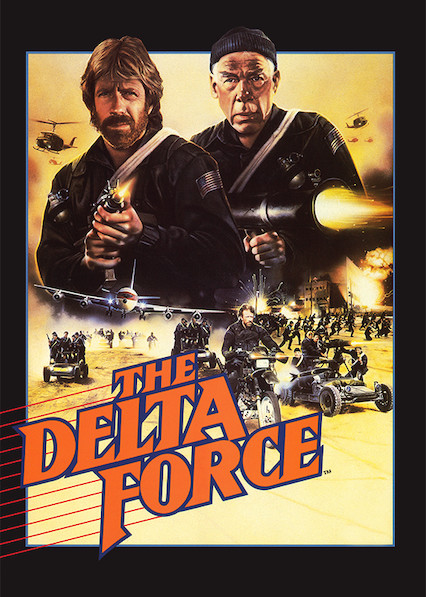
The Delta Force (1986)

THE DELTA FORCE

THE DELTA FORCE (1986) Three stars

Watching THE DELTA FORCE for the first time in 30 years, it surprised me in three ways.

First, it accumulates a running time of 2 hours, 5 minutes.

Second, the heavy action does not kick in until about 1 hour, 15 minutes in.

Third, it’s more thoughtful than expected, given that it is a Golan-Globus production starring Chuck Norris and featuring a cast of many highlighted by hostages Martin Balsam, Joey Bishop, Lainie Kazan, George Kennedy, and Shelley Winters, actors who initially suggest the movie would quickly become AIRPORT ‘86.

About that running time, let’s see here, RAMBO: FIRST BLOOD PART II and COMMANDO, both from 1985, clock in at approximately 96 and 92 minutes, respectively. Then again, Norris’ previous cinematic crusade against terrorism, INVASION U.S.A., lasts 110 minutes.

Once the action does kick in, it kicks in real good in THE DELTA FORCE and it especially delivers the goods with shit blown up real good just like an old school action movie should. Of course, I hope the demolition experts were paid real good.

The action truly begins with a chase: Major Scott McCoy (Norris) and his Delta Force colleague are pursued by Lebanese terrorists through Beirut and one terrorist vehicle crashes into a poor defenseless fruit cart and melons fly everywhere. Ah, yes, this is one of the better fruit cart scenes in history because they used both slow motion and big melons. I say the bigger the melons, the better the fruit cart scene.

I have argued the best Chuck Norris movies are the ones with the best supporting casts and THE DELTA FORCE definitely upholds that argument. Other cast members include Robert Forster, Hanna Schygulla (it’s a long way from Rainer Werner Fassbinder melodramas to Chuck Norris action spectaculars), Susan Strasberg, Bo Svenson, and Robert Vaughn. The great Lee Marvin (1924-87) also plays a key role in his final movie performance. Of course, Marvin brings his association with THE DIRTY DOZEN.

This is Norris’ best supporting cast, though I still rate THE DELTA FORCE slightly below LONE WOLF MCQUADE and CODE OF SILENCE overall.

Palestine born Menahem Golan (1929-2014) wrote, produced, and directed the film, which takes an undeniable pro-Israeli, pro-Jewish position. Golan served in the Israeli Air Force as a young man, long before he and his younger cousin and business partner Yoram Globus attempted to conquer the international film market.

Call me a fool and slap me silly, but it seems that Golan paid a lot more attention and dedicated more craft to THE DELTA FORCE than the average run-of-the-mill Cannon production, like, for example, Norris’ other 1986 film, FIREWALKER. Granted, J. Lee Thompson directed that one, but it’s doubtful that Golan would have evinced any passion in a watered down third-rate Indiana Jones retread like he did for THE DELTA FORCE.

THE DELTA FORCE ripped its plot from the real-life hijacking of Trans World Airlines Flight 847 on June 14, 1985. There’s a real-life Delta Force who have engaged in Operation Eagle Claw, Operation Enduring Freedom, the Iraq War, Operation Inherent Resolve, and Operation Kayla Mueller, among many other specialized missions incorporating counter-terrorism, hostage rescue, and direct action.

THE DELTA FORCE began production in July 1985 and filming in September 1985. The shoot lasted until early November. The filming took place in predominantly Israel. THE DELTA FORCE opened February 14, 1986, 245 days after the hijacking.

We have about the same number of passengers and crew members in the movie as in real life, the same number of terrorists behind the hijacking, a purser based on flight service manager Uli Derickson, the singling out of the Jewish passengers and the Navy divers and the eventual murder of one of them, and a similar flight pattern.

In real life, though, diplomats brought about the release of the hostages, not the Delta Force. Of course, that’s not what anybody wants to see in an action movie. I mean, you don’t cast Chuck Norris and Lee Marvin for that.

THE DELTA FORCE can be a wish fulfillment fantasy particularly for those who feel the United States perpetually takes a soft position on international terrorism and that we should go right into the heart of the Middle East and “Kill all the A-rabs” once and forever. Never mind that all our prior and ongoing efforts in the Middle East have seemingly only compounded matters and created more terrorists. One just might be left to conclude the War on Terrorism will never end, just like the War on Drugs.

The Arab characters in THE DELTA FORCE, terrorists one and all, earned their place in Jack G. Shaheen’s book “Reel Bad Arabs: How Hollywood Vilifies a People.” Vincent Canby of the New York Times wrote, “[DELTA FORCE] will be the 1986 film all others will have to beat for sheer, unashamed, hilariously vulgar vaingloriousness.”

Subaru customized a motorcycle just for Norris’ late picture heroics. Gene Siskel wrote in his one-star review for the Chicago Tribune, “The action in Beirut is more appropriate for a bad James Bond film than for a subject that has been all too real lately. Norris gets off shooting rocket launchers from his specially built motorcycle, and we sit there stunned at the movie industry’s ability to make money off of any tragedy.”

Israeli filmmaker Rafi Bukai said that he hated films like THE DELTA FORCE because they do not show Arabs as human beings.

Veteran character actor Robert Forster (1941-2019) plays the main terrorist Abdul Rafai. Forster was born in Rochester, New York, to parents of Italian, English, and Irish descent. His father trained elephants for the Ringling Bros. and Barnum & Bailey Circus. File this casting alongside John Wayne as Genghis Khan in the 1956 THE CONQUEROR. Along this same line, how many ethnicities and nationalities have character actors like Alfred Molina and Armand Assante played over the years?

I give THE DELTA FORCE a positive review because I enjoy it as a big, dumb, and even stupid action movie and it is an effective time capsule piece with Golan-Globus, Cannon Films, Chuck Norris, Lee Marvin, and all those older character actors. Not because it is a sobering, thoughtful, and balanced consideration of Middle East politics and international terrorism. Thankfully, I have read several books just like that on those subjects.

The Big Red One (1980)

day 72, the big red one

THE BIG RED ONE (1980) Four stars
When I think of the dumb things college students love to say, I drift back to the History in Film & Fiction class that I took back in 2005 at Pittsburg State.

Boy oh boy, all those undergrads sure did say the dumbest things. (A graduate student like myself would never.)

Like, for example, after we consumed SAVING PRIVATE RYAN around Veterans’ Day.

Were these normally cynical and reserved undergrads all of a sudden turned into Steven Spielberg’s press agents?

Sounded like it.

I mean, for crying out loud, I don’t remember any of those bastards liking the other films we considered that semester or liking at least enough to break on through that cool, detached undergrad reserve.

Several classmates said “SAVING PRIVATE RYAN is the greatest war movie ever made.” One even said, “It’s the only war movie to ever truly care about its characters.” All said with that gleeful, pretentious undergrad enthusiasm.

The first opinion makes you wonder how many war movies they have seen. Probably not that many, either then or now for that matter. Anyway, just say that it’s your favorite and not make that great leap to being an asshole by saying “the greatest.”

The second one makes you wonder how that undergrad history major knew how Spielberg felt about his characters and how that was somehow purer of heart than all the other makers of countless war movies.

For example, makes you wonder how director William Wyler, a World War II veteran, felt about the three veteran characters returning home in THE BEST YEARS OF OUR LIVES (1946). Man, oh man, betcha he must have disliked them characters and didn’t care a single lick about them and their plight. Sure, sure, sure, Wyler just did it for the money and the heaps of critical praise, unlike Mr. Spielberg.

We needed a Walter Sobchak in our class that day and he could have pretended the undergrads were all named Donny, especially when they were getting just a wee bit too grandiose in their statements.

“SAVING PRIVATE RYAN is the greatest war movie ever made. …”

“Shut the fuck up, Donny.”

“It’s the only war movie to ever truly care about its characters. …”

“Forget it, Donny, you’re out of your element.”

“SAVING PRIVATE RYAN is the greatest war movie ever made. …”

Jeffrey Lebowski speaks up, “Yeah, well, you know, that’s just, like, your opinion, man.”

I am sure that Spielberg would not be guilty of such ridiculous statements as his many unabashed admirers in that Film & Fiction class.

For example, Spielberg and George Lucas grabbed the character name “Short Round” for INDIANA JONES AND THE TEMPLE OF DOOM from director Samuel Fuller’s Korean War film THE STEEL HELMET.

You can be sure Spielberg watched Fuller’s World War II epic THE BIG RED ONE before taking on SAVING PRIVATE RYAN.

Fuller (1912-97) was truly an one-of-a-kind dynamo who lived one helluva life. A screenwriter, a novelist, a reporter, a combat veteran, a World War II survivor, a director, an actor, an inspiration to many. He directed some of the best movies you could ever have the chance to see (I would start with WHITE DOG) and THE BIG RED ONE lives and breathes Fuller.

From his 1980 Cannes Film Festival interview with Roger Ebert, where there’s an audience of a German TV crew and they ask him if THE BIG RED ONE was pro-war or anti-war, Fuller said, “Pro or anti, what the hell difference does it make to the guy who gets his ass shot off? The movie is very simple. It’s a series of combat experiences, and the times of waiting in between. Lee Marvin plays a carpenter of death. The sergeants of this world have been dealing death to young men for 10,000 years. He’s a symbol of all those years and all those sergeants, no matter what their names were or what they called their rank in other languages. That’s why he has no name in the movie.

“The movie deals with death in a way that might be unfamiliar to people who know nothing of war except what they learned in war movies. I believe that fear doesn’t delay death, and so it is fruitless. A guy is hit. So, he’s hit. That’s that. I don’t cry because that guy over there got hit. I cry because I’m gonna get hit next. All that phony heroism is a bunch of baloney when they’re shooting at you. But you have to be honest with a corpse, and that is the emotion that the movie shows rubbing off on four young men.

“I wanted to do the story of a survivor, because all war stories are told by survivors. Pro- or anti-war, that’s immaterial, because in any war picture, you’re going to allegedly feel anti-war because they make a character sympathetic and then the character gets shot, and so you say, ‘How tragic.’ What baloney. Why should I be against war because some kid gets hit while he’s reading a letter from Mom? I don’t think I’ve seen any war movie where you get to know the characters and one of them isn’t killed. It’s a cliche.

“But to the guy who’s killed, try telling him about heroism and courage. Get him to listen after he’s dead. Even World War II, with all its idealism, basically there was a lot of hypocrisy. …”

I could read a Fuller interview all day.

Fuller served in the 1st Infantry Division or “The Big Red One” and he received the Silver Star, Bronze Star, and Purple Heart during his service. THE BIG RED ONE’s based on his experiences with Robert Carradine’s Pvt. Zab as Fuller’s alter ego. Fuller sold a gangster novel that he wrote during his military service and in the movie, just like in real life, he finds out that his novel’s been published when he spots a soldier reading it.

Fuller, in his interview with Ebert, said that Carradine’s character is not nearly as vicious as Fuller was in real life.

Zab’s the narrator in THE BIG RED ONE and I just love his narration, both the words themselves (apparently written by Jim McBride) and Carradine’s delivery.

A couple examples: “The Bangalore Torpedo was 50′ long and packed with 85 pounds of TNT and you assembled it along the way. By hand. I’d love to meet the asshole who invented it.”

Example No. 2: “These Sicilian women cooked us a terrific meal. It’s too bad they were all over 50. We were more horny than we were hungry.”

Those are words you could find yourself saying.

Our four privates are Zab, Griff (Mark Hamill), Vinci (Bobby DiCicco), and Johnson (Kelly Ward), and they all do bang-up jobs. It’s especially nice seeing Hamill in a live-action role outside Luke Skywalker.

In the long run, though, THE BIG RED ONE belongs to Lee Marvin as The Sergeant.

You could just say that Marvin was born to play this role.

He’s one gruff son-of-a-bitch and he’s lovable because of it.

Marvin’s delivery and Fuller’s dialogue are a match made in heaven.

Check out this conversation and try and imagine Marvin saying it as The Sergeant.

Griff: I can’t murder anybody.

The Sergeant: We don’t murder; we kill.

Griff: It’s the same thing.

The Sergeant: The hell it is, Griff. You don’t murder animals; you kill ’em.

THE BIG RED ONE marked Fuller’s return to directing after 11 years, with THE SHARK from 1969 his previous credited film, and it was to be his grand epic.

Fuller originally submitted a 4-hour cut and then a 2-hour cut, and both were rejected, of course, by the studio.

The studio reedited the film and tacked on the narration, but still in any form, THE BIG RED ONE packs a wallop and it’s one of the best war movies out there.