Auto Pilot Cinema: The Airport Movies

AUTO PILOT CINEMA: THE AIRPORT MOVIES
When thinking of the worst series in movie history, I am tempted to start with Saw and Fast and the Furious then move back through time with The Omen and Amityville Horror and finally go way way way back to the Dead End Kids, er, Bowery Boys.

In piecing through all this cinematic carnage, I should not leave behind the four Airport movies that were churned out by Universal Pictures from 1970 to 1979. Maybe I should leave them behind.

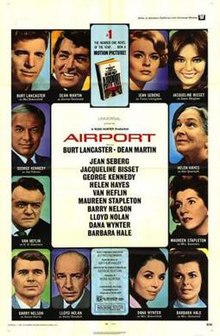
Airport, based on Arthur Hailey’s 1968 novel of the same name, made a killing at the box office upon its late May release in 1970 and it even received 10, yes, believe it or not, 10 Academy Award nominations, including Best Picture, and 70-year-old Helen Hayes won Best Supporting Actress.

The three subsequent films — helpfully labeled 1975, ’77, and ’79 — got worse and worse, naturally, and the last film in the series, The Concorde … Airport ’79, is so bad (and so aggressively stupid) in fact that it could kill off any series. That’s despite the fact that it reportedly made $65 million, a much better take than, for example, Irwin Allen productions The Swarm ($7.7 million), Beyond the Poseidon Adventure ($2.1 million), and When Time Ran Out ($3.8 million). Regardless, Universal stopped making Airport movies after The Concorde and I’m almost dumbfounded why there’s not been a remake or a reboot loaded with today’s stars.

Hey, wait, did somebody mention stars? Yes, stars, that’s what these Airport movies were about — speculating which ones would emerge at the end of the picture relatively intact and which ones would die spectacularly. Grand Hotel in the sky, not exactly, since none of the careers in the Airport movies were at their peak like the ones in Grand Hotel, but the idea of stuffing the screen with stars in every scene applies just the same.

Airport: Burt Lancaster, Dean Martin, Jean Seberg, Jacqueline Bisset, George Kennedy, Hayes, Van Heflin, Maureen Stapleton, Barry Nelson, Dana Wynter, Lloyd Nolan.

Airport 1975: Charlton Heston, Karen Black, Kennedy, Efrem Zimbalist Jr., Susan Clark, Helen Reddy, Linda Blair, Dana Andrews, Roy Thinnes, Sid Caesar, Myrna Loy, Gloria Swanson.

Airport ’77: Jack Lemmon, Lee Grant, Branda Vaccaro, Joseph Cotten, Olivia de Havilland, Darren McGavin, Christopher Lee, Robert Foxworth, Kathleen Quinlan, James Stewart.

Airport ’79: Alain Delon, Susan Blakely, Robert Wagner, Sylvia Kristel, Kennedy, Eddie Albert, Bibi Andersson, Charo, John Davidson, Andrea Marcovicci, Martha Raye, Cicely Tyson, Jimmie Walker, David Warner, Mercedes McCambridge.

More like Hollywood Squares in the Sky? Yeah, believe so, especially since Davidson hosted a Hollywood Squares revival in the late ’80s.

Beside Airport in the titles, Kennedy (1925-2016) proved to be the connective tissue between all four pictures, meaning he’s the inverse of the Brody boys (Jaws) and the Griswold children (Vacation). Kennedy played Joe Patroni — first as mechanic, then as vice president of operations (1975), a consultant (’77), and finally an experienced pilot (’79). Regardless of position or rank, the character got worse and worse over the course of the films, not that he or the films started out all that hot. I found even his cigar was guilty of overacting in the original film and Patroni was so odiously obnoxious in the fourth film, especially after he utters the line that articulates the sexism of the entire series, They don’t call it the cockpit for nothing, honey. George Kennedy as sex symbol? Sure, I’ll believe anything, nearly anything except for, oh, the entire plot of The Concorde.

I’ll talk more about The Concorde and the original because they’re fresher in my memory. To be honest, though, I probably won’t even feel like discussing the original because …

Movies rarely come any dumber than The Concorde: Let’s see, this is going to be fun, not really, anyway TV reporter Susan Blakely comes across some highly incriminating evidence against defense contractor (and covert arms dealer) Robert Wagner. Wagner decides that he’s going to attempt to blow up real good the plane she’s on en route from Washington to Paris. Okay, okay, his plot to blow up the Concorde real good fails and they have dinner together in Paris during the middle section of the movie, because, you know, they have a history together and they still love each other. She still has this incriminating evidence, naturally, she’s going to eventually go public with it, of course, and what does he do? Kill her? He lets her walk away safe and unharmed, so he’ll have to go after the plane again. That’s right, she gets back on the Concorde for the final leg of the flight from Paris to Moscow. Guilt stricken, Wagner commits suicide very late in the picture and I believe it’s not because his secret’s been discovered and will be exposed regardless of whether he’s alive or not, but more that he’s one of the worst villains in cinematic history.

The Concorde is so laughable in so many ways, as if that whole plot discussed in the last paragraph wasn’t enough. The Concorde stops over in Paris for a night, and every single passenger gets back on the plane the next morning. They all seem way too calm and collected after the events of the first half of the movie. I would love to have just heard one character say ‘Hell no, I’m not getting back on that damn plane!’ They all deserved to die, but we know that’s not happening.

At one critical point during the first attack on the Concorde, the Übermensch George Kennedy proves that he’s truly The Übermensch by sticking his hand out the window of the Concorde and throwing a flare. Unbelievable, utterly unbelievable even in this preposterous movie. If only the first Airport had been the in-flight movie on The Concorde, especially that scene where Patroni discusses the effects of a bomb on a 707 and concludes, When I was a mechanic in the Air Force, I was being transferred on a MATS plane. At 20,000 feet, one of the windows shattered. The guy sitting next to it was about 170 pounds. He went through that little space like a hunk of hamburger going down a disposal, and right after him coats, pillows, blankets, cups, saucers. That was just a MATS plane, not the fastest plane in the universe.

I’m done, I can’t take it anymore, and I’m bailing out on the Airport movies.

Airport (1970) **; Airport 1975 (1974) **1/2; Airport ’77 (1977) *; The Concorde: Airport ’79 (1979) 1/2*
Bomb, Bomb, Bomb: Partners, Charlie Chan and the Curse of the Dragon Queen, When Time Ran Out

BOMB, BOMB, BOMB: PARTNERS, CHARLIE CHAN AND THE CURSE OF THE DRAGON QUEEN, WHEN TIME RAN OUT

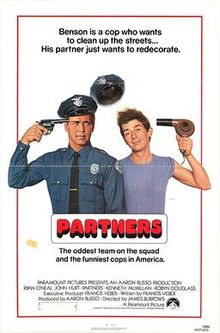
I could only make it through about 30 minutes of Partners and that’s more than enough for at least about 10 lifetimes, I’d say. I gave up on the picture for good around the fourth time star Ryan O’Neal uttered the epithet faggot. Yeah, Partners basically plays Cruising for laughs. Ha-ha, funny … about as funny as punching somebody’s mother in the face.

I consider Partners the absolute worst film from 1982, at least among the 70 or so films that I have seen thus far in my 42 years on this planet. It supplanted Amityville II: The Possession, a lovely little number incorporating blood, vomit, incest, matricide and patricide, fratricide and sororicide, and demonic possession. Never mind Inchon, a $46 million Korean War epic that bombed mightily at the box office with only a $5.2 million return. Never mind Halloween III: Season of the Witch, which features one of the least likable lead characters (Dr. Dan Challis) and lead performances (Tom Atkins) in recent memory. Believe it or not, Partners beats those other films in sheer unpleasantness.

Did longtime TV director James Burrows use Partners for his audition for Will and Grace? I seriously doubt it, because Partners is one of the nastiest pieces of work I have ever seen. Burrows has directed more than 1,000 TV episodes, including 237 Cheers and 75 Taxi and 32 Frasier. Thankfully, Burrows stuck with television after Partners.

Early in the picture, O’Neal asks his boss how he got stuck partnering up (literally) with gay records clerk Kerwin (John Hurt) to infiltrate and investigate a series of murders in the Los Angeles gay community. Anyway, Chief Wilkins (Kenneth McMillan) tells our matinee idol, “Because you’re a good cop, a real good cop. And because of your cute ass.” Maybe that’s how O’Neal himself got the gig. O’Neal certainly dressed up for the part, wearing a ridiculous tank top and then a leather garb in just the portion I watched before saying Roberto Duran on Partners.

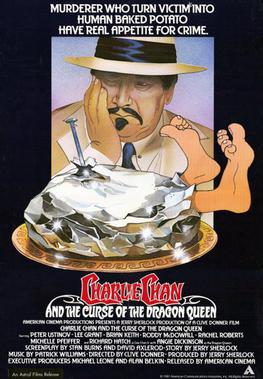
— As I sit here before this keyboard and ponder my next direction, I consider how I endured all 95 minutes or so of Charlie Chan and the Curse of the Dragon Queen, another great big smelly turd from the early ’80s like the ones mentioned about three paragraphs up.

When folks express this incredible nostalgia for the ’80s, undoubtedly it’s not Charlie Chan or Partners or Inchon, for that matter, they’re nostalgic about, because they SUCK in the immortal words of Al from Caddyshack. Then again, if I have learned anything over the years writing about movies or music online, it’s that somewhere in this great big world there’s a cult following Howard the Duck or Halloween III, for example, and they just might flame you for not cherishing their cult object in the same way they do.

Charlie Chan asks us to believe Peter Ustinov (1921-2004), Richard Hatch (1945-2017), and Angie Dickerson as characters of Asian descent. Sure, I believe the Englishman Ustinov as fictional Belgian detective Hercule Poirot (a character he played six times, including features Death on the Nile, Evil Under the Sun, and Appointment with Death) and Roman emperor Nero in Quo Vadis, but I call it more of a stretch to consider him as Chan in 2020, nearly 40 years after the film was made. It’s even worse for both Hatch and Dickerson.

Charlie Chan features plenty of the broadest comedy and frenzied overacting by a rather distinguished cast that also includes Lee Grant, Brian Keith, Roddy McDowall, Rachel Roberts, and Michelle Pfeiffer early in her career. Hatch plays Chan’s fumbling bumbling stumbling grandson Lee Chan Jr. and I’ve watched so many films lately with fumbling stumbling bumbling would-be detectives that I now grumble and rumble when I see them on the screen. I’m thankful my Grandma never behaved like the one played by Grant in Charlie Chan. Keith’s police chief says ‘Goddamn’ about 50 times. McDowall and Roberts play Grant’s domestic helpers, Gillespie and Mrs. Dangers respectively, but they both provide little help to Charlie Chan since they are both in the grand tradition of melodramatic domestic help in the movies; Mrs. Dangers calls to mind Patsy Kelly’s frantic maid in The Gorilla. Pfeiffer could have dialed the perkiness down a notch or few and still have saved enough for the rest of her career. Nearly all of these characters are cringeworthy.

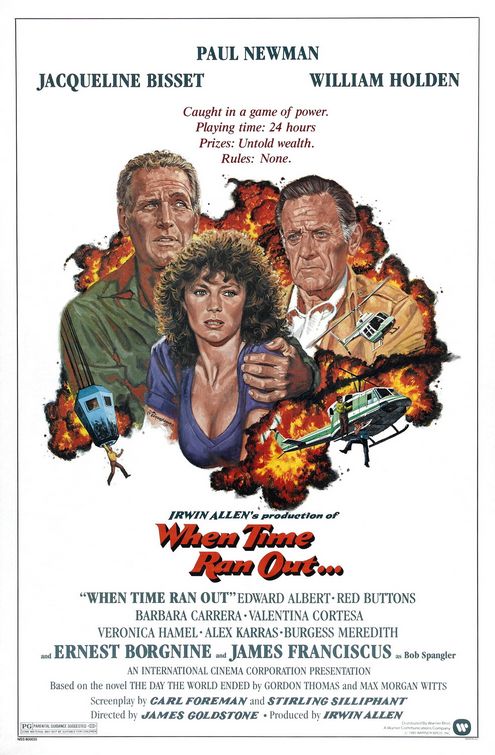
When Time Ran Out came out Mar. 28, 1980 and it eventually fell about $16 million short of making its $20 million production budget back at the American box office.

Later that year, on July 2, Airplane parodied Airport specifically and disaster movies in general, and became one of the biggest hits of the summer and the entire calendar year.

The failure of When Time Ran Out and the success of Airplane signaled the end of the disaster movie, at least in the form that dominated the first half of the seventies with The Poseidon Adventure, Earthquake, and Towering Inferno and then dribbled out pure unadulterated dreck the final half of that decade like The Swarm, Beyond the Poseidon Adventure, and Meteor. Since I mentioned Meteor, I also have to mention Avalanche, which provided disaster footage recycled in Meteor as if being in one disaster of a disaster movie just simply was not enough.

Master of disaster Irwin Allen (1916-91) produced at least half the films mentioned in the paragraph right above this one and he even stepped in the director’s chair for the turkey bombs The Swarm and Beyond the Poseidon Adventure. Allen called on Rollercoaster director James Goldstone for When Time Ran Out, which features the required number of old time movie stars, hot commodities, and fledgling character actors. When Time Ran Out should have been called Take the Money and Run, though Woody Allen and Steve Miller already used it for a comedy (1969) and a hit song (1976).

We have William Holden (1918-81), Paul Newman (1925-2008), Jacqueline Bisset, Ernest Borgnine (1917-2012), James Franciscus (1934-91), Burgess Meredith (1907-97), Red Buttons (1919-2006), Barbara Carrera, Pat Morita (1932-2005), Veronica Hamel, Edward Albert (1951-2006), and Alex Karras (1935-2012), as well as a volcano, a tidal wave, etc.

Seemingly half of the cast takes part in a glorified soap opera before the molten lava really begins to flow and they have to repeat business from Beyond the Poseidon and seemingly every other disaster movie of the era. Here’s that glorified soap opera: Holden proposes to Bisset very early in the movie and she turns him down because she’s in love with Newman, who’s not the marrying kind and anyway he does not seem to much care for Bisset but maybe he’s just masking his true feelings toward her with standard male bluster. Franciscus is married to Hamel but he’s fooling around with half-brother Albert’s significant other Carrera. Just wait, it gets better, Albert does not know that he’s Franciscus’ half-brother … and Holden and Hamel are sleeping together. I think I just about nailed it down and you’re right if you’re thinking all that seems like too much plot for such a dimwitted movie.

You’re also right that I hated these characters and their miserable lives, and rooted for the volcano to wipe them all out.

Especially Franciscus, who takes chronic disbelief in the face of impending disaster to new lows in When Time Ran Out. Unfortunately, an incredibly shoddy special effect leads to an incredibly unsatisfying death for Franciscus’ character. We crave to see him bite the dust or eat molten lava in spectacular fashion, and what we get is just plain laughable.

Of course, just plain laughable describes about 99 percent of When Time Ran Out.

Believe it or not, costume designer Paul Zastupnevich earned an Academy Award nomination for Best Costume Design and went against winner Tess, The Elephant Man, My Brilliant Career, and Somewhere in Time, all of them period films where the look of the film itself becomes another important character.

Yeah, I hope the 1981 Oscar broadcast used a shot of Newman in his utterly ridiculous Urban Cowboy garb.

Zastupnevich received a nomination for the same award two years before for his edgy, state-of-the-art costume work on The Swarm, beekeeper outfits. The Agatha Christie Hercule Poirot period murder mystery Death on the Nile won the prize.

I hate to say it, but time ran out on this review because I don’t want to consider When Time Ran Out any longer than I already have.

Partners No stars; Charlie Chan and the Curse of the Dragon Queen 1/2*; When Time Ran Out *