Goin’ Coconuts (1978)

GOIN’ COCONUTS (1978) 1/2*

In the distant future, one of the great mysteries of human behavior will be why there were so many teen idols after, oh, let’s say, 1955. Imagine trying to explain Tiger Beat, Joey Lawrence, Jonathan Taylor Thomas, NSYNC and the Backstreet Boys, and Justin Bieber to future generations.

I can only hope that future rational beings will reach the conclusion that many people (mostly girls, but also boys with such beacons of humanity as Britney Spears, Paris Hilton, Kim Kardashian, et cetera ) in the late 20th and early 21st centuries obsessed about the shallow and the superficial and the stupid and such attributes as perfect hair, perfect teeth, and dimples. “He / She has got such a perfect body. He’s so cute. She’s so hot.” All that jive can just go fuck off.

I thought about this “teen idol” angle during and after GOIN’ COCONUTS, the motion picture debut and finale of former teen idols Donny and Marie Osmond. Since I watched it after SLITHIS, I just might have survived the worst two movies I have ever seen back-to-back; I am blanking on whether or not I ever watched BATTLEFIELD EARTH after LEONARD PART 6 or vice versa.

Anyway, I hated just about every second of GOIN’ COCONUTS. Hated every musical number. Hated every bit of perfunctory dialogue. Hated every single attempt at humor. Hated the jewelry caper story and every single plot development that we have seen before from a million different movies and TV shows. Hated seeing legendary movie villains being reduced to buffoons for comedic purposes that miserably failed. Hated it the longer it went on. I rejoiced at the first sight of the end credits and turned off the movie. I didn’t even care all that much about the Hawaiian scenery, just because we had to watch this stupid movie take place within it.

I felt especially bad for actors like Kenneth Mars, Ted Cassidy, Khigh Dhiegh, and Harold Sakata. But, hey, not that bad, since they got paid and had the opportunity to make a movie in Hawaii. That sounds great right about now. I could go for that, even a movie as shitty as GOIN’ COCONUTS.

The reason I felt bad for them was they had to play cosmically inept. Like, for example, Sakata’s Ito could not take out Donny Osmond, for crying out loud. The filmmakers made the dread mistake of costuming Sakata (1920-82) in the same hat that he wore in GOLDFINGER as super henchman Oddjob. Sure we all remember what Oddjob did with his hat in GOLDFINGER; let’s just say that he wears the hat throughout GOIN’ COCONUTS and that’s that. It’s so insulting to see a World War II veteran and an Olympic silver medalist in weightlifting (Sakata represented the United States in the 1948 Summer Olympics in London) reduced to playing the fool, thwarted at every churn of the plot by a couple teen idols and their perfect teeth.

Dhiegh (1910-91) played a key role in THE MANCHURIAN CANDIDATE as brainwashing expert Dr. Yen. Yes, THE MANCHURIAN CANDIDATE, one of the most intelligent movies ever made. Then, 16 years later, Dhiegh appeared in GOIN’ COCONUTS, which should have borrowed from THE WIZARD OF OZ its musical theme … “If I Only Had a Brain.” Again, it simply defies all credibility that Dhiegh’s character would be outsmarted by a pair of coconuts.

In GOIN’ COCONUTS, Mars (1935-2011) more or less gives us a variation on his characters from the Mel Brooks comedies THE PRODUCERS and YOUNG FRANKENSTEIN, only without the laughs.

Cassidy (1932-79) played Lurch on “The Addams Family” and would it have been too much to ask director Howard Morris (who played Ernest T. Bass on “The Andy Griffith Show”) and screenwriters William Marc Daniels and Raymond Harvey to include a gag where Cassidy’s Mickey answers the phone with “You rang.” Yes, of course, it would have been too much to ask. That’s silly to ask if you’ve survived GOIN’ COCONUTS.

It was a pathetic sight every time watching these villains shoot their guns at Donny and Marie. They should have been sent back to marksmanship class or had their diabolical henchmen licenses revoked.

Aside from the end credits, there was something else great about GOIN’ COCONUTS. Since it failed at the box office, Donny and Marie made only this one movie rather than a series of Donny and Marie spectaculars. They returned to their variety show where they belonged with their aw shucks gee whiz nature and perfect teeth intact.
Young Frankenstein (1974)

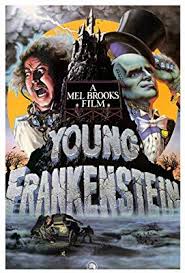
YOUNG FRANKENSTEIN

YOUNG FRANKENSTEIN (1974) Four stars

Over a 20-year period from the late ‘60s to the late ’80s, Mel Brooks directed a series of inspired comedies: THE PRODUCERS, THE TWELVE CHAIRS, BLAZING SADDLES, YOUNG FRANKENSTEIN, SILENT MOVIE, HIGH ANXIETY, HISTORY OF THE WORLD PART I, and SPACEBALLS.

I’ll choose YOUNG FRANKENSTEIN as his best (i.e. my favorite) work.

It’s not his funniest work, per se, but you could put it on a DVD following FRANKENSTEIN, BRIDE OF FRANKENSTEIN, SON OF FRANKENSTEIN, and THE GHOST OF FRANKENSTEIN and it would be perfect. In fact, YOUNG FRANKENSTEIN nearly gives you the feeling that it’s a lost classic from Universal Studios during their reign of terror.

Brooks and co-writer and star Gene Wilder obviously loved Universal classics like FRANKENSTEIN. Brooks’ last feature film, DRACULA: DEAD AND LOVING IT, came in 1995, so Brooks took on Universal’s two most legendary monsters.

We can be sure the big boys at 20th Century Fox did not want YOUNG FRANKENSTEIN made in black & white. Some folks are guaranteed to say, “Black & white will never work again,” but what about every time it has worked over the years.

Wilder and Brooks based their characters on Mary Wollstonecraft Shelley’s original classic novel. They might as well have credited the screenwriters for the old Universal FRANKENSTEIN pictures.

All the technical people deserve their fair share of the credit for YOUNG FRANKENSTEIN: John Morris’ musical score, Gerald Hirschfeld’s cinematography, John C. Howard’s editing, Dale Hennesy’s production design, Robert De Vestel’s set decoration, Dorothy Jeakins’ costume design, and Edwin Butterworth’s, Mary Keats’, and William Tuttle’s work in the makeup department.

YOUNG FRANKENSTEIN benefits from using some of the same sets the original FRANKENSTEIN used.

Beyond the overall look and style of the picture, though, both the performances and the jokes are their usual grab bag that’s found in a Mel Brooks film.

Wilder’s obits called him “A Master of Hysteria” and he gave some of his defining performances in Mel Brooks comedies, namely THE PRODUCERS, BLAZING SADDLES, and YOUNG FRANKENSTEIN. There’s even the legendary “I’m hysterical and I’m wet” scene in THE PRODUCERS. Honestly, though, I prefer Wilder when he’s more calmer, more restrained and that patented hysteria did not work as well in his later pictures.

Wilder’s hysteria fits Dr. Frederick Frankenstein, the grandson of Victor Frankenstein, because British actor Colin Clive (1900-37) specialized in a bit of hysteria in FRANKENSTEIN and BRIDE OF FRANKENSTEIN.

Brooks himself does not appear as a main character in YOUNG FRANKENSTEIN, which differentiates it from later Brooks productions like SILENT MOVIE, HIGH ANXIETY, and HISTORY OF THE WORLD PART I.

Marty Feldman (1934-82) was perfect for the role of Igor (pronounced “EYE-gore”), Frankenstein’s hunchback compadre. Madeline Kahn (1942-99), Cloris Leachman, and Teri Garr insure that it’s not all about the boys — Kahn eventually makes a perfect bride for The Monster after being engaged to Frankenstein, Leachman plays a character and a name (Frau Blucher) loved by horses, and Garr’s cleavage deserves its own screen credit. Kenneth Mars’ police inspector Hans Wilhelm Friedrich Kemp calls to mind Dr. Strangelove in addition to his FRANKENSTEIN precursors. Gene Hackman makes a cameo as the blind hermit who befriends The Monster.

That brings us to The Monster, played by the great character actor Peter Boyle (1935-2006). I’ll make a case for Boyle being the second best actor to play The Monster, behind only the immortal Boris Karloff (1887-1969) who initiated the role. Boyle definitely gives a better performance than his TAXI DRIVER co-star Robert DeNiro did as “The Creation” in Kenneth Branagh’s MARY SHELLEY’S FRANKENSTEIN (1994). Of course, Boyle is the only Monster required to perform a soft-shoe number and he enjoys a domestic life.

Brooks practiced “saturation comedy,” a style where the jokes fly past fast and furious. It’s been said to not worry if you missed one joke because another one will be coming any moment. Brooks’ comedies are not quite as saturated as the works of the Zucker Brothers and Jim Abrahams during AIRPLANE!, TOP SECRET!, and THE NAKED GUN, which have jokes in virtually every inch of the frame. Saturation comedies are special because they believe in the intelligence of the audience, that we’re smart enough to get the jokes.

I’ll say that my favorite moment in YOUNG FRANKENSTEIN involves a revolving bookcase.