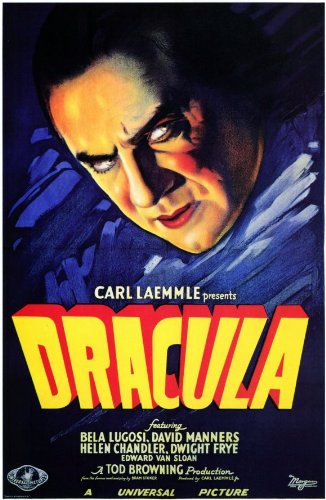
Dracula (1931)

DRACULA (1931) ****
I remember being first disappointed by the 1931 Dracula and that disappointment carried over for more than two decades.

Around the turn of the 21st Century, I bought the 1999 VHS release and that’s what I first watched, the one with Classic Monster Collection across the top and then New Music by Philip Glass and Performed by Kronos Quartet immediately below. Of course, I thought Bela Lugosi as Dracula and Dwight Frye as Renfield were absolutely incredible, David Manners as Jonathan Harker and Edward Van Sloan as Professor Van Helsing and Helen Chandler as Mina Harker less so, and I loved director Tod Browning’s 1932 Freaks at first sight contemporaneous with Dracula. Freaks remains one of my absolute favorite movies, so obviously some movies hit people right from the start and others just simply take more time or sometimes they never make that deep, personal connection others do.

For the longest time, at least a decade if not longer, I thought Dracula was overrated and paled in comparison against Freaks, Frankenstein, The Bride of Frankenstein, and The Wolf Man, all of which I first saw around the same time as Dracula and I loved, absolutely loved, and still do love all of them. At the time, I also loved Abbott and Costello Meet Frankenstein more than Dracula.

It was that darn Philip Glass / Kronos Quartet score that stank up Dracula and I still get a big kick out of the Triumph the Insult Comic Dog couplet, Philip Glass, atonal ass, you’re not immune / Write a song with a fucking tune. I remember my wife complained about Glass’ score for the experimental non-narrative film Koyaanisqatsi and I bristled at his score for Candyman upon revisiting that 1992 film for the first time in several years.

Revisiting the 1931 Dracula in recent years, without the Glass / Kronos score and back closer to how it first appeared in theaters on Feb. 14, 1931, it’s risen in stock from three to three-and-a-half and finally four stars. I cannot deny that it still has a fair share of faults, like those performances I mentioned earlier and the stage-bound production quality since it’s based off the 1924 stage play adapted from Bram Stoker’s 1897 novel, but I’ve grown appreciation for everything that works from the opening scenes in Transylvania to Lugosi (1882-1956) and Frye (1899-1943), who inspired later songs from Bauhaus (Bela Lugosi’s Dead) and Alice Cooper (The Ballad of Dwight Fry).

It also helps one to catch up with the Spanish language Dracula from the same year and the same sets but a different cast, a different language, and a different director. This Spanish version, rediscovered first in 1978 and then later on video in 1992, lasts 30 minutes longer and it’s better in almost every respect than its famous counterpart. Better shot and better looking, vastly superior cleavage and far sexier women (Lupita Tovar over Helen Chandler any day of the millennium), and less wimpy men in the Spanish version, but Lugosi still prevails against Carlos Villarias.

Several lines had already entered the lexicon decades before I first watched Dracula: I never drink … wine. For one who has not lived even a single lifetime, you’re a wise man, Van Helsing. Listen to them. Children of the night. What music they make. Even I am Dracula belongs somewhere in the pantheon near Bond, James Bond. Lugosi’s ability or lack thereof speaking the English language actually benefits the otherworldly nature of his Dracula and I hold his performance in high regard alongside Max Schreck in Nosferatu, Christopher Lee in Dracula, and Gary Oldman in Dracula.

I have a long relationship with vampires.

I remember the 1985 Fright Night being the highlight of a boy slumber party circa 1988 and third or fourth grade.

I must have been 11 or 12 years old and in the fifth or sixth grade when reading the Stoker novel. Right around that point in time, I also read Sir Arthur Conan Doyle’s The Hound of the Baskervilles and Roald Dahl’s Charlie and the Chocolate Factory. I loved all three of them and they each fired up my imagination and creative spirit.

A few years later, I caught up with the Francis Ford Coppola version and talk about a movie that wowed a 14-year-old boy. I remember staying up late and sneaking around (somewhat) to watch this Dracula on my bedroom TV, captivated by all the nudity and sexuality and violence and Winona Ryder and Sadie Frost and it recalled some of what I liked about the novel all while becoming a cinematic extravaganza. I know critics of the 1992 Dracula blasted the film for being all style, no substance and for being overblown, but I think it’s overflowing with creativity and sheer cinematic beauty. I rate it right up there with F.W. Murnau’s Nosferatu as one of the best vampire films ever.

Some things simply transcend Keanu Reeves’ horrible accent and Dracula’s at one point beehive hairdo.

The vampire genre itself transcends such duds as Dracula 2000 and New Moon.

Bill & Ted Face the Music (2020)

BILL & TED FACE THE MUSIC (2020) ***

What the world needs more than ever before is Bill S. Preston Esquire and Ted “Theodore” Logan, characters played respectively by Alex Winter and Keanu Reeves who live by the credo “Be excellent to each other.”

Yes, we could all use a little more being excellent to each other right about now.

They are back in BILL & TED FACE THE MUSIC, the third entry in a series that began way before Cardi B. (born 1992) and Megan Thee Stallion (born 1995), the Internet boom, widespread cell phones, and COVID … and if a time traveler from 2020 told you in 1989 or 1991 that one day Donald Trump would be your President you’d react about just like 1955 Emmett “Doc” Brown did when Marty McFly told him Ronald Reagan was President in 1985.

I know what some of you might be thinking: Why does the world need another dumb comedy starring two dim-witted characters who have not been seen on a movie screen for 29 years … more than Christopher Nolan’s TENET, the film already considered 2020’s most anticipated theatrical release during a time of much uncertainty for the future of movie theaters and movies in general.

For one, I have never believed the Bill & Ted characters to be dumb and their movies are definitely not dumb. Those who believe that Bill & Ted (and their movies) are dumb are perhaps easily distracted by a vernacular featuring such words as “dude,” “bogus,” “non-heinous,” and “excellent” or their frequent air guitar pyrotechnics.

Also, Bill & Ted were flunking history in EXCELLENT ADVENTURE and surely that did not help their cause, but so what, I mean I wish I had a dollar for every time somebody told me “History’s boring, man, but I do love watching me some History Channel.” I’d have amassed a small fortune.

Bill & Ted, first and foremost, are positive and upbeat without being a preachy drag or becoming simps, and that’s a tricky feat to pull off. They are two of the most likeable characters in film history, a fact made apparent once again by their return in FACE THE MUSIC.

Secondly, I have enjoyed the first two Bill & Ted movies more than I have anything by Christopher Nolan. That’s not saying EXCELLENT ADVENTURE and BOGUS JOURNEY are better than INTERSTELLAR and DUNKIRK, for example, or MEMENTO and THE DARK KNIGHT, for that matter. It’s not much of an understatement, though, when I state I must have watched EXCELLENT ADVENTURE and BOGUS JOURNEY 100 times when they played on cable TV in the early ’90s.

FACE THE MUSIC won me over almost right from the start, when wedding singers Bill & Ted (no longer rock stars) introduce their latest epic “That Which Binds Us Through Time: The Chemical, Physical and Biological Nature of Love; an Exploration of The Meaning of Meaning, Part 1.” Rick Wakeman, eat your heart out!

Just before that number, though, FACE THE MUSIC revisits a running joke from their prior movies. Missy, who’s three years older than Bill & Ted, married Bill’s dad in EXCELLENT ADVENTURE, Ted’s dad in BOGUS JOURNEY (Bill’s dad took it really hard), and now Ted’s younger brother Deacon in FACE THE MUSIC. Just think Bill & Ted each asked her to the prom when they were freshmen and she was a senior. When it is suggested that Ted’s father is now his own son, I sensed a disturbance in the force in my wife seated to my immediate right. I looked over at her and she was in deep thought. I laughed to myself.

FACE THE MUSIC introduces several new characters and they’re mostly winners.

Let’s see, we have Theodora “Thea” Preston (Samara Weaving) and Wilhelmina “Billie” Logan (Brigette Lundy-Paine), Bill & Ted’s daughters. They are music lovers and they share a chemistry and bond just like their fathers. They are every bit as endearing as Bill & Ted.

There’s a scene-stealing robot (Anthony Carrigan) from hundreds of years in the future who’s sent to kill Bill & Ted. We eventually learn his full name.

We also have Jimi Hendrix (DazMann Still), Louis Armstrong (Jeremiah Craft), Wolfgang Amadeus Mozart (Daniel Dorr), and legendary founder of music Ling Lun (Sharon Gee) given a gender switch. Possessing two college degrees in history, I have always loved the Bill & Ted movies for their astonishing historical accuracy.

FACE THE MUSIC incorporates basic plot elements from both EXCELLENT ADVENTURE and BOGUS JOURNEY. Facing a major deadline crunch to finally write the song to save the world, Bill & Ted are back in their H.G. Wells phone booth to visit their future selves and steal the song from themselves. Can they do that? I mean, it’s not really stealing if you “steal” from yourself, right? I laughed at this plot development, because I thought about how John Fogerty got sued by his former record company for ripping himself off.

Bill & Ted visit at least four different future self permutations, highlighted by a tender scene in 2067 with a geriatric Bill & a geriatric Ted. Just like BACK TO THE FUTURE PART 2 and EXCELLENT ADVENTURE, FACE THE MUSIC flat out embraces the silliness of time-travel. Unlike the BACK TO THE FUTURE series, the Bill & Ted movies do not concern themselves with paradoxes or plot loopholes, for that matter. They (and we) are having too much fun.

Thea & Billie take on a similar role as their fathers in EXCELLENT ADVENTURE, as they travel through time to recruit the all-time ultimate band to play their fathers’ song.

Like BOGUS JOURNEY, we descend into Hell, because Bill & Ted need to get their daughters, Ted’s dad, and Hendrix, Armstrong, et cetera, as well as killer bass player Grim Reaper (William Sadler), to round out the band. Nearly 30 years later, this character and the way Sadler plays him remain a hoot. I only wish they would have got to him a little sooner, despite the fact FACE THE MUSIC plugs the killer robot into the role served by the Reaper in BOGUS JOURNEY.

There are numerous other faults in FACE THE MUSIC (including Reeves’ sometimes obvious discomfort playing Ted), but, in the end, they’re smoothed over by the genial spirit of the enterprise. BOGUS JOURNEY remains the best entry in the series, because of its darker sense of humor and inspired production design in places like Heaven and Hell … and it features limited time-travel.

Chris Matheson and Ed Solomon wrote all three Bill & Ted movies and they originated the characters in a Hollywood improv shop in 1983. Matheson (son of the science fiction writer Richard Matheson) and Solomon make “stupid” cameos in each film, waiters in EXCELLENT ADVENTURE, seance members in BOGUS JOURNEY, and demons in FACE THE MUSIC. Matheson and Solomon, Winter and Reeves, and Sadler and Hal Landon Jr. (Ted’s perpetually disapproving father) help FACE THE MUSIC become more a labor-of-love than cynical cash grab.

I left FACE THE MUSIC with a goofy smile on my face and a burning desire to get in the car and blare some music. I rocked out to a playlist that started with Pink Floyd’s “Pigs (Three Different Ones),” Neil Young’s “Like a Hurricane,” and AC/DC’s “Let There Be Rock.” Yes, what a wonderful world!

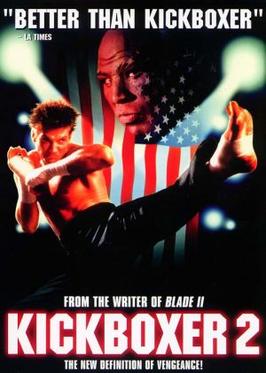
Kickboxer 2 (1991)

KICKBOXER 2

KICKBOXER 2 (1991) *1/2

En route to the cinematic crapper, Albert Pyun’s KICKBOXER 2 abuses two of the worst cinematic devices: slow motion and an offscreen death.

On their review program, Gene Siskel and Roger Ebert pointed out how much Pyun and the picture relied on slow motion during the fight scenes. Ebert claimed they used slow motion for every single moment of every single fight scene in the movie, including for the voices of the announcer and the referee, but that the sound effects guy must not have got the same memo because all the punches and kicks sounded like they were in regular motion. Siskel accused Ebert of eating spiked popcorn. Bottom line: If only KICKBOXER 2 had been half as entertaining as the Siskel & Ebert review.

Let’s take the fight that’s right smack dab in the middle of the picture, between our principled, reluctant-to-fight hero David Sloan’s former protege Brian “The Hammer” Wagner (Vince Murdocco) and the super villainous Tong Po (Michel Qissi) who’s back from KICKBOXER: THE MOTION PICTURE (not its real title). Brian Wagner dies in the ring from a series of brutal slow motion kicks and punches and other blows to the body. Coming that slow, he should have seen it coming and got out of the way. No, no, no, of course not, Brian Wagner wanted to die. Okay, maybe not wanted to die per se, but he was destined to die in that post-Apollo Creed ROCKY IV way. Anyway, we knew he was going to die from early in the picture, when his worried mother told David Sloan (Sasha Mitchell) that she’s afraid for her son and made Mr. Sloan promise to look after him. Brian Wagner further sealed his cinematic doom by walking away from David Sloan and cursing him on the way to greener pastures, by taking the easy fights and that cheap nickname, by allowing himself to be pumped full of steroids, and finally by his defiant overconfidence and his blatant refusal to surrender to his opponent. Yes, yes, he deserved to die.

The final buildup to Wagner’s death hits us over the head with a slow-moving sledge hammer. Not only are Tong Po and Brian Wagner in super duper excruciating slow motion, but Wagner’s poor mother and David Sloan are both moving like that in the crowd … in a cinematic technique derived especially from the later ROCKY pictures, you know when Clubber Lang and Ivan Drago are beating the brain stuffing out of Rocky (or Apollo Creed) and Rocky’s corner men or even his poor, poor wife Adrian are laboriously freaking out but ultimately helpless in the face of slow motion annihilation. I am so, so glad this overdone cinematic technique eventually faded away.

Offscreen deaths are usually cheap and sometimes, they’re even worse. For example, Hicks and Newt at the beginning of ALIEN 3. That one left millions reeling and they’re still talking about it today flabbergasted and frustrated.

In KICKBOXER 2, we are informed that Tong Po killed both David Sloan’s older brothers, including KICKBOXER protagonist Kurt Sloane (Jean-Claude Van Damme), after the events of the first movie and before the events of the second one. And to think Kurt avenged his paralyzed older brother Eric Sloane (played by former world kickboxing champion Dennis Alexio) against Tong Po for the big thrilling conclusion of KICKBOXER.

Yes, that’s right, Sloan and Sloane, that’s what really confused this unfrozen caveman writer. Sloan’s older brothers each have an ‘e’ on the end of their surname. Fascinating. Let’s see here: Van Damme speaks with a thick Franco-Belgian accent, while Sasha Mitchell, why he’s just a poor man’s Keanu Reeves. Bizarre family that must really get around. Ironically enough, though, Mitchell has been called both a poor man’s Keanu and a poor man’s Jean-Claude. Mitchell’s not without a slight charm, however, and he’s definitely not the biggest problem in KICKBOXER 2. The film’s biggest problem is that we’ve seen it all done before … and better numerous times.

KICKBOXER 2 lacks the off-the-wall qualities of a Shaw Brothers spectacular or a truly batty WTF exploitation picture like NINJA III: THE DOMINATION and SAMURAI COP, as well as the genuine pathos of ROCKY and THE KARATE KID. It is neither truly good enough nor bad enough to be any good.

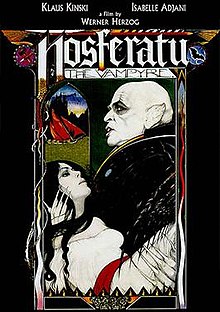
Nosferatu (1979)

NOSFERATU

NOSFERATU (1979) ***1/2

German director Werner Herzog’s NOSFERATU THE VAMPYRE has often been described as a “slow burn” horror film and every critic seems to want to sound a fire alarm that it’s not the average “creature feature” with cheap thrills every few minutes and that it will disappoint most horror movie fans.

The former is certainly true and I cannot speak for the latter except to say this horror movie fan liked it. I’ll be honest, I did not much enjoy it the first time watching it a good 20 years before my return viewing. I remember having a more neutral reaction that first time. Not sure why.

Looking up “slow burn,” I find that it means “a filmmaking style, usually in narrative productions, wherein plot, action, and scenes develop slowly, methodically toward a (usually) explosive boiling point.”

NOSFERATU definitely fits methodical and perhaps only slow to viewers raised on Attention Deficit Cinema. I’d rather say that Herzog’s remake and F.W. Murnau’s original 1922 masterpiece subtitled A SYMPHONY OF HORROR both move at their own leisurely pace. They play more like fever dreams than the average horror movie.

NOSFERATU does not fit the back end of that slow burn definition, because there’s not an explosive boiling point. Certainly not anything resembling the stereotypical big bang grand finale to a standard Hammer Dracula picture.

Herzog marches to the beat of his own drum. That’s for sure and thank God for that, just as we should be thankful for every great director. I consider his AGUIRRE, THE WRATH OF GOD to be the best film I have seen from 1972 and I would put it on a list of the greatest films ever made. LITTLE DIETER NEEDS TO FLY and GRIZZLY MAN are on my top 10 lists for 1997 and 2005, respectively. Les Blank’s documentary BURDEN OF DREAMS, which chronicles Herzog’s great adventure making FITZCARRALDO, also makes my top 10 list for 1982. Ramin Bahrani’s 18-minute PLASTIC BAG, a top 10 entry for 2010, utilizes Herzog as its narrator.

I know that NOSFERATU was my first time watching a Herzog movie and I believe I had not yet seen the Murnau original. To be sure, I was more equipped watching NOSFERATU for a second time.

More than anything else, images stand out. Brilliant images are the heart of both the 1922 and 1979 films and both Murnau’s and Herzog’s filmography.

Musophobes should not watch NOSFERATU, because rats take over the screen at crucial points late in the picture. The rats are the source of some legendary stories: Herzog said the rats were better behaved during the shoot than star Klaus Kinski and since real grey rats proved to be unavailable, white rats were given a grey makeover, for example.

The rats call to mind the monkeys from AGUIRRE.

Of course, there’s every time Dracula (Kinski) is on the screen. Since copyright was not a concern for Herzog like it had been in 1922 for the first NOSFERATU, Herzog returned names like Dracula, Jonathan Harker, and Lucy to his version. Dracula’s look echoes Max Schreck’s iconic Count Orlok and both vampires are radically different from the classic bloodsuckers played by Bela Lugosi and Christopher Lee, as well as just about every other vampire in cinematic history. Herzog and Murnau both show how it is more of a curse to be a vampire and make it far less of a power trip. Herzog’s Dracula and Count Orlok are not suave and debonair, and their striking physical appearances echo vampire folklore. We also have far more complex reactions to the vampires played by Schreck and Kinski, since we feel more empathy for them.

Around her mid-20s at the time she made NOSFERATU, French actress Isabelle Adjani already had a strong claim on the title of most beautiful woman in the world. NOSFERATU did nothing to refute that.

Thinking about the various Jonathan Harkers over time, Bruno Ganz’s performance ranks better than David Manners in the 1931 DRACULA and Keanu Reeves in the 1992 DRACULA. He certainly goes through a wider emotional range than either Manners or Reeves, who are both “mannered” in their performances.

Ultimately, NOSFERATU leaves one with feelings different from how we normally react to a vampire picture. There’s not the standard euphoria that we experience, for example, when Lee’s Dracula spectacularly bites the dust. Instead, we are more pensive and melancholic than excited and thrilled.

Bill & Ted’s Bogus Journey (1991)

BILL & TED’S BOGUS JOURNEY (1991) ***1/2

A great supporting character can elevate a movie.

Take, for example, the Grim Reaper from BILL & TED’S BOGUS JOURNEY. I mean, it’s not every day that a supposedly lowbrow comedy puts a novel spin on a character and plot thread from Ingmar Bergman’s THE SEVENTH SEAL.

In that one, you might remember a medieval knight (Max von Sydow) plays a game of chess against a personification of Death (Bengt Ekerot) to prolong his life. The mere image of the knight and Death playing chess by the sea had become one of the most revered in movie history by the time BOGUS JOURNEY director Peter Hewitt, writers Chris Matheson and Ed Solomon, and Grim Reaper player William Sadler, as well as co-stars Keanu Reeves and Alex Winter, got their grubby little mitts on it.

In BOGUS JOURNEY, our two most excellent dudes Bill S. Preston Esquire (Winter) and Ted “Theodore” Logan (Reeves) find themselves in a most hellish predicament. They are killed by evil robot Bill & Teds, called the Evil Robot Usses by our poetic lead characters, and wind up in Hell. What else would happen to a pair of heavy metal fans? Bill & Ted, who quickly discover their album covers lied to them, man, are greeted by Granny Preston, an evil Easter Bunny, Colonel Oats, and eternal boot camp, a plight highlighted by infinity push-ups and verbal abuse, in their own personal Hell. Colonel Oats tells Bill & Ted they are silky boys and silk comes from the butts of Chinese worms.

Back to the Grim Reaper. “How’s it hanging, Death?” asks Ted.

Bill & Ted play The Reaper dude in a series of games, including Battleship, Clue, and Twister, because Death is a sore loser and Bill & Ted must win two out of three or was that three out of five. Nah, believe it’s best five out of seven. The Reaper finally relents, “I will take you back.”

Bill & Ted are the first to ever beat The Reaper, and before that the first to melvin him. “Ted, don’t fear the reaper.” Cue them celestial cowbells.

I love just about everything about the Grim Reaper in BOGUS JOURNEY and he contributes to BOGUS JOURNEY being a step up from EXCELLENT ADVENTURE.

Sadler should have been at least nominated for Best Supporting Actor for his performance here. No, instead, the Academy of Motion Picture Arts and Sciences saw fit to nominate Harvey Keitel and Ben Kingsley from BUGSY, Michael Lerner from BARTON FINK, Tommy Lee Jones from JFK, and winner Jack Palance from CITY SLICKERS. Keitel and Kingsley should have faced off against Sadler in a best-of-seven to see if we could get one less nomination for BUGSY. Colonel Oats would certainly have approved of Palance’s victory with his celebratory one-armed push-ups.

EXCELLENT ADVENTURE takes on time travel, historical figures, and historical fiction. Bill & Ted need to earn an A+ on their final report in history … and the future of the human race hangs in the balance. Literally, because in a mere 700 years in the future, humanity exists in an utopia built around the music of the Wyld Stallions, Bill & Ted’s most excellent rock band.

BOGUS JOURNEY adds depictions of the afterlife, Heaven, and Hell to the mix, and it gives us good and evil robot Bill & Teds in addition to living and dead Bill & Teds. Winter and Reeves compete with Michael J. Fox and Thomas F. Wilson for most permutations in a time travel comedy. Peter Sellers and Tony Randall would have been proud of all of them.

Additionally, the universe’s most brilliant scientific genius uses a single word vocabulary and that’s his name, Station. Station builds the “good robot usses” or “Station’s creations.”

I should not forget Joss Ackland as arch villain Chuck DeNomolos, who programs the evil robots to kill the good Bill & Ted because he hates their ideas and their insipid music. Don’t feel too bad for Chuck, because he gets a shot with Missy. Doesn’t just about everybody?

In the end, though, remember “You might be a king or a street sweeper, but sooner or later you dance with the reaper.”

That and, of course, “Be excellent to each other.”