
Alice, Sweet Alice (1976)

ALICE, SWEET ALICE (1976) ***

They really tried hard with ALICE, SWEET ALICE, the horror film that’s best known for being Brooke Shields’ film debut.

It appeared in November 1976 at the Chicago International Film Festival, where it competed against such films as ALLEGRO NON TROPPO, GREY GARDENS, SMALL CHANGE, THE DEVIL’S PLAYGROUND, and Best Feature winner KINGS OF THE ROAD.

It received theatrical release (and mostly negative reviews) in 1977, 1978, and 1981. Viewers might have seen it as either ALICE, SWEET ALICE or COMMUNION (the original title) or HOLY TERROR depending on when they watched it.

The promotional forces especially played on the Brooke Shields angle in ‘78 and ‘81.

One of the ‘78 ALICE, SWEET ALICE ads proclaimed at its top, “PRETTY BABY Brooke Shields, America’s New Star,” a reference to Shields being in Louis Malle’s contemporaneous PRETTY BABY.

Three years later, the film returned as HOLY TERROR with a hard sell promotional campaign again built around exploiting Shields’ notoriety from her Calvin Klein advertisements and her film projects like THE BLUE LAGOON. Shields put up a fight, though, because she had more clout and ENDLESS SUMMER coming down the pike; “Brooke was concerned that film goers could only be disappointed if led into the theater with the promise that the film was of recent vintage or that she had a central part in it,” said her attorney. See, the original HOLY TERROR ads used a photo of Shields circa ‘81 rather than one of her from the film that was made during a different administration. Those naughty ad men, they did a bad, bad thing.

Roger Ebert made the advertising campaign for HOLY TERROR his “Dog of the Week.” “The ads promise that it stars Brooke Shields,” Ebert said. “That’s where the trouble begins, because HOLY TERROR was first released five years ago under the title of COMMUNION and then it was released three years ago as ALICE, SWEET ALICE. Now, when this movie was originally shot, Brooke Shields was a little girl, only 10 years old, and as Calvin Klein can tell you, she’s not 10 years old anymore. Shields has a supporting role in the movie as an apparently demented little girl and it’s an effective thriller alright, but how many title changes is it going to go through in an attempt to cash in on Brooke Shields’ recent popularity?” Gene Siskel replied, “Maybe they ought to try GONE WITH THE WIND.”

Truth in advertising: Shields, listed 10th in the cast in the end credits, appears in the picture for about the first 10 minutes. For those of us who think she’s one of the worst mainstream actresses ever committed to celluloid, that’s a major blessing in disguise. She’s not a demented little girl, though, but the first murder victim. Attending her first communion, her character Karen gets killed real good before she can receive it, strangled to death and then incinerated by a masked figure in a costume that should make one think back to the superior thriller DON’T LOOK NOW. Only this raincoat is yellow rather than red like DON’T LOOK NOW.

Deceptive promotional campaigns are not anything new. They’ve happened before and they will happen again. It happens all the time, and not only (but especially) during election years.

For example, John Travolta made his debut (briefly) in the ridiculous 1975 thriller THE DEVIL’S RAIN, which features Ernest Borghine, Eddie Albert, Ida Lupino, Tom Skerritt, William Shatner, and Keenan Wynn in the cast, as well as the special participation of Anton LaVey, high priest of the Church of Satan. Anyway, in the original 1975 ads, not a mention of Travolta. Instead, we have mug shots of “Satan on Earth” (Borghine), “Devil Destroyer” (Albert), “Demon Sacrifice” (Lupino), “Tortured Soul” (Shatner), and “Faceless Follower” (Wynn) right above the claim “Absolutely the most incredible ending of any motion picture ever!”

Preying on Travolta’s success in SATURDAY NIGHT FEVER and GREASE, THE DEVIL’S RAIN made a comeback. Siskel named it a “Dog of the Week” the same week in 1978 his colleague Ebert picked that awful monster movie SLITHIS. “My dog this week is a four-year old film named THE DEVIL’S RAIN that’s suddenly come back to a lot of theaters advertised as starring John Travolta,” Siskel said. “Well, that’s a complete lie. THE DEVIL’S RAIN stars Ernest Borghine as a Devil’s helper trying to hang on to some lost souls. Travolta is on screen for less than a minute, this was his first film. He had only one line of dialogue in it. Most of the time, he has red and green wax melting all over his face. Looks like he fell asleep on a pizza. … Beware of films you’ve never heard of promising big stars. One reason you’ve never heard of them, they’re lousy.”

These promotional campaigns definitely backfired in the case of ALICE, SWEET ALICE, because it’s a good little thriller often compared with the works of Alfred Hitchcock and called a prototype of the slasher film. That should have been more than enough to sell the film.

ALICE, SWEET ALICE involves a series of murders in 1961 in Paterson, New Jersey, around a church and an apartment building. Our title character, a 12-year-old girl played by a 18- or 19-year-old Paula Sheppard, becomes the first suspect and she’s sent to a psychiatric institution for evaluation. She was always mean to her little sister and besides, she’s just plain “weird.” Their parents are divorced and they live with their mother Catherine (Linda Miller) and attend St. Michael’s Parish Girls’ School. We also have the girls’ father Dom (Niles McMaster) and their aunt (Jane Lowry), Father Tom (Rudolph Willrich), his housekeeper Mrs. Tredoni (Mildred Clinton), the creepy obese landlord (Alphonso DeNoble), and assorted policemen and minor characters. Dom leaves behind his new wife to more or less become a detective on behalf of his oldest daughter, and that leads to his demise in a scene that echoes Donald Sutherland’s death at the end of DON’T LOOK NOW.

ALICE, SWEET ALICE reminds one of not only DON’T LOOK NOW, but also any number of giallos or Italian thrillers because of the anti-Catholic themes, dark humor, and familial dysfunction. Lucio Fulci’s DON’T TORTURE A DUCKLING and Dario Argento’s PROFONDO ROSSO quickly come to mind. Of course, all these films have their roots in Hitchcock.

Director, producer, and co-writer Alfred Sole, who shared the screenplay with Rosemary Ritvo, reveals the real killer around the two-thirds mark and that’s a departure from the modus operandi of the thriller.

ALICE, SWEET ALICE stands up long after the promotional campaign has become a faded memory. Anyway, I’ll still call it Brooke Shields’ best movie.
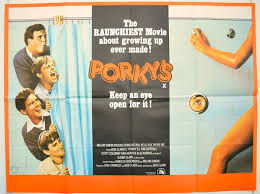
Porky’s (1981)

PORKY'S

PORKY’S (1981) Three stars

“Nobody ever went broke underestimating the intelligence of the American public,” H.L. Mencken famously said.

Mencken said that long before the success of PORKY’S, PORKY’S II: THE NEXT DAY, and PORKY’S REVENGE!, comedies which combined for over $200 million in box office and rental returns. Mencken died in 1956.

PORKY’S earned the vast majority of that $200 million and it came from out of seemingly nowhere to place fifth at the American box office in 1982, behind only breakaway winner E.T., ROCKY III, ON GOLDEN POND, and AN OFFICER AND A GENTLEMAN. PORKY’S sat on top of the American box office from late March through early May and it was dethroned by Arnold Schwarzenegger and CONAN THE BARBARIAN.

Unlike those other films, however, critics absolutely detested PORKY’S and aligned it with FRIDAY THE 13TH and THE CANNONBALL RUN in an unholy trinity of films that would no doubt lead to the downfall of Western Civilization. PORKY’S exhibits more than most how a film can be hated by critics and loved by the masses.

The success of the first PORKY’S spawned a whole slew of teenage sex comedies, often nostalgic and especially set in either the 1950s or 1960s.

I claimed a copy of PORKY’S as one of my first VHS purchases in my late teenage years and it quickly became a favorite movie of my rowdy group of friends. We loved it, as well as NATIONAL LAMPOON’S ANIMAL HOUSE, CADDYSHACK, KINGPIN, and THE BIG LEBOWSKI.

Every time I watch PORKY’S, I find a few big laughs and that’s why I am giving the film a passing grade. As far as the sequels are concerned, they are dreadful and deserve their horrible reputation. I remember seeing all of them in heavily edited form on “USA Up All Night,” before catching up with them all on video or pay TV.

Of course, our seven high school horn balls in PORKY’S are all played by older actors: Dan Monahan turned 26 in 1981, Mark Herrier 27, Wyatt Knight 26, Roger Wilson 25, Cyril O’Reilly 23, Tony Ganios 22, and Scott Colomby 29. That’s not anything new for a Hollywood film. For example, in GREASE, another highly successful nostalgia piece, John Travolta was 23 when he made it and Olivia Newton-John was 28 almost 29, Stockard Channing 33, Jeff Conaway 27, Barry Pearl 27, and Michael Tucci 31 when they were playing high school students.

Speaking of GREASE, one could describe PORKY’S as GREASE with T&A and rednecks instead of PG and greasers and without musical numbers.

PORKY’S includes sex jokes, condom jokes, sex jokes, size jokes, sex jokes, nude jokes, sex jokes, penis jokes, sex jokes, virgin jokes, sex jokes, and fat jokes, especially at the expense of villains Porky (Chuck Mitchell, a 6-foot-3, nearly 400-pound man) and Ms. Beulah Balbricker (Nancy Parsons).

Porky is a real vile piece of work, a saloon and brothel owner who is the most powerful man in his county. Every public official seems to be related to Mr. Wallace, namely his brother Sheriff Wallace (former NFL great Alex Karras). Mitchell wraps his best redneck goon around such dialogue as “I was givin’ the old place an enema and this pile of shit come floatin’ up to the surface” and “Where are these five little virgins who think they reached manhood? You wanna tangle ass with me? Come up here, you sawed-off punk! I’ll educate ya! I’ll wrap this right around your damn neck!” It is to Mitchell’s credit that he creates such a nasty character that we do root for his comeuppance in the final reel.

Balbricker embodies the worst killjoy or she’s basically portrayed as the Carrie Nation of the teenage sex comedy. Less successful, though, much less successful. After all, Carrie Nation (1846-1911) said things like “I felt invincible. My strength was that of a giant. God was certainly standing by me. I smashed five saloons with rocks before I ever took a hatchet” and “I want all hellions to quit puffing that hell fume in God’s clean air.” Balbricker (also called “Ball-breaker” and “King Kong” by other characters) develops an obsession with one character’s penis. Please can we call it a tallywhacker? Penis is so personal. Parsons, like Mitchell, gives a very good performance, one that rates with John Vernon in ANIMAL HOUSE.

Kim Cattrall must have used her work here as Miss Honeywell (“Lassie”) during her audition for “Sex and the City.” It definitely beats MANNEQUIN.

Writer and director Bob Clark (1939-2007) has a very interesting story and filmography, since his credits include the 1974 proto-slasher BLACK CHRISTMAS, the beloved A CHRISTMAS STORY, and the first two PORKY’S films, as well as even more diverse entries like MURDER BY DECREE, TRIBUTE, RHINESTONE, TURK 182!, LOOSE CANNONS, and BABY GENIUSES.

His entry in “Take One’s Essential Guide to Canadian Film” from 2001 : “Clark turned down bids to play pro football to complete a drama major at the University of Miami. With the success of his low-budget horror classic CHILDREN SHOULDN’T PLAY WITH DEAD THINGS, Clark moved to Montreal in 1973 and came to dominate Canadian commercial filmmaking for a decade. He followed CHILDREN with BLACK CHRISTMAS, a box-office hit starring Margot Kidder, and then, from 1978 to 1981, he directed MURDER BY DECREE, TRIBUTE, and PORKY’S – three of the most successful films produced in the tax-shelter era. Sad to say, the sophomoric PORKY’S remains the Canadian box-office champ. Clark returned to the United States in 1984; his career, like his locale, has gone south since.”

I read that Clark gathered the material for PORKY’S over a 15-year period, combining stories from other males of his generation with his own experiences. Every Hollywood studio passed on PORKY’S and it was produced by the Canadian company Astral Bellevue Pathe and Melvin Simon Productions (Mr. Simon, who died in 2009 at the age of 82, developed Mall of America, co-owned the Indiana Pacers along with his brother Herbert, and produced films including PORKY’S, THE STUNT MAN, and ZORRO, THE GAY BLADE), but 20th Century Fox picked up the U.S. distribution and a slick marketing campaign, combined with strong word-of-mouth, produced a monster hit on a $4 million budget.

Clark passionately defended the film amid the constant cries of misogyny and racism.

Those critics are missing that Wendy, played by Kaki Hunter, is often the sunniest presence and that Clark set his film in the Deep South in 1954. One character does overcome his initial anti-Semitism and becomes friends with a Jewish classmate.

THE NEXT DAY seems to address both criticisms, though, with one thoughtful dialogue scene between Wendy and main horn ball Pee-Wee (Monahan) and then adds a fanatical reverend, hypocritical politicians, a Native American, and the Ku Klux Klan to the mix. All the latter material simply does not mesh with the juvenile sex comedy.

Clark did not return to direct REVENGE and director James Komack and screenwriter Ziggy Steinberg wanted the third installment to return to the pure sex farce of the first movie. All the actors simply look too long in the tooth to be partaking in such adolescent shenanigans. I mean, for crying out loud, Colomby was nearly in his mid-30s by the point they made this third PORKY’S film; he graduated from Beverly Hills High School in 1970. Bottom line: I laughed not a single time at PORKY’S REVENGE, maybe once at NEXT DAY.


PORKY’S II: THE NEXT DAY (1983) One star; PORKY’S REVENGE! (1985) No stars