
Conan the Barbarian (1982)

CONAN THE BARBARIAN

CONAN THE BARBARIAN (1982) Three stars

For the longest time, at least since Al Gore invented the Internets, I have thought the ultimate version of CONAN THE BARBARIAN is the 3-minute, 52-second version on YouTube that scores select scenes from the movie with Iron Maiden’s “Run to the Hills.”

As I watched CONAN THE BARBARIAN again, I kept hoping that Basil Poledouris’ score would be replaced by Bruce Dickinson’s wail and the soaring guitars of Dave Murray and Adrian Smith. Alas, it was not to be.

Lyrically, though, it’s not a perfect fit, since Conan seeks revenge against Thulsa Doom, who’s played by none other than James Earl Jones.

Iron Maiden released “Run to the Hills” on February 12, 1982 and THE NUMBER OF THE BEAST album on March 22.

CONAN THE BARBARIAN came out on May 14, 1982.

Both works proved to be controversial.

Critics thought CONAN THE BARBARIAN was either too violent or that it fell too short of the violence in the source material. That was the biggest controversy for John Milius’ film.

Of course, with an album title like THE NUMBER OF THE BEAST, Iron Maiden were called Satanists and boycotts, record burning, and demonstrations were organized by religious groups in the United States. Just picture old women smashing hundreds of copies of THE NUMBER OF THE BEAST to bits with their hammers.

“The Number of the Beast,” though, is not 867-5309.

Sword and sorcery films were big in the 1980s, a fantasy sub-genre defined as “sword-wielding heroes engaged in exciting and violent adventures. An element of romance is often present, as is an element of magic and the supernatural.”

CONAN THE BARBARIAN inspired a steady stream of imitations and knockoffs, like the DEATHSTALKER series: A big man with a big sword, busty women, and plenty of sex, violence, and head-splitting gore. Not that there’s anything wrong with that.

I had forgotten (shame on me) the amount of nudity during the first hour of CONAN and here I thought that I never forget a nude scene. (For what it’s worth, I remembered Sandahl Bergman’s shining moments in CONAN.)

Then, down the home stretch, CONAN turns up the violence to an operatic level. There’s also an orgy late in the picture.

Arnold Schwarzenegger was born to play Conan and he played him twice, less effectively though a second time. Arnold also played supporting role Lord Kalidor in RED SONJA, so three of his four films made for sultan of schlock producer Dino DeLaurentiis were sword and sorcery. Ed Pressman and fellow producer Edward Summer had considered Charles Bronson, Sylvester Stallone, and William Smith for the Conan role, but they found Arnold to be the embodiment of Conan the Barbarian after they watched a rough cut of PUMPING IRON. The success of both CONAN and THE TERMINATOR made Arnold a star.

Before CONAN, Arnold found mixed success in the motion picture business. In his 1969 debut HERCULES IN NEW YORK, Arnold’s thick Austrian accent required a dub job and the film credits him as “Arnold Strong ‘Mr. Universe’” partly to play against the name of co-star Arnold Stang. If you watch HERCULES IN NEW YORK, you will be amazed that Arnold ever had a motion picture career. I’ve seen it several times and it gets me every single time.

Other than PUMPING IRON, Arnold’s best early career role is Joe Santo in STAY HUNGRY, where he played alongside Jeff Bridges and Sally Field in a supporting role. This is a role that stands alone in a Schwarzenegger filmography populated with action and comedy.

CONAN started Arnold’s decade long run of solid action movies. Why did this seemingly muscle-bound guy with a ridiculous accent become at one point the biggest movie star in the world? Siskel & Ebert pondered that very question in an entire show dedicated to Arnold called “Arnold Schwarzenegger: The Unlikeliest Star.”

A joy of performance is the one element that Arnold exudes in all his best films and it’s what separates him from his competition.

Arnold meets his match in Broadway dancer Sandahl Bergman and when she and Arnold pair up, CONAN truly kicks into gear. The 6-foot tall Bergman (this Shawnee Mission East High graduate liked to say that she’s 5-12 rather than 6-0 because no girl should have to be 6-0) possesses an impressive physicality that’s not dwarfed by Arnold or any of her male co-stars and she exudes the same joy of performance as Arnold.

There’s certainly not been another woman, not Grace Jones in CONAN THE DESTROYER or Brigitte Nielsen in RED SONJA, paired more effectively on screen with Arnold than Bergman.

James Earl Jones became a popular villain after STAR WARS came out in 1977; Jones lent his voice to Darth Vader because director George Lucas did not want David Prowse’s English accent for Vader. Never mind Jones’ role as the older Kokumo in EXORCIST II: THE HERETIC, which was released not long after STAR WARS during the summer of ‘77. Just imagine the collection Jones possibly built from his villainous roles in the STAR WARS films, THE HERETIC, and CONAN. Not only Darth Vader’s helmet, but also his locust costume from THE HERETIC and possibly the snake from CONAN after his transformation. Later in the 1980s, Jones began playing kindly older men and that’s where he’s been ever since.

In addition to Jones, Max von Sydow (most famous for his work with Ingmar Bergman and THE EXORCIST) and Mako (Academy Award nomination for Best Supporting Actor for THE SAND PEBBLES) also lend their gravitas to the proceedings.

When he was the Governor of California, did Arnold read the following dialogue, “To crush your enemies, to see them driven before you, and to hear the lamentations of their women,” or say the following prayer, “Crom, I have never prayed to you before. I have no tongue for it. No one, not even you, will remember if we were good men or bad. Why we fought, or why we died. All that matters is that two stood against many. That’s what’s important! Valor pleases you, Crom … so grant me one request. Grant me revenge! And if you do not listen, then to HELL with you!”

Let’s hope there’s a soundboard with Arnold’s CONAN dialogue out there somewhere. This would restore a smidgen of my faith in humanity.
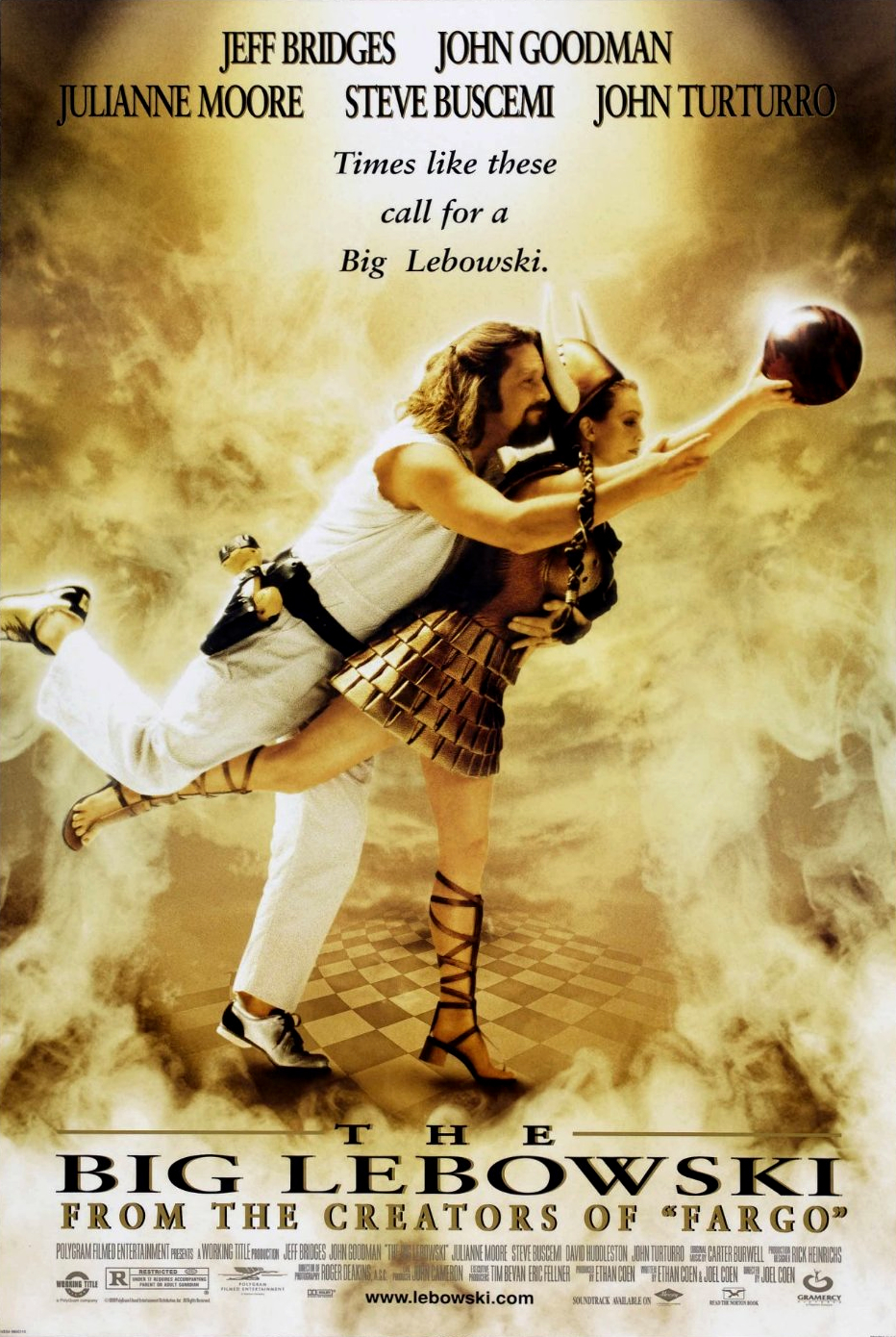
The Big Lebowski (1998)

THE BIG LEBOWSKI

THE BIG LEBOWSKI (1998) Four stars
The Coen Brothers’ THE BIG LEBOWSKI starts with a brilliant idea: Why not take a blissed out former 1960s radical who loves his White Russians and his bowling with his two best mates and place him right smack dab in the heart of a labyrinthine plot straight from THE BIG SLEEP.

You might remember Howard Hawks’ 1946 classic, starring Humphrey Bogart and Lauren Bacall. That’s the one where writer Raymond Chandler famously said of the identity of the murderer of the Sternwoods’ chauffeur, “I don’t know.” Apparently, neither did Hawks or any of the various writers — William Faulkner, Leigh Brackett, Jules Furthman, and Phiip Epstein — involved with the screen adaptation of Chandler’s 1939 novel.

How does Jeffrey “The Dude” Lebowski react to such a convoluted plot?

I believe he explains it as such, “This is a very complicated case. You know, a lotta ins, lotta outs, lotta what-have-you’s. And, uh, lotta strands to keep in my head, man. Lotta strands in old Duder’s head. Luckily I’m adhering to a pretty strict, uh, drug regimen to keep my mind, you know, limber.”

Main characters “The Dude” and Walter Sobchack are known to be inspired by a couple Hollywood eccentrics: Jeff Dowd and John Milius.

Dowd was a member of the Seattle Liberation Front, a radical anti-Vietnam War protest group that became known as the Seattle Seven. Lebowski mentions this fact in THE BIG LEBOWSKI.

Dowd then became a producer’s representative, a consulting producer, creative consultant, post-production consultant, producer, and executive producer. Those are some of his credits.

Ethan and Joel Coen first met Dowd around the time of their feature debut BLOOD SIMPLE.

I remember coming across him in the writings of Roger Ebert, for example a story from the 1999 Toronto Film Festival called “Dude Keeps Building a Rep.”

It starts out with Dowd telling Ebert that he’s got to see a movie called GOAT ON FIRE & SMILING FISH. Ebert’s in the press office at the Toronto Film Festival, only out of his hotel room four minutes before Dowd could find the critic. Dowd hands Ebert two Xeroxed sheets stapled together promoting GOAT ON FIRE & SMILING FISH.

Ebert wrote, “The Dude’s name is Jeff Dowd. He is tall and large and has a lot of unruly curly hair and a big mustache. If you saw the Coen Brothers movie THE BIG LEBOWSKI, Jeff Bridges was playing a character based on him, although the Dude is a great deal more abstentious than the Bridges character. If he were not, the movie would have been called THE LATE LEBOWSKI. The Coens and Dowd go back a long way, to 1984, when he was telling me, ‘You gotta see this one. It’s called BLOOD SIMPLE. These are the Coen Brothers.’”

Dowd “repped” THE BLACK STALLION, CHARIOTS OF FIRE, HOOSIERS, THE STUNT MAN, and THE BLAIR WITCH PROJECT, just like he did GOAT ON FIRE & SMILING FISH.

Dowd to Ebert, “Just so people see them. I’d walk up and down the lines for hit movies, handing out brochures for what we were showing. The way I figure it is, who goes to movies? People who go to movies, that’s who. They may or may not read Premiere magazine. They may or may not watch TV. But they go to movies. So if Warner Bros. spends $40 million to promote a movie and they’re standing in line to see it, why not tell them about my movie?

“A lot of the movies, they’re not what they seem to be. You take THE BLACK STALLION. The studio said it would never appeal to children because the first 18 minutes were without dialogue. I hold a test screening. A little girl, 5 years old, is in front of me. She tells her mommy she has to pee. She gets up and stands on the aisle, still watching the screen, and she stands there for the next 10 minutes. Her knees are knocking together, she has to pee so bad, but she can’t stop watching. The whole history of THE BLACK STALLION was changed, right then and there.”

The St. Louis-born Milius’ writing credits include JEREMIAH JOHNSON, MAGNUM FORCE, APOCALYPSE NOW, 1941, and CLEAR AND PRESENT DANGER. He both wrote and directed THE WIND AND THE LION, BIG WEDNESDAY, CONAN THE BARBARIAN, and RED DAWN. He’s not directed anything since 1997.

Milius says that Hollywood blacklisted him for his conservative beliefs.

He’s the disreputable one of the Film Brat Generation, whose friends and colleagues include Steven Spielberg, George Lucas, Francis Ford Coppola, and Brian DePalma.

A 2017 Indie Film Hustle story comes with the tagline “John Milius: The Craziest Director in Hollywood?”

“He’s a really funny guy, a really good storyteller,” Ethan Coen said of Milius in a book on THE BIG LEBOWSKI. “He was never actually in the military, although he wears a lot of military paraphernalia. He’s a gun enthusiast and survivalist type. Whenever we saw him, he’d invite us out to his house to look at his guns — although we never took him up on it.”

You can hear Milius’ storytelling abilities on commentaries for APOCALYPSE NOW, 1941, and CONAN THE BARBARIAN, for example.

Milius contributed Robert Shaw’s famous U.S.S. Indianapolis speech in JAWS (uncredited), some of Dirty Harry’s best lines, and all that stuff about surfing in APOCALYPSE NOW.

It helps that John Goodman, like Milius, is a native of the St. Louis area.

Bridges and Goodman have been two of the best actors working in the movies.

They’re probably as close to a guarantee of quality as anybody you can name.

“The Dude” and Walter are likely the characters they will be most associated with all their lives.

There’s lots of inspired madness throughout THE BIG LEBOWSKI.

Like the trippy production number called “Gutterballs,” combining bowling and Busby Berkeley, all scored by Kenny Rogers and the New Edition’s “Just Dropped In (To See What Condition My Condition Was In),” Rogers’ first Top 10 hit.

Like the German nihilists who have a band and album that are parodies of / homages to Kraftwerk, with the band name Autobahn and the album cover that’s similar to THE MAN-MACHINE.

Like utilizing gems like Bob Dylan’s “The Man in Me” and Captain Beefheart’s “Her Eyes Are A Blue Million Miles.”

Like Mr. Lebowski’s rant about the Eagles. Reportedly, Allen Klein (1931-2009) wanted $150,000 for usage of the Rolling Stones’ “Dead Flowers,” but he waived that licensing fee because he so loved the scene where “The Dude” hates on the Eagles. You’re not the only one, Mr. Klein.

THE BIG LEBOWSKI joins TWILIGHT ZONE: THE MOVIE and AN AMERICAN WEREWOLF IN LONDON for some of the best utilization of Creedence Clearwater Revival in a moving picture.

Coupled with BOOGIE NIGHTS (1997), THE BIG LEBOWSKI helped start my love affair with Julianne Moore, which continued over many, many years in everything from THE END OF THE AFFAIR to CHLOE.

Character actors Steve Buscemi, John Turturro, Ben Gazzara, David Huddleston, and Philip Seymour Hoffman all lend their abilities to the menagerie.

Never mind Sam Elliott’s voiceover narration.

I vividly remember coming across THE BIG LEBOWSKI when it came on Showtime in the late 1990s. I played the VHS dub I had for several friends and it became one of our favorite movies.

I’ve seen it many, many, many times over the years. It’s my favorite Coen Brothers movie, certainly far ahead of the overrated FARGO and NO COUNTRY FOR OLD MEN.

An old friend would seemingly only want to play THE BIG LEBOWSKI, FEAR AND LOATHING IN LAS VEGAS, and THE CROW, although he would also play the hell out of CITY LIGHTS, BLADE RUNNER, and SOME LIKE IT HOT as well, for that matter.

It’s been a while since I’ve watched it and I just might have to change that very, very soon.