Halloween Ends? Surely, They Can’t Be Serious! They’re Not But Please Don’t Call Me Shirley!

HALLOWEEN ENDS? SURELY, THEY CAN’T BE SERIOUS! THEY’RE NOT BUT PLEASE DON’T CALL ME SHIRLEY!
I have not yet seen Halloween Ends, the latest and 13th overall installment that has now passed Friday the 13th (12) and long passed A Nightmare on Elm Street (9), but I have watched and read a great many reviews of the film.

Based on the early returns, Halloween Ends just might go down in history as the most divisive Halloween film since 1982’s Halloween III: Season of the Witch, you know the one without Michael Myers absolutely hated for many years before it developed a cult following in recent years, like the 1985 tandem A Nightmare on Elm Street 2: Freddy’s Revenge and Friday the 13th: A New Beginning.

Currently, Halloween Ends has a 5 out of 10 score on IMDb, 39 percent on Rotten Tomatoes, and 47 percent on Metacritic.

General audiences seem to hate it even more than critics, interestingly enough for a horror film.

Google returns a 1.9 score for the film, based on 3,266 ratings with the vast majority giving it one.

Probably in the shape of an upraised middle finger.

By comparison, Season of the Witch returns a 3.3 audience rating and both Freddy’s Revenge and A New Beginning score 3.5.

They were hated back in the day, especially Season of the Witch and A New Beginning since they do not feature Michael Myers and Jason Voorhees.

You can bet the initial audience feedback on them would have read or sounded like the furor now over Halloween Ends.

The enraged are treating Halloween Ends like a betrayal of the faith and the spirit of Halloween and Michael Myers.

Seriously, could anything in Halloween Ends possibly be worse than EVIL DIES TONIGHT in Halloween Kills, the White Horse and Michael talking in Rob Zombie’s Halloween II, the white trash back story and mommy issues for Michael in Rob Zombie’s Halloween, Busta Rhymes kicking Michael’s ass in Resurrection, the Dawson’s Creek-meets-Scream flavor of H20, the Thorn cult in The Curse and The Revenge of Michael Myers, no Michael in Season of the Witch, and the revelation that Michael and Laurie are brother and sister in Halloween II?

I don’t like Season of the Witch very much at all, but it’s not because it doesn’t feature Michael Myers.

I like a lot of the ideas behind Season of the Witch, but I feel they are poorly executed.

The majority of Halloween fans seem to want just one more Halloween sequel with a Michael Myers silently stalking and slashing his way through a series of disposable teenagers and disposable adults or corpses-in-waiting for 90-95 minutes.

They could probably take or leave Laurie Strode, but it’s obvious they want more of the same and they don’t want something different when it comes to a Halloween movie.

On the other hand, I wish the Halloween series ended many, many, many years ago, but I don’t think anybody’s foolish enough at this point to believe that it’s the end for Michael Myers or Laurie Strode. The Halloween films have always seemed much smarter than Friday the 13th and even to a lesser degree A Nightmare on Elm Street, because they never featured ends or final or dead in any of their titles until Halloween Ends.

This franchise has returned more times from the dead than any other.

I didn’t want to watch Halloween Ends after Halloween 2018 and especially Halloween Kills where all the gruesome kills in the world cannot make up for some of the worst characters we’ve ever seen in a Halloween movie … even in this series. Evil might (or might not) have died tonight, it might not have since they made another movie, but my desire to watch another new Halloween film seemingly died with Halloween Kills.

I’m just so damn sick and tired of Laurie Strode and Michael Myers, whether or not they’re brother and sister or just two strangers passing in the night and no matter how many times they’ve been retconned, rebooted, and repackaged for maximum consumption.

I love the original from 1978 directed by John Carpenter and starring Donald Pleasence and Jamie Lee Curtis. It remains one of the all-time greats, absolutely essential viewing for the Halloween season.

I liked H20 when I first watched it on the big screen in 1998, but it has not aged well and it has fallen in my estimation, and Halloween II, Halloween 4: The Return of Michael Myers, Halloween 2007, and Halloween 2018 each have their moments, but the rest of the sequels that I have seen are bloody terrible.

I don’t see how Halloween Ends could possibly be any worse a movie than Season of the Witch or Halloween 5 or Halloween 6 or Resurrection.

Maybe one day soon I’ll give it a chance and find out for myself.

The Fog (1980)

THE FOG (1980) **1/2
Fog has been a critical element in many horror movies and the 1939 Hound of the Baskervilles, The Wolf Man, Frankenstein Meets the Wolf Man, and The Return of the Vampire immediately leap to mind as films made definitely better from their use of fog effects to create a foreboding atmosphere.

Edgar Allan Poe died at the age of 40 in 1849 but his writing and his influence live on forever. Is all that we see or seem / But a dream within a dream?

Ghost stories around the campfire have been around longer than The Legend of Sleepy Hollow, and I believe that’s how Washington Irving first heard about Ichabod Crane, Brom Bones, and the Headless Horseman.

John Carpenter directed, co-wrote, and scored the original Halloween in 1978, one of the great transcendent low-budget shockers with a boogeyman killer.

Carpenter’s The Fog, his first horror film after Halloween, combines the title character, a Poe quote before the opening credits, a ghost story around the campfire told by distinguished actor John Houseman, and some grisly murder set pieces that far surpass the relatively tame and nearly entirely bloodless Halloween, but I remain steadily down the middle of the road in my reaction to it.

I want to like it a lot more than I do, believe me, and maybe I will get there next time.

I liked it more during the most recent viewing of the film and I definitely understand why it’s developed a cult following and a much better reputation in recent years.

It does create quite the foreboding atmosphere at times, it bears all the trademarks of a Carpenter film with his penchant for great composition both in the sense of framing and the music present throughout, and I do like the story of this small California town celebrating their centenary with a dark secret about the founding discovered, discussed, and confronted during the film as the dead men return 100 years to the day for their revenge.

Still, all the same, it’s underwhelming.

I believe it’s mainly because I don’t particularly connect to any of the characters and thus, I don’t really care about their fates particularly all that much.

I come the closest to connecting with radio station owner and host Stevie (played by Carpenter’s former wife Adrienne Barbeau) and Father Patrick Malone (Hal Holbrook), but they’re not on the same level as Dr. Loomis and Laurie Strode in Halloween, Kurt Russell’s characters in Escape from New York and The Thing, Keith Gordon’s Arnie Cunningham in Christine, Karen Allen’s and Jeff Bridges’ characters in Starman, and Roddy Piper’s George Nada in They Live, some of Carpenter’s best characters and best films.

While it is comforting to see Carpenter regulars like Barbeau, Jamie Lee Curtis, Tom Atkins, Charles Cyphers, Nancy Kyes, and good old ‘Buck’ Flower, they’ll still all be remembered first for other characters in other Carpenter films.

We simply don’t get enough of any of the main characters.

The Fog lacks a certain something, energy perhaps first and foremost, to really take it over the top and into the stratosphere like Halloween.

All that said, The Fog still has some very good even almost great moments.

I especially like the scene when Father Malone reads four entries from his grandfather’s journal and then delivers the best line of the film, The celebration tonight is a travesty. We’re honoring murderers.

Speaking of a travesty, I watched the 2005 remake in a theater and I have to believe that it’s one of the 10 worst movies I’ve ever watched in a multiplex near you.

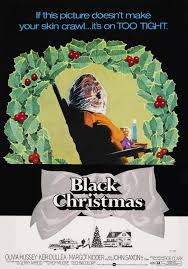
Black Christmas (1974)

BLACK CHRISTMAS

BLACK CHRISTMAS (1974) Three stars

Watching BLACK CHRISTMAS for the first time, one might be surprised just how many standards of the slasher film can be seen during this 1974 Canadian chestnut from director Bob Clark.

Let’s see, we have an opening shot later repeated by John Carpenter’s HALLOWEEN, a killer who racks up a rather impressive body count, POV shots from the killer’s perspective, obscene phone calls from the killer following every killing, plot twists (including the location of the caller), “The Final Girl,” and a shock ending, as well a holiday theme. BLACK CHRISTMAS basically synthesized elements that were already present during previous films like PSYCHO, PEEPING TOM, and Mario Bava movies BLOOD AND BLACK LACE and TWITCH OF THE DEATH NERVE into a single horror film narrative.

The plot also echoes “The Babysitter & The Man Upstairs” urban legend, so we already know the location of the caller. Still, the characters do not, so it’s a jolt hearing “The call is coming from inside the house.” Several movies, notably BLACK CHRISTMAS and WHEN A STRANGER CALLS, have relied on this angle for their chills and thrills.

A real-life case has been credited for inspiring the urban legend.

On Mar. 18, 1950, 13-year-old babysitter Janett Christman was raped and strangled to death in Columbia, Missouri, three days before her 14th birthday. Mr. and Mrs. Ed Romack found the body when they returned home, but, fortunately, their 3-year-old son Gregory was still alive, sleeping in his room. From the AP story, “Prosecuting Attorney Carl Sapp said blood was smeared through the house, indicating the girl put up a terrific struggle. … Footprints were found in a sleet-covered area near a broken window in the house. Police believe the intruder crawled through the window. The state highway patrol also is processing fingerprints found at the scene.”

More from the report, “An electric iron cord was twisted around the girl’s throat. Her scalp had been pierced several times by an instrument, apparently similar to a small lead pipe.”

Christman may have attempted to call the police around 11 p.m. the night of her death. Columbia policeman Roy McCowan took a call from a frightened girl who told him to “come quick.” “I urged her to calm down and just tell me where she was,” he said. “Then there was silence — not the sound of a receiver being hung up — just silence.” The Romacks’ phone was discovered “improperly placed on the instrument.”

Christman’s murder remains unsolved.

Just a few years earlier in Columbia, Stephens College student Marylou Jenkins, a white woman, was raped and murdered with an electric cord (reportedly from a lamp) twisted around her throat. An all-white jury convicted black man Floyd Cochran of the crime and he was executed Sept. 26, 1947 in the Missouri State Penitentiary Gas Chamber in Jefferson City. Cochran was originally arrested for murdering his wife with a shotgun and then he confessed to raping and murdering Jenkins.

For his last meal, Cochran ordered but did not partake in consuming a T-bone steak, french fries, scalloped corn, cream gravy, bread, butter, cake, and coffee. He died at the age of 36.

From 1938 through 1989, Missouri put to death 40 inmates in the gas chamber at Jefferson City, with John Brown the first on Mar. 3, 1938 and George “Tiny” Mercer the last on Jan. 6, 1989. Mercer was the first person from Missouri executed since 1965.

Just about seemingly every horror movie in existence shoots for a slambang ending, so we leave it discussing just what happened inside our heads or with all our friends and loved ones who have also seen this movie. BLACK CHRISTMAS gives us a rather unconventional ending, in that we are left unsure of the fate of protagonist Jess (Olivia Hussey) as she’s alone in the sorority house with the killer. Also, we never find out the real identity of the killer other than he’s named “Billy” and very rare indeed is the horror movie (especially a slasher) without a great big reveal in the grand finale. You just might have to be a fan or at least more forgiving of an ambiguous ending to appreciate BLACK CHRISTMAS. Either way, though, it will be discussed.

Like the later HALLOWEEN, BLACK CHRISTMAS thrives on atmosphere. That’s what they both do best and why fans appreciate them all these decades later.

Both films have rather distinguished casts for low-budget horror movies. Hussey came to fame during her teenage years for her performance as Juliet in Franco Zeffirelli’s 1968 ROMEO AND JULIET. Keir Dullea played astronaut Dave Bowman in both 2001: A SPACE ODYSSEY (1968) and later 2010 (1984); Dave uttered the famous words, “Open the pod bay doors please, HAL.” Margot Kidder (1948-2018) appeared previously in Brian De Palma’s 1973 shocker SISTERS and subsequently made her fame as Lois Lane in four Superman movies. Character actor John Saxon’s six-decade career includes ENTER THE DRAGON, TENEBRAE, A NIGHTMARE ON ELM STREET, and FROM DUSK TILL DAWN.

Director, screenwriter, and producer Clark (1939-2007) is best known for his two radically different nostalgia pieces, PORKY’S and A CHRISTMAS STORY. Yes, please wrap that magnificently designed brain around the fact that Clark directed both BLACK CHRISTMAS and A CHRISTMAS STORY. Louisiana born Clark found his greatest success up north in Canada. PORKY’S supporting actors Doug McGrath and Art Hindle both appear in BLACK CHRISTMAS.

Kidder almost steals the show in BLACK CHRISTMAS as the drunken, profane sorority girl Barb. She rips into her dialogue with extra relish. Hussey makes for a good entry point and rooting interest. Saxon knows how to maximize his screen time.

For horror movie fans who have not yet seen BLACK CHRISTMAS, I fully recommend amending it immediately.

The Burning (1981)

THE BURNING (1981) Two stars
The late, great director Howard Hawks (1896-1977) once said that a good movie is “three great scenes and no bad ones.”

No way that Hawks could have possibly had a movie like THE BURNING in mind, since he died a few years before the release of the 1981 slasher and even before the boom of that genre. John Carpenter paid Hawks tribute in HALLOWEEN with characters watching THE THING FROM ANOTHER WORLD on TV.

THE BURNING does have three great scenes but also several bad ones.

Let’s get the three great scenes out of the way first.

There’s an effective jump scare in an early hospital scene, before the opening credits. It makes up for a couple clunker false alarms later on in the picture.

Several early period slasher films include a scene where one character would regale both the rest of the characters and the audience with an origin story of the killer. THE BURNING, FRIDAY THE 13TH PART 2, and MADMAN all have a similar campfire story. These scenes are fun, because most of us can remember at least once being enthralled and freaked out by somebody’s ghastly yarn around the fire. Cropsy is based on a real-life New York urban legend, the Cropsey Maniac, a genuine campfire tale which obviously had a major impact on the creative forces, including Bob and Harvey Weinstein and Brad Grey (later three of the most powerful men in Hollywood), behind THE BURNING.

The “infamous raft massacre” scene, when Cropsy takes out five teenagers with his garden shears. This is the pièce de résistance of THE BURNING and the one scene when the film deserves its reappraised “classic” status. Splatter effect maestro Tom Savini earned his paycheck for this sequence alone and it can stand side-by-side with his best work.

In some quarters, THE BURNING has been called one of the best slasher films and a classic that flew under the radar.

Truth be told, I’ve always been underwhelmed and sometimes even disgusted by it, except for the three great scenes. I first watched it on late night Cinemax in the early 2000s and a few years later, I taped it off IFC.

The three great scenes probably make up less than 10 percent of the running time. Some of the camp scenes also work on a basic level.

Most often, though, THE BURNING alternates a jeering, leering tone with moments of brutal violence, a juxtaposition that makes for strange bedfellows.

We especially find that leering tone in the nude scenes of Carrick Glenn and Carolyn Houlihan. Houlihan, who won Miss Ohio in 1979, reportedly felt very uncomfortable with her nude scene and it only gets much worse for her Karen character as she receives first a temper tantrum from her would-be boyfriend after she changes her mind about sex and then Cropsy’s garden shears as she looks for her clothes scattered in the woods. Houlihan only appeared in two features, her second and final role “Bathing suit model” in A LITTLE SEX.

Ned Eisenberg and Larry Joshua play jerks in Eddy and Glazer, respectively. Joshua makes undoubtedly one of the oldest summer campers in screen history, as he turned 29 years old three months before the May 1981 release of the film. We just have absolutely no idea what Glenn’s Sally even sees in the first place in a creep like Glazer. Eddy, he’s not quite as bad as Glazer, but his scene with Karen leaves us liking the guy appreciably less.

Guess it goes to show what kind of movie we’re dealing with when Brian Matthews’ Todd and Brian Backer’s Alfred (possible nod to Hitchcock) take on Cropsy at the end. We find out Todd was one of the campers who participated in the fiery prank on Cropsy that horribly backfired during the prologue and we first see Alfred peeping on Sally in the shower. Alfred does grow on us, especially as he becomes friends with four of his fellow male campers.

Cropsy’s first murder, naturally of a prostitute, represents one of the worst aspects of the slasher film: a self-contained murder sequence that wastes precious time (sometimes minutes on end) and contributes nothing of virtue to the film.

THE BURNING holds interest today predominantly as a time capsule film.

It was part of a wave of low-budget horror films that attempted to cash in on the runaway success of HALLOWEEN. There proved to be a glut of these films in 1981.

Several famous performers and behind-the-scenes figures got their start with THE BURNING. Holly Hunter, Jason Alexander (with a head of hair), and Fisher Stevens made their screen debuts. THE BURNING marked one of the first productions of Miramax, known for their film production and distribution; Miramax (named after the Weinsteins’ parents Miriam and Max) started in 1979 in Buffalo, New York, close to where they filmed THE BURNING.

Maybe that leering, jeering tone should come of no surprise considering Harvey Weinstein’s role in THE BURNING as writer and producer.

Former production assistant Paula Wachowiak recounted her worst experience on THE BURNING with the Buffalo News in October 2017. She went to Harvey Weinstein’s hotel room, because she needed him to sign checks, and he greeted her at the door wearing nothing but a towel, which he naturally dropped when she entered his room. He wanted a massage. Wachiowiak spurned him. The Buffalo News article features the headline, “’You disgust me’: Buffalo woman tells of 1980 encounter with Weinstein.”

Friday the 13th (1980)

FRIDAY THE 13TH (1980).jpg

FRIDAY THE 13TH (1980) One-and-a-half stars

Of all the horror movies over the decades that have been labelled “classic,” FRIDAY THE 13TH is the one arguably least deserving of that label.

Plain and simple, it’s a bad movie. One-dimensional characters, corny dialogue that even makes references to much much much better movies like CASABLANCA, filler scenes, and perhaps the least convincing mass murderer in screen history are some of its crimes against cinema.

Harry Manfredini’s musical score derived from PSYCHO and JAWS and Tom Savini’s make-up and special effects are both very good, and their work earns the film one half-star each.

I can only see FRIDAY THE 13TH being considered a classic if you count all the sequels and imitations.

My personal favorite FRIDAY THE 13TH movies are PART III, THE FINAL CHAPTER (perhaps the most schizophrenic movie ever made, a cross between leering teenage sex comedy and brutal violence), and JASON LIVES. They succeed more at having a sense of humor and a sense of fun than all the other installments. The rest of the movies all have their isolated moments.

If you have seen the sequels before the original, you might be shocked by the film that started it all. It is very sluggish, at times, and there’s no hockey-masked homicidal maniac in the middle of the mayhem.

Sean Cunningham (director) and Victor Miller (screenwriter) made FRIDAY THE 13TH to cash in on HALLOWEEN, which earned $60-70 million on a $300,000 budget. When there’s an unexpected runaway success like that, naturally the clones and variations start appearing in droves and they did after HALLOWEEN for at least five years.

Cunningham and Miller worked together previously on a family film called MANNY’S ORPHANS, released nearly two months before HALLOWEEN. Cunningham began with adult movies THE ART OF MARRIAGE and TOGETHER, produced Wes Craven’s THE LAST HOUSE ON THE LEFT, and directed a sexploitation comedy named CASE OF THE FULL MOON MURDERS before consecutive family pictures in 1978.

In other words, he saw FRIDAY THE 13TH as the way to make inroads in the brutal movie business. Honestly, who could blame Cunningham, especially as many others had a similar brainstorm.

Cunningham, of course, lacked the finesse and skill of HALLOWEEN director-writer-composer John Carpenter. FRIDAY THE 13TH does benefit, however, from its own low budget production — $550,000 — so it is effective in fits and starts despite itself. It is far more of an exploitation film than HALLOWEEN, and proved nearly as profitable. We saw FRIDAY THE 13TH movies in every year of the 1980s except for 1983 and 1987.

What FRIDAY THE 13TH did was establish a campground setting, add more corpses, er, characters, and amplify the gore, elements that quickly became the norm for an onslaught of “dead teenager” movies. Like virtually every horror movie since CARRIE (1976), it also has one final jump scare. The sequels — namely PART 2, THE FINAL CHAPTER, and THE NEW BEGINNING — upped the nudity and sex quotient. (FRIDAY THE 13TH fans should check out Mario Bava’s BAY OF BLOOD, a 1971 film that undoubtedly influenced the first two FRIDAY THE 13TH installments. If you’ve not seen the Bava film before, you might be surprised. It’s also much better than any of the FRIDAY THE 13TH movies.)

The original FRIDAY THE 13TH exists in that post-HALLOWEEN storytelling mode, where there’s a prologue detailing terrible events that happened in the past and will dovetail with the events of the present. Just about every horror film made after HALLOWEEN includes a bloody, sordid back story.

In FRIDAY THE 13TH, we head back in time to Friday, June 13, 1958, Camp Crystal Lake, when camp counselors Barry and Claudette sneak inside a storage cabin for a little lovin’ and they are murdered. We come to find out that one year before, a 11-year-old boy named Jason Voorhies apparently drowned in Camp Crystal Lake, due to negligent camp counselors.

You could build a nifty little collection of these back story / terrible event in the past scenes.

Let’s see, HALLOWEEN began on Halloween 1963 with 6-year-old Michael Myers killing his older sister Judith.

In PROM NIGHT, it’s 1974 when 11-year-olds Wendy, Jude, Kelly, and Nick cause the accidental death of 10-year old Robin.

In TERROR TRAIN, a sexual initiation prank at a college fraternity’s New Year’s Eve party leads a young man named Kenny to become traumatized and committed to a psychiatric hospital.

In THE BURNING, it’s a fiery prank on a cruel, alcoholic summer camp caretaker named Cropsy that leads to five years in the hospital before his release and revenge.

MY BLOODY VALENTINE waits a bit to spring its 20 years ago flashback story on us.

Anyway, you get the point.

Steve Christy (Peter Brouwer) decides that he will reopen a renovated Camp Crystal Lake. That’s his big mistake, one that results in eight deaths — seven of them Christy and his staff — on Friday, June 13, 1979.

Final Girl Adrienne King does have a great scream and some of the same wholesome All-American appeal as Jamie Lee Curtis. We also find out that she’s very talented at making coffee. Alice Hardy is virtually the only likable character among the lot, although we’re aghast that she ever had a love affair with the creepy Steve Christy. Girl, what were you thinking? There goes the whole idea of the Final Girl being a virgin.

As far as the boys go, Kevin Bacon later became a big star but he’s not around long in FRIDAY THE 13TH. Harry Crosby, son of the legendary actor and singer Bing (1903-77), attended the London Academy of Music and Dramatic Art and earned his MBA from the Fordham Graduate School of Business Administration before becoming a successful investment banker. Anyway, he’s killed in FRIDAY THE 13TH.

That all leads us to Mrs. Pamela Voorhees, played by Betsy Palmer (1926-2015), who we find out committed all the murders in a final act reveal. This middle-aged, albeit crazy, middle-aged lady, who at first seems like a kindly middle-aged lady, created all that mayhem. Early in this review, I called Mrs. Voorhees “perhaps the least convincing mass murderer in screen history” and I stand behind that claim. I just don’t believe that she could have accomplished such murderous feats, especially as she begins her attack on Alice by slapping her silly. Palmer brings on the camp — as in campy — during her screen time.

Film critic Gene Siskel (1946-99) hated FRIDAY THE 13TH so much that he first gave away the movie’s reveal and Palmer’s fate and then he provided the addresses for the chairman of the board of Gulf & Western Industries (who owned Paramount back then) and Palmer. Siskel rated FRIDAY THE 13TH “no stars.”

Palmer herself thought very little initially of the film and took on the assignment so she could buy a Volkswagen Scirocco. She called the script “a piece of shit” and she thought no one would go see FRIDAY THE 13TH.

In her later years, Palmer embraced the film and the role.

Nowadays, the next FRIDAY THE 13TH might be a documentary on the legal copyright battle between Miller and Cunningham.

As of Oct. 19, 2019, 655 folks have signed the change.org petition “Victor Miller & Sean Cunningham, End The Lawsuit and Work Together To Let Jason Live Again.”

The petition reads, “We, the fans of Friday the 13th ask both Victor Miller, Sean Cunningham along with Horror Inc to end the lawsuit and find resolution over the copyright claim by working together.

“Allowing the battle to take place in court helps no one, especially not the fans of the series. Relying on a courts decision will take years with neither side truly profiting within that time frame. Even after the courts decision one side will likely appeal the case and that will lead to even more years of not profiting on the franchise.

“By coming to a mutual agreement you both compromise and get something you want. You find common ground and you can work together to profit both sides. You’d also be supporting the fans that have supported you and the franchise for so many years. We want to continue to watch the franchise grow under your direction. Please support us as we have supported you. Thank you.”

They Live (1988)

THEY LIVE

THEY LIVE (1988) Three-and-a-half stars
Back in October 2018, I started writing movie reviews again and sharing them on Facebook so that we could have something else to read other than one more political diatribe or one more unfunny meme taking cheap shots at entire groups of people.

Months later, I will go against the grain and consider THEY LIVE, both an anti-yuppie, anti-Reagan satire and a kick ass 1980s action and science fiction thriller from director John Carpenter.

THEY LIVE came out November 4, 1988 and made $4.8 million during its opening weekend, earning one-third of its box office take.

Four days after THEY LIVE’s opening day, tough-talking and hard-hitting Texan conservative George H.W. Bush crushed soft and elitist Massachusetts liberal Michael Dukakis in the U.S. Presidential Election.

(Though, of course, Bush was born in Massachusetts, attended Yale, and belonged to Skull and Bones, a secret society at Yale, he was not one of the elite to his fervent supporters. Bush’s son, George W. Bush, later riffed on similar associations with Texas and Massachusetts in 2004 against John Kerry. I mean, don’t you know that Massachusetts is the exclusive domain of the most “pussy liberals” and “T is for Tough” just like “T is for Texas.” You can have the utmost faith in a Texan against terrorism.)

Bush could have used THEY LIVE’s most famous one-liner for his campaign slogan, “I have come here to chew bubblegum and kick ass … and I’m all out of bubblegum.”

In the long run, that might have worked out better for Bush — given his popularity after “Operation Nifty Package” and “Operation Desert Storm” — than “Read my lips: no new taxes,” a mantra written by Peggy Noonan for the 1988 Republican National Convention.

Likewise, THEY LIVE would have worked better for Dukakis than a tank, a photo op the Bush campaign used against Dukakis in a memorable 30-second ad with dramatic narration and subtitles, “He opposed new aircraft carriers. He opposed anti-satellite weapons. He opposed four missile systems, including the Pershing Two Missile deployment. Dukakis opposed the Stealth Bomber and a ground emergency warning system against nuclear attack. He even criticized our rescue mission to Grenada and our strike on Libya. And now he wants to be our Commander-in-Chief. America can’t afford that risk.”

“America can’t afford that risk” pops up on a screen mostly filled with the ridiculous image of a smiling Dukakis in that darn tank, topped off by that even more ridiculous name-tagged helmet “Mike Dukakis.” Dukakis looks like an absolute fool, an absolute tool, even worse than “strategic guest star” Eddie Murphy in BEST DEFENSE. Who would vote for this clown?

The Democrats would have been so much cooler if they had been able to latch on to THEY LIVE for the 1988 presidential campaign.

No, as we all know, they failed.

Just imagine an ad with Dukakis sitting at home watching the Republican National Convention and he puts on the THEY LIVE shades, revealing all the Republicans to be aliens. Their real agenda also shows up on screen: CONSUME — OBEY — SUBMIT — WATCH TV — BUY — MARRY REPRODUCE — DO NOT QUESTION AUTHORITY — NO THOUGHT — WORK 8 HOURS. (This would also work against the Democrats.)

I bet nobody can remember any negative campaign ad against Bush in the 1988 Election … but we all remember Willie Horton and “Revolving Door” against Dukakis painting him in broad ideological strokes. Again, leftist = wimp, conservative = tough guy.

It worked and still works.

I mean, where would Donald Trump be without such macho, tough guy associations?

You can just chuck any claims on “family values” and “Moral Majority” right out the window.

“I moved on her, and I failed. I’ll admit it.

“I did try and fuck her. She was married.

“And I moved on her very heavily. In fact, I took her out furniture shopping. She wanted to get some furniture. I said, ‘I’ll show you where they have some nice furniture.’ I took her out furniture — I moved on her like a bitch. But I couldn’t get there. And she was married. Then all of a sudden I see her, she’s now got the big phony tits and everything. She’s totally changed her look. …

“I better use some Tic Tacs just in case I start kissing her. You know I’m automatically attracted to beautiful — I just start kissing them. It’s like a magnet. Just kiss. I don’t even wait. And when you’re a star, they let you do it. You can do anything. Grab ‘em by the pussy. You can do anything.”

Now there’s a campaign slogan for your average Republican or Democrat candidate in an Election coming soon to a screen near you — I CAN DO ANYTHING.

(For the record, I think Trump, Bill Clinton, Hillary Clinton, Spike Lee, Ted Nugent, Rush Limbaugh, and Alec Baldwin are flip sides of the same coin.)

So THEY LIVE mixes liberal and radical ideology with, let’s face it, conservative ass kicking or “Rambo Meets The Sandinistas.”

THEY LIVE’s poster: “You see them on the street. You watch them on TV. You might even vote for one this fall. You think they’re people just like you. You’re wrong. Dead wrong.”

Carpenter, under the name “Frank Armitage,” adapted Ray Nelson’s 1963 short story “Eight O’Clock in the Morning.” Nelson and Philip K. Dick were friends and even co-conspirators on the 1967 alien invasion novel “The Ganymede Takeover.”

On the eve of the 2012 Election, Carpenter talked with “Entertainment Weekly,” “Well, THEY LIVE was a primal scream against Reaganism of the ‘80s. And the ‘80s never went away. They’re still with us. That’s what makes THEY LIVE look so fresh — it’s a document of greed and insanity. It’s about life in the United States then and now. If anything, things have gotten worse.”

In the same interview, Carpenter touched on why aliens should be evil and why professional wrestler — which should be synonymous with “professional actor” — Roddy Piper (1954-2015) landed the gig of the protagonist John Nada.

“First of all, I was a wrestling fan when I was young. Even when I figured out what wrestling was, I was still a fan. To me, Roddy just had a weathered face and looked like he’d been working all his life. He wasn’t a Hollywood star. He had some scars on his face and I thought he would be convincing walking into town with a backpack on his back looking for work. I’d met Roddy at Wrestlemania 3 in Pontiac, Michigan. He was a great heel.”

Piper works his way around one-liners every bit as effectively as both Clint Eastwood and Arnold Schwarzenegger.

Not only the epic “bubblegum,” but also “Either put on these glasses or start eating that trash can,” “It looks like you dipped your face in the cheese dip back in 1957,” “That’s like pouring perfume on a pig,” and “Life’s a bitch, and she’s in heat.”

Piper was one of the all-time great wrestling trash talkers and that served him (and us) well in THEY LIVE.

Keith David plays the character Frank Armitage and we remember David from PLATOON, where he proved a nice counterpoint to Charlie Sheen’s green protagonist, especially in the first part of the film.

For example, in this dialogue, “Shit. You gotta be rich in the first place to think like that. Everybody know the poor are always being fucked over by the rich. Always have, always will.”

Piper and David have one of the memorable fights in THEY LIVE. “South Park” later paid tribute with a Timmy and Jimmy brawl.

Piper and David slug it out for a good six minutes — just because Dada wants Frank to put on the shades and Frank demurs — and in a 2015 article, Vulture starts out, “The fight lasts for six minutes and purportedly serves no purpose; its incomprehensible duration is the joke, and in lieu of a punch line, Carpenter gives us punches.”

Wrong, in that it serves no purpose.

For one, it’s a showcase for the professional wrestler.

Secondly, Piper and David wanted a real brawl, according to info found on IMDb, only faking hits to the face and groin. Apparently, the duo rehearsed their fisticuffs for three weeks. Their final brawl impressed Carpenter so much that he left every single bit of it in the film. The plans had originally been for a 20-second fight.

Finally, viewers have read it as a metaphor for working class people fighting each other rather than fighting their real enemies and that we are wasting our precious time in that fight amongst ourselves.

Six minutes in a movie could symbolize a lifetime in reality.

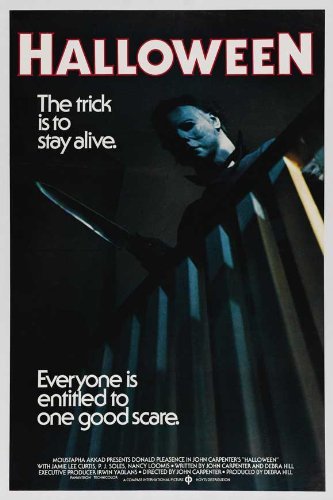
Halloween (1978)

day332challoween

HALLOWEEN (1978) Four stars

There’s one particularly cherished moment from all the years watching HALLOWEEN.

Every time I have showed the film to friends and family, there’s one scene I patiently wait for with devilish anticipation.

I make internal bets with myself that it will work on everybody who’s seeing the movie for the first time, and it will even still work on those return viewers.

It’s a jump scare, one of the best ever filmed.

Every time, I would be taciturn leading up to this scene, not wanting to give a single thing away to my friends and family.

I wanted to see them jump, and I wanted to hear them scream.

It worked every single time.

It’s the scene where Dr. Loomis (Donald Pleasence) and Sheriff Brackett (Charles Cyphers) are discussing matters inside the old Myers house.

I won’t go any further than that.

Like the slasher films that followed, including its own many sequels, HALLOWEEN is a fun one to watch especially with several peers, but for slightly different reasons than the many, many, many followers and imitators.

First and foremost, director John Carpenter (in the words of Alfred Hitchcock) played the audience like a piano in HALLOWEEN. He’s the maestro and we love the music he’s playing, literally. The main theme in HALLOWEEN just stays with the viewer and in fact right now writing this review, I have that song playing over scenes from the first movie playing inside my head. Like other classics PSYCHO and JAWS, the music in HALLOWEEN added immeasurably to the film’s success.

Reportedly, Carpenter composed the theme in one hour, according to an interview he did for Consequence of Sound.

Carpenter discusses the movie and its music at some length on his official site: “HALLOWEEN was written in approximately 10 days by Debra Hill and myself. It was based on an idea by Irwin Yablans about a killer who stalks baby-sitters, tentatively titled ‘The Baby-sitter Murders’ until Yablans suggested that the story could take place on October 31st and HALLOWEEN might not be such a bad title for an exploitation-horror movie.

“I shot HALLOWEEN in the spring of 1978. It was my third feature and my first out-and-out horror film. I had three weeks of pre-production planning, twenty days of principle photography, and then Tommy Lee Wallace spent the rest of the spring and summer cutting the picture, assisted by Charles Bornstein and myself. I screened the final cut minus sound effects and music, for a young executive from 20th Century-Fox (I was interviewing for another possible directing job). She wasn’t scared at all. I then became determined to ‘save it with the music.’

“I had composed and performed the musical scores for my first two features, DARK STAR and ASSAULT ON PRECINCT 13, as well as many student films. I was the fastest and cheapest I could get. My major influences as a composer were Bernard Herrmann and Ennio Morricone (who I had the opportunity to work with on THE THING). Hermann’s ability to create an imposing, powerful score with limited orchestra means, using the basic sound of a particular instrument, high strings or low bass, was impressive. His score for PSYCHO, the film that inspired HALLOWEEN, was primarily all string instruments.

“With Herrmann and Morricone in mind, the scoring for HALLOWEEN began in late June at Sound Arts Studios, then a small brick building in an alley in central Los Angeles. Dan Wyman was my creative consultant. I had worked with him in 1976 on the music for ASSAULT. He programmed the synthesizers, oversaw the recording of my frequently imperfect performances, and often joined me to perform a difficult line or speed-up the seemingly never ending process of overdubbing one instrument at a time. I have to credit Dan as HALLOWEEN’s musical co-producer. His fine taste and musicianship polished up the edges of an already minimalistic, rhythm-inspired score.

“We were working in what I call the ‘double-blind’ mode in 1978, which simply means that the music was composed and performed in the studio, on the spot, without reference or synchronization to the actual picture. recently, my association with Alan Howarth has led me to a synchronized video-tape system, a sort of ‘play it to the TV’ approach. Halloween’s main title theme was the first to go down on tape. The rhythm was inspired by an exercise my father taught me on the bongos in 1961, the beating out of 5-4 time. The themes associated with Laurie (Jamie Lee Curtis) and Dr. Loomis (Donald Pleasence) now seem to be the most Herrmannesque. Finally came the stingers. Emphasizing the visual surprise, they are otherwise known as ‘the cattle prod’: short, percussive sounds placed at opportune moments to startle the audience. I’m now ashamed to admit that I recorded quite so many stingers for this one picture.

“The scoring sessions took two weeks because that’s all the budget would allow. HALLOWEEN was dubbed in late July and I finally saw the picture with an audience in the fall. My plan to ‘save it with the music’ seemed to work. About six months later I ran into the same young executive who had been with 20th Century-Fox (she was now with MGM). Now she too loved the movie and all I had done was add music. But she really was quite justified in her initial reaction.

“There is a point in making a movie when you experience the final result. For me, it’s always when I see an interlock screening of the picture with the music. All of a sudden a new voice is added to the raw, naked-without-effects-or-music footage. The movie takes on it’s final style, and it is on this that the emotional total should be judged. Someone once told me that music, or the lack of it, can make you see better. I believe it.”

HALLOWEEN, unlike its sequels and imitators, works from a minimalist base, with much fewer characters than the run-of-the-mill body count thriller for one prominent example of minimalism. HALLOWEEN gives us time with the characters, especially the three girls Laurie (Curtis), Annie (Nancy Loomis), and Lynda (P.J. Soles) and Dr. Loomis (Pleasence), and this is definitely to the film’s benefit. These characters take on a greater resonance than, for example, the gallery of grotesqueries in FRIDAY THE 13TH: A NEW BEGINNING, who only have a couple minutes of (largely) unpleasant behavior before their gruesome death scenes.

Carpenter and Hill found gold in Curtis: not only the daughter of Janet Leigh (PSYCHO) and Tony Curtis, but a great rooting interest who can be intelligent and resourceful and strong enough that we forgive her for the other moments that are standard in horror films, like (for just one example) her difficulty finding the keys with a madman bearing down on her. She’s pretty, as well, without it being overwhelming.

Annie and especially Lynda are pioneers of the Valley Girl speak, totally, and that might be one of the great sources of annoyance for anybody watching HALLOWEEN. Soles, though, is one of the more likable young actresses from that era, seen to even more effect in ROCK ‘N’ ROLL HIGH SCHOOL and STRIPES.

Likability is a key in the success of both HALLOWEEN and the first NIGHTMARE ON ELM STREET.

Dr. Loomis is the character lacking in any of the FRIDAY THE 13TH movies, for example. He’s just brilliant, brought to the life by the indelible screen presence of the late Pleasence (1919-95). His character commands our attention every time he steps onscreen and definitely every time he delivers that dialogue he keeps that attention, especially about Michael Myers and “pure evil.”

“I met him 15 years ago,” Dr. Loomis said. “I was told there was nothing left: no reason, no conscience, no understanding in even the most rudimentary sense of life or death, of good or evil, right or wrong. I met this … 6-year-old child with this blank, pale, emotionless face, and … the blackest eyes – the Devil’s eyes. I spent eight years trying to reach him, and then another seven trying to keep him locked up, because I realized that what was living behind that boy’s eyes was purely and simply … evil.”

` That’s one of the best monologues in any horror film (or any film period).

Monologues like that can sometimes bring the attached film to a halt, because we don’t want to hear this psychological jive talk recited by some hack actor at just that very moment. Please, shut the fuck up (Donnie).

For example, Simon Oakland’s jive talk late in PSYCHO drags us down a bit.

Honestly, though, I could have listened to Dr. Loomis talk all day.

Pleasence sells this dialogue with the conviction of his craft and I don’t know, I’ve always got the feeling that maybe Dr. Loomis is maybe just maybe a bit mad himself all these years working around Michael Myers.

You see this Dr. Loomis coming, and you just might head to the next city or county or perhaps country, because you know he’s trouble.

In horror films, often times authority figures do not believe the stories of teenage protagonists until it’s too late, but HALLOWEEN applies the slight twist to the formula by having authority figures question the story of another authority figure.

I love the way Carpenter and his team utilize Michael Myers in HALLOWEEN: he’s driving or standing around in the background of many early shots and combined with Dr. Loomis’ dramatic playing up of Myers in dialogue, he takes on mythic proportions. Paraphrasing from Dr. Loomis, this isn’t a man. He’s a shape, and a killing force. But we also get the sense that he’s childlike and in one of the great moments for any screen killer, Myers stands and admires his own craftmanship after one kill.

He’s far more interesting with far less back story, as the sequels beginning with HALLOWEEN II irrefutably proved.

Let’s see here, we have two great protagonists, one great killer (and one great weapon), and great music.

Seems like this is the beginning of a great horror movie.

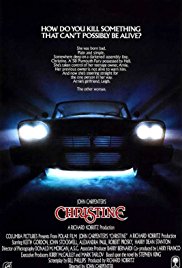
Christine (1983)

DAY 2, CHRISTINE

CHRISTINE (1983) Three-and-a-half stars
Back in college, during my first assignment for the school paper, I wrote a section about how Americans love their cars, from Route 66 and Jack Kerouac to James Dean and back. The summer editor took out the Americans love their cars section and now, it’s a suitable introduction for John Carpenter’s CHRISTINE, an adaptation of a Stephen King novel that does put a novel spin on some American fiction tropes.

We’ve seen many, many (arguably too many) films where boy meets girl and it’s love at first sight, but this is a film where it’s boy meets car and they meet cute with the car in shambles and up for sale by a codger who’s suspiciously quick to accept any price for the car. The boy’s arguably not in any better shape than the car.

The boy in love is Arnie Cunningham, a nerd supreme, and the car is a 1958 Plymouth Fury named Christine that’s definitely “bad to the bone” or at least bad to the bumper. Arnie, who dwells in 1978 California, might have liked to seen the 1957 Detroit prologue where an assembly line worker’s killed by the devil car, but Arnie and Christine are definitely meant for each other.

True love at first sight for both parties, and it will not be denied.

Yeah, you might say the film’s ridiculous, but most horror films are ridiculous, of course, and CHRISTINE works partly because it’s a love story with a twist in the main premise that we can appreciate. We love our cars, of course, but our love thankfully never reaches Arnie and Christine levels. It’s undeniable, though, to watch it happen to somebody else in a movie.

CHRISTINE also works because of the lead performance by Keith Gordon as the super nerd Arnie, who might be the cousin of Terry the Toad. He’s transformed by his love for his car into somebody foreign to his parents and his best friend Dennis, a football jock who sticks up for Arnie in the face of relentless school bullies and who questions Arnie’s purchase of the car right from the start. With this special car in his life, Arnie becomes a new young man by discarding his old taped-up horn-rimmed glasses, dressing like a latter day James Dean (ideal since Christine only plays ’50s rock ‘n’ roll), and becoming first arrogant and later belligerent, especially whenever any one comes between him and Christine. Fools they are, several individuals mess with the boy and car or just the car alone and they usually face gruesome consequences for their reprehensible actions.

We like this Arnie character and Gordon performance even more when Arnie starts taking a walk (or drive) on the mean side.

Anyway, the new brimming-with-confidence Arnie begins seeing the hot new girl in school, Leigh Cabot, and their relationship needless to say is complicated by Christine. Romantic triangles are frequent in the movies, but CHRISTINE might be the first and only one with a boy, a girl, and a killer car.

The girl and the car are both jealous of each other and that leads to the classic moment at the drive-in when the car attempts to kill the girl. Serves her right.

Needless to say, the girl wants very little to do with the boy after surviving this moment and the boy and the car become even closer, all leading us to a thrilling duel-to-the-death climax between machines in a garage.

John Rockwell and Alexandra Paul are just fine in their roles as best friend Dennis and would-be girlfriend Leigh, respectively, and if Columbia Pictures had its way, casting would have been disastrous with Scott Baio in the Arnie role and Brooke Shields as Leigh. Egads! Thankfully, the filmmakers insisted on lesser known actors. Kevin Bacon auditioned for Arnie, but he went off to do FOOTLOOSE instead and that obviously worked out best for all parties involved.

Gordon, who had previously appeared in JAWS 2 and DRESSED TO KILL, gives the defining performance of his career and his Arnie Cunningham rates with the greats in screen nerddom.

Veteran character actors Robert Prosky, Harry Dean Stanton, and Roberts Blossom (three of the best) are on hand and their old-fashioned grit and grime mesh well with the teeny boppers and the possessed car.

We talked about the subtle twists CHRISTINE puts on formula material. Well, the final line reading gives us Leigh declaring “God, I hate rock ‘n’ roll.” Probably the first teenager to ever say that in a film.