Grand Hotel (1932)

GRAND HOTEL (1932) ***
MGM once boasted More stars than there are in Heaven and as I typed out those words, sounds and images from Grand Hotel played on the motion picture spread inside my head.

Of course, because Grand Hotel put Greta Garbo, John Barrymore, Joan Crawford, Wallace Beery, and Lionel Barrymore — five good old-fashioned movie stars — together. A commercial and critical success, Grand Hotel gave Hollywood a casting model still with us today, as well as the custom that a luxurious setting must host our stars. They even named the movie after this luxurious setting.

Part of the appeal of watching Grand Hotel to this very day — nearly 90 years after the film’s original release, for crying out loud — derives from drawing parallels between the real-life performer and their character, especially true for Garbo, John Barrymore, and Crawford.

Top billed Garbo (1905-90) plays ballerina Grusinskaya, but it’s virtually impossible to not draw the parallels with the actress herself when we hear the famous words, I want to be alone. Or I think Suzette, I’ve never been so tired in all my life. Yes, I listened to the Kinks’ “Celluloid Heroes” so many times before I watched Grand Hotel that the song informed every second of seeing Garbo in arguably her most famous movie role, Don’t step on Greta Garbo as you walk down the Boulevard / She looks so weak and fragile, that’s why she tried to be so hard / But they turned her into a princess / And they sat her on a throne / But she turned her back on stardom / Because she wanted to be alone.

Garbo appeared in eight films after Grand Hotel, her final one being George Cukor’s Two-Faced Woman in 1941. That one came with the slogan Go Gay with Garbo! Her first talking picture, 1930’s Anna Christie, simply hyped Garbo Talks!

John Barrymore (1882-1942) first made his motion picture fame as Dr. Henry Jekyll and Mr. Edward Hyde in the 1920 Dr. Jekyll and Mr. Hyde. Barrymore’s life played out like Jekyll and Hyde, seeing that his matinee idol looks earned him the nickname ‘The Great Profile’ and benefited him in romantic lead parts in Grand Hotel (as the formerly wealthy Baron Felix von Gaigern, who specializes in thievery and gambling with Garbo his potential mark) and Twentieth Century (arguably his best performance as tempestuous temperamental theatrical director Oscar Jaffe) before many years of heavy drinking finally wore him down into a shell of his former self. John Barrymore died 10 years after Grand Hotel premiered, at the age of 60 from pneumonia and cirrhosis of the liver. He’s more famous today for being Drew Barrymore’s grandfather, but his acting talents are well-preserved on celluloid and I’d start (and possibly finish) with Dr. Jekyll and Mr. Hyde, Grand Hotel, and Twentieth Century.

Crawford (1904-77) has remained a divisive figure some 50 years after her final movie — Trog in 1970 — embodied by the essay The Feminine Grotesque: On the Warped Legacy of Joan Crawford by Angelica Jade Bastien that reappeared on RogerEbert.com during Women’s History Month. No lesser authority than Crawford herself described her Grand Hotel character Flaemmchen as “the little whore stenographer,” and the actress’ eternal divisiveness stems in part from her infamous reputation for sleeping her way to the top. Bette Davis said of her arch rival, She slept with every star at MGM. Of both sexes.

Kansas City (Missouri)-born Beery (1885-1949) shared the 1933 Academy Award for Best Actor — with Fredric March from Dr. Jekyll and Mr. Hyde — for his performance as the title character in the feel good heartstring yanker The Champ. The Champ premiered Nov. 21, 1931. Grand Hotel premiered 143 days later and Beery plays a character, General Director Preysing, who proves to be a complete 180 from The Champ. Beery chews through the scenery not only on Grand Hotel but every other movie MGM had in production at that moment in time.

John’s older brother Lionel Barrymore (1878-1954) etched his place in history as the epitome of villain, Mr. Henry F. Potter from It’s a Wonderful Life. So to see him play such a likable character in Grand Hotel might be a great shock for most viewers who are only familiar with Barrymore through It’s a Wonderful Life. He’s definitely a scene stealer in Grand Hotel.

Ironically enough, Lionel Barrymore presented Beery with his Oscar statuette. Barrymore won Best Actor the previous year for his performance in A Free Soul.

I must admit, though, that I prefer International House, taglined in 1933 as ‘The Grand Hotel of Comedy’ and released by Paramount, over Grand Hotel. International House gives us a cast that includes famous gold digger Peggy Hopkins Joyce, W.C. Fields, George Burns and Gracie Allen, Rudy Vallee, and Bela Lugosi, plus Stoopnagle and Budd, Baby Rose Marie, and Cab Calloway. We have Calloway and his band performing “Reefer Man,” Fields smoking opium and driving his American Austin automobile through this grand hotel in Wuhu China, Doctor Burns and Nurse Allen bantering, and plenty more Paramount pre-Code shenanigans stuffed into a 70-minute cinematic confectionery. By comparison, Grand Hotel, lasting more than 110 minutes, seems awful staid and stodgy.

That said, Grand Hotel serves a lasting reminder of how powerful star power used to be.
Beyond and Back (1978)

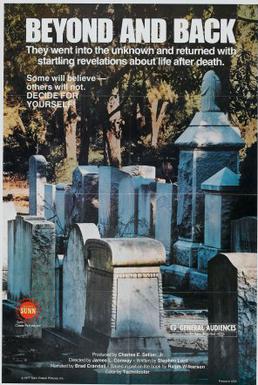
BEYOND AND BACK (1978) No stars

I am here to tell you about life after Beyond and Back.

I cannot believe that I finally watched a film that displaces The Star Wars Holiday Special as my selection for the worst film made in 1978.

Beyond and Back proved to be D.O.A. It showed no vital signs of cinematic life and brought me a micrometre closer to atheism with its faith-based and family-friendly agenda shoved down my throat, 90 minutes of bad actors monotonously gushing over near-death experiences, life after death, psychokinesis, Heaven and Hell, bright light, weighing souls, seeing dead relatives, ad nauseam.

Beyond and Back puts Benjamin Franklin, Elizabeth Barrett Browning, Eddie Rickenbacker, Thomas Edison, Louisa May Alcott, Ernest Hemingway, George S. Patton, and Harry Houdini on an equal plane with Anne Fleck, Dr. Stevens, Byron Temple, and Dr. Paul Kelly, since they’re all just cannon fodder for that agenda told through a pseudo-documentary approach with bad narration and bad reenactment.

Two of the worst films ever made (both from 1978) involve laughable disclaimers:

The African killer bee portrayed in this film bears absolutely no relationship to the industrious, hardworking American honey bee to which we are indebted for pollinating vital crops that feed our nation — The Swarm

The events you have just seen have been taken from actual accounts, but the names of the persons involved have been changed to preserve their anonymity. All such persons have been portrayed by professional actors and actresses — Beyond and Back

Of course, Beyond and Back is the same picture that starts with its narrator telling us, “You are about to see one of the most extraordinary movies of our time, a movie that dares to investigate the possibility of life after death.”

We can thank the folks at Sunn Classic Pictures for such classics, er, drivel as Beyond and Back, namely director, producer, novelist, and Sunn Classics founder Charles E. Sellier. Sellier (1943-2011) evolved from Cajun Catholicism to Mormonism and finally evangelical Christianity, but his product remained in the realm of quick-buck exploitation, whether it was Sunn Classic productions In Search of Noah’s Ark and In Search of Historic Jesus or the controversial killer Santa picture Silent Night, Deadly Night and the teenage comedy Snowballing (both directed by Sellier) or his later productions George W. Bush: Faith in the White House, Breaking the Da Vinci Code, The Search for Heaven, and Apocalypse and the End Times.

For obvious theological reasons and philosophical differences, Beyond and Back passed on many tales and famous last words.

Last words are for fools who haven’t said enough — Karl Marx

I hope the exit is joyful and hope never to return — Frida Kahlo

Dammit, don’t you dare ask God to help me — Joan Crawford

I’m bored with it all — Winston Churchill

I’m going, but I’m going in the name of the Lord — Bessie Smith (I do not recall a single black person in Beyond and Back)

My wallpaper and I are fighting a duel to the death. One or the other of us has to go — Oscar Wilde

Dear World, I am leaving because I am bored. I feel I have lived long enough. I am leaving you with your worries in this sweet cesspool. Good luck — George Sanders (a charming wit to the end)

As we depart this mortal review, I leave this joke: What’s the last thing that goes through a fly’s mind when I kill him? My fist (reporter’s notebook).

Let’s Dance! Let’s Sing! Let’s Nostalgia!: That’s Entertainment I, II, III

LET’S DANCE! LET’S SING! LET’S NOSTALGIA!: THAT’S ENTERTAINMENT I, II, III

I dutifully watched THAT’S ENTERTAINMENT, the 2-hour, 15-minute compilation of clips from MGM highlighting their hallowed “Golden Age of Musicals.” MGM, founded on April 17, 1924 by Louis B. Mayer and Marcus Loew, commemorated its 50th anniversary and then released THAT’S ENTERTAINMENT two months later commemorating it even more.

I have two immediate spoilsport thoughts, the first which originally occurred to me on June 22, 2004, watching the American Film Institute unveil the super bland “100 Years, 100 Songs.”

THAT’S ENTERTAINMENT brought it all back with a vengeance.

That night in 2004, I said aloud, “Are they going to put every single fucking song ever sung by Judy Garland on the list?” Ditto for Gene Kelly, Barbra Streisand, Julie Andrews, et cetera, who dominated the AFI list with their 20 or 25 songs seeming more like 80 or 100; Kelly and Garland, who passed away in 1969 at the age of 47, dominate THAT’S ENTERTAINMENT.

We get a double dose of heavy duty Judy in THAT’S ENTERTAINMENT, first through her Mickey (Rooney) and Judy “Hey gang, let’s put on a show” Era montage and then a tribute presented by her daughter Liza Minnelli, not long after CABARET. Garland also sings “You Made Me Love You” over a montage of Clark Gable that allows GONE WITH THE WIND (MGM’s most famous production) to be shoehorned into the song-and-dance ballyhoo.

Second spoilsport thought: Aside from THE WIZARD OF OZ and SINGIN’ IN THE RAIN, most of my favorite musicals are not from MGM. For example, Fred Astaire, who’s featured in THAT’S ENTERTAINMENT, did most of his best work at RKO — including TOP HAT and SWING TIME — in the 1930s paired with Ginger Rogers. Never mind alternative musicals like THE 5,000 FINGERS OF DR. T (Columbia and Stanley Kramer Productions) and ONE FROGGY EVENING and WHAT’S OPERA, DOC?, both famous Warner Bros. animated shorts.

What do I like about THAT’S ENTERTAINMENT?

Well, it’s always great seeing the usual suspects from THE WIZARD OF OZ and SINGIN’ IN THE RAIN no matter how many times I have seen them, especially Donald O’Connor’s showstopper “Make ‘Em Laugh.” Clark Gable singing “Puttin’ on the Ritz” from IDIOT’S DELIGHT. Jimmy Stewart’s jab at Robert “He tries his best” Montgomery. The Esther Williams montage. Somebody once said about Williams, “Dry, she ain’t much. Wet, she’s a star.” Madeline Kahn impersonating Marlene Dietrich in BLAZING SADDLES said, “It’s twue, it’s twue.”

We get more or less the same from PART 2, only we get token appearances from MGM employees Groucho Marx, Laurel and Hardy, Buster Keaton, and W.C. Fields and, of course, musical numbers that did not appear in PART I.

It would have been nice to see a musical number from the Marx Brothers or Laurel and Hardy or Fields, despite the fact they all did their best work somewhere else. I mean, would it have killed PART II director Gene Kelly to have aired Groucho’s “Lydia the Tattooed Lady” from AT THE CIRCUS … for example … instead of, I don’t know, one more variation on the song “That’s Entertainment” offered up by contemporaneous Astaire, contemporaneous Kelly together again and for the last time.

After watching PART II, I began hating Arthur Schwartz’s chestnut “That’s Entertainment” unlike ever before, although honestly I hardly ever gave it much thought until it was the (bludgeoning) recurring theme in a darn movie. They must have trotted it out 50 freaking times.

Eventually, to counterbalance the effects of cornball showbiz schmaltz, though, I started humming “That’s Entertainment” from the Jam. Let’s get all misty-eyed nostalgic over a song that starts “A police car and a screaming siren / A pneumatic drill and ripped up concrete / A baby wailing and stray dog howling / The screech of brakes and lamp light blinking.” I particularly love the second verse, “A smash of glass and the rumble of boots / An electric train and a ripped up phone booth / Paint splattered walls and the cry of a tomcat / Lights going out and a kick in the balls.”

I should just stop bitching and moaning and groaning about PART I and PART II of THAT’S ENTERTAINMENT, perhaps because life is short and also perhaps because I realize that I am not the target audience for these nostalgic entertainments. First and foremost, I was born in 1978 and my generation did not grow up on “classic” American musicals. In fact, a lot of us came to hate musicals in our teenage years, especially of the vintage celebrated endlessly by the THAT’S ENTERTAINMENT series. I have come to appreciate some of them corny old classics somewhat more in middle age, but I still prefer musical numbers from Monty Python, Mel Brooks, and “South Park” and I still grumble like nobody’s business at 21st Century schmaltz like FROZEN, MOANA, and THE GREATEST SHOWMAN, entertainment packages that give me fleas. I don’t even have to watch them to get fleas, because it seems like 90 percent of the people around me have memorized every single darn word of every single darn song and they don’t mind singing ‘em every single darn time they feel like singing in their darn glorious off-key melodramatic voice.

Recently, I conducted some independent research by watching MILLION DOLLAR MERMAID (a.k.a. THE ONE PIECE BATHING SUIT in the U.K.) from 1952 and starring Esther Williams, Victor Mature, and Walter Pidgeon. It was directed by Mervyn LeRoy, produced by Arthur Hornblow Jr., and replayed in at least one THAT’S ENTERTAINMENT. I watched it for Williams and the numbers choreographed by the legendary Busby Berkeley (who might be more fondly remembered today for being parodied in early 80s comedies CADDYSHACK and HISTORY OF THE WORLD). I enjoyed it and I realize that I probably would have enjoyed it for the same reasons at a younger age had I given it even half a chance. Now, that’s progress!

MGM returned to the vaults for a third time for THAT’S ENTERTAINMENT! III in 1994, only 18 years after PART II and 20 after the very first greatest hits-golden cinematic oldies compilation.

Anyway, who’d have ever thought that PART III tops both PART I and PART II and does it by including outtakes and unfinished numbers more than greatest hits and golden oldies.

We have Lena Horne’s “Ain’t It the Truth,” a sultry little number cut from CABIN IN THE SKY because a sexy black woman in a bathtub in 1943 would have spurred on a third American Revolution, yes, even in the middle of World War II.

We have two lip-sync takes on “Two-Faced Woman,” presented side-by-side, outtake Cyd Charisse from THE BAND WAGON and black face Joan Crawford from TORCH SONG (both dubbed by India Adams). Crawford’s scene made me think of Pauline Kael’s review of TROG, “Joan Crawford plays Stella Dallas with an ape instead of a baby girl. Some actors will do anything to be in movies: she probably would have played the ape.”

We have another Esther Williams montage and I must say that I am in favor of Esther Williams montages, especially ones that work in Tom and Jerry. Eat your hearts out, Frank and Gene, your movie (ANCHORS AWEIGH) only had Jerry dancing with Gene! In all honesty, the Esther Williams montages in PART I and PART III pushed me to seek out MILLION DOLLAR MERMAID and I have a feeling that I will be consuming Esther, Tom, and Jerry in DANGEROUS WHEN WET soon.

I also prefer PART III because it has much less of the elitist, self-congratulatory, self-important tone that marred the first two installments, as much as I enjoyed seeing all the “old” entertainers that have not been matched (let alone surpassed) since their heyday. PART III hints at the MGM that treated the cast of FREAKS like “freaks” and it at least delves beyond the surface glitz and glamour to the showbiz ugliness beneath.

That’s entertainment.

THAT’S ENTERTAINMENT PART I ***; PART II ***; PART III ****

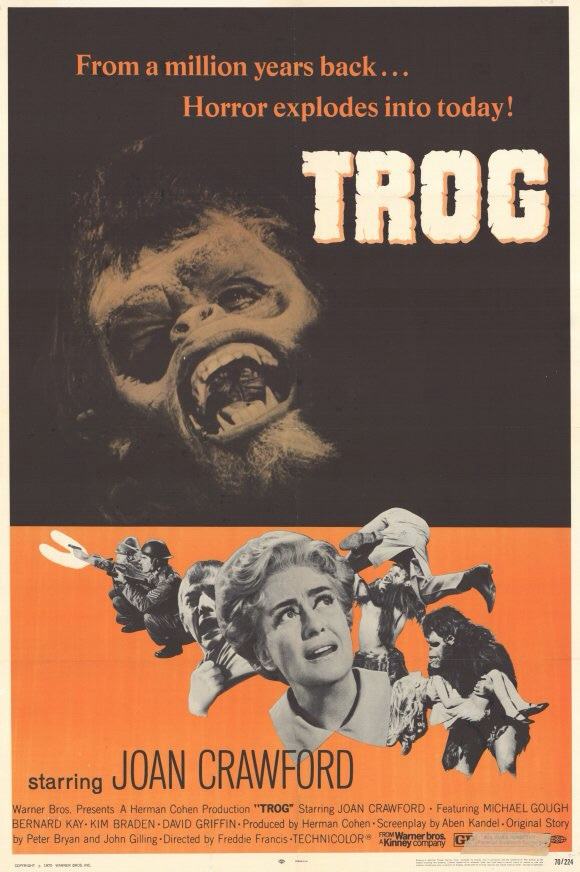
Trog (1970)

TROG

TROG (1970) ***

Joan Crawford began her long cinematic career in 1925 as the double for Norma Shearer in LADY OF THE NIGHT.

She appeared in small roles in Erich von Stroheim’s THE MERRY WIDOW, King Vidor’s THE BIG PARADE, and Fred Niblo’s BEN-HUR: A TALE OF THE CHRIST and first made her fame in Tod Browning’s THE UNKNOWN, her 20th screen credit already by 1927.

Crawford survived the transition from silent to sound and she won the Academy Award for Best Actress for her performance in the 1945 film noir MILDRED PIERCE.

That brings us to her final screen appearance, TROG.

To the best of all knowledge, Crawford (1906-77) is the only Academy Award winner to star in a caveman movie and speak lines “Please, Trog, let me have the girl!” and “Music hath charms that soothes the savage beast.” Aben Kandel wrote the screenplay and Peter Bryan and John Gilling received credit for original story.

Granted, she’s also the only Academy Award winner to star in a Blue Öyster Cult song, a ditty inspired by the book and the film MOMMIE DEAREST written by Crawford’s far beyond estranged daughter Christina. The boys turned Joan Crawford into more of a monster than Godzilla. That part in the song where Mommie Dearest is calling for bad little Christina, it just doesn’t get much better than that in this oh so cruel bitch of a world. “Joan Crawford has risen from the grave,” indeed.

Back on point: I enjoyed TROG a good deal, and it’s one of those films that inspires the very best stories.

Film critic Pauline Kael (1919-2001) wrote, “Joan Crawford plays Stella Dallas with an ape instead of a baby girl. Some actors will do anything to be in movies: she probably would have played the ape.”

Herman Cohen (1925-2002), a producer whose credits include BELA LUGOSI MEETS A BROOKLYN GORILLA and I WAS A TEENAGE WEREWOLF, said that Crawford’s alcoholism raged during TROG and she had 100-proof vodka in her frosted Pepsi Cola glass. He added that Crawford brought four cases of the juice with her to England, because of its unavailability in Merrie Olde. (Speaking of Pepsi, Crawford, once married to the chairman of the board and CEO of Pepsi and then herself a board of the directors member, works in one brief moment of product placement during an early scene.)

Freddie Francis (1917-2007), a two-time Academy Award winner for Best Cinematography for SONS AND LOVERS and GLORY, said that he regretted directing TROG (which he called terrible) and that Crawford had so much trouble remembering her lines they had to resort to using “idiot cards” to get through her scenes.

Former English professional wrestler Joe Cornelius played the title character in TROG and he defended Crawford against those accusations in a 2015 interview with cult film director and fan John Waters after the British Film Institute retrospective of the film.

In the ring, they called Cornelius “The Dazzler.” From the Online World of Wrestling, “What a presence ‘The Dazzler’ made when he entered the ring, the wavy jet black hair, the dazzling smile, the eyebrows! Damn! He had it all, a personality as big as the Royal Albert Hall and ring savvy second to none, he was like a puppet master with strings fastened to the hearts of every member of the audience.”

Guess at this point we should discuss exactly what’s a Trog.

Trog is short for “troglodyte” or a person who lived in a cave, especially in prehistoric times. He’s proclaimed, in promotion of the film, as having the strength of 20 demons, so it makes perfect sense to have Cornelius play the role.

Crawford stars as Dr. Brockton, who of course represents science against those who just want to destroy the “monster.” She wants to reach and teach Mr. Trog. She wants to domesticate “The Missing Link,” half-man and half-ape with a costume borrowed from 2001. These domestication scenes are worth their weight in gold, especially the one when Trog learns how to play catch. “Good boy, Trog!”

Thankfully, for the sake of the movie and its cult following, Crawford does not condescend to her role. She plays it absolutely 100 percent straight and resolutely serious. In other words, Crawford plays it just like she did in MILDRED PIERCE. That makes TROG even funnier than if she just played it winking at the audience the entire time.

Michael Gough (1916-2011) opposes Brockton and Trog from his very first appearance. I doubt Gough used TROG in his audition for Tim Burton’s BATMAN, because his bad manners here as Sam Murdock do not mesh with Alfred Pennyworth, Bruce Wayne’s dedicated butler. We await the fate that waits for Mr. Murdock and it is well worth the wait.

During his attempted domestication, Trog freaks out both at the color red and more upbeat music.

That got me thinking: What if they played Trog the Troggs’ “Love is All Around” from 1967? Just forget about “Wild Thing.” Yes, the Troggs, an English rock band originally called the Troglodytes before the name was shortened, had a huge impact on future noise with their songs covered by Jimi Hendrix, the Buzzcocks, and Hüsker Dü.

Bette Davis: Tougher than Anybody Else

BETTE DAVIS: TOUGHER THAN ANYBODY ELSE
Like most people in my generation, I first encountered Bette Davis (1908-89) through popular music rather than her 123 movie or TV roles from 1931 through 1989.

Oh, let’s see, Davis made a starring performance in Kim Carnes’ “Bette Davis Eyes,” a hit that spent nine weeks at No. 1 on the Billboard Hot 100 and proved to be 1981’s biggest song. You might vividly remember that one and songwriters Donna Weiss and Jackie De Shannon gave their heroine — er, their femme fatale — not only Bette Davis eyes, but also “Harlow gold hair” and “Greta Garbo’s standoff sighs.”

Davis also made the hall of fame in songs by Madonna and the Kinks.

Madonna Ciccone and Step Pettibone (Ciccone-Pettibone has got a better ring to it than Lennon-McCartney or Strummer-Jones) co-wrote “Vogue” and Madonna’s rap (her best) finishes off with “Bette Davis, we love you” after running through Garbo, Monroe, Dietrich, DiMaggio, Brando, James Dean (called Jimmy Dean, not the sausage manufacturer), Kelly, Astaire, Hayworth, Bacall, Hepburn, and Lana Turner.

Like the other two songs that came later in time, Ray Davies’ lyrics on “Celluloid Heroes” mention Garbo and she gets top billing (first mention) before the song moves on to Rudolph Valentino, Bela Lugosi, Davis, George Sanders, Mickey Rooney, and Marilyn Monroe. Davies groups Davis with Valentino and Lugosi, capping off six lines with “But stand close by Bette Davis / Because hers was such a lonely life.” (Davis named her 1962 autobiography “The Lonely Life.”) For the record, Garbo gets six lines, Monroe four, and Valentino, Lugosi, Sanders, and Rooney two each.

— The first Bette Davis movies I saw were ALL ABOUT EVE (1950) and WHAT EVER HAPPENED TO BABY JANE? (1962), both highly enjoyable for different reasons.

Their common ground, though, centers around Davis.

ALL ABOUT EVE, that’s the one featuring her famous line “Fasten your seat belts. It’s going to be a bumpy night.” Margo Channing — a highly-regarded but aging and difficult stage actress — must not have been a great stretch for a Davis in her early 40s.

Other actresses considered for the role were Ingrid Bergman, Marlene Dietrich, Susan Hayward, Gertrude Lawrence, and Barbara Stanwyck. Think we can all agree that Davis was the perfect choice for Margo Channing.

You can almost feel Davis herself speaking through dialogue like “Lloyd, I am not twenty-ish. I am not thirty-ish. Three months ago I was forty years old. Forty. 4-0. That slipped out. I hadn’t quite made up my mind to admit it. Now I suddenly feel as if I’ve taken all my clothes off” and “Bill’s 32. He looks 32. He looked it five years ago. He’ll look it twenty years from now. I hate men.”

BABY JANE capitalized on the real-life feud between Davis and Joan Crawford, where most of the fun comes from speculating how much reality crossed over into their fictional characters.

Just a casual search on the Internet will bring up all sorts of quotes from Davis on Crawford and I might as well as share a few within this space: “You should never say bad things about the dead, you should only say good … Joan Crawford is dead. Good”; “There may be a heaven, but if Joan Crawford is there, I’m not going”; “Why am I so good at playing bitches? I think it’s because I’m not a bitch. Maybe that’s why Miss Crawford always plays ladies”; and “The best time I ever had with Joan Crawford was when I pushed her down the stairs in WHAT EVER HAPPENED TO BABY JANE?”

Davis never had a problem being the villain and that’s one of the things that made her so great. Let’s face it, sometimes we like the villains infinitely more than bland, square heroes.

She played a strong character in almost every single role.

Davis became the first performer to be nominated for 10 Academy Awards, all for Best Actress, and she won statuettes for DANGEROUS (1935) and JEZEBEL (1938), her first two nominations.

— Recently, I caught up with OF HUMAN BONDAGE (1934), FOG OVER FRISCO (1934), and THE PETRIFIED FOREST (1936).

OF HUMAN BONDAGE — her 22nd film — is renowned for being the film that made Davis a star.

Davis’ character Mildred Rogers has been described as “callous,” “manipulative,”  “cold,” “shrewish,” et cetera, and Davis really sinks her teeth into “You cad, you dirty swine! I never cared for you, not once! I was always makin’ a fool of ya! Ya bored me stiff; I hated ya! It made me SICK when I had to let ya kiss me. I only did it because ya begged me, ya hounded me, and drove me crazy! And after ya kissed me, I always used to wipe my mouth! WIPE MY MOUTH!”

That’s her big scene with Leslie Howard’s Philip Carey, an overly sensitive, club-footed man who’s in love with Mildred despite the fact that she treats him like trash.

— FOG OVER FRISCO came out 26 days before OF HUMAN BONDAGE in 1934 and it’s a fast-moving crime melodrama over in 68 minutes. Action-packed and the big chase scene called to mind BULLITT and THE DEAD POOL, believe it or not.

Davis considered this one of her favorite pictures, though her character Arlene Bradford does not make it to the final reel.

Maybe here’s why FOG OVER FRISCO rated among her favorites: Davis received top billing after Warner Bros. boss Jack Warner caught drift of the Bette buzz from rushes of the film and she found out while filming FOG OVER FRISCO that Warner agreed to loan Davis out to RKO to make OF HUMAN BONDAGE.

Davis also said that FOG OVER FRISCO had a good script and that it was superbly directed by William Dieterle over a shoot that lasted around 20 days (Monday, January 22, 1934 through Saturday, February 10, 1934).

Davis plays characters on opposing ends of the social spectrum in FOG OVER FRISCO and OF HUMAN BONDAGE. In both films, though, she has a weak male admirer. She’s the stronger character, as usual.

— A lot of the fascination watching THE PETRIFIED FOREST came from seeing both Davis and Humphrey Bogart in roles early in their career.

Bogart had done 10 feature films before THE PETRIFIED FOREST and he first played the Duke Mantee role in the 1935 Broadway production alongside Leslie Howard. Warner Bros. wanted Edward G. Robinson (LITTLE CAESAR) for the film adaptation, but Howard refused to appear in the film unless Bogart got the chance to revisit Mantee, a character and performance inspired by John Dillinger. The rest was history. (Bogart and Lauren Bacall named their daughter Leslie Howard Bogart, born 1952, in honor of their friend.)

Bogart is just dynamite in THE PETRIFIED FOREST.

Like OF HUMAN BONDAGE, Davis plays a waitress and Howard’s love interest. Unlike that earlier movie, however, her Gabrielle Maple’s almost instantly smitten with Howard’s Alan Squier and their fates are reversed from OF HUMAN BONDAGE.

The New York Times’ review of the film said of her performance in THE PETRIFIED FOREST, “There should be a large measure of praise for Bette Davis, who demonstrates that she does not have to be hysterical to be credited with a grand portrayal.”

Gabrielle’s a very sympathetic character, a dreamer and an aspiring artist.

— Davis once said, “I survived because I was tougher than anybody else.”

ALL ABOUT EVE (1950) Four stars; WHAT EVER HAPPENED TO BABY JANE? (1962) Four stars; OF HUMAN BONDAGE (1934) Three-and-a-half stars; FOG OVER FRISCO (1934) Three-and-a-half stars; THE PETRIFIED FOREST (1936) Three-and-a-half stars