The Man Who Knew Too Much (1956)

THE MAN WHO KNEW TOO MUCH (1956) ***
I would have liked to been a fly on the wall (but not Mike Pence’s head) for several conversations throughout motion picture history.

For example, when Chevy Chase was offered Oh Heavenly Dog. We all remember that one, right, where Chase plays a private detective who’s murdered real early in the picture and then, almost just like Warren Beatty in Heaven Can Wait, he’s reincarnated as, wait for it, Benji. We see Benji solve the murder and hear Chase on the soundtrack. Yes, it’s a real movie.

Another example would be how Alfred Hitchcock reacted when he was told his Man Who Knew Too Much star Doris Day would sing Que Sera, Sera (Whatever Will Be, Will Be) not once but twice during the movie — the first time about 12 minutes in and the second with about 12 minutes left.

Isn’t it obvious, though, that Hitchcock wasn’t into Que Sera, Sera, even before Day sings that line about 500 times.

I search it up (as the kids today say) and find this juicy bit of IMDb trivia: Throughout the filming, Doris Day became increasingly concerned that Alfred Hitchcock paid more attention to camera set-ups, lighting, and technical matters than he did to her performance. Convinced that he was displeased with her work, she finally confronted him. His reply was, ‘My dear Miss Day, if you weren’t giving me what I wanted, then I would have to direct you!’

Apparently, Day (1922-2019) herself was initially turned off by the notion of singing what became her signature song, even in death. She thought it was a forgettable children’s song.

I call this 1956 version The Woman Who Sang Too Much.

The Man Who Knew Too Much ’56 (a remake of Hitchcock’s own 1934 film) predominantly works because of the performance of James Stewart and a couple spectacular set pieces.

Despite this being the least of the four features Stewart made with Hitchcock, way behind Vertigo, Rope, and Rear Window (in that order), we follow the events from beginning to end mostly because of the inherent pull of Stewart … and we also know that even during a lesser Hitchcock film, that sly old master, that dirty old dog, would still come up with something to wow us.

Here, it’s the murder of the mysterious Frenchman in Morocco and the attempted assassination of the prime minister at Royal Albert Hall. Personally, I still prefer Jimi Hendrix’s two nights at the Royal Albert in February 1969. Que sera, sera, right?

Bernard Herrmann, the man responsible for the scores to seven Hitchcock films as well as Citizen Kane and Taxi Driver, makes a cameo as the conductor.

Hitchcock apparently made his trademark cameo around 25 minutes in, but I missed it. Que sera, sera, right?

Especially now that I’m blaring Hendrix’s Hear My Train A Comin’.

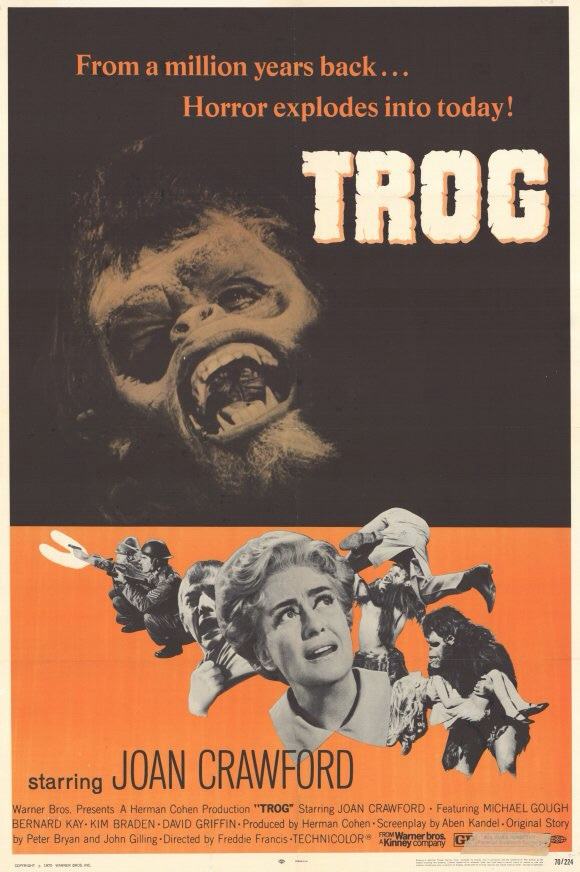
Trog (1970)

TROG

TROG (1970) ***

Joan Crawford began her long cinematic career in 1925 as the double for Norma Shearer in LADY OF THE NIGHT.

She appeared in small roles in Erich von Stroheim’s THE MERRY WIDOW, King Vidor’s THE BIG PARADE, and Fred Niblo’s BEN-HUR: A TALE OF THE CHRIST and first made her fame in Tod Browning’s THE UNKNOWN, her 20th screen credit already by 1927.

Crawford survived the transition from silent to sound and she won the Academy Award for Best Actress for her performance in the 1945 film noir MILDRED PIERCE.

That brings us to her final screen appearance, TROG.

To the best of all knowledge, Crawford (1906-77) is the only Academy Award winner to star in a caveman movie and speak lines “Please, Trog, let me have the girl!” and “Music hath charms that soothes the savage beast.” Aben Kandel wrote the screenplay and Peter Bryan and John Gilling received credit for original story.

Granted, she’s also the only Academy Award winner to star in a Blue Öyster Cult song, a ditty inspired by the book and the film MOMMIE DEAREST written by Crawford’s far beyond estranged daughter Christina. The boys turned Joan Crawford into more of a monster than Godzilla. That part in the song where Mommie Dearest is calling for bad little Christina, it just doesn’t get much better than that in this oh so cruel bitch of a world. “Joan Crawford has risen from the grave,” indeed.

Back on point: I enjoyed TROG a good deal, and it’s one of those films that inspires the very best stories.

Film critic Pauline Kael (1919-2001) wrote, “Joan Crawford plays Stella Dallas with an ape instead of a baby girl. Some actors will do anything to be in movies: she probably would have played the ape.”

Herman Cohen (1925-2002), a producer whose credits include BELA LUGOSI MEETS A BROOKLYN GORILLA and I WAS A TEENAGE WEREWOLF, said that Crawford’s alcoholism raged during TROG and she had 100-proof vodka in her frosted Pepsi Cola glass. He added that Crawford brought four cases of the juice with her to England, because of its unavailability in Merrie Olde. (Speaking of Pepsi, Crawford, once married to the chairman of the board and CEO of Pepsi and then herself a board of the directors member, works in one brief moment of product placement during an early scene.)

Freddie Francis (1917-2007), a two-time Academy Award winner for Best Cinematography for SONS AND LOVERS and GLORY, said that he regretted directing TROG (which he called terrible) and that Crawford had so much trouble remembering her lines they had to resort to using “idiot cards” to get through her scenes.

Former English professional wrestler Joe Cornelius played the title character in TROG and he defended Crawford against those accusations in a 2015 interview with cult film director and fan John Waters after the British Film Institute retrospective of the film.

In the ring, they called Cornelius “The Dazzler.” From the Online World of Wrestling, “What a presence ‘The Dazzler’ made when he entered the ring, the wavy jet black hair, the dazzling smile, the eyebrows! Damn! He had it all, a personality as big as the Royal Albert Hall and ring savvy second to none, he was like a puppet master with strings fastened to the hearts of every member of the audience.”

Guess at this point we should discuss exactly what’s a Trog.

Trog is short for “troglodyte” or a person who lived in a cave, especially in prehistoric times. He’s proclaimed, in promotion of the film, as having the strength of 20 demons, so it makes perfect sense to have Cornelius play the role.

Crawford stars as Dr. Brockton, who of course represents science against those who just want to destroy the “monster.” She wants to reach and teach Mr. Trog. She wants to domesticate “The Missing Link,” half-man and half-ape with a costume borrowed from 2001. These domestication scenes are worth their weight in gold, especially the one when Trog learns how to play catch. “Good boy, Trog!”

Thankfully, for the sake of the movie and its cult following, Crawford does not condescend to her role. She plays it absolutely 100 percent straight and resolutely serious. In other words, Crawford plays it just like she did in MILDRED PIERCE. That makes TROG even funnier than if she just played it winking at the audience the entire time.

Michael Gough (1916-2011) opposes Brockton and Trog from his very first appearance. I doubt Gough used TROG in his audition for Tim Burton’s BATMAN, because his bad manners here as Sam Murdock do not mesh with Alfred Pennyworth, Bruce Wayne’s dedicated butler. We await the fate that waits for Mr. Murdock and it is well worth the wait.

During his attempted domestication, Trog freaks out both at the color red and more upbeat music.

That got me thinking: What if they played Trog the Troggs’ “Love is All Around” from 1967? Just forget about “Wild Thing.” Yes, the Troggs, an English rock band originally called the Troglodytes before the name was shortened, had a huge impact on future noise with their songs covered by Jimi Hendrix, the Buzzcocks, and Hüsker Dü.

American Pop (1981)

AMERICAN POP

AMERICAN POP (1981) Four stars
From 1972 to 1983, British Mandate of Palestine born and New York City and Washington D.C. raised Ralph Bakshi directed eight animated features: FRITZ THE CAT, HEAVY TRAFFIC, COONSKIN, WIZARDS, THE LORD OF THE RINGS, AMERICAN POP, HEY GOOD LOOKIN’, and FIRE AND ICE.

Bakshi definitely proved to be a game changer: Feature-length animation could be combative, satirical, adult entertainment and more than just good, clean, wholesome family entertainment as in the socially accepted definition for animated films. His films — especially his first three — paved the way for “The Simpsons,” “Beavis & Butt-Head,” “South Park,” “Family Guy,” “Adult Swim,” et cetera.

FRITZ THE CAT, loosely based on Robert Crumb’s comic strip, became a landmark motion picture, the first animated feature to earn the ‘X’ rating in the United States.

HEAVY TRAFFIC, COONSKIN, AMERICAN POP, and HEY GOOD LOOKIN’ are ‘R’ and WIZARDS, THE LORD OF THE RINGS, and FIRE AND ICE are ‘PG,’ although that rating once packed a punch with the first two Indiana Jones, JAWS, POLTERGEIST, GREMLINS, and LONE WOLF McQUADE, arguably the most violent ‘PG’ ever made, being some of the most notorious ‘PG’ entries before ‘PG-13’ debuted in August 1984 with the release of RED DAWN.

I’ve watched seven of the eight Bakshi films listed above, liked nearly all of them, and FRITZ THE CAT, THE LORD OF THE RINGS, and AMERICAN POP have earned a spot on my personal top 10 lists for 1972, 1978, and 1981, respectively.

I just watched AMERICAN POP last night and I was once again impressed by the overall sweep of the enterprise — narratively and musically and, of course, its animation — just like I had been several years back watching it for the first time.

AMERICAN POP tells the story of four generations of Russian Jewish immigrants who all have some involvement with American popular music.

First, we meet Zalmie around the late 19th and early 20th century and follow him for a series of years. Zalmie, who started hanging around burlesque shows at an early age, wants to be a singer, but a wound to his throat during World War I kills his singing career. After the war, back home in New York City, he falls in love and marries a stripper named Bella, and Zalmie transfers his star-making ambition to his wife. She’s killed opening a letter bomb intended for him. See, Zalmie used money from mob boss Nicky Palumbo for his wedding to Bella and eventually, Zalmie testifies against Palumbo on TV, calling the mob boss “a rat.”

Zalmie and Bella have a son named Benny, who becomes a very talented jazz pianist. Benny fights in World War II and in one of the film’s best scenes, he finds an abandoned piano in a bombed-out building that leads to his demise. When we first see Benny in Nazi Germany, he’s playing the harmonica (not exactly his musical forte) and even he quips to two fellow troops who call out his lousy playing, “I know, but it’s hard to fit a piano in a foxhole.” At this abandoned piano, Benny first riffs on “As Time Goes By” (Dooley Wilson’s Sam had to play it — again — in CASABLANCA) and his playing quickly draws the attention of an awakened, armed Nazi soldier who approaches Benny from the rear. Benny changes tune to “Lili Marleen” (Marlene Dietrich made it especially famous) and the appreciative Nazi waits to shoot down Benny until he’s done playing “Lili Marleen.” The Nazi even says thanks in German before firing his shots.

Third generation Tony experiences the Beats and the Hippies as he migrates from East to West and back again — of course, we hear Allen Ginsberg’s “I saw the best minds of my generation destroyed by madness,” one of the best starts to any poem — and he gets poetic himself first over “The Blonde” from Kansas. “Yeah, I’m crazy,” Tony tells her. “I’m crazy in love with your blue eyes … and your corn-sulked hair. Your corn-sulked hair. I’ll never eat corn again without thinkin’ about you. Canned corn, candy corn, popcorn, Crackerjacks! You’re the prize in my box! And my box is this country. It’s all tinfoil on the outside. Corn and sweetness on the inside.”

Tony’s journey leads him next to California and he writes songs for a rock band on the edge of stardom. Tony and female lead singer Frankie Hart — a character archetype obviously inspired by Grace Slick and Janis Joplin — become heroin addicts. With the band set to play after Jimi Hendrix one night in Kansas, two important events happen to Tony: his lover Frankie overdoses backstage and he meets his son Pete, who came from the one night with the corn-sulked hair girl.

Tony moves back to New York City, joined by his son. Both Tony and Pete become drug dealers and Pete begins selling drugs to rock bands. Pete finally seizes the moment and gives the band members an ultimatum: They must listen to Pete’s music before they can have any more cocaine. Pete chooses to play Bob Seger’s “Night Moves” for the band and the management. Next thing we know, before we can get all the way through “Night Moves,” Pete’s on stage with the band playing “Blue Suede Shoes,” “Devil in a Blue Dress,” and “Crazy on You.” Late in the medley, we start to see images from earlier in the movie — Zalmie, Benny, and Tony — with Pete on stage.

Of course, Lynyrd Skynyrd’s “Free Bird” plays over the end credits.

AMERICAN POP guides us through 80 years of popular music — everything from standards to Jimi Hendrix’s “Purple Haze,” Janis Joplin’s “Summertime,” and Lou Reed’s “I’m Waiting for the Man,” in addition to the songs already mentioned. That list barely hints at the music heard throughout AMERICAN POP.

Stylistically, we not only have rotoscoping (a process where live actors are filmed and then animators draw over the live-action footage), but also water colors, computer graphics, live-action shots, and archival footage.

Bakshi swung for the fences making AMERICAN POP — an epic achieved in 96 minutes with any failures consumed by the successful elements.

If you still have, somehow at this point in time after many advances in the field, a belief that animated films occupy a limited range aesthetically, emotionally, and intellectually, then Ralph Bakshi’s AMERICAN POP just might free and expand your mind.

In other words, “Whether you dance to it, drive to it, sing with it or swing to it … if you can crank it up, plug it in, or switch it on … if it assaults your senses, rocks your body, or touches your soul, it’s AMERICAN POP.”