The Fog (1980)

THE FOG (1980) **1/2
Fog has been a critical element in many horror movies and the 1939 Hound of the Baskervilles, The Wolf Man, Frankenstein Meets the Wolf Man, and The Return of the Vampire immediately leap to mind as films made definitely better from their use of fog effects to create a foreboding atmosphere.

Edgar Allan Poe died at the age of 40 in 1849 but his writing and his influence live on forever. Is all that we see or seem / But a dream within a dream?

Ghost stories around the campfire have been around longer than The Legend of Sleepy Hollow, and I believe that’s how Washington Irving first heard about Ichabod Crane, Brom Bones, and the Headless Horseman.

John Carpenter directed, co-wrote, and scored the original Halloween in 1978, one of the great transcendent low-budget shockers with a boogeyman killer.

Carpenter’s The Fog, his first horror film after Halloween, combines the title character, a Poe quote before the opening credits, a ghost story around the campfire told by distinguished actor John Houseman, and some grisly murder set pieces that far surpass the relatively tame and nearly entirely bloodless Halloween, but I remain steadily down the middle of the road in my reaction to it.

I want to like it a lot more than I do, believe me, and maybe I will get there next time.

I liked it more during the most recent viewing of the film and I definitely understand why it’s developed a cult following and a much better reputation in recent years.

It does create quite the foreboding atmosphere at times, it bears all the trademarks of a Carpenter film with his penchant for great composition both in the sense of framing and the music present throughout, and I do like the story of this small California town celebrating their centenary with a dark secret about the founding discovered, discussed, and confronted during the film as the dead men return 100 years to the day for their revenge.

Still, all the same, it’s underwhelming.

I believe it’s mainly because I don’t particularly connect to any of the characters and thus, I don’t really care about their fates particularly all that much.

I come the closest to connecting with radio station owner and host Stevie (played by Carpenter’s former wife Adrienne Barbeau) and Father Patrick Malone (Hal Holbrook), but they’re not on the same level as Dr. Loomis and Laurie Strode in Halloween, Kurt Russell’s characters in Escape from New York and The Thing, Keith Gordon’s Arnie Cunningham in Christine, Karen Allen’s and Jeff Bridges’ characters in Starman, and Roddy Piper’s George Nada in They Live, some of Carpenter’s best characters and best films.

While it is comforting to see Carpenter regulars like Barbeau, Jamie Lee Curtis, Tom Atkins, Charles Cyphers, Nancy Kyes, and good old ‘Buck’ Flower, they’ll still all be remembered first for other characters in other Carpenter films.

We simply don’t get enough of any of the main characters.

The Fog lacks a certain something, energy perhaps first and foremost, to really take it over the top and into the stratosphere like Halloween.

All that said, The Fog still has some very good even almost great moments.

I especially like the scene when Father Malone reads four entries from his grandfather’s journal and then delivers the best line of the film, The celebration tonight is a travesty. We’re honoring murderers.

Speaking of a travesty, I watched the 2005 remake in a theater and I have to believe that it’s one of the 10 worst movies I’ve ever watched in a multiplex near you.

Fat City (1972)

FAT CITY

FAT CITY (1972) ****

I would not be surprised if writer and director John Huston (1906-87) had the nickname “The Great Adapter.”

Huston directed 37 feature films from 1941 through 1987 and his films adapted from works by Dashiell Hammett, Ellen Glasgow, Robert Carson, B. Traven, Maxwell Anderson, Robert Sylvester, W.R. Burnett, Stephen Crane, C.S. Forester, Pierre LaMure, Claud Cockburn, Herman Melville, Charles Shaw, Romain Gary, Alan LeMay, Philip McDonald, Tennessee Williams, the Book of Genesis, Carson McCullers, Ian Fleming, David Haggart, Hans Koningsberger, Noel Behn, Leonard Gardner, Desmond Bagley, Rudyard Kipling, Flannery O’Conner, Zoltan Fabri, Harold Gray, Malcolm Lowry, Richard Condon, and James Joyce.

Huston co-wrote some of those adaptations, but it was Gardner himself who adapted his own novel, “Fat City,” for the big screen.

In a 2019 interview with the Paris Review, celebrating the 50th anniversary of his novel, Gardner spoke about Huston and the film adaptation.

“Before I started to write it (the screenplay), he invited me to come over to his place in Ireland for a couple of weeks for a discussion about how it was going to go,” Gardner said. “He was a funny guy. He trusted me, I think, because we didn’t talk all day about the script. We talked maybe a half an hour. Then he wanted to paint. He was always painting.

“He’d been an amateur boxer. It was lucky because my objection to boxing movies back then was that they were all the same. It’s a fixed fight and the hero won’t take a dive and maybe they break his hands afterward. I thought there needed to be a boxing film done another way. He was all for it.”

FAT CITY set itself within the city of Stockton, California, population over 100,000 at the time of the making of the film. The scenes are played out in skid row bars, restaurants and living spaces, work on a migrant labor farm, bowling alleys, a boxing gym, and boxing venues in a gritty, street-level fashion. Huston and Gardner definitely created a boxing film that’s done another way.

Stockton, now with a population above 300,000, received a dubious recognition from Forbes Magazine in 2012: “The Most Miserable City in the U.S.”

“I think that this is such a rough place that people who are highly educated use it as a springboard to get jobs in other places, and what it leaves behind is not the cream of the crop. The really smart people don’t want to stay here. They don’t want to be here with the violence and the crime and everything,” said substitute teacher Ronald Schwartz in a story for PBS News Hour.

So things only seemed to get worse in Stockton since 1972.

Creedence Clearwater Revival released the song “Lodi” as the B-side to “Bad Moon Rising,” the lead single from their third album “Green River,” in April 1969. Farrar, Straus & Giroux published “Fat City” in 1969.

Lodi is approximately 15-20 miles north of Stockton.

Creedence songwriter John Fogerty has said that he picked Lodi because it had the coolest-sounding name. The song’s refrain “Oh Lord, stuck in Lodi again” has truly stuck with Lodi for more than 50 years, unfairly or not.

FAT CITY utilizes Kris Kristofferson’s “Help Me Make It Through the Night” and the lyrics and the way Kristofferson sings them suit FAT CITY perfectly. Kristofferson said that he got his inspiration for the song from an interview with Frank Sinatra, who said “Booze, broads, or a bible … whatever helps me make it through the night.”

Any of the characters in FAT CITY could have said that.

We follow two boxers in FAT CITY: 29-year-old Billy Tully (Stacy Keach) and 18-year-old Ernie Munger (Jeff Bridges). Tully meets Ernie in a Stockton gym, sees potential in the young man after they spar, and encourages him to get into the fight game. Tully recommends manager and trainer Ruben (the great character actor Nicholas Colasanto).

Keach and Bridges play off or against each other perfectly. Bridges, in his early 20s and on his fifth feature overall, fits the part of a promising up-and-coming talent like a glove; Bridges had already received an Academy Award nomination for Best Supporting Actor for his performance in THE LAST PICTURE SHOW. Keach’s own struggles to get a part like Billy Tully infuses his characterization of a washed-up boxer clawing and scratching (and drinking) his way through life; for example, Mike Nichols fired Keach from CATCH-22 a week into rehearsals. Keach’s propensity for overacting and Bridges’ for underacting factored in.

“FAT CITY is a good film,” Keach said in Dennis Brown’s “Actors Talk: Profiles and Stories from the Acting Trade,” “but 20 minutes were cut. Twenty minutes longer, FAT CITY is a great film, a classic. Unfortunately, 20 minutes longer made it 20 minutes more depressing.”

A theory: All good films are not depressing and all bad films are.

Boxing takes Ernie away from the pressures of a young wife (Candy Clark) and the start of a nuclear family. Tully, a shell of himself since his wife left him and since his defeat in the ring in Panama City, takes up with Oma (Susan Tyrrell), a character described as a “woozy boozy floozy” in the New York Times. Booze initially lubricates their relationship, of course, but it fizzles out spectacularly down the home stretch.

Tully tells Oma “You can count on me!” so many times that you wonder if he’s attempting to get himself to believe that more than even this woman.

King Kong (1976)

KING KONG 1976

KING KONG (1976) Three-and-a-half stars
Of course this 1976 KING KONG cannot hold a candle to the 1933 version, one of the all-time screen classics.

If and when you and I can get past that fact, admittedly not an easy hurdle, the 1976 version stands out for being a great entertainment.

Jeff Bridges and Jessica Lange are improvements over Bruce Cabot and Fay Wray, respectively, in the male and female leads and Charles Grodin’s not far below what Robert Armstrong did in a similar role.

Of course, you can immediately tell when this movie was made by all the contemporaneous dialogue (especially from Lange) and Grodin plays an executive with Petrox Corporation, a fictional American oil company referencing the “pet rock” phenomenon. This KONG is more bound to 1976 than the original is to 1933.

Beset with production issues of a wide variety, including a complicated legal battle between Paramount, Universal, RKO, and the Cooper estate before filming even started (at one point, both Paramount and Universal had KONG projects lined up), and a first-time leading lady, as well as practical effects that often look more dated than what Willis O’Brien accomplished in 1933, KONG 1976 still works on a basic level.

It is fun.

The stories around the film, though, are more interesting than the finished product and help explain why the hype for the film took on epic proportions before its December 17 premiere.

Italian producer Dino DeLaurentiis (1919-2010) had the Carl Denham quotes in real life: “No one cry when JAWS die,” he said in Time. “But when the monkey die, people gonna cry. Intellectuals gonna love Kong. Even film buffs who love the first Kong gonna love ours.”

Or how about this one about Barbra Streisand told by Roger Ebert: “It’s-a no good, have two monsters in one movie.”

Unfortunately, when Meryl Streep auditioned for the Jessica Lange part, Dino said to his son in Italian that she was “too ugly” for the role; Streep understood Italian and replied in Italian to Dino, “I’m sorry I’m not beautiful enough to be in KING KONG.” We are printing legends, and that only seems appropriate for KING KONG.

Dino talked more smack about JAWS with ORCA THE KILLER WHALE (1977).

Gotta love Dino, whose mouth bit off more than his productions could chew.

Rather than Universal’s competing KONG movie (not released until Peter Jackson’s remake in 2005), the public first received A*P*E, an American / South Korean co-production with its Grade Z special effects, an early appearance for future TV mother Joanna (“Growing Pains”) Kerns, and an infamous shot where the ape uses the middle finger to show his disgust with the helicopters shooting at him.

Either that or he’s just showing his disgust at being trapped in that damn gorilla suit in a shitty movie.

A*P*E would later be topped, in the KING KONG ripoff department, by the Shaw Brothers’ MIGHTY PEKING MAN, the best of the King Kong ripoffs.

There’s also KING KUNG FU from 1976, where a gorilla trained in martial arts wreaks havoc on Wichita, Kansas. Financial constraints forced the makers into not being able to finish their film until 1987.

A*P*E invaded movie screens in October 1976, beating DeLaurentiis’ KONG by a good two months. MIGHTY PEKING MAN came out April 10, 1977, and Quentin Tarantino’s Rolling Thunder Pictures re-released the film on April 23, 1999.

Carlo Rambaldi, Glen Robinson, and Frank Van der Veer won a Special Achievement Award from the Academy of Motion Picture Arts and Sciences for the visual effects in KING KONG, believe it or not.

Legendary make-up artist Rick Baker played Kong, or he’s the man in the ape suit. The original plan had been for KONG ’76 to feature a 40-foot high mechanical ape, but that mechanical monster worked even less than Bruce the Shark in JAWS. JAWS director Steven Spielberg worked around the frequent mechanical failure to make an even better film than if the mechanical shark had been fully operational.

That’s not exactly the case with KONG ’76, partially because musical cues would not be a proper substitute for an ape like John Williams’ musical score proved to be for the shark or even Harry Manfredini’s score for the psycho killer in FRIDAY THE 13TH.

In other words, you have to see the ape.

“KING KONG offered the one chance to do a really perfect gorilla suit,” Baker said. “With the money and the time, it could have been outstanding. Unfortunately, it wasn’t. There were compromises and enforced deadlines.”

Let’s face it, KONG director John Guillermin, he’s no Spielberg.

At the same time, though, I give KONG ’76 and JAWS both three-and-a-half stars. Why?

A) Because life (and my brain) work in mysterious ways.

B) Because star ratings are basically arbitrary.

C) Because both films tap into the same primordial appeal and work as great entertainments for a couple hours each.

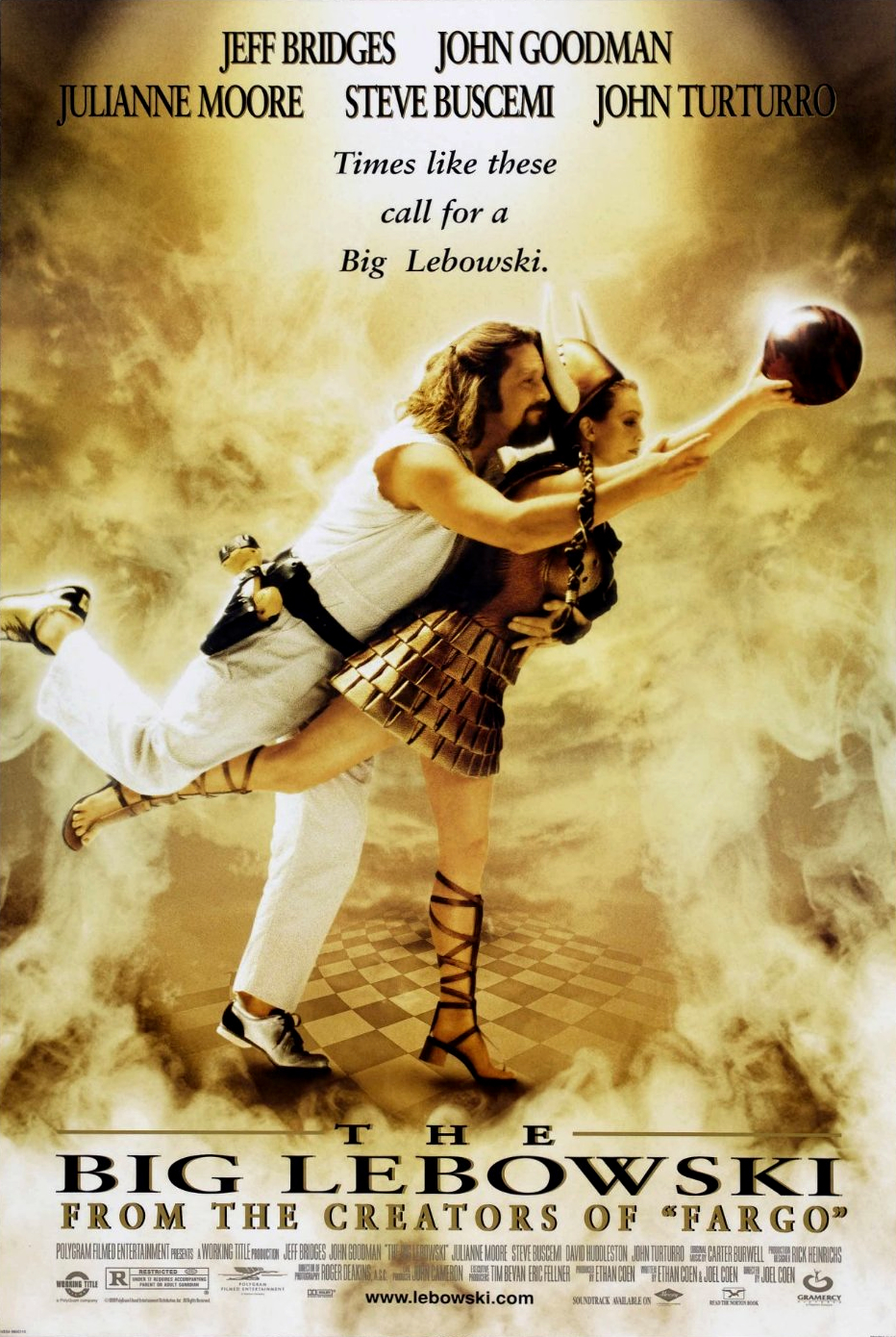
The Big Lebowski (1998)

THE BIG LEBOWSKI

THE BIG LEBOWSKI (1998) Four stars
The Coen Brothers’ THE BIG LEBOWSKI starts with a brilliant idea: Why not take a blissed out former 1960s radical who loves his White Russians and his bowling with his two best mates and place him right smack dab in the heart of a labyrinthine plot straight from THE BIG SLEEP.

You might remember Howard Hawks’ 1946 classic, starring Humphrey Bogart and Lauren Bacall. That’s the one where writer Raymond Chandler famously said of the identity of the murderer of the Sternwoods’ chauffeur, “I don’t know.” Apparently, neither did Hawks or any of the various writers — William Faulkner, Leigh Brackett, Jules Furthman, and Phiip Epstein — involved with the screen adaptation of Chandler’s 1939 novel.

How does Jeffrey “The Dude” Lebowski react to such a convoluted plot?

I believe he explains it as such, “This is a very complicated case. You know, a lotta ins, lotta outs, lotta what-have-you’s. And, uh, lotta strands to keep in my head, man. Lotta strands in old Duder’s head. Luckily I’m adhering to a pretty strict, uh, drug regimen to keep my mind, you know, limber.”

Main characters “The Dude” and Walter Sobchack are known to be inspired by a couple Hollywood eccentrics: Jeff Dowd and John Milius.

Dowd was a member of the Seattle Liberation Front, a radical anti-Vietnam War protest group that became known as the Seattle Seven. Lebowski mentions this fact in THE BIG LEBOWSKI.

Dowd then became a producer’s representative, a consulting producer, creative consultant, post-production consultant, producer, and executive producer. Those are some of his credits.

Ethan and Joel Coen first met Dowd around the time of their feature debut BLOOD SIMPLE.

I remember coming across him in the writings of Roger Ebert, for example a story from the 1999 Toronto Film Festival called “Dude Keeps Building a Rep.”

It starts out with Dowd telling Ebert that he’s got to see a movie called GOAT ON FIRE & SMILING FISH. Ebert’s in the press office at the Toronto Film Festival, only out of his hotel room four minutes before Dowd could find the critic. Dowd hands Ebert two Xeroxed sheets stapled together promoting GOAT ON FIRE & SMILING FISH.

Ebert wrote, “The Dude’s name is Jeff Dowd. He is tall and large and has a lot of unruly curly hair and a big mustache. If you saw the Coen Brothers movie THE BIG LEBOWSKI, Jeff Bridges was playing a character based on him, although the Dude is a great deal more abstentious than the Bridges character. If he were not, the movie would have been called THE LATE LEBOWSKI. The Coens and Dowd go back a long way, to 1984, when he was telling me, ‘You gotta see this one. It’s called BLOOD SIMPLE. These are the Coen Brothers.’”

Dowd “repped” THE BLACK STALLION, CHARIOTS OF FIRE, HOOSIERS, THE STUNT MAN, and THE BLAIR WITCH PROJECT, just like he did GOAT ON FIRE & SMILING FISH.

Dowd to Ebert, “Just so people see them. I’d walk up and down the lines for hit movies, handing out brochures for what we were showing. The way I figure it is, who goes to movies? People who go to movies, that’s who. They may or may not read Premiere magazine. They may or may not watch TV. But they go to movies. So if Warner Bros. spends $40 million to promote a movie and they’re standing in line to see it, why not tell them about my movie?

“A lot of the movies, they’re not what they seem to be. You take THE BLACK STALLION. The studio said it would never appeal to children because the first 18 minutes were without dialogue. I hold a test screening. A little girl, 5 years old, is in front of me. She tells her mommy she has to pee. She gets up and stands on the aisle, still watching the screen, and she stands there for the next 10 minutes. Her knees are knocking together, she has to pee so bad, but she can’t stop watching. The whole history of THE BLACK STALLION was changed, right then and there.”

The St. Louis-born Milius’ writing credits include JEREMIAH JOHNSON, MAGNUM FORCE, APOCALYPSE NOW, 1941, and CLEAR AND PRESENT DANGER. He both wrote and directed THE WIND AND THE LION, BIG WEDNESDAY, CONAN THE BARBARIAN, and RED DAWN. He’s not directed anything since 1997.

Milius says that Hollywood blacklisted him for his conservative beliefs.

He’s the disreputable one of the Film Brat Generation, whose friends and colleagues include Steven Spielberg, George Lucas, Francis Ford Coppola, and Brian DePalma.

A 2017 Indie Film Hustle story comes with the tagline “John Milius: The Craziest Director in Hollywood?”

“He’s a really funny guy, a really good storyteller,” Ethan Coen said of Milius in a book on THE BIG LEBOWSKI. “He was never actually in the military, although he wears a lot of military paraphernalia. He’s a gun enthusiast and survivalist type. Whenever we saw him, he’d invite us out to his house to look at his guns — although we never took him up on it.”

You can hear Milius’ storytelling abilities on commentaries for APOCALYPSE NOW, 1941, and CONAN THE BARBARIAN, for example.

Milius contributed Robert Shaw’s famous U.S.S. Indianapolis speech in JAWS (uncredited), some of Dirty Harry’s best lines, and all that stuff about surfing in APOCALYPSE NOW.

It helps that John Goodman, like Milius, is a native of the St. Louis area.

Bridges and Goodman have been two of the best actors working in the movies.

They’re probably as close to a guarantee of quality as anybody you can name.

“The Dude” and Walter are likely the characters they will be most associated with all their lives.

There’s lots of inspired madness throughout THE BIG LEBOWSKI.

Like the trippy production number called “Gutterballs,” combining bowling and Busby Berkeley, all scored by Kenny Rogers and the New Edition’s “Just Dropped In (To See What Condition My Condition Was In),” Rogers’ first Top 10 hit.

Like the German nihilists who have a band and album that are parodies of / homages to Kraftwerk, with the band name Autobahn and the album cover that’s similar to THE MAN-MACHINE.

Like utilizing gems like Bob Dylan’s “The Man in Me” and Captain Beefheart’s “Her Eyes Are A Blue Million Miles.”

Like Mr. Lebowski’s rant about the Eagles. Reportedly, Allen Klein (1931-2009) wanted $150,000 for usage of the Rolling Stones’ “Dead Flowers,” but he waived that licensing fee because he so loved the scene where “The Dude” hates on the Eagles. You’re not the only one, Mr. Klein.

THE BIG LEBOWSKI joins TWILIGHT ZONE: THE MOVIE and AN AMERICAN WEREWOLF IN LONDON for some of the best utilization of Creedence Clearwater Revival in a moving picture.

Coupled with BOOGIE NIGHTS (1997), THE BIG LEBOWSKI helped start my love affair with Julianne Moore, which continued over many, many years in everything from THE END OF THE AFFAIR to CHLOE.

Character actors Steve Buscemi, John Turturro, Ben Gazzara, David Huddleston, and Philip Seymour Hoffman all lend their abilities to the menagerie.

Never mind Sam Elliott’s voiceover narration.

I vividly remember coming across THE BIG LEBOWSKI when it came on Showtime in the late 1990s. I played the VHS dub I had for several friends and it became one of our favorite movies.

I’ve seen it many, many, many times over the years. It’s my favorite Coen Brothers movie, certainly far ahead of the overrated FARGO and NO COUNTRY FOR OLD MEN.

An old friend would seemingly only want to play THE BIG LEBOWSKI, FEAR AND LOATHING IN LAS VEGAS, and THE CROW, although he would also play the hell out of CITY LIGHTS, BLADE RUNNER, and SOME LIKE IT HOT as well, for that matter.

It’s been a while since I’ve watched it and I just might have to change that very, very soon.