
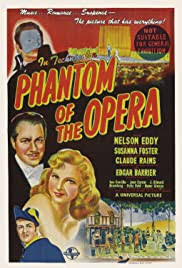
Phantom of the Opera (1943)

PHANTOM OF THE OPERA (1943) **
I put off watching a sound version of Phantom of the Opera for the longest time and the 1943 Phantom of the Opera only confirmed that suspicion and doubt.

Claude Rains did not even remotely approach what Lon Chaney accomplished in the 1925 silent version and I have to face the fact that I am definitely not the world’s biggest opera fan.

Yes, I do realize that I made it through A Night at the Opera and Opera with relative ease, but predominantly because I am big fans of both the Marx Brothers and Dario Argento, not opera.

Allan Jones’ production numbers in both A Night at the Opera and A Day at the Races, as well as James Whale’s Show Boat, are why they invented the fast-forward and skip buttons. The Marx Brothers’ numbers are infinitely better on the ears.

As for Argento, he goes so far over the top (especially in the murder sequences) that I find his operatic excess in Opera enjoyable.

Universal Studios invested $1.75 million on Phantom of the Opera (both Phantom and fellow 1943 release Frankenstein Meets the Wolf Man received much larger production budgets than previous Universal releases, like, for example, the $180,000 Wolf Man from 1941) and the film accomplished something unique for an Universal horror film — win an Academy Award, for Best Art Direction and Best Cinematography, and it was nominated in two more categories.

Phantom of the Opera, the first adaptation of the 1910 Gaston Leroux novel filmed in Technicolor, became a hit, especially in France.

Sorry to say, though, it’s not deserving of classic status.

Universal released 25 horror films from 1931’s Dracula through 1948’s Abbott and Costello Meet Frankenstein that are grouped together in the Classic Monsters series and I rank Phantom of the Opera only ahead of The Mummy’s Ghost, The Mummy’s Curse, and The Invisible Woman.

Lon Chaney Jr. (1906-73) felt slighted Universal did not consider him for his father’s most legendary role. Granted, he was an incredibly busy actor. Chaney Jr. had starring roles in the three films immediately surrounding Phantom of the Opera in 1942 and 1943 — his first time playing Kharis in The Mummy’s Hand, his second time as Larry Talbot / The Wolf Man in Frankenstein Meets the Wolf Man, and his first and only time as Dracula in Son of Dracula. Chaney Jr. previously took on Frankenstein’s Monster in The Ghost of Frankenstein (1942) and he proved himself Universal’s most versatile monster thespian, only missing the Invisible Man and the Phantom from his credits.

Chaney Jr. especially worked as Larry Talbot / The Wolf Man, and I am imagining what he could have done in Phantom of the Opera.

Rains killed it as Dr. Jack Griffin in the 1933 James Whale classic The Invisible Man. In Phantom of the Opera, not so much, because he’s just not scary, even without his ridiculous mask when his mutilated face is revealed in the laughable grand finale. He’s not the film’s main problem, though, believe it or not.

I mean, Rains plays the freaking title character in Phantom of the Opera and he’s third-billed, for crying out loud, behind our singing leads Nelson Eddy and Susanna Foster. This never happened to Lon Chaney, who’s billed above both Mary Philbin and Norman Kerry. Rains’ Phantom becomes less of a factor and that just about sums up the failure of this particular Phantom of the Opera — too heavy on the opera and too light on the phantom.
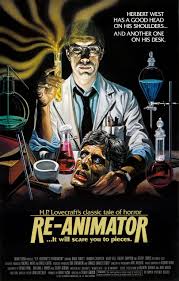
Re-Animator (1985)

RE-ANIMATOR

RE-ANIMATOR (1985) Four stars

Watching director Stuart Gordon’s feature debut for the first time in a theater and the first time in a couple years, I became impressed all over again by a horror movie that’s so gory and gross that it crosses over from gory and gross into surreal and comical.

DAWN OF THE DEAD (1978) and EVIL DEAD II (1987) are two more examples.

I also became impressed once again by the performances of Jeffrey Combs as Herbert West and the late David Gale as Dr. Carl Hill. Their work helps elevate RE-ANIMATOR.

I absolutely love Combs’ performance in RE-ANIMATOR. West’s a mad scientist pushed to the absolute limit of madness, but he’s not the least bit campy. He’s intense and 1,000 percent committed to his life’s work. West never waivers from this intensity, not even in the face of death or being kicked out of medical school. Mr. West has developed a reagent that can re-animate dead bodies, and his experiments graduate from a house cat to humans. West will see it through.

The poster’s tagline: “Herbert West has a good head on his shoulders … and another one on his desk.”

That another one belongs to Dr. Hill, whose ego and libido are epic and legendary.

Gale (1936-91) plays Dr. Hill in sleaze mode. This is a character that you absolutely love to hate. You want to see him bashed over the head with that shovel, but you also enjoy when his disembodied head takes command over the rest of his body and then takes control of the situation against West and his reluctant partner Dan Cain (Bruce Abbott). West hates Dr. Hill from the get-go and it’s fun to watch their mutual hatred for each other develop over RE-ANIMATOR.

Dr. Hill lusts after both Cain’s fiancee Megan (Barbara Crampton) and West’s reagent, and his intense lusting only makes this character even more hatable.

Crampton plays a tougher role than any of the boys: She gasps and screams a lot, understandably so, and she’s naked a couple times, including for one of the most interesting sex scenes around since it alternates between disturbing and comical. Let’s just say the disembodied head of Dr. Hill attempts to carry out his depraved sexual fantasies.

RE-ANIMATOR follows Mr. West and Dr. Hill into some ripped, twisted territory, but it’s also delightfully funny.

In a review of AN AMERICAN WEREWOLF IN LONDON, I rattled off a bunch of titles from the 80s that effectively balanced horror and comedy: EVIL DEAD II, FRIGHT NIGHT, GREMLINS, GHOSTBUSTERS, KILLER KLOWNS FROM OUTER SPACE, and, yes, of course, RE-ANIMATOR.

Those films carry on the proud tradition of the great 1930s horror films that successfully integrated comedy into horror, without one sacrificing the other. You can laugh one moment and be frightened the next, or delighted that next moment, all legitimate reactions.

Guess it’s the highest praise for RE-ANIMATOR when you say that it could have been directed by James Whale (1889-1957), who brought us FRANKENSTEIN, THE OLD DARK HOUSE, THE INVISIBLE MAN, and BRIDE OF FRANKENSTEIN.

The Old Dark House (1932)

day 15, the old dark house

THE OLD DARK HOUSE (1932) Four stars
Stop me if you think you’ve heard this plot before: On a dark and stormy night, five travelers are caught up in one helluva storm and flooded out roads make it virtually impossible for travel by motorcar. Our travelers seek out overnight shelter from the storm and take refuge at the nearest house.

Next time, of course, our travelers might just take their chances with the rain and the mud rather than people like the ones they find inside that house or, if nothing else, keep walking and eventually find another house with different people inside.

THE OLD DARK HOUSE takes this old-fashioned plot (probably old-fashioned in 1932) and classes it up because of atmosphere, the cast, and the sharp screenplay by J.B. Priestley, Benn Levy, and R.C. Sherriff.

It’s directed by that master of 1930s cinema, James Whale, whose credits include WATERLOO BRIDGE, FRANKENSTEIN, THE INVISIBLE MAN, BRIDE OF FRANKENSTEIN, and THE GREAT GARRICK, some of the best from that era.

Whale’s movies generally have style for miles and miles, and intelligence and wit at their core to go along with their atmosphere.

THE OLD DARK HOUSE is no different, and cinematographer Arthur Edeson and production designer Charles D. Hall do wonders to create a sustained mood for 72 minutes. You’re in the hands of master craftsmen, as well as master performers.
Worlds collide in THE OLD DARK HOUSE.

The Femm house contains dread people who have dread secrets: brother and sister Horace (Ernest Thesiger) and Rebecca (Eva Moore), butler Morgan (Boris Karloff, still not speaking after FRANKENSTEIN), 102-year-old patriarch Sir Roderick Femm (played by a woman named Elspeth Dudgeon when the credits give John Dudgeon), and the pyromaniac named Saul (Brember Willis) who’s kept hidden in a locked room. Horace and Rebecca behave like they’re hiding something (namely their brother Saul) and Morgan, why he’s a mean drunk.

Our travelers are Philip Waverton (Raymond Massey) and his wife Margaret (Gloria Stuart) and Roger Penderel (Melvyn Douglas) and then Sir William Porterhouse (Charles Laughton) and his girlfriend Gladys DuCane (Lilian Bond), who come calling at dinner time.

You can basically guess what happens in THE OLD DARK HOUSE and while that normally sinks lesser pictures, you want the travelers to encounter the dread people and discover the dread secrets inside the Femm house, because you know that you will enjoy watching this plot unfold. We want to see who gets out of there alive in the morning.

There’s really not anything complicated about THE OLD DARK HOUSE, but it’s one of the best examples of the haunted house film, a branch of the horror genre that includes such films as THE SHINING, POLTERGEIST, AMITYVILLE HORROR, and the first two EVIL DEAD movies.

The late film critic Roger Ebert loved to say “It’s not what a movie is about, it’s how it is about it.”

THE OLD DARK HOUSE could be used as one of the exhibits for that argument.

Bride of Frankenstein (1935)

day 14, bride of frankenstein

BRIDE OF FRANKENSTEIN (1935) Four stars
Boris Karloff movies could fill an entire year of daily movie reviews.

Karloff (1887-1969) undoubtedly is one of the most prolific actors who ever lived, working steadily from 1918 through 1968.

Karloff established an incredible work pace, especially in the 1930s.

Take, for example, the years 1931 and 1932 alone when Karloff appeared in 24 films, including such classics as FRANKENSTEIN, SCARFACE, THE OLD DARK HOUSE, THE MASK OF FU MANCHU, and THE MUMMY.

He was billed only as “Karloff” in several pictures after FRANKENSTEIN (1931) made him a phenomenon.

For example, a producer’s note before the start of THE OLD DARK HOUSE: “Karloff, the mad butler in this production, is the same Karloff who created the part of the mechanical monster in ‘Frankenstein.’ We explain this to settle all disputes in advance, even though such disputes are a tribute to his great versatility.”

Every time I watch both FRANKENSTEIN and BRIDE OF FRANKENSTEIN (1935), I am just amazed once again by what Karloff was able to do with The Monster.

He’s absolutely phenomenal.

It took make-up artist Jack Pierce four hours every day to make Karloff into Frankenstein’s Monster, with a concoction of cotton, collodion, gum, and green greasepaint. Pierce and Karloff worked together on a multitude of films during the Golden Age of Horror (1930s and 1940s).

The IMDb identified eight Karloff trademarks and I especially like the eighth one: “Making audiences feel sorry for his evil characters by displaying extreme frailty and vulnerability, even when the material didn’t call for this.”

We feel a multitude of things for the Frankenstein Monster, and that’s at the center of the character’s greatness.

We especially feel for The Monster during BRIDE OF FRANKENSTEIN, a rare sequel that builds upon and honestly betters the previous film.

Karloff did not want The Monster to speak, feeling that it would eventually destroy the character. He looks a little differently here than in the first film, because in order to speak more clearly Karloff did not remove the dental plate in his face like he did in the first film. His cheeks appear less hollow as a result.

While giving The Monster the ability to speak could have miserably backfired, it works (like just about everything else) in BRIDE OF FRANKENSTEIN.

The Monster is a quick learner and the writers give him some great lines.

“I love dead … hate living” and “Alone: bad. Friend: good!” might not seem like much on the page, but the way Karloff handles them, they affect viewers on a deep emotional level.

There’s much poignancy to be found in the plight of The Monster.

He’s more like an innocent child than pure evil in both FRANKENSTEIN and BRIDE OF FRANKENSTEIN.

He can’t help what God or Dr. Henry (Victor in the novel) Frankenstein in this case made him.

Like Karloff, Colin Clive returns for the sequel as Dr. Frankenstein and he’s reluctant to the extreme (after the events of the first movie) to participate in Dr. Pretorius’ scheme to make The Monster a bride. Finally, he does though, of course, and it’s back to the laboratory; production designer Charles D. Hall’s lab sets in the first two FRANKENSTEIN films have been endlessly influential.

Clive and Dwight Frye (killed as two different characters in FRANKENSTEIN and BRIDE OF FRANKENSTEIN) are two of the great scenery chewers of all-time, but this is largely Karloff’s and Ernest Thesiger’s show.

Thesiger plays Dr. Pretorius, Dr. Frankenstein’s former teacher and, of course, a rebellious mad scientist. He’s as explicitly homosexual as one could present in a 1935 film and, according to the book “The Monster Show: A Cultural History of Horror” by David J. Skal, openly gay director James Whale told Thesinger to play Dr. Pretorius as an “over-the-top caricature of a bitchy and aging homosexual.”

Frankenstein and Pretorius rank among the best screen mad scientists.

BRIDE OF FRANKENSTEIN can be enjoyed at face value or can be seen as a daring gay parable that sneaked just enough content past the censors.

In the 1997 Gary Morris article “Sexual Subversion: The Bride of Frankenstein” printed in the Bright Lights Film Journal, the author postulates that the movie “assaults the notion of the sanctity of standard sex roles and ‘family values.'” Whale thus made the only sequel that interested him.

“THE BRIDE can be read from a modern perspective as a homosexual joke on the heterosexual communities Whale — a gay man — served and benefited from: his ‘masters’ at Universal and the mass audience to whom he could present unconventional images and ideas and see them unknowingly endorsed and approved in the most direct way possible: from the moviegoer’s pocketbook,” Morris wrote.

Under this theory, Whale’s attacks on hetero institutions can be seen most vividly when The Bride (Elsa Lanchester) rejects The Monster near the end, including a famous hiss that speaks louder than a thousand words. (Reportedly, Lanchester based her spitting and hissing on the swans in Regent’s Park, London.)

Not everything passed the censors enforcing the Motion Picture Production Code: Any references to the sexual arrangements of Mary Shelley (Lanchester in her first of two roles), Percy Bysshe Shelley, and Lord Byron (especially this line of dialogue: “We are all three infidels, scoffers at all marriage ties, believing only in living freely and full”) and “too revealing” shots of Lanchester’s cleavage were cut.

It’s still amazing what Whale put into the film.

Others have dismissed the gay parable angle in BRIDE OF FRANKENSTEIN.

That’s fine because any way you read it, though, BRIDE OF FRANKENSTEIN is a classic.