
Dead of Night (1945)

DEAD OF NIGHT (1945) ****
Back in 2005, I needed three credits to complete a master’s degree in history (lifetime underachievement) and I finished a three-week 120-hour internship that summer at the National Archives in Kansas City, Missouri.

Anyway, they let me loose on their free account on some genealogical site as reward for good behavior and a day-and-a-half later I came back with Sisney family history dating back to 1776.

On February 27, 1776, a few months before the Declaration of Independence, Steven Sisney fought at and was captured and imprisoned during the Battle of Moores Creek Bridge near Wilmington, North Carolina. Sisney was one of about 1600 loyalist-siding Highland Scots who marched from Cross Creek, North Carolina, toward the coast behind British Colonel Donald McLeod. The loyalists lost, the patriots received a morale boost, and North Carolina became the first colony to vote for independence, beating the official declaration by a couple months easy.

Every once in a while, I think about Steven Sisney and his loyalty to the British since I favor the Beatles and the Stones and the Who and the Kinks and Black Sabbath and Led Zeppelin and the Clash and the Sex Pistols and the Buzzcocks and Radiohead and Pink Floyd and Peter Cushing and Christopher Lee and Sherlock Holmes and James Bond and Alec Guinness and Cary Grant and Ben Kingsley and Ian McKellen and Glenda Jackson and Hammer and Hitchcock and Monty Python and Lord of the Rings and Harry Potter and on and so on and on some more again.

If nothing else, the 1945 horror anthology film Dead of Night made me think about Steven Sisney, the epic 1989 David Hackett Fischer history book Albion’s Seed: Four British Folkways in America (never forget the saga of the poor one-eyed servant George Spencer in New Haven, who was hanged for bestiality after a sow birthed a deformed pig with one eye and the two witnesses required for conviction were the deformed piglet and Spencer’s recanted confession), the late Pittsburg State history professor Judith Shaw (1931-2013) who taught many British History courses over the decades, and how much of an impact Dead of Night had on Richard Attenborough’s Magic.

Horror anthologies generally offer a mixed bag of success and failure.

Of course, Ray Davies outlined it in Celluloid Heroes, Success walks hand-in-hand with failure along Hollywood Boulevard. I always think about Twilight Zone: The Movie from 1983 to illustrate the mixed bag qualities of just about every anthology we’ve ever been expected to consume. The segments directed by John Landis and Steven Spielberg suck, the ones from Joe Dante and George Miller are dynamite, and the prologue and epilogue push the overall package into positive review terrain.

In Dead of Night, Alberto Cavalcanti directed Christmas Party and The Ventriloquist’s Dummy, Charles Crichton directed Golfing Story, Robert Hamer directed The Haunted Mirror, and Basil Dearden directed Hearse Driver and Linking Narrative.

It all starts when architect Walter Craig (Mervyn Johns) tells host and potential client Eliot Foley (Roland Culver) and his guests at country estate Pilgrim’s Farm that he’s seen them all in a recurring dream. Craig feels like he’s been at Pilgrim’s Farm before and every guest rings a bell to him despite never having met any of them before. Each person (host and guests alike) rattles off a supernatural tale, inspired by Craig’s revelations. Craig wants to leave because he doesn’t want his dream to come true and the guests do their best to make him stay.

The Haunted Mirror and The Ventriloquist’s Dummy are especially brilliant and Golfing Story reminds one that Ealing Studios later brought us Kind Hearts and Coronets, The Lavender Hill Mob, and The Ladykillers, all of which feature a dark comedy that seems to have started with Hitchcock. Hamer directed Kind Hearts and Coronets and Crichton directed The Lavender Hill Mob (and later on in his career A Fish Called Wanda).

Basil Radford (1897-1952) and Naunton Wayne (1901-70) appear together in Dead of Night, but not as their characters Charters and Caldicott. Charters and Caldicott began in Hitchcock’s 1938 classic The Lady Vanishes and then the acting duo appeared together in a series of films from 1940 through 1949, including three more times playing Charters and Caldicott. They are very funny, both individually and collectively, in Dead of Night. They don’t seem particularly gay in Dead of Night.

During The Haunted Mirror, guest Joan Cortland (Googie Withers) relays to us what happened after she gifted an antique mirror to her future husband Peter (Ralph Michael). Peter sees another room in the mirror’s reflection, does not see Joan in the mirror when she confronts him, and for a spell he sees the room as normal. Joan finds out the history of the mirror and the wealthy man who owned it after she visits the antique shop from which she purchased the mirror. This wealthy man was crippled in a riding accident, then he grew so insanely jealous of his wife that he strangled her and he finally slit his own throat in front of the mirror. When Joan returns home, Peter accuses her of having an affair and then he attempts to strangle her. Joan smashes the mirror in sheer desperation and breaks the spell.

In The Ventriloquist’s Dummy, the absolute most effective segment, resident rational explanation seeker Dr. Van Straaten (Frederick Valk) tells us about the case of ventriloquist Maxwell Frere (Michael Redgrave) and his dummy Hugo Fitch. Maxwell develops a dual personality with Hugo becoming the dominant part. Poor, poor, poor Sylvester Kee (Hartley Power), who happens to catch and be impressed by the act.

In the long run, I was much impressed by Dead of Night and I recommend it to anyone.
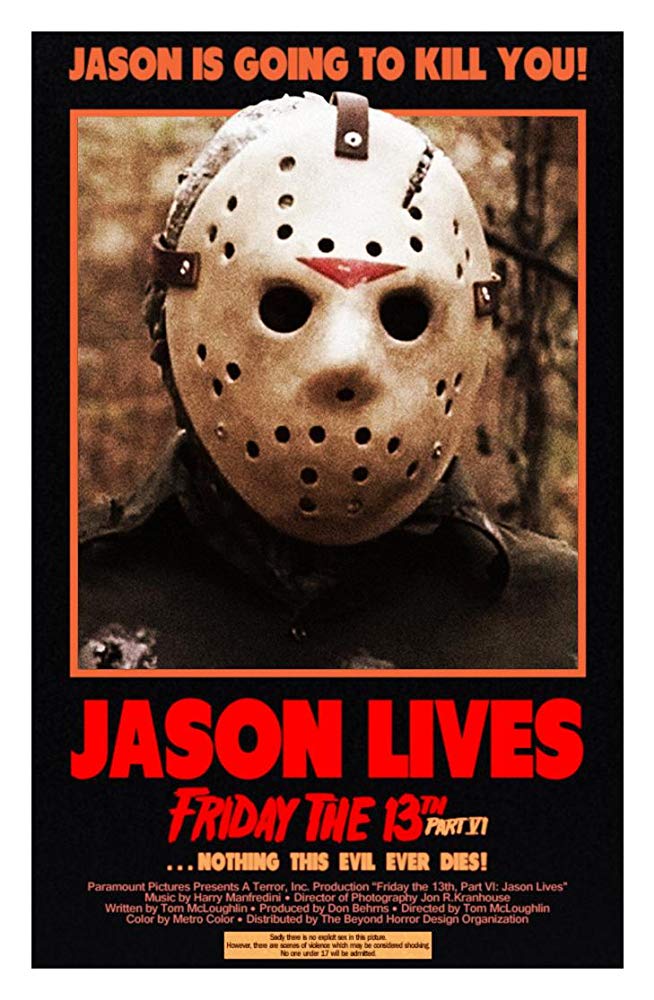
Friday the 13th Part VI: Jason Lives (1986)

JASON LIVES

FRIDAY THE 13TH PART VI: JASON LIVES (1986) Three stars

I find the FRIDAY THE 13TH movies that I like the most are the ones with the best sense of humor.

That’s why I’ll call PART VI: JASON LIVES the best film in the entire series, beating out PART III and THE FINAL CHAPTER. JASON LIVES includes several intentionally funny scenes and that helps its 86 minutes go down smoothly.

Director and writer Tom McLoughlin wanted to satirize a slasher movie all while making one, turn Jason into a supernatural zombie, and not simply churn out a carbon copy of the five previous movies in the series. There are moments intended to recall classic horror movies, like the beginning scene in the cemetery echoes the grave robbers at the beginning of FRANKENSTEIN MEETS THE WOLF MAN. Jason’s revival from the dead courtesy lightning also recalls Frankenstein’s Monster.

“I set up a lot of visual gags,” McLoughlin said in the book “A Strange Idea of Entertainment — Conversations with Tom McLoughlin.” “Like when my wife Nancy is killed by Jason. She tries to bribe him, offering him her wallet to keep him from killing her. She’s got money and a credit card in her wallet, and when Jason kills her in this giant mud puddle, the money sinks and the American Express card floats. I held on that shot for a few extra beats because I knew there would always be some joker in the theater that would yell, ‘Don’t leave home without it!’ And someone always did.”

McLoughlin’s background proved to have a strange influence on Jason Voorhees.

“I was recently interviewed about it, and someone said, ‘Your Jason seemed to be much more communicative,’” McLoughlin said. “I said, ‘That’s because I was dealing with a mime character.’ When he sees the motor home bouncing up and down because a couple are having sex in there, Jason just stands there and stares, with his head tilting back and forth — like a dog trying to figure out what’s going on. It got a big laugh. I wasn’t making fun of Jason … I just figured he would be processing what was going on in that motor home. Whenever I find a way to put my mime training to use in storytelling, I do it.”

Marcel Marceau influenced Jason Voorhees. Makes perfect sense to me.

McLoughlin sang in a rock band before he went to Paris to study mime under Marceau. Back in the States, several years later, McLoughlin had a part as the mutant bear monster in the 1979 horror film PROPHECY directed by John (MANCHURIAN CANDIDATE) Frankenheimer. All these experiences seemingly fed McLoughlin more insight into Jason than any other director.

Alice Cooper provided three songs for JASON LIVES:  “Teenage Frankenstein,” “Hard Rock Summer,” and “He’s Back (The Man Behind the Mask).” Unfortunately, they are not classic Alice Cooper songs, a la the four-album period from “I Love It to Death” through “Billion Dollar Babies” when the band cranked out some of the greatest hard rock ever made, but I still enjoy “He’s Back.” SCREAM later made great use of the Alice classic “School’s Out.”

Speaking of SCREAM, apparently screenwriter Kevin Williamson wanted McLoughlin to direct his hot commodity screenplay, before the project ended up with Wes Craven. Williamson told McLoughlin that JASON LIVES and its humor made a huge impact on Williamson during his youth, so much so that it served as one of the inspirational springboards for SCREAM.

There’s a James Bond gun barrel sequence parody, dialogue that breaks the proverbial fourth wall, a camper reading Jean-Paul Sartre’s existentialist play “No Exit,” a camper praying to God for the first (and only) time in the series, and even Jason surprised at his own astonishing strength. Also, for the first and only time in the series, young campers are in attendance at Camp Forest Green, er, Camp Crystal Lake.

“I’ve seen enough horror movies to know any weirdo wearing a mask is never friendly” and “Some folks sure got a strange idea of entertainment” are lines that display how JASON LIVES influenced SCREAM.

The young children, who Jason does not harm, have their moments, as well, especially when one boy asks his little friend, “So, what were you gonna be when you grew up?”

All these words so far and I have not even mentioned protagonist Tommy Jarvis, who figured in THE FINAL CHAPTER, A NEW BEGINNING, and JASON LIVES. He’s responsible for reviving Jason in the opening sequence and Tommy even makes sure to bring that infamous hockey mask with him. Originally, it had been planned for Tommy to become the antagonist, but it was the extremely negative reaction to A NEW BEGINNING and its non-Jason killer which truly brought Jason back from the dead. Tommy never panned out like he should have and part of the problem is that he’s played by three different actors, Corey Feldman (THE FINAL CHAPTER), John Shepherd (A NEW BEGINNING), and Thom Mathews (JASON LIVES).

Anyway, definitely by this point in the series, Jason became the focus of attention and the antihero extraordinaire of the late ‘80s. Dan Bradley played Jason in the paintball massacre sequence, but former soldier C.J. Graham handled the rest of the duties. He’s a lot more interesting than Tommy Jarvis. That’s why the series moved forward with Jason (Kane Hodder the man behind the mask for four more sequels) and without Tommy Jarvis.

The Spy Who Loved Me (1977)

THE SPY WHO LOVED ME

THE SPY WHO LOVED ME (1977) Three-and-a-half stars

This is the best of the James Bond films starring Roger Moore (1927-2017) and the one that ranks with the Best of the Bonds like FROM RUSSIA WITH LOVE, GOLDFINGER, ON HER MAJESTY’S SECRET SERVICE, TOMORROW NEVER DIES, and SKYFALL.

I believe it’s no small coincidence that after our small Kansas town of Arcadia finally picked up cable TV, I became hooked on watching James Bond films on TBS. It also helped that I hit puberty during this Bond discovery. Bond just fits perfectly with an adolescent mindset.

Moore had the unenviable task of replacing Sean Connery as Bond. Connery established Bond in the hearts and minds of the public after playing the character in DR. NO, FROM RUSSIA WITH LOVE, GOLDFINGER, THUNDERBALL, YOU ONLY LIVE TWICE, and then DIAMONDS ARE FOREVER after the George Lazenby Bond Experiment proved disastrous. (I’ll argue that ON HER MAJESTY’S SECRET SERVICE is one of the two or three best James Bond pictures.)

Connery’s first three Bond pictures especially worked as legitimate thrillers. He brought a conviction and toughness to the character that Moore generally lacked during his run from 1973 to 1985. Moore made seven Bond films, beginning with LIVE AND LET DIE and ending with A VIEW TO A KILL. In 1983, both Moore and Connery starred in competing Bond pictures, Moore in OCTOPUSSY and Connery in NEVER SAY NEVER AGAIN, the latter title a reference to Connery’s reported quote from 1971 that he would never play James Bond again.

Moore played a radically different Bond than Connery and his worst Bond films descended into campy territory, everything from the cheesiest double entendres and over-the-top product placement to a cartoonish character like Clifton James’ Sheriff J.W. Pepper in two films and a Bond-meets-Blaxploiation plot like 1973’s LIVE AND LET DIE.

Connery got down and dirty, whereas Moore never soiled his suit. That’s at least the perception.

THE SPY WHO LOVED ME is a cinematic exhibit for that old phrase “third time’s a charm,” since this is Moore’s third outing as Bond.

Moore fits the character better and let’s face it, THE SPY WHO LOVED ME benefits significantly from a great Bond girl, Russian agent Major Anya Amasova a.k.a. Agent XXX (played by Barbara Bach), and a great henchman, Jaws (played by the 7-foot-2 Richard Kiel). Both Agent XXX and Jaws stand among the great Bond girls and great Bond henchmen, respectively.

On top of that, we have Carly Simon’s “Nobody Does It Better,” one of the great Bond songs with music by Marvin Hamlisch and lyrics by Carole Bayer Sager.

Jaws puts a genuine fright into Bond and we like the British super agent a lot better under such circumstances. Bond’s one-liners won’t save him against this relentless Jaws, who does take a licking and keeps on ticking. He’s a dedicated henchman.

We cheer on Jaws’ destruction — he does some great work on a truck — and we especially love him when he makes Bond squirm. Of course, we’re rooting for Bond, but it’s still more fun seeing the indestructible Bond against the indestructible Jaws. It’s a fair matchup, for a change. Silly fools that we are, we believe for isolated moments that Bond might finally meet his match. We hadn’t felt that way since ON HER MAJESTY’S SECRET SERVICE and before that GOLDFINGER.

Not only does Bond face Jaws, but Agent XXX wants revenge on Bond once she finds out that he killed her lover Sergi Barsov (in the movie’s opening). Will she or won’t she kill Bond? Of course, we all know the answer.

Production designer Ken Adam (1921-2016) did some of his best work for THE SPY WHO LOVED ME, and he earned an Academy Award nomination. Our megalomaniac Stromberg (Curt Jargons) wants to destroy the world and build a civilization under the sea … designed by Adam.

Veteran cinematographer Claude Renoir (1913-93) worked on his uncle’s films TONI and THE GRAND ILLUSION. His work on THE SPY WHO LOVED ME should have been a fourth Academy Award nomination for the film.

In other words, THE SPY WHO LOVED ME is a first-rate production and entertainment that ranks among the very best James Bond films.

Five best James Bond films:

— ON HER MAJESTY’S SECRET SERVICE (1969)

— GOLDFINGER (1964)

— FROM RUSSIA WITH LOVE (1963)

— SKYFALL (2012)

— THE SPY WHO LOVED ME (1977)