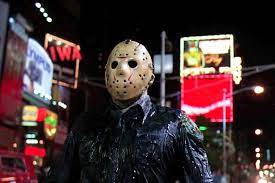
Friday the 13th Part VIII: Jason Takes Manhattan

FRIDAY THE 13TH PART VIII: JASON TAKES MANHATTAN (1989) *
The tragically titled Friday the 13th Part VIII: Jason Takes Manhattan just might be the first movie that I ever considered a bust, a disappointment, and a great big ripoff.

I remember looking forward to Jason Takes Manhattan because I had already seen Part III and Jason Lives on video and liked them a good deal and, let’s face it, I got all hyped up on promotional material that included the trailer and TV spots, the poster and print ads, and Jason Voorhees himself making a guest appearance on The Arsenio Hall Show on Friday, July 28, 1989, the date of the film’s release.

At that very point in time, I thought Jason Takes Manhattan would be the greatest thing ever in the whole wide world.

Boy, would I ever be wrong on that one!

Let’s see here, where to start, other than none of the human characters are exactly likable in the slightest degree, just like most of the later Friday the 13th sequels starting with A New Blood and running through both New Line Cinema films and the 2009 remake.

Uncle Charles, played by veteran character actor Peter Mark Richman (1927-2021), just might possibly be the most reprehensible character in the Friday series. Other worthy contenders right off the old head are Axel from The Final Chapter and Roy Burns from A New Beginning, but there’s so many loathsome characters in the later Friday films.

Jason Takes Manhattan almost feels like an episode of The Love Boat … seriously, the movie spends far more time on a boat than it does Manhattan. It’s unfortunate that Jason Takes Manhattan came out 30 years before Lonely Island’s I’m on a Boat.

Takes Manhattan? Seriously, are you kidding? More like Barely Walks Through Manhattan! It takes more than an hour of the longest entry in the Friday series to even get to Manhattan, and it’s disappointing even after we get there.

Director and screenwriter Rob Hedden possessed a vision to incorporate landmarks like the Statue of Liberty, the Brooklyn Bridge, and Madison Square Garden, naturally, but parent studio Paramount decided to be the Grinch and slash the budget for what turned out to be the final Paramount entry after a series of declining returns starting with A New Beginning and continuing through Jason Lives, A New Blood, and finally Jason Takes Manhattan.

They spent very little time in the actual Manhattan, and of course Vancouver stands in for the Big Apple most of the time.

Guess you could say Jason Takes Manhattan paved the way for Rumble in the Bronx, which makes up for featuring even less of the Bronx than Manhattan’s featured in Jason Takes Manhattan by having some absolutely fantastic Jackie Chan action scenes.

The kill scenes in Jason Takes Manhattan are disappointing, just like about every other single thing during the 100-minute motion picture.

In the film’s most famous scene, Lakeview High School boxing champion Julius Gaw engages our anti-hero Jason Voorhees in a boxing match and punches Jason many, many, many times before Jason knocks Julius’ block off with just a single punch.

I’ve always been underwhelmed by that scene, and I far prefer a similar scene the year before in Killer Klowns from Outer Space.

I don’t even want to think about another one of those patented beyond weird Friday endings that leave viewers dumbfounded and stupefied.

Here instead is a transcript of the Arsenio interview.

A: How are you?

That’s good.

You know what I’ve noticed. I see all your movies, man, and you know what I’ve really noticed. You’re angry.

I don’t mean to laugh. Excuse me, it’s just the way I am, but you’re you’re you’re angry.

What happened, man, where did it all begin?

[Long pause]

You know what I mean? Was it a woman? Did you get cut from the hockey team in high school?

What happened? What’s up?

Let me ask you this.

I saw the new movie, Jason Takes Manhattan.

You killed 16 people … I don’t know why I’m laughing.

You killed 16 people and you were responsible for the death of eight others. Total, that’s less than what you usually kill in a movie.

Are you getting soft? Are you losing a step?

You’re trembling, man.

Oh, you brought a clip.

Would you set it up for us?

Set up the clip, like tell them you know how this fits into the movie and what they’re about to see and all that kind of stuff.

Jason Takes Manhattan, here’s his clip.

[Times Square clip plays.]

Working on the streets of New York, did you get a lot of people come up to you to ask for your autograph and stuff like that?

Ever think about doing a musical?

[Another pause.]

I’m running out of questions, man.

Oh, I know what I wanted to ask you.

You didn’t kill anybody with that big knife you used to kill people with, did you change because you were afraid of being typecast as just being a big knife killer?

So what’s next, man?

Some more of Jason Part Nine, I got some great titles I put together.

Jason and the Three Babies. What do you think of that?

Jason’s Big Top would be funny.

Oh … Jason Rabbit.

That would be great.

Oh … When Jason Met Sally … would that be funny?

You don’t do many comedies, do you?

Um … I’d like to thank you for coming by. It’s a pleasure.

(Jason shakes Arsenio’s hand very, very, very strongly.)

Jason, ladies and gentlemen.

Definitely another case where the promotion is a whole lot better than the picture.
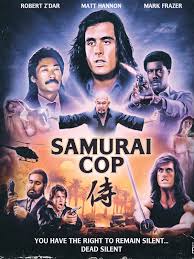
Samurai Cop (1991)

SAMURAI COP

SAMURAI COP (1991) ***

An outtake is defined as “a scene or sequence filmed or recorded for a movie or program but not included in the final version.”

Blown lines and stunts, we all know the routine by now.

Hal Needham and Jackie Chan may have made outtakes for the end credits a cinematic institution, but Iranian “jack of all trades and master of none” Amir Shervan (1929-2006) directed SAMURAI COP, a feature movie solely comprised of outtakes.

Shervan trumped such legendary figures as Dwain Esper, William “One Shot” Beaudine, Bert I. Gordon, Bill Rebane, Ray Dennis Steckler, and even Ed Wood in absolute sheer incompetence.

Like a select few bad movies, SAMURAI COP is so, so, so bad in so, so, so many marvelous ways that it passes all the way through bad into good. It belongs filed next to Efren C. Pinon’s THE KILLING OF SATAN and Claudio Fragasso’s TROLL 2.

— Mathew Karedas, a.k.a. Matt Hannon, stars as Joe Marshall. Most people, though, just call him “Samurai Cop.” Joe must be the least convincing samurai in all history, cinematic and otherwise. For one, Joe’s entire look screams more Fabio and Kato Kaelin than, let’s say, Toshiro Mifune and his most dangerous weapon brandished is that damn speedo he spends what feels like the entire second half of the movie in. Anyway, for somebody allegedly well-versed in the Japanese vernacular, he sure does struggle pronouncing the name “Fujiyama.” When asked by his partner Frank Washington (Mark Frazer) what “katana” means, Joe snaps back “It means Japanese sword.” You don’t say, you don’t say.

— Samurai Cop arguably spends more time being a ladies man than anything else. No, seriously, he beds three, er, two women and he even blatantly talks about the beauty of another woman in the presence of his lover. Smooth, real smooth. Late in the 96-minute spread, he tells his future conquest, “Let’s just say … I can read eyes.” I wish that you couldn’t read dialogue.

Here’s a dialogue exchange from the Planet-X:


Nurse: Do you like what you see?

Joe Marshall: I love what I see.

N: Would you like to touch what you see?

JM: Yes. Yes, I would.

N: Would you like to go out with me?

JM: Uh, yes I would.

N: Would you like to fuck me?

JM: Bingo.

N: Well, then let’s see what you’ve got …

[Nurse investigates Joe’s bulge]

N: Doesn’t interest me. Nothing there.

JM: Nothing there? Just exactly what would interest you, something the size of a jumbo jet?

N: Have you been circumcised?

JM: Yeah, I have, why?

N: Your doctor must have cut a large portion off.

JM: No, uh, he was a, he was a good doctor.

N: Good doctors make mistakes too, that’s why they have insurance.

JM: Hey … don’t worry. I got enough. It’s big.

N: I want bigger.

[Nurse walks away]


I doubt that any screen lothario has ever partaken in dialogue that bad and the sound that we just heard is Rudolph Valentino saying “Thank you” for having made only silent movies.

That dialogue plays like a combination of a porno movie and “Dick and Jane” (most of the rest of the movie belongs to knocking off LETHAL WEAPON) and it belongs alongside the SHARK ATTACK 3: MEGALODON interchange in the anals, er, annals of cinematic history:


Cataline Stone: I’m exhausted.

Ben Carpenter: Yeah, me too. But you know I’m really wired. What do you say … I take you home and eat your pussy.


Boy, that’s just about as great as the whole “Fini can water you” debacle from YES, GIORGIO.

— Lead actor Matt Hannon thought he was done with the picture and got himself a short haircut. Several months later, Shervan looked up Hannon and informed him they were going to reshoot scenes. Unfortunately, Hannon still had short hair. I say unfortunately because Hannon wears one of the least convincing wigs ever made during SAMURAI COP. It does not help that Hannon’s wig flies off during a late fight scene and the actor also displays his obvious displeasure having to wear his wig. Yeah, it’s that bad.

— The chase scenes alternate between moving incredibly slow (nothing like slow-moving cars …) and being artificially sped up (… except for cars that zip along unnaturally). Yes, there are times when the action in SAMURAI COP plays like a silent film projected at the wrong speed.

— Not sure that I want to spend that much more time and space on SAMURAI COP, because I don’t want to risk writing a dissertation. Yes, over 750 words feels like I have been writing on this movie for a long time. However, there’s so many more things wrong but right about SAMURAI COP that we could be here all day, ironic for a movie that lasts a meager 96 minutes. Just imagine SAMURAI COP at GONE WITH THE WIND length.

— In a review long ago, I wrote that the 1979 Chuck Norris action vehicle A FORCE OF ONE combines a standard issue cops and criminals plot acted out by a good cast with martial arts and a “very subtle” anti-drug message that plays like one of those infamous 1980s TV commercials, only featuring roundhouse kicks.

On that note, we can end this review with a public service announcement from SAMURAI COP: “Now I’m telling these son-of-a-bitches that we respect the Japanese of this country, who are honest businessmen. And yeah, this is the land of opportunity for legitimate business, not for death merchants who distribute drugs to our children through schools and on the streets. Now I’m telling these motherfuckers that if they continue killing our children to make their precious millions that they deposit in their secret Swiss bank accounts, counselor, before your lawsuit even gets off the court clerk’s desk, I’ll have their stinking bodies in garbage bags and ship them back to Japan for fertilizer.”

Beautiful, absolutely beautiful, and it makes me want to pop a top on an ice cold one and blast Alice Cooper’s “I Love America.”

Code of Silence (1985)

CODE OF SILENCE

CODE OF SILENCE (1985) Three-and-a-half stars

CODE OF SILENCE and LONE WOLF McQUADE are the best Chuck Norris movies.

They are the ones for people who otherwise grunt and groan at the possibility of watching a Chuck Norris movie. You know, individuals who go, “Ugh, I don’t like Chuck Norris, his movies are so dumb and stupid. They’re ridiculous and redneck.” Then, there’s other people who only want to watch Norris on “Walker, Texas Ranger” re-runs 24 hours a day 365 days a year because they have little tolerance for movie violence and vulgarity.

Let’s get a few things straight: I don’t especially care for Norris’ ultra-conservative politics (he predicted 1,000 years of darkness if Obama won a second term). I hate those darn infomercials that he did with Christie Brinkley plugging exercise machines. I cannot stand “Walker, Texas Ranger,” except for when clips were used for the “Walker, Texas Ranger Lever” on Conan O’Brien. I hate that he sued “Chuck Norris Facts” author Ian Specter because “Mr. Norris is known as an upright citizen to whom God, country, and values are of paramount importance” and “Mr. Norris also is concerned that the book may conflict with his personal values and thereby tarnish his image and cause him significant personal embarrassment.” I often dislike the use of slow motion in many Norris pictures, like, for example, at the end of A FORCE OF ONE and I cannot decide if that ridiculous echoed voice-over in THE OCTAGON is the worst or the funniest thing I have ever heard. Finding all his voice-overs compiled into a 4-minute, 20-second YouTube video, I vote for the latter. I will one day write a review of THE OCTAGON in the style of that voice-over; I remember Richard Meltzer’s review of the Creedence album PENDULUM with a built-in echo. For whatever reason, Norris’ inner monologues in THE OCTAGON call to mind Ted Striker’s cockpit moment when he hears echo and Manny Mota pinch-hitting for Pedro Borbon. THE OCTAGON voice-over is even funnier than the one in AIRPLANE! I understand that I like watching old Norris movies for their camp and nostalgic value. I’d rather watch one than listen to a Ted Nugent album (or song). I apologize for (possibly) coming on so defensive about Carlos.

In the pantheon of action stars, Norris rates below Clint Eastwood, Steve McQueen, Jackie Chan, Bruce Lee, Arnold Schwarzenegger, and Sylvester Stallone. He’s never made a movie quite at the level of THE GOOD, THE BAD AND THE UGLY, THE GREAT ESCAPE, DRUNKEN MASTER, ENTER THE DRAGON, the first two TERMINATOR movies, and ROCKY. Norris belongs in the second tier of action stars.

Back to CODE OF SILENCE (and LONE WOLF McQUADE).

Both movies have good supporting casts — for example, CODE OF SILENCE surrounds Norris with quality character actors like Henry Silva, Bert Remsen, Dennis Farina (before he became a full-time actor), Ralph Foody, Ron Dean, and Joseph F. Kosala.

Andrew Davis directed CODE OF SILENCE, his first action picture, and his later credits include ABOVE THE LAW, THE PACKAGE, UNDER SIEGE, THE FUGITIVE, CHAIN REACTION, and COLLATERAL DAMAGE. THE FUGITIVE, one of the best films of 1993, was nominated for seven Academy Awards, including Best Picture, and good old grizzled Tommy Lee Jones won an Oscar for Best Supporting Actor. He’s a good director, certainly the best of any Norris movie.

At this point in his career, Norris wanted to distance himself somewhat from his karate and become a more polished, all-purpose action star. If all his subsequent movies were more like CODE OF SILENCE, he would have been onto something, but, alas, Norris returned to third- and fourth-rate product like FIREWALKER and MISSING IN ACTION III before finding his greatest commercial success on TV.

In CODE OF SILENCE, Norris plays Chicago policeman Eddie Cusack, who finds himself in the middle of a gang war all while he’s alienated himself from his fellow officers (barring one, his former partner) for breaking the “code of silence” by standing and testifying lone wolf like against a veteran officer (Foody) accused of killing an unarmed teenager.

Norris enlists Prowler on his side for the final confrontation, Prowler a police robot with a tremendous arsenal that kills bad guys good.

We do see one particularly rare scene in any Norris movie: He gets knocked around real good by a group of thugs. That’s not happened often to Norris since he took on Bruce Lee late in WAY OF THE DRAGON.

Between his work in CODE OF SILENCE, ABOVE THE LAW, and THE FUGITIVE, Davis showed himself to be a master of scenes involving the ‘L,’ Chicago’s elevated train rapid transit system that we have seen on many films and shows. There’s a chase and fight scene on top of the ‘L’ in CODE OF SILENCE that belongs with Norris’ flying kick through a windshield in GOOD GUYS WEAR BLACK and driving his super-charged Dodge Ramcharger out of the grave in LONE WOLF McQUADE as the best Norris moments.

The Cannonball Run (1981)

CANNONBALL RUN

THE CANNONBALL RUN (1981) Two stars

THE CANNONBALL RUN is not a very good movie, but nonetheless it contains a certain undeniable value in the time capsule department.

That’s right, THE CANNONBALL RUN shows us a society that once highly valued Burt Reynolds, James Bond, crude foreign stereotypes, cameos, cleavage, NFL, TV, and stuntman turned director Hal Needham, not in that exact order. THE CANNONBALL RUN finished sixth in the 1981 box office sweepstakes.

However, it came a few years late in the cinematic car chase-and-crash department, not so hot on the wheels of such illustrious precursors as GONE IN 60 SECONDS, DEATH RACE 2000, CANNONBALL,THE GUMBALL RALLY, EAT MY DUST, GRAND THEFT AUTO, and SMOKEY THE BANDIT, by far the best of the six Needham and Reynolds productions that saw the light of multiplex from 1977 through 1984. Never mind John Landis’ THE BLUES BROTHERS, which should have been the final word on car chases and crashes.

Needham (1931-2013) made his directorial debut with SMOKEY AND THE BANDIT and that film contains just about everything you need to know about the director and his films: chases, races, curves, stunts, pile-ups, punch-ups, slapstick, Southern humor, and Reynolds. The great success of SMOKEY AND THE BANDIT, only behind STAR WARS at the box office in 1977, paved the road for the TV show “The Dukes of Hazzard” (1979-85).

On the Needham scale, THE CANNONBALL RUN finds itself halfway between the high point of SMOKEY AND THE BANDIT and the dual low points of STROKER ACE and CANNONBALL RUN II.

SMOKEY AND THE BANDIT had the benefit of the great performance of Jackie Gleason, a performance not matched in any of the other Needham and Reynolds productions, including Gleason again in SMOKEY AND THE BANDIT II. Gleason walked (or drove) away with the first movie.

Reynolds (1936-2018) more or less squandered his career on Needham films.

For example, he chose STROKER ACE over TERMS OF ENDEARMENT. Jack Nicholson won the Best Supporting Actor Oscar for playing former astronaut Garrett Breedlove, the role turned down by Reynolds. The $16.5 million STROKER ACE bombed at the box office as it earned $5 million less than its budget. TERMS OF ENDEARMENT won Best Picture and took in over $100 million, succeeding both commercially and critically.

Reynolds’ career was never quite the same after STROKER ACE.

It would not be until BOOGIE NIGHTS (1997) the name “Burt Reynolds” was spoken with respect again. Reynolds earned a Best Supporting Actor nomination (part of a tally of 12 awards and three more nominations) for his performance as porn director Jack Horner in Paul Thomas Anderson’s sprawling epic. BOOGIE NIGHTS showed us a glimpse of what could have been for Reynolds had the actor not chosen his friend Needham in cynical productions.

They are cynical because they believed that Reynolds’ trademark grin and laugh could get us through a series of tossed off stunts, gags, and in-jokes.

This cynicism hit its absolute worst in CANNONBALL RUN II, which ironically found Reynolds playing alongside TERMS OF ENDEARMENT star Shirley MacLaine.

Frank Sinatra phoned in his cameo appearance and animator-for-hire Ralph Bakshi worked harder on the race than any of the big-name performers.

Roger Ebert called THE CANNONBALL RUN “Hollywood Squares on Wheels.”

“I’ll take James Bond for the block, please.”

“I’ll take Adrienne Barbeau’s cleavage for the win, please.”

When Roger Moore passed on the sequel, they brought in Bond villain Richard Kiel. The 7-foot-2 actor played Jaws in THE SPY WHO LOVED ME and MOONRAKER.

Barbeau and her busty blonde counterpart Tara Buckman were replaced by Catherine Bach and Susan Anton for the sequel.

The best thing to come from the CANNONBALL RUN films was that Jackie Chan borrowed the closing credit gag reel for his productions. Chan showcased not only bloopers and cast members cracking up like the CANNONBALL RUN films, but also stunts like the one in ARMOUR OF GOD that nearly killed him.

“I try to grab every tree,” Chan said in a 2017 interview. “They just keep breaking. Breaking, breaking, breaking, breaking. Then, boom, I just hit on the rock. I get up, I thought, ‘It’s nothing.’ I just feel my back’s hurt. Then I get up, but everybody pushes me down because my whole body was numb. By the time the numb passed, then I feel my air and I see the blood. We go to the hospital … I almost died.”

Even in his worst films, Chan gives it everything he got, certainly more than what the vast majority of the cast members did in CANNONBALL RUN, CANNONBALL RUN II, and SPEED ZONE. Chan’s presence helped CANNONBALL RUN II make a killing in Japan.

All we need to know about the CANNONBALL RUN series is that Jamie Farr’s Sheik Abdul ben Falafel is the only character to appear in all three films.

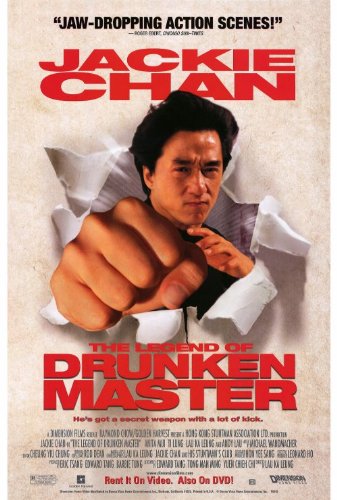
The Legend of Drunken Master (2000)

DAY 53, THE LEGEND OF DRUNKEN MASTER

THE LEGEND OF DRUNKEN MASTER (2000) Three-and-a-half stars
Once upon a time, there was a commonly held belief that Jackie Chan and his movies would never succeed in America.

Chan’s first two attempts to capture the American market both failed, 1980’s THE BIG BRAWL (Robert Clouse) and 1985’s THE PROTECTOR (James Glickenhaus).

Clouse (ENTER THE DRAGON, BLACK BELT JONES, GAME OF DEATH) and Glickenhaus (THE EXTERMINATOR, THE SOLDIER, SHAKEDOWN) did not see eye-to-eye with Chan and vice-versa, as Chan felt more confined to the generic American style of movie violence rather than his own more idiosyncratic style during both films. Chan even released his own edit of THE PROTECTOR.

Glickenhaus once said in an interview, “Well, you know that’s still the most successful Jackie Chan movie internationally and always will be because the American audience, the mainstream audience, will never sit still for Jackie’s style of action.”

Wrong, and wrong again.

In 1995, in the third attempt on cornering the American market, New Line Cinema (Freddy Krueger’s studio) finally succeeded with an English dubbed, shortened RUMBLE IN THE BRONX (17 minutes of cuts from the Hong Kong version, two additional scenes filmed for the international market). On a budget of $8.5 million, RUMBLE IN THE BRONX earned $40 million in America, then we saw the deluge of Jackie Chan pictures.

There were SUPER COP, JACKIE CHAN’S FIRST STRIKE, and MR. NICE GUY, for example, leading up to RUSH HOUR in late 1998.

Ah, yes, RUSH HOUR, one of my memorable multiplex experiences because of the way good fortune smiled down on me. Two friends and I went out for pizza and a movie, originally intended to be Adam Sandler’s THE WATERBOY. Already at that point in life, I had tired of Sandler movies after finding so very little of interest or laughter in BILLY MADISON and HAPPY GILMORE; I liked Sandler on “Saturday Night Live,” for what it’s worth. After devouring our large order of cheesesticks, we headed to the Pittsburg Cinema 8 and discovered that THE WATERBOY sold out. Bummer, man, but at least not for me. We discussed it over and finally decided that we take a chance on RUSH HOUR rather than have driven to Pittsburg for virtually nothing.

This was my first exposure to Jackie Chan and I liked it. I liked RUSH HOUR for Chan far more than motormouth Chris Tucker. Of course, it’s a formula picture, “the buddy cop” picture that somehow had survived debacles like A COP AND A HALF (1993), remember that one with Norman D. Golden II and Burt Reynolds. Chan had been successfully integrating comedy and martial arts in his movies for years, and so he was right at home in RUSH HOUR with both elements. Chan and Tucker played well off each other and so naturally, they made two more RUSH HOUR films each less successful than the one before it.

At the turn of the 21st Century, a friend and I watched THE LEGEND OF DRUNKEN MASTER at the Joplin 14.

Around this time, I had discovered the first DRUNKEN MASTER on video and had purchased a couple Chan films on video.

In other words, I became a fan, a big fan.

THE LEGEND OF DRUNKEN MASTER, dubbed into English and re-edited for the American market, is the sequel to the 1978 film that helped make Chan a star. It was originally released in 1994 as DRUNKEN MASTER 2.

I don’t enjoy it nearly as much as the first DRUNKEN MASTER, a film that’s highly reminiscent of both ROCKY and ANIMAL HOUSE, as well as Bruce Lee, but the sequel definitely finishes on an incredibly high note with a rousing fight scene apparently directed by Chan himself.

This fight scene pits Chan against his personal bodyguard Ken Lo, a member of the famous Jackie Chan Stunt Team, the group of martial artists and stuntmen that worked alongside Chan on his movies.

Kinetic would be one word for this fight scene. Epic another. Fiery one more. “Do not try it at home” overkill.

Chan and Lo move so fast and are so fleet of foot and fist that it’s downright amazing, a ballet with kicks and punches.

It’s also funny in the way that Chan and his “drunken boxing” can be.

It makes use of the props that are in the scene’s immediate environment, a Chan trademark that originates from his affinity for silent movie comedians Charlie Chaplin, Buster Keaton, and Harold Lloyd.

Just a couple days ago, we looked at WAY OF THE DRAGON and that featured the epic fight scene between Lee and Chuck Norris. We could pair that scene with Chan and Lo.

After THE BIG BRAWL and before THE PROTECTOR, Chan took supporting roles in two CANNONBALL RUN films directed by Hollywood stuntman turned filmmaker Hal Needham and featuring a cast of thousands headlined by Needham’s friend, Burt Reynolds. Hong Kong production company Golden Harvest produced both CANNONBALL RUN films. The great thing that came from CANNONBALL RUN was that Needham’s tradition of a bloopers reel during the end credits inspired Chan to do the same for his future films. Both CANNONBALL RUN films, thanks to Chan’s popularity, were big in Japan.

The Foreigner (2017)

the foreigner

THE FOREIGNER (2017) Three stars

There’s a scene in Cameron Crowe’s SAY ANYTHING (1989) when Ione Skye’s Diane accuses John Cusack’s Lloyd of ageism or “prejudice or discrimination on the grounds of a person’s age.”

That was nearly three decades ago and you’d think we’d have progressed beyond all that, given Mike Gundy’s epic “I’m a man! I’m 40!” rant from several years back and the fact that Donald Trump’s over 70 years old, although Trump’s not a good example of aging gracefully.

Perhaps we have progressed generally, but not specifically in the realm of the action movie.

Hell, I don’t know, maybe it’s just me who’s guilty of action movie ageism.

I last liked an Arnold Schwarzenegger action spectacular all the way through, why it’s been since TERMINATOR 2: JUDGMENT DAY and that’s 1991, folks. For what it’s worth, LAST ACTION HERO, TRUE LIES, and ERASER all had their high points but their lows outweighed their highs. BATMAN & ROBIN is just a disaster of epic proportions and COLLATERAL DAMAGE and TERMINATOR 3 are just weak retreads of previous Arnold hits. Arnold’s THE LAST STAND from a few years back did very little for me, though Johnny Knoxville’s presence certainly did not help and especially not when he’s wearing that damn goofy hat.

I’ve had trouble with Sylvester Stallone outside ROCKY and RAMBO movies. It’s been several years since I watched it, but I had great difficulty taking THE EXPENDABLES (2010) seriously or even appreciating it as preposterous action comic strip and now that I’ve admitted that I just might have my “man card” revoked. That’s why my mind was blown when CREED (2015) turned out so damn good. It’s one of the very best ROCKY movies, right behind the original in my estimation. Arnold and Sly teamed up for a prison escape flick named ESCAPE PLAN (2013) and I escaped from watching it with somebody else by taking a nap.

Bruce Willis branched out to PULP FICTION, THE SIXTH SENSE, and UNBREAKABLE, not to mention the absolutely ridiculous COLOR OF NIGHT made the same year (1994) as PULP FICTION. He’s not as pigeonholed to the action genre as Stallone and Schwarzenegger.

Guess this all brings me back around to THE FOREIGNER, starring Jackie Chan and Pierce Brosnan. Honestly, I had no great expectations one way or another coming in and I finished the movie feeling pleasantly surprised.

I’ll be the first to admit that I lost interest in Chan during the more American stage of his career. RUSH HOUR 3 can do that to a person and I skipped THE KARATE KID remake just because it seemed like a lame movie to watch in the 21st century. Over the years, though, I have sought out and watched several Chan spectaculars from earlier in his career, including RUMBLE IN THE BRONX, FIRST STRIKE, SUPERCOP, and THE LEGEND OF DRUNKEN MASTER, that succeeded in making him more of a star in America.

I thought Brosnan made a couple solid James Bond pictures, TOMORROW NEVER DIES and THE WORLD IS NOT ENOUGH, but I honestly believe that he’s become a better actor with age, just like fellow pretty boys Robert Redford and Richard Gere. A couple days after consuming THE FOREIGNER, I saw Brosnan play basically the same “powerful man with dread secrets” role in Roman Polanski’s THE GHOST WRITER (2010). He’s good in this role. Maybe we’ve seen him become like Hal Holbrook or Dabney Coleman, who created archetypes for themselves decades ago.

The plot: Chan plays a London restaurateur (yes, he’s the foreigner or make that “The Foreigner”) whose daughter’s killed by a bomb in an early scene. Of course, it turns out that it’s a terrorist bomb and the terrorists responsible are, of course, the Irish Republican Army. Think it’s been a while since I’ve seen the IRA in the movies. This leads Chan’s protagonist Quan (after he’s been shooed away by the authorities) to the Deputy First Minister of Northern Ireland, Liam Hennessy (Brosnan), who’s a former IRA member. Quan wants Hennessy to give him names and he cannot believe Hennessy knows nothing. Quan seeks revenge.

Basically, we have two movies for the price of one: Quan’s single-minded revenge and Hennessy’s now chaotic life. We go back-and-forth between story lines. Of course, sometimes Quan and Hennessy meet in the middle.

Quan’s a departure for Chan. He’s not high energy like he’s been in everything from DRUNKEN MASTER to RUSH HOUR. There’s no slapstick and no mugging that distinguished Chan from other action movie stars, namely Schwarzenegger and Stallone. With his character in mourning, Chan plays it more melancholy than we likely have ever seen him before. Chan plays him quiet and we see all his pain.

Quan also takes advantage of the fact that all the other characters underestimate him.

We are fascinated by watching for that exact moment when Brosnan’s cool disintegrates in the face of plot developments, all those heavy machinations involving his nephew, his wife, his mistress, and his former IRA associates. Of course, there’s Quan, that fly in the ointment. Granted, this is a fly with special ops training.

Seeing Brosnan in THE FOREIGNER, I flashed back on THE LONG GOOD FRIDAY, where Brosnan played an Irish assassin and one-half of that film’s incredible ending. What ever happened to Harold Shand (played by the late, great Bob Hoskins)?

Drunken Master (1978)

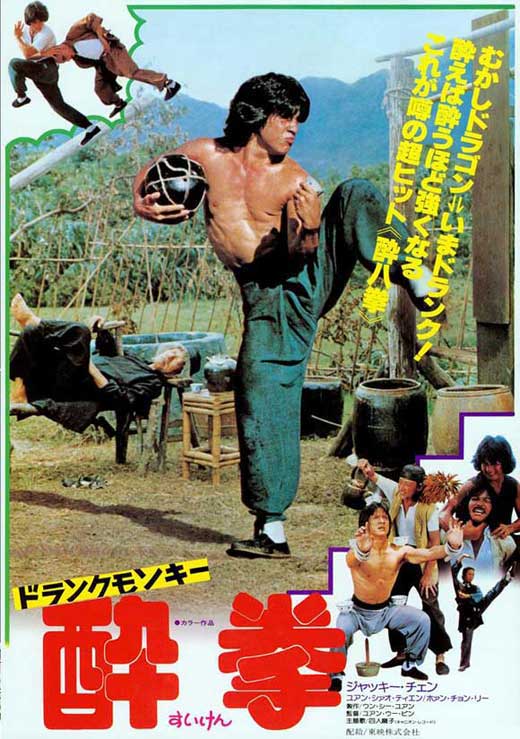
DAY 35, DRUNKEN MASTER

DRUNKEN MASTER (1978) Four stars
There’s at least one more DRUNKEN MASTER fan out there in this great big world: 11-year-old Isaac Gonzalez from Carthage, Missouri.

Looking for a movie to watch one night, bored out of his skull after being grounded from his PlayStation 4 and his tablet, Mr. Gonzalez started thumbing around through hundreds of “old” and “older” movies, finally discovering a run of martial arts films, namely Jackie Chan films.

A wise old man finally asked Mr. Gonzalez, “Don’t you like THE KARATE KID?”

Mr. Gonzalez said, “Yeah.”

The wise old man then declared, “Well, I’ve got a movie that’s much better than THE KARATE KID. It’s awesome.”

Mr. Gonzalez said, “OK, put it on.”

Mr. Gonzalez, after subtitles were retired and the English dub reinstated early on, sat back and watched DRUNKEN MASTER in an apparent state of joy.

He laughed at the slapstick comedy, the vulgar humor, the silly banter, and the drunken boxing shenanigans. After all, doesn’t the Three Stooges’ humor transcend?

He enjoyed all the fight scenes and the great wide world variety of fighters thrown at Chan’s Wong Fei-hung.

The wise old man, after the 110 minutes were over and right before the 11-year-old boy had to go to bed on a school night, asked Mr. Gonzalez how the movie was and he said, “You were right, it’s better than THE KARATE KID. It’s awesome.”

Watching the film again with Mr. Gonzalez, paying attention to his reaction to it as well as my own, I was reminded that DRUNKEN MASTER rates as one of the most entertaining movies ever made.

It’s a blast.

This was still relatively early in Chan’s long career and two films released in 1978 helped make Chan a star, at least in Hong Kong, SNAKE IN THE EAGLE’S SHADOW and DRUNKEN MASTER. Both films have the same director and the same three actors in hero and villain roles.

I prefer DRUNKEN MASTER because, let’s see, it’s ROCKY meets ANIMAL HOUSE meets Bruce Lee.

It’s sublime ridiculousness.

Just imagine if Rocky Balboa drank alcohol before he came out against Apollo Creed and if Rocky’s trainer Mickey threw him a bottle in the middle of the fight and Rocky downed every single drop of it before knocking out Apollo.

Or if Bluto Blutarsky threw down and kicked the holy living hell out of Marmalard and Neidermeyer in a karate fight rather than start a food fight or throw a toga party. (Not that ANIMAL HOUSE had any influence on DRUNKEN MASTER. Both were released in 1978: ANIMAL HOUSE on July 28 in the United States and DRUNKEN MASTER on October 5 in Hong Kong. However, I would pair them in a double feature or perhaps group them with ROCKY for a triple feature.)

Lee tried some relatively bawdy humor early on during THE WAY OF THE DRAGON, but alas, that style worked better for Chan.

Just as it worked better for Chan developing his own brand of martial arts theater and not becoming “the next Bruce Lee.” Not possible, anyway.

DRUNKEN MASTER mixes raunch, slapstick, and (of course) great fight scenes in a way that I had never seen before.

It must have been almost 20 years ago when I first saw it; I rented a dubbed copy on VHS and was blown away.

Like I said not that long ago (certainly not been 20 years), I had never seen anything like DRUNKEN MASTER before and it especially enthralled me with its bountiful supply of colorful fighters with distinct fighting styles. Seems like there’s a great fight scene every few minutes, and they just keep getting better every single fight.

Yes, virtually every single character in this action spectacular can fight and these characters each get their moment in the sun over 110 minutes.

It also has a fantastic “Eight Drunken Gods” training montage.

Speaking of training, before we leave one should mention THE KARATE KID (1984) features a watered-down, more feel-good version of the mentor by comparison with the one in DRUNKEN MASTER. Beggar So (Yuen Siu-Tien) can be cruel and sadistic, at times, but he and Chan’s Wong Fei-Hung do form enough of a bond that helps carry us through.
Ironic that Chan played the mentor role in THE KARATE KID remake (2010).

With DRUNKEN MASTER, Chan started to find his niche as one of the most enduring of action movie stars.

He’s so damn likable partly because he gives you value for money. You know you’re likely to get your money’s worth when you put it down on Chan, through action or humor or both and you know that it’s Chan performing all those stunts himself. That man certainly risked life and limb to entertain us.

Chan also brought his influences from silent movie comedians like Buster Keaton, Charlie Chaplin, and Harold Lloyd, unique sources for inspiration. Chan even replicated a pair of the most famous stunts from Keaton and Lloyd, respectively.

Having a small role in CANNONBALL RUN, Chan was influenced by that Burt Reynolds-starring, Hal Needham-directed, cast-of-thousands car race comedy to feature a gag reel in his own movies, but rather than blown lines, Chan’s end credits often highlight stunts gone awry.

Chan belongs in the upper echelon of action stars, alongside such luminaries as Clint Eastwood, Arnold Schwarzenegger, Bruce Lee, Paul Newman, and Sylvester Stallone, who at their very best deliver the goods at a high level.