
Meatballs (1979)

MEATBALLS

MEATBALLS (1979) Three stars

MEATBALLS left me with a nice, warm feeling this last time I watched it and I must admit to feeling both delighted and surprised by it.

It’s certainly no comic masterpiece, to be sure, but it contains Bill Murray’s first starring role in a motion picture comedy. That alone makes it an important movie to watch … and that’s not to denigrate the contributions of the other cast members. In all honesty, though, we sit through MEATBALLS for Murray and everybody knows it.

In his first starring role, he establishes the basic Bill Murray comic persona that his fans have come to love. He’s a modern variation on Groucho Marx, playing the smartest character in the movie, always wisecracking, always finding some new angle or scheme, always putting on everything (including himself), always having fun with authority figures. Fun is the key word, because it seems like everybody had fun on MEATBALLS. We like his Tripper, who eases our way through this low-budget, ragged Canadian tax shelter comedy.

Murray also gives his first great ridiculous serious speech in MEATBALLS, something that he would return to during CADDYSHACK, STRIPES, and GHOSTBUSTERS. There’s even a boat scene in MEATBALLS that made me think fondly back on Groucho and Thelma Todd in HORSE FEATHERS.

Unlike Groucho, though, Murray showcases a kinder, gentler side through Tripper’s interactions with Chris Makepeace’s Rudy. Tripper takes a shine to the young camper and their scenes together contribute to the nice, warm feeling created by MEATBALLS. Murray does not drift far away from his comic persona, though, during his scenes with Makepeace.

Every review I have read of MEATBALLS compared it (unfavorably) with NATIONAL LAMPOON’S ANIMAL HOUSE, the huge comedy hit from 1978. The reviewers were disappointed by the sheer lack of raunchiness displayed in MEATBALLS.

Maybe it has something to do with MEATBALLS director Ivan Reitman being a producer on ANIMAL HOUSE.

Or maybe something to do with the presence of Kristine DeBell in the cast. After all, DeBell made her screen debut in 1976’s X-rated ALICE’S ADVENTURES IN WONDERLAND.

Or maybe it was expected that Murray would follow more in the physical comedy direction of “Saturday Night Live” co-star John Belushi, whose star exploded into the stratosphere with ANIMAL HOUSE.

Of course, I far prefer ANIMAL HOUSE over MEATBALLS and wish the latter film aimed for being R-rated rather than ‘PG.’

In the end, though, I like MEATBALLS and I accept that it displays a lighter comic touch.

Murray has a lot to do with the success of MEATBALLS, but I also like the rest of the main cast just fine, Makepeace and DeBell as well as Harvey Atkin, Kate Lynch, Jack Blum, and Keith Knight.

MEATBALLS, the 14th highest grossing movie from 1979, spawned three sequels, none of which feature Murray or any of the other cast members of the first movie, for that matter. MEATBALLS earned six times what Parts Two and Three combined earned. That only seems fitting in that both of them are six times worse the film as the original and they’re more like hairballs than MEATBALLS, anyway.
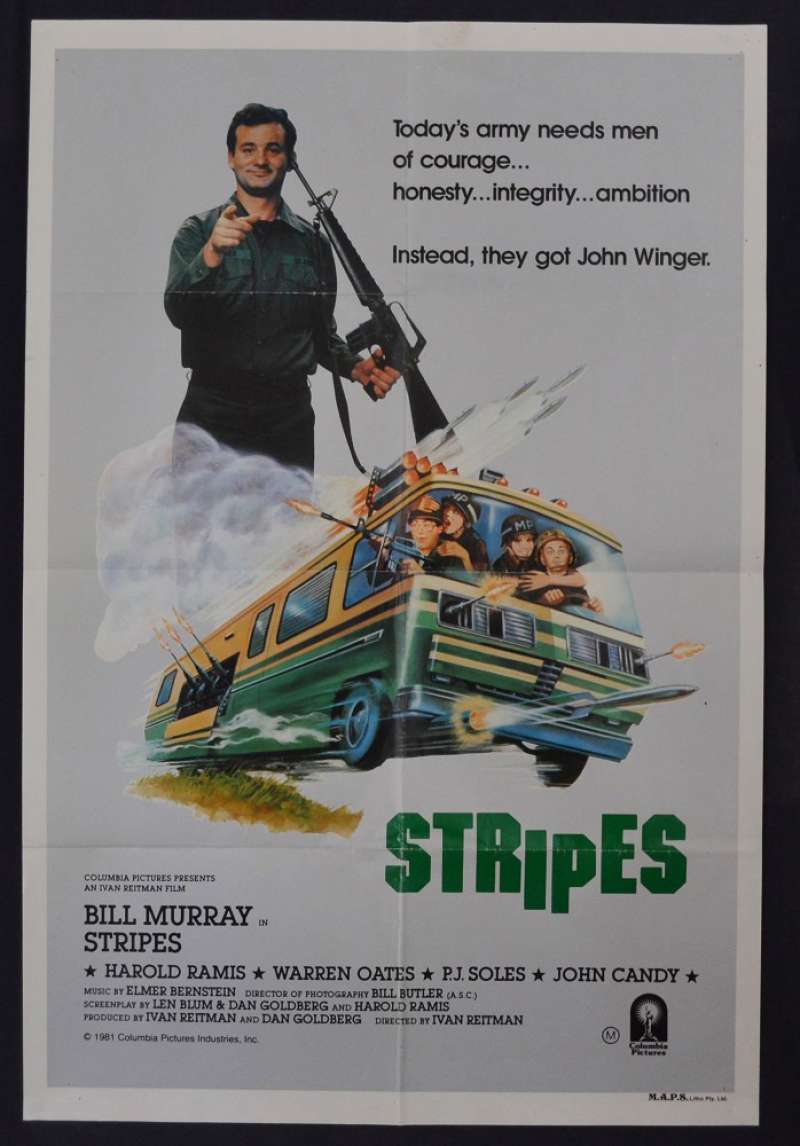
Stripes (1981)

day 66, stripes

STRIPES (1981) Three-and-a-half stars
Bill Murray was the Groucho Marx of the 1980s, especially during films like STRIPES and GHOSTBUSTERS.

STRIPES is Murray’s DUCK SOUP.

It’s not only all the one-liners and the institutional putdowns throughout both films, but a couple later scenes.

In DUCK SOUP, Groucho’s Rufus T. Firefly starts opening up machine gun fire and it only brings him immense pleasure.

Firefly boasts “Remind me to give myself the Firefly medal for this!”

Then his loyal assistant informs Firefly that he’s firing upon his own men.

Of course, Firefly offers his assistant $5 to keep it under his hat, but then Firefly withdraws the offer and keeps the five spot under his own hat.

Firefly’s joy during that sequence and the whole film, for that matter, come back when Murray’s John Winger takes on them darn Commies in STRIPES.

Murray, like Groucho, treated all this like one great big put-on.

That’s the comic attitude that informs STRIPES and like Groucho, Murray never played the fool. He’s the intelligent one, the hustler who knows the score, and sure Murray’s foil Sgt. Hulka (Warren Oates) socks it to Winger during basic training, but eventually the pair reluctantly find common ground and reach an understanding.

Winger first wanted to join the U.S. Army based on a lark, not some great conviction to serve his country.

For example, Winger thought he could pick up more women in the military.

Winger: “Chicks dig me, because I rarely wear underwear and when I do it’s usually something unusual. But now I know why I have always lost women to guys like you. I mean, it’s not just the uniform. It’s the stories that you tell. So much fun and imagination.”

Winger and his best friend Russell Ziskey (Harold Ramis) see the EM-50 Urban Assault Vehicle as an opportunity to go pick up their Military Police girlfriends (P.J. Soles, Sean Young) in West Germany and enjoy a holiday in Switzerland. Of course, this leads to their comrades seeking them out and being captured by the Soviet Army. Winger and the gang rescue their friends with that heavily-armed recreational vehicle on their side.

Winger keeps that lark attitude throughout STRIPES, even after his friends fall into Soviet hands.

Winger: “C’mon, it’s Czechoslovakia. We zip in, we pick ’em up, we zip right out again. We’re not going to Moscow. It’s Czechoslovakia. It’s like going into Wisconsin.”

Everything’s a lark to Winger (and Murray).

Murray and Ramis make a very good comedic duo. You might be surprised to find out STRIPES (directed by Ivan Reitman) had been originally intended to be a Cheech and Chong vehicle, but that pair wanted the dreaded “complete creative control.” Both Ramis himself (who scripted ANIMAL HOUSE and directed CADDYSHACK) and Columbia Pictures were reluctant to have Ramis onscreen, but Murray insisted that he would only be paired with Ramis.

Ramis is vital to the success of STRIPES. He’s the ordinary guy counterbalance to Winger, but also the loyal best friend who ends up along for the ride despite knowing that his best friend’s crazy. Ramis brings an interesting tension to the movie that might not have been there, for example, had Dennis Quaid played Russell, such as the scene when Russell starts choking Winger. Quaid seems far more the stereotypical All-American hero type. Also, Ramis and Murray shared dynamite chemistry.

Veteran character actor Warren Oates is also vital to STRIPES. Like Russell, Sgt. Hulka makes a great counterbalance to Winger. There’s just one dramatic scene in STRIPES, when Hulka confronts Winger in the latrine. Hulka dares Winger to take a swing at him. Winger obliges, and Hulka wipes the floor with Winger. Even more so than Winger, Hulka knows the score. Hulka had originally been scheduled for death in the mortar accident and to be replaced by his twin brother also played by Oates, but the creative powers-that-be thankfully scrapped that concept.

On vacation in 2017, riding over the George Rogers Clark Memorial Bridge headed into Louisville, I thought it seemed very familiar and sure enough, it’s the bridge where Winger melodramatically quits taxi driving by flinging his keys into the Ohio River. Fortunately, we did not reenact the scene that day; it definitely would have been fun making it back home.

Would it be safe to say STRIPES is the greatest movie ever shot in Louisville?

Not so fast, my friend, as former Louisville head coach Lee Corso would say.

GOLDFINGER, RAIN MAN, A LEAGUE OF THEIR OWN, and THE INSIDER, for example, might have something to say about that.