
The Fog (1980)

THE FOG (1980) **1/2
Fog has been a critical element in many horror movies and the 1939 Hound of the Baskervilles, The Wolf Man, Frankenstein Meets the Wolf Man, and The Return of the Vampire immediately leap to mind as films made definitely better from their use of fog effects to create a foreboding atmosphere.

Edgar Allan Poe died at the age of 40 in 1849 but his writing and his influence live on forever. Is all that we see or seem / But a dream within a dream?

Ghost stories around the campfire have been around longer than The Legend of Sleepy Hollow, and I believe that’s how Washington Irving first heard about Ichabod Crane, Brom Bones, and the Headless Horseman.

John Carpenter directed, co-wrote, and scored the original Halloween in 1978, one of the great transcendent low-budget shockers with a boogeyman killer.

Carpenter’s The Fog, his first horror film after Halloween, combines the title character, a Poe quote before the opening credits, a ghost story around the campfire told by distinguished actor John Houseman, and some grisly murder set pieces that far surpass the relatively tame and nearly entirely bloodless Halloween, but I remain steadily down the middle of the road in my reaction to it.

I want to like it a lot more than I do, believe me, and maybe I will get there next time.

I liked it more during the most recent viewing of the film and I definitely understand why it’s developed a cult following and a much better reputation in recent years.

It does create quite the foreboding atmosphere at times, it bears all the trademarks of a Carpenter film with his penchant for great composition both in the sense of framing and the music present throughout, and I do like the story of this small California town celebrating their centenary with a dark secret about the founding discovered, discussed, and confronted during the film as the dead men return 100 years to the day for their revenge.

Still, all the same, it’s underwhelming.

I believe it’s mainly because I don’t particularly connect to any of the characters and thus, I don’t really care about their fates particularly all that much.

I come the closest to connecting with radio station owner and host Stevie (played by Carpenter’s former wife Adrienne Barbeau) and Father Patrick Malone (Hal Holbrook), but they’re not on the same level as Dr. Loomis and Laurie Strode in Halloween, Kurt Russell’s characters in Escape from New York and The Thing, Keith Gordon’s Arnie Cunningham in Christine, Karen Allen’s and Jeff Bridges’ characters in Starman, and Roddy Piper’s George Nada in They Live, some of Carpenter’s best characters and best films.

While it is comforting to see Carpenter regulars like Barbeau, Jamie Lee Curtis, Tom Atkins, Charles Cyphers, Nancy Kyes, and good old ‘Buck’ Flower, they’ll still all be remembered first for other characters in other Carpenter films.

We simply don’t get enough of any of the main characters.

The Fog lacks a certain something, energy perhaps first and foremost, to really take it over the top and into the stratosphere like Halloween.

All that said, The Fog still has some very good even almost great moments.

I especially like the scene when Father Malone reads four entries from his grandfather’s journal and then delivers the best line of the film, The celebration tonight is a travesty. We’re honoring murderers.

Speaking of a travesty, I watched the 2005 remake in a theater and I have to believe that it’s one of the 10 worst movies I’ve ever watched in a multiplex near you.
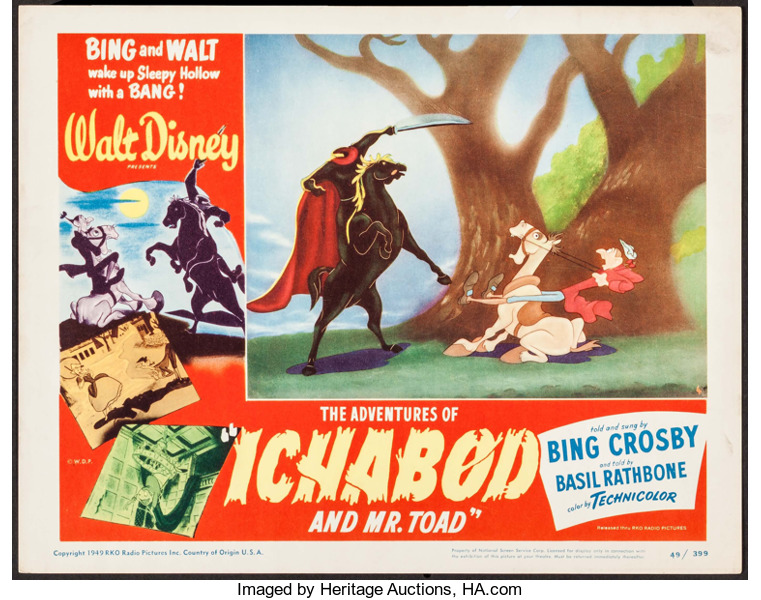
The Adventures of Ichabod and Mr. Toad (1949)

DAY 21, THE ADVENTURES OF ICHABOD AND MR. TOAD.jpeg

THE ADVENTURES OF ICHABOD AND MR. TOAD (1949) Three-and-a-half stars

Walt Disney favored package films after the release of BAMBI (1942) and released about one every year to close out the 1940s.

THE ADVENTURES OF ICHABOD AND MR. TOAD runs at 68 minutes, split at just the right length between the opening Mr. Toad segment based on “The Wind in the Willows” by Kenneth Grahame and the closing Ichabod Crane segment based on “The Legend of Sleepy Hollow” by Washington Irving. We have narration duties split between Basil Rathbone (MR. TOAD) and Bing Crosby (ICHABOD), plus Crosby handles voice duties for both Ichabod Crane and Brom Bones and sings a few songs. Crosby sings “The Headless Horseman” tale Brom Bones tells at the campfire that sticks in Ichabod Crane’s imagination on that famous long ride home.

Since we’re on a month of horror movie reviews, I will be focusing on the ICHABOD segment for the purpose of these few hundred words.

I must have first read “The Legend of Sleepy Hollow” in eighth grade and it’s long been one of my favorite stories. It’s compulsively readable (an engrossing yarn as the publicists said in 1820) and I’m looking around for that damn Irving anthology I bought several years ago. It must be hiding, of course, probably somewhere right around that Edgar Allen Poe anthology that could squish a spider the size of a Buick.

Just take a prose sample:

“As Ichabod approached this fearful tree, he began to whistle; he thought his whistle was answered: it was but a blast sweeping sharply through the dry branches,” Irving wrote. “As he approached a little nearer, he thought he saw something white, hanging in the midst of the tree: he paused and ceased whistling; but on looking more narrowly, perceived that it was a place where the tree had been scathed by lightning, and the white wood laid bare. Suddenly he heard a groan—his teeth chattered, and his knees smote against the saddle: it was but the rubbing of one huge bough upon another, as they were swayed about by the breeze. He passed the tree in safety, but new perils lay before him.

“About two hundred yards from the tree, a small brook crossed the road, and ran into a marshy and thickly wooded glen, known by the name of Wiley’s Swamp. On that side of the road where the brook entered the wood, a group of oaks and chestnuts, matted thick with wild grape vines, threw a cavernous gloom over it. To pass this bridge was the severest trial. It was at this identical spot that the unfortunate Andre was captured, and under the covert of those chestnuts and vines were the sturdy yeoman concealed who surprised him. This has ever since been considered a haunted stream, and fearful are the feelings of the schoolboy who has to pass it alone after dark.”

As much as I like the Johnny Depp and Tim Burton SLEEPY HOLLOW (1999), it only appropriates the title and a few character names from Irving’s short story. It’s laughable when you read “Based on ‘The Legend of Sleepy Hollow’ by Washington Irving” in the credits, because Ichabod Crane’s transformed into a horror movie hero who’s rather normal even by Burton and Depp standards and he’s no longer a gold digger like in Irving’s story, where Ichabod schemes after Katrina Van Tassel more for her money than her looks and personality. Ichabod becomes the standard issue lovable movie eccentric and he’s also a constable and not a schoolteacher. Of course, that plays into a murder mystery that manufactures more twists than a year’s worth of production at a pretzel factory.

I have to stifle laughter at this very instant after reading the Wikipedia entry for the 1999 version, which starts “SLEEPY HOLLOW is a 1999 American gothic supernatural horror film directed by Tim Burton. It is a film adaptation loosely based on Washington Irving’s 1820 short story ‘The Legend of Sleepy Hollow.’”

How loosely? Very loosely. Maybe as loosely as the Demi Moore version of SCARLET LETTER.

Burton’s film seems more heavily influenced by Hammer Films (none other than Christopher Lee plays a small role) than the original story, which plays on legends, superstitions, and Ichabod’s overactive imagination for its horrors. SLEEPY HOLLOW makes one feel that it’s merely exploiting the Washington Irving name and literary reputation to give class to what would otherwise be another gory horror movie with a rather convoluted plot.

Take away the slapstick and Crosby’s songs about Ichabod and Katrina, the Walt Disney version sticks closer to the spirit and letter of Washington Irving and the final dozen minutes of ICHABOD AND MR. TOAD are a vivid reminder of Disney films’ ability to scare audiences in classics like SNOW WHITE, PINOCCHIO, and BAMBI.

Ultimately, though, with the Burton film, I accept it for what it is rather than what it is not. Cue to “Seinfeld” and “Not that there’s anything wrong with that.” It does have a lot of virtues and I’ve enjoyed it every time seeing it since that first time in a theater in late 1999. Hey, that reminds me, I need to grab my VHS copy and put the damn thing on.