
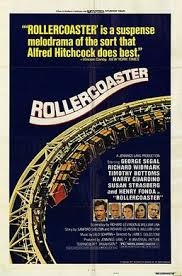
Rollercoaster (1977)

ROLLERCOASTER (1977) *
Rollercoaster, a thriller that combines Peter Bogdanovich’s vastly superior Targets, a disaster movie, and a mad bomber movie, marked the first time I returned to an amusement park since that fateful day on family vacation this past summer at Holiday World in Santa Claus, Indiana.

Everything was fine and dandy, we even maintained social distance and wore our masks as often as possible, until 16-year-old Emily wanted 12-year-old Isaac to ride on a roller coaster. She said he promised that he would try at least one roller coaster with her, he said that he made no such promise, she won’t ride on a roller coaster by her lonesome, he did not budge and refused to ride, and they eventually broke into hysterics and went their separate ways. Emily followed my wife Lynn and I back into the main body of the park and she frequently groused about her younger brother, while Isaac stayed behind and wept for the state of the world or something on a bench.

Two hours later, Emily decided to go to the car and she found Isaac sleeping on a bench just outside the park en route to the parking lot. No big deal, he said, he was tired, so he walked off, walked out, and took a nap. He did look a little refreshed.

I virtually walked the entire length of Holiday World twice over looking for Isaac to no avail and I lost count of every Beatles, every Beach Boys song the park blasted that day over the loud speakers. I had precise numbers, and they were gone. Lynn and I were obviously not pleased with either Emily or Isaac, and this is the first time I have spoken publicly about that Sunday afternoon in a place seven hours away from home.

The best thing about Rollercoaster, aside from the fact that it finally ended, is that it put that day in Santa Claus in perspective. I mean, yeah, at least we didn’t have happen to us what happened to the characters in Rollercoaster, especially at the 10-minute mark in the movie when our resident mad bomber (just call him The Mad Bomber with No Name who apparently represents something about our fears) played by Timothy Bottoms blows up a section of track and spectacularly derails a roller coaster. Needless to say, Universal Studios released Rollercoaster — in Sensurround, which Universal head Sidney Sheinberg called as big as any star in the movies — in June ’77 and a little release named Star Wars blew it away. Universal made just one more film in Sensurround. Big star?

Bottoms’ bomber presents one fundamental problem, because we never learn even his name or his motivation or much of anything ’bout him or even see that he enjoys being a mad bomber. He’s a cipher who’s not even mad enough in either way to justify being called a mad bomber. So when he meets his inevitable demise in the film’s grand finale, I felt no joy and only relief because it finally put this two-hour movie to pasture where it can rest in manure for eternity.

Here’s that perspective: Rollercoaster and that ordeal in Holiday World both lasted about two hours in real time, and both felt much longer. Yeah, I don’t much care for roller coasters in real life or captured on celluloid.

In closing, I should mention that Helen Hunt and Steve Guttenberg make their feature film debuts, iconic actors Henry Fonda and Richard Widmark appear here strictly for the money, and the eccentric rock band Sparks reportedly calls their cameo appearance in Rollercoaster — where they perform two songs from their 1976 LP Big Beat — the biggest regret of their career.

Couple Bombs from ’81: The Legend of the Lone Ranger, First Monday in October

COUPLE BOMBS FROM ‘81: THE LEGEND OF THE LONE RANGER, FIRST MONDAY IN OCTOBER

THE LEGEND OF THE LONE RANGER fails miserably at capturing any of the magic of the 1978 blockbuster SUPERMAN, its obvious cinematic inspiration.

Not even one speck.

Like SUPERMAN, LONE RANGER gives us a mythic origin story for an old cultural hero and then unfurls a new grand adventure featuring our updated hero and other updated characters. Sounds like a great time at the movies, but where did LONE RANGER go so absolutely incredibly stupendously wrong?

First stumbling block first, we have screen neophyte Klinton Spilsbury, who more or less remains a screen neophyte after LONE RANGER. That’s because Spilsbury botched his opportunity so badly that producers dubbed him with James Keach in post-production. Spilsbury quickly became a punchline upon the release of the film. For example, Gene Siskel remarked in his review that Spilsbury playing the Lone Ranger would make for a fine trivia question in the 1990s. I am straining to remember if Spilsbury appeared in “Trivial Pursuit” or perhaps on “Jeopardy” as the answer to who played the Lone Ranger in THE LEGEND OF THE LONE RANGER. If producers dub in another actor’s voice, how much of a performance did the dubbed out actor really give? Nevertheless, Spilsbury joined the ranks of infinitely superior actor Harvey Keitel, whose trademark Brooklyn accent did not make the final cut of SATURN 3. Sorry, Mr. Keitel.

Spilsbury definitely proved to be no Christopher Reeve, whose performance as both mild-mannered reporter for a great metropolitan newspaper Clark Kent and Kal-El, a.k.a. Superman, a.k.a. The Man of Steel, contributed a great deal to what made SUPERMAN and SUPERMAN II successful super-budget entertainments that connected with a mass audience on a personal level. Reeve said that he found inspiration from Cary Grant’s performance in BRINGING UP BABY and SUPERMAN and SUPERMAN II indeed at times resemble screwball romantic comedies. (Gene Hackman, Ned Beatty, and gang unfortunately suggest the campy villains from the 1960s Batman TV show, almost upsetting that precarious balance ‘tween humor and seriousness. Terence Stamp, Jack O’Halloran, and Sarah Douglas make better villains in SUPERMAN II.)

LONE RANGER lacks a lighter, humorous touch to counterbalance its mythology attempts. It is so somber that it becomes ponderous and then dreary before it finally springs into action, despite the efforts of Merle Haggard in the Waylon Jennings “Dukes of Hazzard” balladeer role. Obituarists skipped this chapter in Haggard’s career out of respect for the man when he died in 2016.

Finally springs into action is an understatement in the case of LONE RANGER.

LONE RANGER takes approximately 70 minutes to get the title character into costume and to play the William Tell Overture on the soundtrack, and we’re talking about a movie clocked at 98 minutes. William A. Fraker (director), Walter Coblenz (producer), Martin Starger (executive producer), and the writing team of Ivan Goff, Ben Roberts, William Roberts, Michael Kane, and Gerald B. Derloshon discovered a new level of stupidity.

Complete epic failure amounts to the only legend created by THE LEGEND OF THE LONE RANGER.

FIRST MONDAY IN OCTOBER also has its roots in old movies, though it may not be as obvious as LONE RANGER.

FIRST MONDAY wanted to be like one of those movies pairing Spencer Tracy and Katharine Hepburn — WOMAN OF THE YEAR, KEEPER OF THE FLAME, WITHOUT LOVE, SEA OF GRASS, STATE OF THE UNION, ADAM’S RIB, PAT AND MIKE, DESK SET, and GUESS WHO’S COMING TO DINNER.

Those movies succeeded in part because of the chemistry between Tracy and Hepburn and our enjoyment from watching them interact.

FIRST MONDAY fails in large part because Walter Matthau and Jill Clayburgh do not spark that Tracy-Hepburn chemistry and they are both miscast in their roles. FIRST MONDAY should be renamed “The Bickersons Go to the Supreme Court.”

Matthau stars as veteran Associate Justice Dan Snow and Clayburgh draws freshly appointed Associate Justice Ruth Loomis. All we need to know about them boils down to cranky old white ultra-liberal male (Snow) and feisty liberated white ultra-conservative female (Loomis) babble and battle but nonetheless develop affection toward each other.

Matthau gives the standard Matthau performance and it simply does not suit his character. Melvyn Douglas and Henry Fonda played this character on stage and they were both much better fits than Matthau.

Clayburgh made her fame as the quintessential liberated woman in AN UNMARRIED WOMAN and so it is jarring to see her play a rigid conservative. Also, she’s too young for her character. Jean Arthur, Jane Alexander (a few years older than Clayburgh), and Eva Marie Saint played the role on stage.

Paramount originally planned to release FIRST MONDAY in early 1982, but after President Ronald Reagan nominated Sandra Day O’Connor to the Supreme Court on July 7, 1981, Paramount rushed FIRST MONDAY forward to release in late August, one month before the Senate confirmed O’Connor’s appointment.

It is possible that FIRST MONDAY benefited commercially from publicity attendant with O’Connor’s historic appointment. FIRST MONDAY earned nearly $13 million in returns. In the long run, though, so what?

Upon first perusal of British director Ronald Neame’s film credits, one sees two disaster films, THE POSEIDON ADVENTURE and METEOR. After watching FIRST MONDAY, I count three disaster films directed by Neame.

I reviewed two bombs from ‘81 because Hollywood still recycles, rehashes, regurgitates, recapitulates, and remakes old movies, old plays, old TV shows relentlessly.

The Swarm (1978)

THE SWARM

THE SWARM (1978) One-half star

Many comedies wish they could make me laugh as hard as I do at the ridiculous disclaimer at the end of the 1978 Irwin Allen film THE SWARM: “The African killer bee portrayed in this film bears absolutely no relationship to the industrious hard-working American honey bee to which we are indebted for pollinating vital crops that feed our nation.”

Were the folks at Warner Bros. seriously afraid of alienating the American honey bee?

I’ve read that the American Bee Association considered suing Allen for defaming the honey bee … and that must be why we ended up with that jive disclaimer right before the end credits. But, honestly, why stop there? The director, writer, and actor guilds should have sued Allen for defaming their respective trades, because this has to be the worst use ever of a $21 million production budget (reports vary on the $), seven Academy Award winning actors (Michael Caine, Olivia de Havilland, Ben Johnson, Jose Ferrer, Patty Duke, Lee Grant, and Henry Fonda, but none of them earned for this movie), and 800,000 bees with their stingers removed.

I’ll never forget THE SWARM because it’s not easy forgetting one of the worst movies ever made. I caught it (not all of it, though) for the first time in either late 1997 or early 1998, home alone late afternoon during my freshman year of college. I returned from class and found this disaster pic flipping channels. It was somewhere in the middle and I watched the rest. The lousy special effects, the cornball everything (premise, plot, dialogue, acting, title), and that darn disclaimer stuck with me. …

I’ve caught up with THE SWARM a couple more times or I’ve watched it at an interval of once every 10 years. It still rates about the exact same as the first time watching it, though, but I guess I have watched it a couple more times after the first as a honest reminder of what a bad movie’s truly like.

Guess we should give a lot of blame for THE SWARM to Allen (1916-91). The Master of Disaster produced THE POSEIDON ADVENTURE, THE TOWERING INFERNO, THE SWARM, BEYOND THE POSEIDON ADVENTURE, and WHEN TIME RAN OUT, the last three of which helped kill off the disaster films that were so popular in the 1970s. THE SWARM earned $7.7 million, BEYOND THE POSEIDON $2.1 million, and WHEN TIME RAN OUT $3.8 million.

Allen also directed THE SWARM and BEYOND THE POSEIDON. In THE SWARM, he kills two genres in one movie, combining disaster with the killer animal genre that became a dominant exploitation staple after the incredible success of Steven Spielberg’s JAWS in 1975.

It was David Hannum, not P.T. Barnum, who came up with the legendary quote, “There’s a sucker born every minute.” Should have been Irwin Allen, though, because his films really take us for suckers one and all. Fortunately, we are better (smarter) than that.

Stirling Silliphant (1918-96) wrote the screenplay for THE SWARM and he wrote both of Allen’s biggest hits, THE POSEIDON and TOWERING INFERNO. He also won an Academy Award for his screenplay for Best Picture winner IN THE HEAT OF THE NIGHT. (Silliphant’s erratic credits include VILLAGE OF THE DAMNED, SHAFT IN AFRICA, and OVER THE TOP.)

Unfortunately, his work on THE SWARM will go down in infamy.

Helicopter pilot: “Oh my God! Bees! Bees! Millions of bees … (later on) Bees! Millions of bees!” Of course, it does not help matters that the bees sometimes look more like painted-on black dots.

There’s some dynamite exchanges in THE SWARM. I’ll highlight just one.

Dr. Crane (Caine): Are you endowing these bees with human motives? Like saving their fellow bees from captivity, or seeking revenge on Mankind?

General Slater (Richard Widmark): I always credit my enemy, no matter what he may be, with equal intelligence.

“No matter what he may bee,” maybe they should have stripped Silliphant of his Academy Award for writing that one.

There’s more howlers in THE SWARM: “Houston on fire. Will history blame me, or the bees?”; “I know people look at me and think that I’m just the man behind the aspirin counter, but inside I love you”; “They’re more virulent than the Australian Brown-Box Jellyfish”; “By tomorrow there will be no more Africans … at least not in the Houston sector.” This dialogue indicts inself.

THE SWARM is one time where calling a film a train wreck is literal.

A train wreck, by the way, that kills Olivia de Havilland, Ben Johnson, and Fred MacMurray, two of the film’s seven Academy Award winning actors. Johnson (1918-96) fared better later as the conductor in the horror film TERROR TRAIN. I really did not want to mention that de Havilland, Johnson, and MacMurray form a romantic triangle in THE SWARM. Let’s just get past that and move on immediately, unlike the movie.

Having such an all-star cast, by the way, backfires miserably for THE SWARM, because I start thinking about movies like ZULU (Caine), THE ADVENTURES OF ROBIN HOOD (de Havilland), THE LAST PICTURE SHOW (Johnson), DOUBLE INDEMNITY (MacMurray), THE MIRACLE WORKER (Duke), and ONCE UPON A TIME IN THE WEST (Fonda), for example, rather than what I am supposed to be watching.

Some of the stars have smaller roles than others. Yeah, and I almost forgot about Richard Widmark, Richard Chamberlain, and Slim Pickens, though I mentioned the always skeptical, always boneheaded General Slater played by Widmark. How could I forget though about Mr. Pickens? According to Cinemorgue Wiki, Pickens died cinematic deaths in THE LAST COMMAND, A THUNDER OF DRUMS, DR. STRANGELOVE, MAJOR DUNDEE, ROUGH NIGHT IN JERICHO, PAT GARRETT & BILLY THE KID, BEYOND THE POSEIDON, THE BLACK HOLE, and THE HOWLING. They missed an opportunity in not killing Pickens in THE SWARM. I mean, his death scenes in DR. STRANGELOVE and PAT GARRETT & BILLY THE KID are legendary.

I am rambling, just like THE SWARM itself.

When you watch THE SWARM, please try and keep in mind that Paul Zastupnevich received a nomination for the Academy Award for Best Costume Design. Unbelievable, just unbelievable, like THE SWARM.