
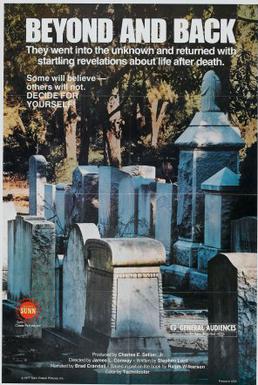
Beyond and Back (1978)

BEYOND AND BACK (1978) No stars

I am here to tell you about life after Beyond and Back.

I cannot believe that I finally watched a film that displaces The Star Wars Holiday Special as my selection for the worst film made in 1978.

Beyond and Back proved to be D.O.A. It showed no vital signs of cinematic life and brought me a micrometre closer to atheism with its faith-based and family-friendly agenda shoved down my throat, 90 minutes of bad actors monotonously gushing over near-death experiences, life after death, psychokinesis, Heaven and Hell, bright light, weighing souls, seeing dead relatives, ad nauseam.

Beyond and Back puts Benjamin Franklin, Elizabeth Barrett Browning, Eddie Rickenbacker, Thomas Edison, Louisa May Alcott, Ernest Hemingway, George S. Patton, and Harry Houdini on an equal plane with Anne Fleck, Dr. Stevens, Byron Temple, and Dr. Paul Kelly, since they’re all just cannon fodder for that agenda told through a pseudo-documentary approach with bad narration and bad reenactment.

Two of the worst films ever made (both from 1978) involve laughable disclaimers:

The African killer bee portrayed in this film bears absolutely no relationship to the industrious, hardworking American honey bee to which we are indebted for pollinating vital crops that feed our nation — The Swarm

The events you have just seen have been taken from actual accounts, but the names of the persons involved have been changed to preserve their anonymity. All such persons have been portrayed by professional actors and actresses — Beyond and Back

Of course, Beyond and Back is the same picture that starts with its narrator telling us, “You are about to see one of the most extraordinary movies of our time, a movie that dares to investigate the possibility of life after death.”

We can thank the folks at Sunn Classic Pictures for such classics, er, drivel as Beyond and Back, namely director, producer, novelist, and Sunn Classics founder Charles E. Sellier. Sellier (1943-2011) evolved from Cajun Catholicism to Mormonism and finally evangelical Christianity, but his product remained in the realm of quick-buck exploitation, whether it was Sunn Classic productions In Search of Noah’s Ark and In Search of Historic Jesus or the controversial killer Santa picture Silent Night, Deadly Night and the teenage comedy Snowballing (both directed by Sellier) or his later productions George W. Bush: Faith in the White House, Breaking the Da Vinci Code, The Search for Heaven, and Apocalypse and the End Times.

For obvious theological reasons and philosophical differences, Beyond and Back passed on many tales and famous last words.

Last words are for fools who haven’t said enough — Karl Marx

I hope the exit is joyful and hope never to return — Frida Kahlo

Dammit, don’t you dare ask God to help me — Joan Crawford

I’m bored with it all — Winston Churchill

I’m going, but I’m going in the name of the Lord — Bessie Smith (I do not recall a single black person in Beyond and Back)

My wallpaper and I are fighting a duel to the death. One or the other of us has to go — Oscar Wilde

Dear World, I am leaving because I am bored. I feel I have lived long enough. I am leaving you with your worries in this sweet cesspool. Good luck — George Sanders (a charming wit to the end)

As we depart this mortal review, I leave this joke: What’s the last thing that goes through a fly’s mind when I kill him? My fist (reporter’s notebook).

Terror Train (1980)

TERROR TRAIN.jpg

TERROR TRAIN (1980) Two stars
An above-average cast and cinematographer John Alcott’s work aboard a novel setting for a horror film distinguish TERROR TRAIN but otherwise, it’s a bumpy ride for 90-plus minutes.

TERROR TRAIN succeeds in making the sales pitch “HALLOWEEN on a train” come true.

Scream queen Jamie Lee Curtis headlined the cast and this was her fourth horror movie of a career that began with a big bang in HALLOWEEN. She appeared in three horror movies alone in the calendar year 1980: THE FOG in February followed by Canadian productions PROM NIGHT (July) and TERROR TRAIN (October). HALLOWEEN II rounded out the Curtis horror movie quintology in October 1981 and she had successfully become typecast. Curtis broke free by the end of the decade, proving herself especially adept at comedy.

HALLOWEEN was a great scary movie and Curtis’ next four ranged from the average (THE FOG, HALLOWEEN II, TERROR TRAIN) to the abysmal (PROM NIGHT). They made her Laurie Strode character in HALLOWEEN II a shell of herself from the first movie: Curtis never quite perfected her limp and it was depressing to see her in that hobbled state after being such a refreshing, resourceful character in the original. She never lost her scream, though.

Like seemingly every other slasher of the era, TERROR TRAIN starts in the past. In the original HALLOWEEN, 6-year-old Michael Myers murdered his teenage sister Judith. In FRIDAY THE 13TH, two camp counselors are murdered. In PROM NIGHT, there’s a prank gone horribly wrong. TERROR TRAIN belongs in the prank gone horribly wrong category.

Curtis plays Alana Maxwell, who reluctantly takes a central role in the sexual initiation prank against fraternity pledge Kenny (Derek MacKinnon). Kenny, of course, goes schizo almost immediately after this prank and he’s sent to a psychiatric hospital. Three years later, these same fraternity and sorority creeps host a New Year’s Eve costume party on a moving train … and they have an uninvited guest. This costume party angle affords the filmmakers another novelty: Kenny can assume the identity of every person he kills, so he can be the guy in the Groucho Marx mask or the great lizard costume and catch his next victim by complete surprise.

These fraternity and sorority characters are by and large noxious pieces of work, especially Doc (Hart Bochner) and Mo (Timothy Webber). Their inevitable deaths feel like they take forever, mainly because we have to endure more and more of their odious behavior. Then, when we get there, their deaths are letdowns compared to similar moments in other slasher films. I mean, for crying out loud, even PROM NIGHT, an otherwise awful movie, gives us a great decapitation replete with a head roll.

And now for something completely different: Slashers often found room for at least one veteran cast member. They picked Ben Johnson (1918-96) as the veteran cast member in TERROR TRAIN and he thankfully gets a more substantial role than, let’s say, Glenn Ford in HAPPY BIRTHDAY TO ME. As the conductor Carne, Johnson shows the cool of a world champion rodeo cowboy and Academy Award winning supporting actor (LAST PICTURE SHOW). In fact, he’s almost too cool in the midst of all the murder and mayhem. Overall, he’s a welcome presence.

David Copperfield (the magician, not the Charles Dickens character) makes his motion picture debut, apparently because producer Sandy Howard liked magicians. Copperfield stretches his chops by playing “The Magician,” does a routine that slows down the movie even more in the middle, and bows out none too gracefully after being an obligatory red herring.

Harry Houdini (1874-1926) made only silent movies: feature-length THE GRIM GAME, THE MAN FROM BEYOND, and HAIDANE OF THE SECRET SERVICE. Silence could have served TERROR TRAIN well.

John Alcott (1931-86) received a mention in the opening paragraph for his cinematography. His credits include the Stanley Kubrick films 2001, A CLOCKWORK ORANGE, BARRY LYNDON, and THE SHINING (released about five months before TERROR TRAIN), and I mentioned him in the review of the 1975 World War II film OVERLORD. OVERLORD seamlessly combined archival footage director Stuart Cooper found from the Imperial War Museum with contemporary footage shot by Alcott. Alcott’s challenge in TERROR TRAIN naturally centered on space and lighting, and he proved up to the challenge. You can file TERROR TRAIN in the great-looking slasher films after HALLOWEEN and MY BLOODY VALENTINE.

Ultimately, though, TERROR TRAIN succeeds at train and fails at terror.