
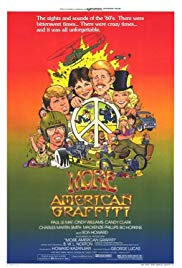
More American Graffiti (1979)

MORE AMERICAN GRAFFITI

MORE AMERICAN GRAFFITI (1979) *

I missed the point of MORE AMERICAN GRAFFITI, the 1979 sequel to George Lucas’ highly influential smash hit from 1973, AMERICAN GRAFFITI.

Sure, I realize we are intended to catch up with John Milner (Paul LeMat), Steve and Laurie Bolander (Ron Howard and Cindy Williams), Debbie Dunham (Candy Clark), Carol “Rainbow” Morrison (Mackenzie Phillips), and Terry “The Toad” Fields (Charles Martin Smith) at different points in the 1960s, but I don’t know if the film had any other greater purpose than attempting to cash in on the AMERICAN GRAFFITI name for another box office bonanza.

You’re right: Richard Dreyfuss and Curt Henderson did not return for the sequel. He’s only the main character in AMERICAN GRAFFITI, for crying out loud. Just like there’s no Dreyfuss and Matt Hooper in JAWS 2. Like his friend Steven Spielberg did not direct JAWS 2, Lucas does not direct MORE AMERICAN GRAFFITI. Unlike Spielberg, though, Lucas had far more involvement with the AMERICAN GRAFFITI sequel, including editing duties.

We have Milner on New Year’s Eve 1964, The Toad in Vietnam on New Year’s Eve 1965, Debbie in San Francisco on New Year’s Eve 1966, and Steve and Laurie on New Year’s Eve 1967.

We shuffle between the four different New Year’s Eve days and director and screenwriter Bill L. Norton gussies up the 1965 and 1966 scenes with grainy newsreel style footage (1965) and split screen (1966). That helps us identify which year we’re seeing, for sure, but otherwise, both gimmicks do not work. Especially the split screen, a technique already overplayed after WOODSTOCK and Brian DePalma films like CARRIE. In MORE AMERICAN GRAFFITI, split screen takes away from every scene it’s used.

The original AMERICAN GRAFFITI focused on a single long day in 1962 and that made the parallel adventures of Curt, Milner, The Toad, and Steve much easier to follow and less distracting. Automobiles cruising the main drag and car radios playing Wolfman Jack’s radio show unified just about every scene.

AMERICAN GRAFFITI also proved to have a theme: It showed Curt, Milner, and The Toad all outside their comfort zones and getting to know somebody beyond their accustomed social circle: intellectual and future college boy Curt and the tough guy car club the Pharaohs, the James Dean “Rebel Without a Cause” Milner and a young teenage girl dumped off on him by her older sister and older friends, and the geeky and socially awkward Toad and the blonde bombshell Debbie. They all form a greater understanding of each other.

Lucas did not get across the theme in a pretentious, heavy-handed, preachy way. Just about every scene in AMERICAN GRAFFITI worked on some level, and it especially seemed incredibly accurate about what life was like in 1962.

Meanwhile, in MORE AMERICAN GRAFFITI, hardly any scenes work and the film never builds up any momentum. It seems to mark off the list of every cliche of the era and maybe it just feels that way even more after one million ‘60s nostalgia trips. MORE AMERICAN GRAFFITI plays like a Time Life movie.

MORE AMERICAN GRAFFITI loses steam early on when Debbie and her loser man friend Lance Harris (John Lansing) are pulled over and he’s busted for just a little joint by Officer Bob Falfa (gratuitous Harrison Ford cameo appearance) after a chase that feels like it takes forever … and that’s immediately followed by Steve and Laurie playing the Bickersons.

Considering how little works in MORE AMERICAN GRAFFITI, it’s even greater insult to injury when the final shot teases us with the death of a main character.
Hanover Street (1979)

HANOVER STREET

HANOVER STREET (1979) One star

In a review of the Michael Bay cinematic bomb PEARL HARBOR, “one of the most insulting, most cloying excuses for mass entertainment ever made” I called that one, I mentioned HANOVER STREET and called it both possibly Harrison Ford’s worst movie and a weeper from Hell.

HANOVER STREET establishes a basic plot scenario that worked much better in films contemporaneous with World War II, films like WATERLOO BRIDGE, CASABLANCA, THE CLOCK, and BRIEF ENCOUNTER. Outside that immediate context, though, a film had better be very good because otherwise it will not get away with a period romance. In fact, played badly, we just might laugh it right off the screen. That’s what I did, for example, to survive PEARL HARBOR.

We have all seen HANOVER STREET many times before, even before seeing the film for the first time. Peter Hyams both directed and wrote HANOVER STREET, so he definitely has nobody but himself to blame for such ridiculous tripe.

David (Ford), American pilot.

Margaret (Lesley-Anne Down), English nurse.

She’s married.

He’s not.

Instant love / lust.

They start a love affair in the midst of a London blown up real good.

She keeps her husband a secret from her new lover.

He’s assigned to escort a British secret agent into France.

They’re shot down behind enemy lines.

David discovers that secret agent, you guessed it, is Margaret’s husband, Paul (Christopher Plummer).

David and Paul must work together to survive.

Enough is enough, because I think anybody with an IQ of at least 100 can finish the rest of the synopsis of HANOVER STREET.

With the staggering success of both ROCKY and STAR WARS in back-to-back years (1976 and 1977), both good old-fashioned popular entertainments, Hollywood began churning out light, feel good, escapist pictures by the dozens. It especially became even more pronounced in 1979 (and beyond), since 1978 releases GREASE, HEAVEN CAN WAIT, and SUPERMAN proved to be major hits in the ROCKY and STAR WARS mold.

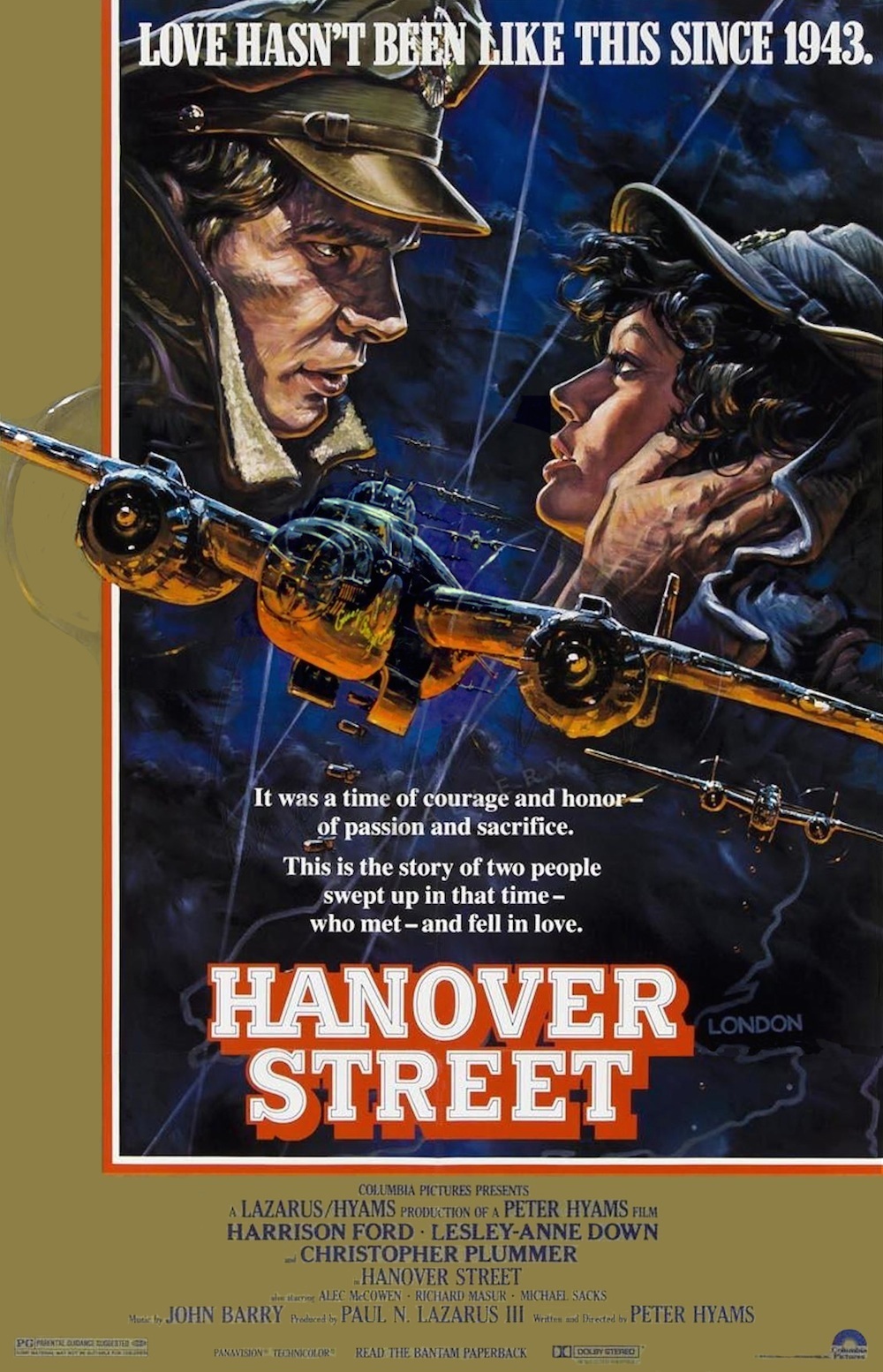
Just take a look at the poster for HANOVER STREET.

The words at the top: LOVE HASN’T BEEN LIKE THIS SINCE 1943.

Below that an illustration of Harrison Ford and Lesley-Anne Down looking each other passionately in the eyes, foreshadowing or merely shadowing a key scene in the movie.

More text (hype): “It was a time of courage and honor – of passion and sacrifice. This is the story of two people swept up in that time – who met – and fell in love.”

There’s also a map and two planes on the poster.

Ford worked so effectively as both Han Solo and Indiana Jones in eight films partly because he found a way to work in humor that counterbalanced all the cornball surrounding him. There’s also that priceless scene in THE EMPIRE STRIKES BACK when Princess Leia (Carrie Fisher) tells Han that she loves him and he merely says, “I know.”

In HANOVER STREET, Ford stumbles his way though dialogue like “Think of me when you drink tea,” “I love you enough to let you go, which is more than I’ve ever felt about anyone in my life,” and “You’ve got to go to him, and I’ve got to turn and walk away.” To be fair, everybody stumbles in HANOVER STREET and there’s no counterbalance to cornball.

Christopher Plummer legendarily disliked working on THE SOUND OF MUSIC (he called it “The Sound of Mucus”) and he said this about his co-star, “Working with Julie Andrews is like getting hit over the head with a valentine.” (Plummer and Andrews have remained friends.)

I just wonder what Plummer has to say about HANOVER STREET.

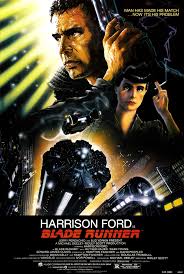
Blade Runner (1982)

BLADE RUNNER

BLADE RUNNER (1982) Four stars

Rutger Hauer’s death at the age of 75 brought me back a day later to BLADE RUNNER, one of the key movies in understanding the cinema of the last four decades.

It seems ironic that Hauer died in 2019, the same year as his character in BLADE RUNNER.

I can’t believe I’ve never written in detail about BLADE RUNNER, which has long been my No. 5 favorite movie of all-time behind CITY LIGHTS, DUCK SOUP, FREAKS, and TAXI DRIVER. Well, now is just as good a time as any to change that.

Watching the theatrical version from 1982, seeing BLADE RUNNER in any cut for what must have been the 100th time, faces especially stood out.

Title character Rick Deckard (Harrison Ford) as he takes in the death of main replicant Roy Batty (Hauer). We can read many different thoughts going through Deckard’s mind. The theatrical cut articulates it through Decker’s voice-over narration. I’ll get back to the narration later.

Batty throughout, from his entrance to his exit. Hauer’s so damn good that he almost steals the movie from both Ford and the incredible production design.

Batty’s punk pleasure model replicant lover Pris (Daryl Hannah) when she ambushes and assaults Deckard late in the picture.

J.F. Sebastian (William Sanderson) as he bears unfortunate witness to Batty settling his account with his creator Tyrell (Joe Turkel, best known as Lloyd from THE SHINING).

Leon Kowalski (Brion James) as he’s shot dead by replicant and Deckard romantic interest Rachel (Sean Young), just when it seemed Kowalski had Deckard near his demise.

Capt. Harry Bryant (M. Emmet Walsh) and his oily charm, and the enigma of Gaff (Edward James Olmos).

I’ve never exactly understood the criticism leveled at BLADE RUNNER that it’s great to look at but difficult to care about any of the characters.

I wonder if those critics saw the same movie.

I’ve always been moved by the plight of the replicants, the bio-engineered people who are “more human than human.”

The Nexus-6 model of replicants — represented by Batty, Pris, Leon, and Zhora (Joanna Cassidy) — look exactly like your average adult human being, but they have superior strength, speed, agility, resilience, and intelligence, especially combat model Batty. For the protection of the human race, replicants have a four-year life span and were given false memories.

Imagine finding out your childhood never happened.

The cold, hard facts of life.

Indeed.

The replicants bring a wide range of responses.

They’re slave labor off Earth … and illegal on Earth. “Quite an experience to live in fear, isn’t it? That’s what it is to be a slave.”

They’re at least complex villains, if they’re even the “bad guys.” We can make a strong case for Tyrell being more of a villain.

Then, we have the ambiguous title character who’ll probably always inspire debate: Is or isn’t Deckard a replicant? Ford argues human, director Ridley Scott replicant, but it’s been left for each viewer to determine.

Deckard plays like the detective hero lifted straight from THE BIG SLEEP or CHINATOWN and that comes across even more in the theatrical version with Ford’s gruff narration explicitly putting over Deckard’s world-weary cynicism.

Deckard gets no pleasure from his job “retiring” replicants. And the narration makes Deckard sound like he’s just woke up from a long hangover. (Ford’s hatred of the narration could not be more obvious.)

Later releases excised the voice-over narration, a device the executives wanted to make the film seem less confusing.

I watched the 1992 Director’s Cut first and so it took some adjustment to the narration. I find it works, except for one scene very late in the film where it’s sheer overkill. I mean, try it out:

“I don’t know why he saved my life. Maybe in those last moments he loved life more than he ever had before. Not just his life — anybody’s life; my life. All he’d wanted were the same answers the rest of us want. Where did I come from? Where am I going? How long have I got? All I could do was sit there and watch him die.” Do we need that? No.

That brings us to Batty’s final speech, “I’ve seen things you people wouldn’t believe. Attack ships on fire off the shoulder of Orion. I watched C-beams glitter in the dark near the Tannhauser gate. All those moments will be lost in time … like tears in rain … Time to die.”

In a sports column way back in 2012, I called Batty’s final speech my favorite movie dialogue.

In office conversation about this column, the late, great Morning Sun writer Nikki Patrick said that Hauer improvised Batty’s speech.

That made the speech even greater and Nikki even cooler.