

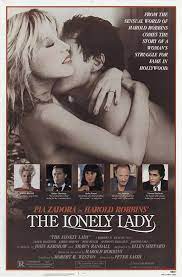
THE LONELY LADY (1983) 1/2*
The Lonely Lady is one of the all-time great stinker movies, 91 minutes of unpleasant characters in unsavory relationships with unbelievably bad actors speaking dialogue that should have never been uttered or ever written in the first place.
Like the (believe it or not) even more awful, killer Santa picture Silent Night, Deadly Night, The Lonely Lady potentially takes the heat off viewers by undercutting a procession of controversial scenes with unintentional humor. I could see hooting and howling in derisive laughter at the performances and the dialogue throughout Silent Night, Deadly Night and The Lonely Lady.
I found myself appalled more than anything else throughout The Lonely Lady, so I was basically too appalled to laugh.
The Lonely Lady especially lays it on thick whenever the title character — aspiring young screenwriter Jerilee Randall, played by the immortal Pia Zadora, though she’s never lonely — expresses her outrage at her perpetual exploitation by Hollywood writers, directors, actors, and producers, every one of them sexist pigs who just nonstop use and abuse her.
At the same time, however, the camera lingers on this exploitation from the rape by garden hose early on in the picture to some of the least sexy movie sex ever captured on celluloid.
On top of all that, Zadora’s real-life husband, Israeli multimillionaire industrialist Meshulam Riklis, funded Butterfly and The Lonely Lady with both pictures starring none other than Zadora. Legend has it that Riklis bought a Golden Globe award for his wife and her performance in Butterfly.
Zadora beat out Elizabeth McGovern and Howard E. Rollins Jr. in Ragtime, Kathleen Turner in Body Heat, Rachel Ward in Sharky’s Machine, and Craig Wasson in Four Friends, all five better-received performances in better-received films.
It remains inconceivable that Zadora — who made her motion picture debut in the 1964 cult film Santa Claus Conquers the Martians — won that award on her own merits.
Riklis was more than 30 years older than Zadora, and that’s not any different than the age gap between Jerilee and her much older husband, veteran Hollywood hack screenwriter Walter Thornton (Lloyd Bochner), in The Lonely Lady.
All those factors combine to make Jerilee’s speech at the Academy Awards — highlighted by that risible line I don’t suppose I’m the only one who’s had to fuck her way to the top! — the absolute worst scene in a movie populated by predominantly bad scenes.
Most of them involve Jerilee sleeping her way through some of the ugliest men imaginable.
Let’s take a look at one more scene that epitomizes The Lonely Lady.
Jerilee and Walter argue outside their Beverly Hills home, near the swimming pool seen first in one of the film’s most appalling scenes.
Jerilee: Walter? Walter, come to bed.
Walter: Haven’t you had enough wine? Go sleep it off.
J: If you’ll come with me.
[W turns away.]
J: I’m trying to say sorry.
W: With a head full of drink!
J: We don’t have to make love.
W: Thank you.
J: We could talk. We need to talk.
W: Why didn’t you go off with Dacosta? He would’ve enjoyed it.
[W picks up the garden hose that raped J earlier in the film.]
W: Or is this more your kick?
That’s even worse than the argument between Kathryn Harrold and Luciano Pavarotti in Yes, Giorgio that culminated in the infamous line I don’t want to be watered on by Fini.
That garden hose, in fact, might have once belonged to Fini.
The Lonely Lady flopped so badly that, thankfully, Hollywood never adapted one of Harold Robbins’ trashy novels again.
Now, I call that a happy ending.

 Attack of the Killer Librarian