
National Lampoon’s Animal House (1978)

NATIONAL LAMPOON’S ANIMAL HOUSE (1978) Four stars

There are few comedies I have enjoyed as much as NATIONAL LAMPOON’S ANIMAL HOUSE.

I have watched it many times over the years and that’s not even counting all those times on TBS, because, let’s face it, one misses so many “good parts” of a movie like ANIMAL HOUSE when it’s been edited for TV. It warped my fragile little mind seeing it on video the first time and I lost count of how many times I watched that VHS tape I bought circa 1997.

I loaned it to Brad Rich so he could watch Bluto’s infamous “Germans bombed Pearl Harbor” speech and remember it verbatim for his high school speech class. Mr. Rich earned an ‘A’ for his performance. Unfortunately, I did not have the opportunity to watch him act it out, though, fortunately, Mr. Rich returned the VHS tape. Bonus points for him.

College friend Don Stephens came over to my house about once a week to watch ANIMAL HOUSE it seemed like after Mr. Stephens joined a fraternity at Pittsburg State. Mr. Stephens and I started living ANIMAL HOUSE just a little bit so the viewings of the movie decreased significantly, especially after I continued my educational career in 2000 at Pitt State. Mr. Stephens eventually returned to the ranks of the independents and I remained one throughout both tours of college.

There was that one night when Mr. Stephens played Otter and I was Boon: “Hi, Don Stephens, damn glad to meet you,” then I hit ‘em with “Hi, that was Don Stephens, he was damn glad to meet you.” We only used it that one night, especially since it seemed like nobody got the reference. That’s when I started losing faith in the youth of America and have ever since.

Another time, Mr. Stephens and I went on a Thanksgiving break pilgrimage to Wichita to meet two young women (sisters) and, ahem, spend the night at their house. At some point, I believe it was early on at the bar, my date said that I was just like that Bluto guy from ANIMAL HOUSE, since I told her I’d been in college seven years. You win some, you lose some, and another time I’ll tell you about the six years off-and-on I knew my date from Wichita, although, to be honest, I really don’t want to do that.

Enough about that: ANIMAL HOUSE made a tremendous impact on the movie industry.

Every year, we get at least one raunchy, R-rated, gross out comedy.

ANIMAL HOUSE paved the parade route for PORKY’S, FAST TIMES AT RIDGEMONT HIGH, DAZED AND CONFUSED, AMERICAN PIE, OLD SCHOOL, WEDDING CRASHERS, and HANGOVER.

Every time I watch ANIMAL HOUSE, it holds up and it remains better than its followers.

First and foremost, it is superbly acted up and down the cast.

Tom Hulce and Stephen Furst (1954-2017) make a successful entry point into this world, as one snooty sorority sister calls them “the wimp and the blimp.” Tim Matheson and Peter Riegert play off each other so well as ladies man Otter and wing man Boon that we believe their characters have been friends for several years. James Daughton and Mark Metcalf, especially Metcalf as Niedermeyer, create thoroughly detestable characters that we love to hate.

Speaking of characters that we love to hate, Canadian actor John Vernon (1932-2005) had a knack for playing them better than just about anybody else. We enjoy every single appearance made by his Dean Wormer in ANIMAL HOUSE, every single time he gets his comeuppance, and especially every single time Vernon sinks his teeth into lines like “Fat, drunk, and stupid is no way to go through life, son” and “Put a sock in it, boy, or else you’ll be outta here like shit through a goose.” Vernon later played a similar character in KILLER KLOWNS FROM OUTER SPACE, retaining that bias against college kids.

John Belushi (1949-82) exploded into stardom with the success of ANIMAL HOUSE, one of the biggest hits of 1978. Outside action heroes Clint Eastwood, Charles Bronson, and Steve McQueen, we don’t find star-making performances built around fewer words. Belushi’s Bluto makes us laugh mostly through classic physical comedy and he irritates the comic villains every bit as effectively as the Marx Brothers and the Three Stooges did in their heyday.

Bluto definitely puts the animal in ANIMAL HOUSE, smashing acoustic guitars, downing full whiskey bottles in one fell swig (actually iced tea), pouring mustard on himself, starting food fights (by popping “zits”) and nationwide dance crazes, and peeping at cute coeds. Bluto’s predominantly silent act pays off with his big speech late in the pic for the Delta troops. It’s not quite George C. Scott as George S. Patton at the start of PATTON, but it’s close, real close in memorability.

Bluto has been described as a cross between Harpo Marx and the Cookie Monster.

Just about everybody has a memorable character in ANIMAL HOUSE, from Kevin Bacon in his motion picture debut (“Thank you sir, may I have another?”; how dare I forget a softball practice where I made every teammate who wanted another grounder hit their way ask that very question) to the lovely Karen Allen also in her debut, as well as Verna Bloom (1938-2019) as the ready and willing dean’s wife, Donald Sutherland as a hip professor, and DeWayne Jessie lip syncing his way through Otis Day on “Shout” and “Shama Lama Ding Dong.”

John Landis began a string of winners here, followed by THE BLUES BROTHERS, AN AMERICAN WEREWOLF IN LONDON, and TRADING PLACES over a few years. Universal wanted Chevy Chase to play the Otter role that went to Matheson, but Landis felt Chase was not right for the part and the director played a little Jedi mind trick by telling Chase that ANIMAL HOUSE would be an ensemble pic. That disinterested Chase, who instead made FOUL PLAY. Landis contributed to the anarchic atmosphere of ANIMAL HOUSE by throwing things at the actors, like an early scene when Bluto leads Flounder and Pinto into the Delta house and they’re greeted by a couple flying bottles.

Harold Ramis (1944-2014), Chris Miller, and Douglas Kenney (1946-80) combined on the screenplay and contributed their own collegiate and fraternal experiences.

George Lucas’ AMERICAN GRAFFITI famously asks “Where were you in ‘62?” ANIMAL HOUSE, released almost five years later to the day by the same studio, also takes place in ‘62 and Lucas, Ramis, Miller, and Kenney obviously had different answers to where they were in ‘62 and these different answers inform their respective movies and characters.

Both smash hit movies inform us what happened to their main characters. For example, in AMERICAN GRAFFITI, we’re told Terry the Toad is reported missing in action in Vietnam in December 1965. Meanwhile, in ANIMAL HOUSE, we read that Neidermeyer’s own troops kill him in Vietnam. Yes, indeed, they fragged Neidermeyer. Maybe even Terry the Toad took part in it.

Caddyshack (1980)

CADDYSHACK

CADDYSHACK (1980) Three-and-a-half stars
Harold Ramis’ CADDYSHACK gives the consumer four movies for the price of one.

1) Rodney Dangerfield vs. Ted Knight.

2) Chevy Chase and his meandering philosophical musings and lady man ways.

3) Bill Murray and his bizarre shenanigans.

4) The caddies and their little melodramas.

Most films don’t even give us one.

We have four distinct comedic styles at work in CADDYSHACK: Dangerfield (1921-2004) comes on and thankfully never stops doing variations on his night club act; Knight (1923-86) plays the ultimate snob and perfect counterpoint to Dangerfield; Chase gives us Zen wisdom filtered through deadpan absurdity; and Murray creates a world of his own that combines Dalai Lama and Cinderella stories, gross out snooty old ladies Baby Ruth taste testing, hunting and blowing up animatronic gophers real good, and Bob Marley joints.

Murray’s like a gopher within CADDYSHACK itself, burrowing underneath Dangerfield vs. Knight and the caddies.

CADDYSHACK plays like a 98-minute throwback to the Marx Brothers, the Three Stooges, and W.C. Fields.

First-time director Ramis (1944-2014), in fact, envisioned Murray as Harpo Marx, Dangerfield as Groucho, and Chevy as Chico. Guess that made Ted Knight the villainous Sig Ruman (A NIGHT AT THE OPERA, A DAY AT THE RACES) and Cindy Morgan a more risqué Thelma Todd (MONKEY BUSINESS, HORSE FEATHERS).

Improvisation and cocaine fueled CADDYSHACK.

It seems like Ramis and gang threw away the script written by Brian Doyle-Murray, Ramis, and Douglas Kenney (Ramis and Kenney worked together on NATIONAL LAMPOON’S ANIMAL HOUSE) just to make it all up as they went along, especially Chase, Dangerfield, and Murray.

This is one example of how the makers of a film went in expecting to make a certain film and came out with something completely different. The original plan had been to make the movie focused on the caddies, of course with a title like that, but the comedians took over and stole the show.

To be fair, however, the caddies have their fair share of funny moments and Doyle-Murray steals every scene that he’s in as caddy master Lou.

Chris Nashawaty’s book “Caddyshack: The Making of a Hollywood Cinderella Story” details just how much of a miracle it was even that the movie got finished.

“I had never seen cocaine before I got to the set of CADDYSHACK,” actor Peter Berkrot said. “This was really good cocaine. Pure, like they had just beaten it out of a leaf in Columbia and somebody had carried the leaf to us and turned it into powder in front of us just so we knew how pure it was,” said actor Hamilton Mitchell.

Ramis and Kenney (1946-80) turned in an original cut that ran four hours. A consultant recommended a through line with Danny Noonan (Michael O’Keefe) and his quest for a caddy scholarship and his relationship with a waitress (Sarah Holcomb, who played the mayor’s daughter in ANIMAL HOUSE).

Like classics by the Marx Brothers, the Three Stooges, and Fields, though, we don’t require much of a plot when there’s so much funny going on.

Over the years, I’ve come to appreciate Knight’s asshole Judge Elihu Smails just as much as Dangerfield’s Al Czervik and Murray’s Carl Spackler.

Smails is every bit as quotable as Czervik, Spackler, and Chase’s Ty Webb.

My favorite Smails line comes right after Noonan says that he would like to go to law school after he graduates but his parents do not have enough money to put him through college.

Smails says, “Well, the world needs ditch diggers, too.”

July 1980 undoubtedly ranks among the great months for comedies: AIRPLANE! debuted July 2, USED CARS on July 11, and CADDYSHACK on July 25.

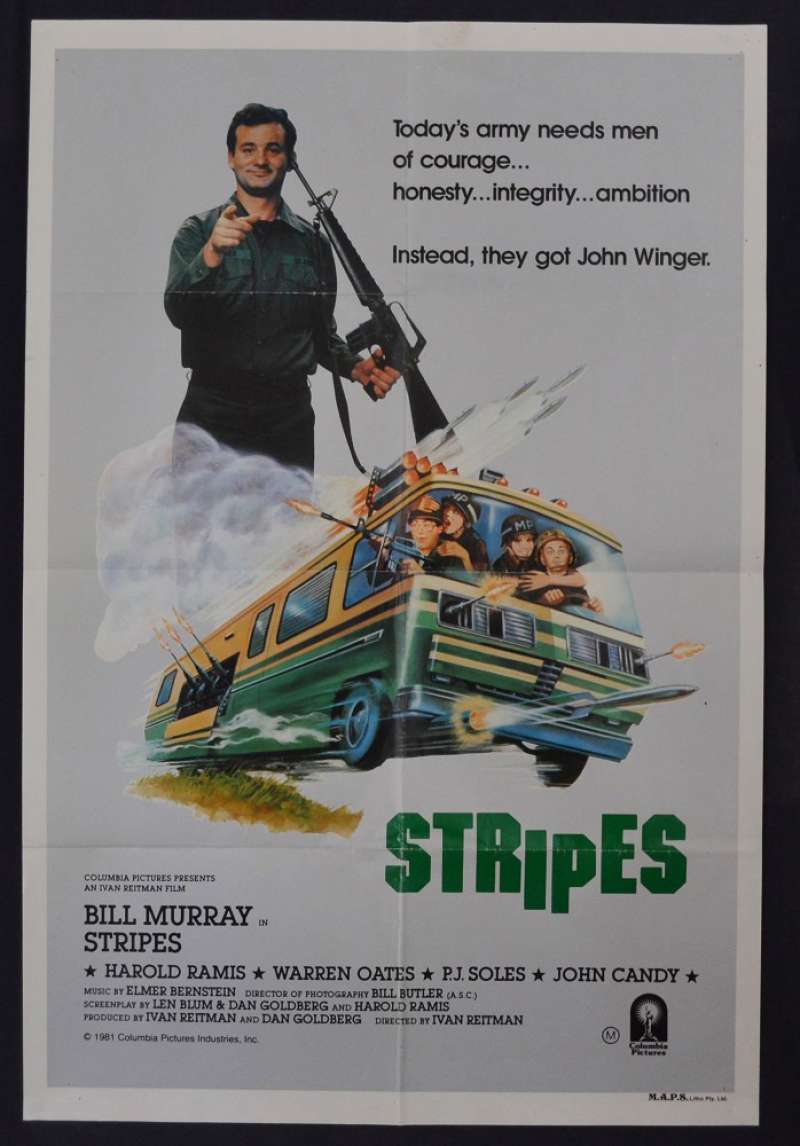
Stripes (1981)

day 66, stripes

STRIPES (1981) Three-and-a-half stars
Bill Murray was the Groucho Marx of the 1980s, especially during films like STRIPES and GHOSTBUSTERS.

STRIPES is Murray’s DUCK SOUP.

It’s not only all the one-liners and the institutional putdowns throughout both films, but a couple later scenes.

In DUCK SOUP, Groucho’s Rufus T. Firefly starts opening up machine gun fire and it only brings him immense pleasure.

Firefly boasts “Remind me to give myself the Firefly medal for this!”

Then his loyal assistant informs Firefly that he’s firing upon his own men.

Of course, Firefly offers his assistant $5 to keep it under his hat, but then Firefly withdraws the offer and keeps the five spot under his own hat.

Firefly’s joy during that sequence and the whole film, for that matter, come back when Murray’s John Winger takes on them darn Commies in STRIPES.

Murray, like Groucho, treated all this like one great big put-on.

That’s the comic attitude that informs STRIPES and like Groucho, Murray never played the fool. He’s the intelligent one, the hustler who knows the score, and sure Murray’s foil Sgt. Hulka (Warren Oates) socks it to Winger during basic training, but eventually the pair reluctantly find common ground and reach an understanding.

Winger first wanted to join the U.S. Army based on a lark, not some great conviction to serve his country.

For example, Winger thought he could pick up more women in the military.

Winger: “Chicks dig me, because I rarely wear underwear and when I do it’s usually something unusual. But now I know why I have always lost women to guys like you. I mean, it’s not just the uniform. It’s the stories that you tell. So much fun and imagination.”

Winger and his best friend Russell Ziskey (Harold Ramis) see the EM-50 Urban Assault Vehicle as an opportunity to go pick up their Military Police girlfriends (P.J. Soles, Sean Young) in West Germany and enjoy a holiday in Switzerland. Of course, this leads to their comrades seeking them out and being captured by the Soviet Army. Winger and the gang rescue their friends with that heavily-armed recreational vehicle on their side.

Winger keeps that lark attitude throughout STRIPES, even after his friends fall into Soviet hands.

Winger: “C’mon, it’s Czechoslovakia. We zip in, we pick ’em up, we zip right out again. We’re not going to Moscow. It’s Czechoslovakia. It’s like going into Wisconsin.”

Everything’s a lark to Winger (and Murray).

Murray and Ramis make a very good comedic duo. You might be surprised to find out STRIPES (directed by Ivan Reitman) had been originally intended to be a Cheech and Chong vehicle, but that pair wanted the dreaded “complete creative control.” Both Ramis himself (who scripted ANIMAL HOUSE and directed CADDYSHACK) and Columbia Pictures were reluctant to have Ramis onscreen, but Murray insisted that he would only be paired with Ramis.

Ramis is vital to the success of STRIPES. He’s the ordinary guy counterbalance to Winger, but also the loyal best friend who ends up along for the ride despite knowing that his best friend’s crazy. Ramis brings an interesting tension to the movie that might not have been there, for example, had Dennis Quaid played Russell, such as the scene when Russell starts choking Winger. Quaid seems far more the stereotypical All-American hero type. Also, Ramis and Murray shared dynamite chemistry.

Veteran character actor Warren Oates is also vital to STRIPES. Like Russell, Sgt. Hulka makes a great counterbalance to Winger. There’s just one dramatic scene in STRIPES, when Hulka confronts Winger in the latrine. Hulka dares Winger to take a swing at him. Winger obliges, and Hulka wipes the floor with Winger. Even more so than Winger, Hulka knows the score. Hulka had originally been scheduled for death in the mortar accident and to be replaced by his twin brother also played by Oates, but the creative powers-that-be thankfully scrapped that concept.

On vacation in 2017, riding over the George Rogers Clark Memorial Bridge headed into Louisville, I thought it seemed very familiar and sure enough, it’s the bridge where Winger melodramatically quits taxi driving by flinging his keys into the Ohio River. Fortunately, we did not reenact the scene that day; it definitely would have been fun making it back home.

Would it be safe to say STRIPES is the greatest movie ever shot in Louisville?

Not so fast, my friend, as former Louisville head coach Lee Corso would say.

GOLDFINGER, RAIN MAN, A LEAGUE OF THEIR OWN, and THE INSIDER, for example, might have something to say about that.