Dead of Night (1945)

DEAD OF NIGHT (1945) ****
Back in 2005, I needed three credits to complete a master’s degree in history (lifetime underachievement) and I finished a three-week 120-hour internship that summer at the National Archives in Kansas City, Missouri.

Anyway, they let me loose on their free account on some genealogical site as reward for good behavior and a day-and-a-half later I came back with Sisney family history dating back to 1776.

On February 27, 1776, a few months before the Declaration of Independence, Steven Sisney fought at and was captured and imprisoned during the Battle of Moores Creek Bridge near Wilmington, North Carolina. Sisney was one of about 1600 loyalist-siding Highland Scots who marched from Cross Creek, North Carolina, toward the coast behind British Colonel Donald McLeod. The loyalists lost, the patriots received a morale boost, and North Carolina became the first colony to vote for independence, beating the official declaration by a couple months easy.

Every once in a while, I think about Steven Sisney and his loyalty to the British since I favor the Beatles and the Stones and the Who and the Kinks and Black Sabbath and Led Zeppelin and the Clash and the Sex Pistols and the Buzzcocks and Radiohead and Pink Floyd and Peter Cushing and Christopher Lee and Sherlock Holmes and James Bond and Alec Guinness and Cary Grant and Ben Kingsley and Ian McKellen and Glenda Jackson and Hammer and Hitchcock and Monty Python and Lord of the Rings and Harry Potter and on and so on and on some more again.

If nothing else, the 1945 horror anthology film Dead of Night made me think about Steven Sisney, the epic 1989 David Hackett Fischer history book Albion’s Seed: Four British Folkways in America (never forget the saga of the poor one-eyed servant George Spencer in New Haven, who was hanged for bestiality after a sow birthed a deformed pig with one eye and the two witnesses required for conviction were the deformed piglet and Spencer’s recanted confession), the late Pittsburg State history professor Judith Shaw (1931-2013) who taught many British History courses over the decades, and how much of an impact Dead of Night had on Richard Attenborough’s Magic.

Horror anthologies generally offer a mixed bag of success and failure.

Of course, Ray Davies outlined it in Celluloid Heroes, Success walks hand-in-hand with failure along Hollywood Boulevard. I always think about Twilight Zone: The Movie from 1983 to illustrate the mixed bag qualities of just about every anthology we’ve ever been expected to consume. The segments directed by John Landis and Steven Spielberg suck, the ones from Joe Dante and George Miller are dynamite, and the prologue and epilogue push the overall package into positive review terrain.

In Dead of Night, Alberto Cavalcanti directed Christmas Party and The Ventriloquist’s Dummy, Charles Crichton directed Golfing Story, Robert Hamer directed The Haunted Mirror, and Basil Dearden directed Hearse Driver and Linking Narrative.

It all starts when architect Walter Craig (Mervyn Johns) tells host and potential client Eliot Foley (Roland Culver) and his guests at country estate Pilgrim’s Farm that he’s seen them all in a recurring dream. Craig feels like he’s been at Pilgrim’s Farm before and every guest rings a bell to him despite never having met any of them before. Each person (host and guests alike) rattles off a supernatural tale, inspired by Craig’s revelations. Craig wants to leave because he doesn’t want his dream to come true and the guests do their best to make him stay.

The Haunted Mirror and The Ventriloquist’s Dummy are especially brilliant and Golfing Story reminds one that Ealing Studios later brought us Kind Hearts and Coronets, The Lavender Hill Mob, and The Ladykillers, all of which feature a dark comedy that seems to have started with Hitchcock. Hamer directed Kind Hearts and Coronets and Crichton directed The Lavender Hill Mob (and later on in his career A Fish Called Wanda).

Basil Radford (1897-1952) and Naunton Wayne (1901-70) appear together in Dead of Night, but not as their characters Charters and Caldicott. Charters and Caldicott began in Hitchcock’s 1938 classic The Lady Vanishes and then the acting duo appeared together in a series of films from 1940 through 1949, including three more times playing Charters and Caldicott. They are very funny, both individually and collectively, in Dead of Night. They don’t seem particularly gay in Dead of Night.

During The Haunted Mirror, guest Joan Cortland (Googie Withers) relays to us what happened after she gifted an antique mirror to her future husband Peter (Ralph Michael). Peter sees another room in the mirror’s reflection, does not see Joan in the mirror when she confronts him, and for a spell he sees the room as normal. Joan finds out the history of the mirror and the wealthy man who owned it after she visits the antique shop from which she purchased the mirror. This wealthy man was crippled in a riding accident, then he grew so insanely jealous of his wife that he strangled her and he finally slit his own throat in front of the mirror. When Joan returns home, Peter accuses her of having an affair and then he attempts to strangle her. Joan smashes the mirror in sheer desperation and breaks the spell.

In The Ventriloquist’s Dummy, the absolute most effective segment, resident rational explanation seeker Dr. Van Straaten (Frederick Valk) tells us about the case of ventriloquist Maxwell Frere (Michael Redgrave) and his dummy Hugo Fitch. Maxwell develops a dual personality with Hugo becoming the dominant part. Poor, poor, poor Sylvester Kee (Hartley Power), who happens to catch and be impressed by the act.

In the long run, I was much impressed by Dead of Night and I recommend it to anyone.

Kill and Kill Again, Firecracker, Circle of Iron

KILL AND KILL AGAIN, FIRECRACKER, CIRCLE OF IRON

In his 1981 TV review of the South African martial arts spectacular KILL AND KILL AGAIN, Roger Ebert predicted action movie stardom for James Ryan and invoked the names Eastwood, Bronson, and Bruce Lee.

Well, in this business and life in general for that matter, you win some, you lose some.

James Ryan, who? Yeah, not exactly a household name.

Describing the plot, I would like to just string together a bunch of random words: martial arts champion for hire undercover government agent top secret rescue mission kidnapped scientist recruit colleagues alternative energy source megalomaniac uniformed cult mind control world domination bar fight mushy romance mushy talk middle-of-nowhere fight storming fortress explosions fisticuffs flips plot revelations not particularly revelatory.

There you go. KILL AND KILL AGAIN, the sequel to KILL OR BE KILLED, in a nutshell.

KILL AND KILL AGAIN works predominantly because it has a good sense of humor and it finds just the right tone to pull off being a successful action comedy.

There’s one especially fun supporting character and supporting performance, the diabolical genius’ assistant and (significant other) Minerva played by Marloe Scott-Wilson. She looks like she drifted over from ROCK ‘N’ ROLL HIGH SCHOOL or THE DECLINE OF WESTERN CIVILIZATION, especially with that ridiculous Day-Glo hairdo. She’s a lot of fun in every scene, especially when she calls residential madman Marduk (Michael Mayer) by these absolutely ridiculous pet names. She comes up with a fresh one every single time. And it rankles Marduk, because good old Minerva says her little terms of endearment right in front of everybody. At one point, Marduk tells her, “I said don’t call me Popsicle.” This running gag even has an explosive payoff in the end.

Guess we should mention that South African beauty queen Anneline Kriel — Miss World 1974 — does her own stunts in the movie. She has to overcome playing a character named “Kandy Kane.” I almost wish they would have named her character “Susan Alexander Kane” or “Emily Kane,” for all us CITIZEN KANE fans in the audience. Now, that would have been an impressive stunt.

Impressive stunts are at the heart of FIRECRACKER, especially during the film’s last 30 minutes.

We’re talking about topless kickboxing and what must surely be one of the weirdest love scenes ever committed to celluloid.

Two sicko creeps pursue our heroine Susanne Carter, played by the luscious Jillian Kesner, and they eventually shed her of her top and bra. She then proceeds to kick their asses viciously. Meanwhile, in the background, we have “Rack Master” boxes. Perfect!

“Rack Master” should have been Carter’s martial arts name and it also should have been a title for FIRECRACKER.

That’s not too much of a stretch, especially since FIRECRACKER traveled as NAKED FIST in Australia.

FIRECRACKER director Cirio H. Santiago plagiarized this topless kickboxing scene from his earlier New World Pictures extravaganza TNT JACKSON.

Now, let us consider that weird love scene. Oh Susanna and her love interest Chuck Donner (Darby Hinton) consummate their relationship, but not before they remove each other’s clothes stitch-by-stitch with a knife. Kinky. Chuck Donner and his incredible mustache, especially his incredible mustache, just scream “Creepy seducer of the ladies who killed Susanna’s sister.” Of course, Susanna does not learn of this fact until after their lovemaking.

Susanna exacts her revenge against Chuck in the ring and we all can be sure that he will never look at another woman ever again.

Kesner passed away in 2007 and she and her late husband Gary Graver (1938-2006) became known for their efforts to preserve the work and legacy of legendary director Orson Welles. I do believe it is time for another reference to CITIZEN KANE.

CIRCLE OF IRON attempts to be something bigger, greater than KILL AND KILL AGAIN and FIRECRACKER. It wants to be a transcendent exploitation film.

We are given the only clue we need as soon as the following title card appears on screen: “Prior to the death of the legendary Bruce Lee he helped to create a movie story that might capture not only the spirit of martial arts but a part of the Zen philosophy he lived by. He was aware that a film with these dynamics would cause controversy, particularly among those unfamiliar with Zen beliefs. But it was this very uniqueness that he believed wound enthrall the moviegoer. Bruce set the story in a land that never was and always is. It is to Bruce Lee that this film is posthumously dedicated.”

I was definitely not enthralled by CIRCLE OF IRON. Not very often.

It certainly did not help that Captain Hairdo, er, Jeff Cooper plays the lead character Cord and this character and performance never quite resonated with me because I kept seeing Roger Daltrey instead and I pretended it was TOMMY.

I kept waiting for Cooper’s cord to break out into song, “Listening to you, I get the music / Gazing at you I get the heat / Following you I climb the mountain / I get excitement at your feet!” and “See me, feel me, touch me, heal me.”

It never happened and I felt extremely disappointed.

David Carradine plays about four roles too many in CIRCLE OF IRON. Okay, I’ll say three roles too many, because we get one of the film’s most entertaining scenes when Carradine assumes the guise of “Monkeyman.” At one point, Carradine’s wig came off and I thought shit like that only happened in SAMURAI COP.

Christopher Lee passed on THE LEGEND OF THE 7 GOLDEN VAMPIRES, a joint venture between Hammer Studios and the Shaw Brothers, because he did not want to play Dracula for the millionth time … but he plays what turns out to be a role that sucks even more in CIRCLE OF IRON, Zoltar, er, Zetan. This is one of those quest movies where you’ll become irritated after hearing a certain name — Zetan, maybe — many, many, many, many, many, many times.

Orson Welles asked me not to reference a certain movie during this review of CIRCLE OF IRON. I must respect his wishes.


KILL AND KILL AGAIN ***; FIRECRACKER ***; CIRCLE OF IRON **

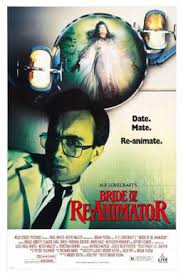
Bride of Re-Animator (1990)

BRIDE OF RE-ANIMATOR

BRIDE OF RE-ANIMATOR (1990) ***

Jeffrey Combs’ Herbert West is one of the all-time great movie characters and his presence alone makes BRIDE OF RE-ANIMATOR, a sequel to the 1985 cult favorite RE-ANIMATOR, worth a recommendation.

H.P. Lovecraft first created Herbert West for the 1922 short story “Herbert West-Reanimator.” RE-ANIMATOR took inspiration from “From the Dark” and “The Plague-Demon” (the first two sections), while BRIDE OF RE-ANIMATOR turned to “The Horror from the Shadows” and “The Tomb Legions” (the final two). West is the central human character in both films.

How to describe West for the uninitiated, that’s a challenge I face during this review. I first think of comparing West to a horror movie character archetype like Colin Clive’s Victor Frankenstein or, to be more precise, Peter Cushing’s Victor Frankenstein from the Hammer FRANKENSTEIN series. He’s brilliant, narcissistic, intense, intensely driven, and essentially amoral. He’s even far less interested in the ladies than Cushing’s Frankenstein. He’s only focused on his work.

West is one of those characters that we love to hate, like Cushing’s Victor Frankenstein and Michael Moriarty’s Jimmy Quinn in Q: THE WINGED SERPENT. There’s that great pencil breaking scene in RE-ANIMATOR, for example, that epitomizes West. He’s one of the great movie assholes.

Alas, most of the rest of BRIDE OF RE-ANIMATOR does not measure up against both West and the first picture. First and foremost, RE-ANIMATOR director and co-writer Stuart Gordon did not return for the sequel and instead Brian Yuzna directed from his own script. Yuzna earned production credits on his friend Gordon’s films RE-ANIMATOR, FROM BEYOND, and DOLLS.

Basically, I find that BRIDE OF RE-ANIMATOR drags more than RE-ANIMATOR or it’s a bit of a slog to get to the sequel’s rather nifty grand finale. I was really struggling around the hour mark and I even contemplated exiting BRIDE OF RE-ANIMATOR.

West’s arch nemesis from the first movie, Dr. Carl Hill (David Gale), returns for the sequel or at least his infamous disembodied head shows up for work. We do not get enough scenes with Hill in the sequel and that helps explain why BRIDE OF RE-ANIMATOR sputters a bit during its middle portion.

The incredible tension between West and Hill contributed a great deal to the success of RE-ANIMATOR. That’s predominantly missing from BRIDE OF RE-ANIMATOR and West battling a persistent burly policeman simply does not possess the same magic. However, we do ultimately have a great payoff when Hill and West are finally reunited.

Bruce Abbott’s Dan Cain returns for the sequel in his role of the straight man and main audience identification figure. He’s not as effective as he was in the first movie.

Kathleen Kinmont and Fabiana Udenio do not make up for the first movie’s Barbara Crampton.

The one area where the sequel trumps the original is special effects, especially during the final 20 minutes. Credited artists include John Carl Buechler, Screaming Mad George, Greg Nicotero, and David Allen, who rank among the best in their field.

Combs’ West and the special effects make BRIDE OF RE-ANIMATOR one of those relatively difficult to come-by sequels that works.

The Legend of the 7 Golden Vampires (1974)

THE LEGEND OF THE 7 GOLDEN VAMPIRES

THE LEGEND OF THE 7 GOLDEN VAMPIRES (1974) ***

It was really only a matter of time before Hammer, the British masters of the macabre, and the Shaw Brothers, the Hong Kong masters of martial arts, would combine forces and make the world’s first martial arts vampire movie spectacular. An exploitation movie fan’s wet dream come true, in other words.

They created THE LEGEND OF THE 7 GOLDEN VAMPIRES in 1974, not the greatest vampire or martial arts movie ever made, of course, but still an enjoyable romp for those who have a hankering for (in no particular order, except for the last item) vampire hunting, neck biting, blood letting, boiling blood, severed hands, throat slitting, stabbings through the heart, vampires turning to dust, fake bats, fake castles, sword fights, martial arts combat between warriors and vampires & their minions, archery, breasts, romance, and one ridiculous, anticlimactic ending. Three stars, check it out.

Christopher Lee first played Dracula for Hammer in 1958 and he returned for PRINCE OF DARKNESS (1966), DRACULA HAS RISEN FROM THE GRAVE (1968), TASTE THE BLOOD OF DRACULA (1970), SCARS OF DRACULA (1970), DRACULA 1972 (1972), and THE SATANIC RITES OF DRACULA (1973). Lee’s animosity toward the series increased over time and he finally refused to participate in THE LEGEND OF THE 7 GOLDEN VAMPIRES after seven times as the Count. Lee read the script and said “No deal.”

That’s a bummer, especially since John Forbes-Robinson makes for a horrible Dracula. How horrible? They dubbed him with David de Keyser and Dracula only appears in a few minutes at the beginning and end of the picture. In the opening scene, Dracula kills a Chinese monk and takes on his form. (Reportedly, Forbes-Robinson was furious about being dubbed. Hey, it’s not the first time in history. A few years after GOLDEN VAMPIRES, SATURN 3 director Stanley Donen felt dissatisfied with Harvey Keitel’s Brooklyn accent and since Mr. Keitel refused participation in post-production, Donen dubbed over Keitel with a British actor using a Mid-Atlantic accent.)

Granted, we do have Peter Cushing for the fifth time as Professor Van Helsing. Who else would handle the plot exposition through dialogue scenes? How about that plot? Van Helsing, on a lecture stop in China, agrees to help seven siblings (six men, one woman) take back their ancestral mountain village that’s been taken over by seven “golden” vampires (including Dracula trapped in another body) and their living dead minions. Then again, I already described the plot in 44 words in the second paragraph.

THE LEGEND OF THE 7 GOLDEN VAMPIRES can stand with any of the goofiest Shaw Brothers spectaculars and it ranks among the best of the Hammer Dracula films.

Fright Night (1985)

FRIGHT NIGHT

FRIGHT NIGHT (1985) Three-and-a-half stars

In a not-at-all shocking revelation, Crispin Glover admitted that he did FRIDAY THE 13TH: THE FINAL CHAPTER (1984) because he needed the money and that he does not think much of the slasher film genre overall.

“I’ve only seen two of those films, I saw the original film [FRIDAY THE 13TH] and the one that I’m in,” Glover told Yahoo! Movies. “I remember when I saw the original one, not too long before it I’d seen the original TEXAS CHAINSAW MASSACRE, and when I saw the first FRIDAY THE 13TH, I thought, ‘Well, this is extremely derivative.'”

Not sure what Glover thinks of FRIGHT NIGHT, but surely he can relate to the dialogue from horror movie host Peter Vincent (Roddy McDowall) after he’s fired by that darn TV station wrapped up in demographics and ratings.

“I have just been fired because nobody wants to see vampire killers anymore, or vampires either. Apparently, all they want to see are demented madmen running around in ski-masks, hacking up young virgins.”

FRIGHT NIGHT gives us vampires and vampire killers, and it’s one of the best examples from a decade of horror movies that successfully mixed horror and comedy. That’s part of a grand tradition that started with all them Universal classics in the 1930s.

FRIGHT NIGHT both pays tribute to classic horror movies of the variety that we’d see on late night TV and updates them for contemporary audiences and mores, taking in the rising expectations for special effects and our increased demand for gore and nudity. Richard Edlund, whose previous credits include RAIDERS OF THE LOST ARK and GHOSTBUSTERS, delivers the gore effect goods late on in FRIGHT NIGHT and Chris Sarandon’s head vampire Jerry Dandridge is both a charming ladies killer and a nasty piece of work. He’s not one of them pretty boy puss vampires that we have seen in such bastardizations of the genre as TWILIGHT and DRACULA 2000.

The name Peter Vincent itself descends from actors Peter Cushing and Vincent Price, who are symbolic of the horror movies obviously loved by director and screenwriter Tom Holland. Cushing slayed Dracula several times in Hammer films, as he played Van Helsing in HORROR OF DRACULA, DRACULA A.D. 1972, THE SATANIC RITES OF DRACULA, THE BRIDES OF DRACULA, and THE LEGEND OF THE 7 GOLDEN VAMPIRES. He should not be mistaken for Christopher Lee, who played Dracula so many times that a Hollywood traffic cop once pulled over the actor and asked him if he should be out in the daylight.

I wonder if Cushing (1913-94) and Price (1911-93) saw FRIGHT NIGHT and what they made of both the film and the Peter Vincent character. (McDowall said that he used “The Cowardly Lion” from THE WIZARD OF OZ as his inspiration for Peter Vincent. As a guest at one of McDowall’s parties, Price said FRIGHT NIGHT was wonderful and McDowall gave a wonderful performance.)

McDowall’s Vincent is one of those characters that elevate a film. Fortunately, there’s a few more memorable characters in FRIGHT NIGHT.

William Ragsdale plays our bright-eyed high school protagonist Charley Brewster who just might be Peter Vincent’s biggest fan. He never misses a “Fright Night” episode. Mr. Brewster encounters great difficulty getting anybody to believe him that his next-door neighbor, the charming and good-looking Jerry, is a vampire. Everybody thinks it’s just a byproduct of Charley’s overactive imagination only made worse by horror movies.

Peter ultimately believes Charley and the old washed-up actor becomes a real-life vampire hunter, paired up with the horror movie fanatic. They believe in each other.

Amanda Bearse is Charley’s girlfriend and Jerry’s target for his vampire bride, since she resembles the lady in that painting on his wall or Bearse’s Amy is the reincarnation of Jerry’s long-lost love. Stephen Geoffreys, who looked like he was Jack Nicholson’s son, almost steals every scene that he’s in as Evil Ed, Charley’s friend.

FRIGHT NIGHT has made a lasting impression on me. I first watched it as part of a horror movie marathon during a friend’s slumber party. It was the film that I remembered most fondly and it stuck with me for several years before watching it again.