Samurai Cop (1991)

SAMURAI COP

SAMURAI COP (1991) ***

An outtake is defined as “a scene or sequence filmed or recorded for a movie or program but not included in the final version.”

Blown lines and stunts, we all know the routine by now.

Hal Needham and Jackie Chan may have made outtakes for the end credits a cinematic institution, but Iranian “jack of all trades and master of none” Amir Shervan (1929-2006) directed SAMURAI COP, a feature movie solely comprised of outtakes.

Shervan trumped such legendary figures as Dwain Esper, William “One Shot” Beaudine, Bert I. Gordon, Bill Rebane, Ray Dennis Steckler, and even Ed Wood in absolute sheer incompetence.

Like a select few bad movies, SAMURAI COP is so, so, so bad in so, so, so many marvelous ways that it passes all the way through bad into good. It belongs filed next to Efren C. Pinon’s THE KILLING OF SATAN and Claudio Fragasso’s TROLL 2.

— Mathew Karedas, a.k.a. Matt Hannon, stars as Joe Marshall. Most people, though, just call him “Samurai Cop.” Joe must be the least convincing samurai in all history, cinematic and otherwise. For one, Joe’s entire look screams more Fabio and Kato Kaelin than, let’s say, Toshiro Mifune and his most dangerous weapon brandished is that damn speedo he spends what feels like the entire second half of the movie in. Anyway, for somebody allegedly well-versed in the Japanese vernacular, he sure does struggle pronouncing the name “Fujiyama.” When asked by his partner Frank Washington (Mark Frazer) what “katana” means, Joe snaps back “It means Japanese sword.” You don’t say, you don’t say.

— Samurai Cop arguably spends more time being a ladies man than anything else. No, seriously, he beds three, er, two women and he even blatantly talks about the beauty of another woman in the presence of his lover. Smooth, real smooth. Late in the 96-minute spread, he tells his future conquest, “Let’s just say … I can read eyes.” I wish that you couldn’t read dialogue.

Here’s a dialogue exchange from the Planet-X:


Nurse: Do you like what you see?

Joe Marshall: I love what I see.

N: Would you like to touch what you see?

JM: Yes. Yes, I would.

N: Would you like to go out with me?

JM: Uh, yes I would.

N: Would you like to fuck me?

JM: Bingo.

N: Well, then let’s see what you’ve got …

[Nurse investigates Joe’s bulge]

N: Doesn’t interest me. Nothing there.

JM: Nothing there? Just exactly what would interest you, something the size of a jumbo jet?

N: Have you been circumcised?

JM: Yeah, I have, why?

N: Your doctor must have cut a large portion off.

JM: No, uh, he was a, he was a good doctor.

N: Good doctors make mistakes too, that’s why they have insurance.

JM: Hey … don’t worry. I got enough. It’s big.

N: I want bigger.

[Nurse walks away]


I doubt that any screen lothario has ever partaken in dialogue that bad and the sound that we just heard is Rudolph Valentino saying “Thank you” for having made only silent movies.

That dialogue plays like a combination of a porno movie and “Dick and Jane” (most of the rest of the movie belongs to knocking off LETHAL WEAPON) and it belongs alongside the SHARK ATTACK 3: MEGALODON interchange in the anals, er, annals of cinematic history:


Cataline Stone: I’m exhausted.

Ben Carpenter: Yeah, me too. But you know I’m really wired. What do you say … I take you home and eat your pussy.


Boy, that’s just about as great as the whole “Fini can water you” debacle from YES, GIORGIO.

— Lead actor Matt Hannon thought he was done with the picture and got himself a short haircut. Several months later, Shervan looked up Hannon and informed him they were going to reshoot scenes. Unfortunately, Hannon still had short hair. I say unfortunately because Hannon wears one of the least convincing wigs ever made during SAMURAI COP. It does not help that Hannon’s wig flies off during a late fight scene and the actor also displays his obvious displeasure having to wear his wig. Yeah, it’s that bad.

— The chase scenes alternate between moving incredibly slow (nothing like slow-moving cars …) and being artificially sped up (… except for cars that zip along unnaturally). Yes, there are times when the action in SAMURAI COP plays like a silent film projected at the wrong speed.

— Not sure that I want to spend that much more time and space on SAMURAI COP, because I don’t want to risk writing a dissertation. Yes, over 750 words feels like I have been writing on this movie for a long time. However, there’s so many more things wrong but right about SAMURAI COP that we could be here all day, ironic for a movie that lasts a meager 96 minutes. Just imagine SAMURAI COP at GONE WITH THE WIND length.

— In a review long ago, I wrote that the 1979 Chuck Norris action vehicle A FORCE OF ONE combines a standard issue cops and criminals plot acted out by a good cast with martial arts and a “very subtle” anti-drug message that plays like one of those infamous 1980s TV commercials, only featuring roundhouse kicks.

On that note, we can end this review with a public service announcement from SAMURAI COP: “Now I’m telling these son-of-a-bitches that we respect the Japanese of this country, who are honest businessmen. And yeah, this is the land of opportunity for legitimate business, not for death merchants who distribute drugs to our children through schools and on the streets. Now I’m telling these motherfuckers that if they continue killing our children to make their precious millions that they deposit in their secret Swiss bank accounts, counselor, before your lawsuit even gets off the court clerk’s desk, I’ll have their stinking bodies in garbage bags and ship them back to Japan for fertilizer.”

Beautiful, absolutely beautiful, and it makes me want to pop a top on an ice cold one and blast Alice Cooper’s “I Love America.”

Slithis (1978)

SLITHIS (1978) 1/2*

SLITHIS is one of the worst movies ever made, I feel safe in saying that, and it did for radioactive mutant monsters what A*P*E did for giant apes.

Maybe I would feel a little better after watching it had I received a “Slithis Survival Kit” like viewers did back in 1978 when this cinematic plague called SLITHIS was unleashed on theaters and drive-ins.

I read about this survival kit in Roger Ebert’s review and I found images of the four-page document through the magic of the Internets.

WARNING!

SLITHIS A CREATURE SPAWNED FROM THE WASTE OF A NUCLEAR ENERGY PLANT … WANTS YOU TO SURVIVE.

FOLLOW THESE INSTRUCTIONS!

  1. REMOVE PICTURE OF SLITHIS BY CUTTING ALONG THE DOTTED LINE.
  2. KEEP PICTURE OF SLITHIS ON YOUR PERSON AT ALL TIMES.
  3. AT NIGHT, WHEN SLEEPING, PLACE PICTURE OF SLITHIS UNDER PILLOW.
  4. JOIN THE SLITHIS FAN CLUB … HE WILL REMEMBER YOU WHEN HE STALKS YOUR NEIGHBORHOOD.

SLITHIS FAN CLUB

FOR MY PERSONAL SAFETY AND SURVIVAL PLEASE SIGN ME UP FOR THE SLITHIS FAN CLUB … I SOLEMNLY SWEAR TO UPHOLD THE FOLLOWING RULES AND REGULATIONS.

  • TO HELP ESTABLISH THAT SLITHIS IS A VICTIM OF OUR SOCIETY.
  • TO PROMOTE A BETTER UNDERSTANDING OF THE SLITHIS AND THE ENVIRONMENTAL CONDITIONS THAT CREATED IT.
  • TO ASSURE OTHERS THAT WITH THE SURVIVAL KIT THEY NEED NOT FEAR THE SLITHIS.

NAME

ADDRESS

CITY STATE ZIP

PLEASE SEND ME MY FREE PHOTO OF THE SLITHIS AND MY OFFICIAL MEMBERSHIP CARD.

(SEE BACK OF CARD FOR FURTHER INFORMATION)

NOTICE

PLEASE DEPOSIT THIS PORTION OF THE OFFICIAL SURVIVAL KIT IN MEMBERSHIP BOX LOCATED IN THE LOBBY OR CONCESSION STAND OF THIS THEATRE … YOU MAY PICK UP YOUR FREE PHOTO AND MEMBERSHIP CARD 3 WEEKS FROM NOW AT THIS THEATRE … or enclose 25¢ FOR POSTAGE & HANDLING AND MAIL TO

SLITHIS FAN CLUB

SUITE 200

1024 WALNUT ST.

DES MOINES, IOWA 50309

That’s absolutely patently ridiculous and far better than the movie itself. I wish I had thought about the Slithis Fan Club when our family vacation stopped in Des Moines.

I am being perfectly blunt with you when I warn you that coffee or any strong stimulant (s) would be a better survival kit for SLITHIS. How about taking a drink every time a character says “Slithis”? No, wait, never mind, alcohol’s a depressant and SLITHIS has been known to create depression within its viewers for at least a few hours. Viewers in 1978 were reportedly incredibly slow in returning home, since they just sat inside their cars unable to move and they were even unable to speak for hours. Hundreds even thousands of people sat in their cars in silence. It took a long time to process SLITHIS.

Because SLITHIS is deadly dull. Deadly dull. It is quite possible that SLITHIS wiped out an entire population of drive-in denizens through its sheer dullness.

After all, dullness is one of the worst possible sins that a monster movie can commit and SLITHIS commits that sin in spades. Its 85 minutes surpass watching GONE WITH THE WIND or the final act of RETURN OF THE KING.

The dialogue is banal, no, wait, it is so beyond banal that we need to invent a new word for the dialogue in SLITHIS.

I know that Warner Bros. plans to unleash GODZILLA VS. KONG on the world at some point during 2020, but I hope that some quick-buck smooth operator can beat that release into theaters with SLITHIS VS. A*P*E. Given the beating that humanity’s taken so far in the first three months of the 20th year of the 21st Century, SLITHIS VS. A*P*E seems only fitting.

Schlock (1973)

SCHLOCK

SCHLOCK (1973) ***

Schlock (/SHläk/): cheap or inferior goods or material; trash.

For quite some time as I watched it, I could not make heads or tails out of John Landis’ 1973 extremely low-budget feature film debut SCHLOCK.

I mean, I understood that it’s a good old-fashioned spoof of good old-fashioned monster movies, sure, from the moment I read a plot synopsis and that its title speaks louder than a thousand words, you bet, but it kept veering between tones. Our title character (played by none other than Landis himself) seemed menacing and imposing one moment and then funny the very next. He’s the missing link and “The Banana Monster” and the poster promises “A love stronger than KING KONG.”

There was one sequence though in particular that changed my tune about SCHLOCK.

Schlock (blanking on his full name right now) watches DINOSAURUS! from 1960 and THE BLOB from 1958 in a movie theater, both classics directed by Irvin S. Yeaworth and produced by SCHLOCK producer Jack H. Harris. We see choice scenes from both films, like a dinosaur fight and that classic moment in THE BLOB when its title character attacks first the projectionist and then the patrons to rudely interrupt the showing of DAUGHTER OF HORROR (renamed from DEMENTIA). Showing THE BLOB also provided Landis an opportunity to work Steven, er, Steve McQueen into his little $60,000 movie.

Not only that, but Schlock learns about vending machines and cleans out a candy counter. Bet he loved them jujubes with his sharp teeth. I love what Schlock does when this incredibly tall man sits in the seat one row in front of him. If only life could be that way. Then again, proper authorities cannot handle Schlock.

At the point Schlock went movie watching, I learned to stop worrying and like (not love) SCHLOCK.

Landis’ love for SEE YOU NEXT WEDNESDAY starts out early in his directorial career, by promoting it with “First, BIRTH OF A NATION! Then, GONE WITH THE WIND! 2001: A SPACE ODYSSEY! LOVE STORY! SEE YOU NEXT WEDNESDAY! And now … SCHLOCK!” A line spoken in 2001 turned into a running gag throughout most Landis films and even the music video for Michael Jackson’s “Thriller.”

So many low-budget movies have a great back story.

Landis and crew, including makeup artist Rick Baker early in his career, made SCHLOCK during 12 days in the summer of 1971, but it was not released until 1973. Johnny Carson found out about the film and he booked Landis on “The Tonight Show.” With this spotlight opportunity, Landis showed clips from SCHLOCK, which helped the first-time director find a distributor in Jack H. Harris Enterprises. Harris put up $10,000 if Landis put 10 minutes of running time on SCHLOCK.

I enjoyed SCHLOCK every bit as much as the Joan Crawford classic TROG (1970) and the similarly low-budget KING KUNG FU (1976).

Of course, I did not forget, but I will see you next Wednesday.

Bela Lugosi Meets a Brooklyn Gorilla (1952)

LUGOSI GORILLA 1953 OWENSBORO

BELA LUGOSI MEETS A BROOKLYN GORILLA (1952) Three stars

They don’t make bad movies like BELA LUGOSI MEETS A BROOKLYN GORILLA any more and that should bring sadness to genuine bad movie connoisseurs everywhere.

It was filmed in six days with a mighty mighty production budget of $12,000. (I have read other reports that have the film down for nine days and $50,000.)

William “One Shot” Beaudine (1892-1970) directed BELA LUGOSI MEETS A BROOKLYN GORILLA and his credits between film and TV amounted to a staggering 372 with his final theatrical features JESSE JAMES MEETS FRANKENSTEIN’S DAUGHTER and BILLY THE KID VS. DRACULA both released in 1966. Beaudine’s directorial career began in 1915, the year of D.W. Griffith’s landmark feature THE BIRTH OF A NATION; in fact, Beaudine assisted Griffith on both THE BIRTH OF A NATION and INTOLERANCE (1916).

Beaudine is not the only legendary Hollywood figure associated with BELA LUGOSI MEETS A BROOKLYN GORILLA.

We have, of course, Mr. Lugosi, no stranger to bad movies, especially in the later stages of his career. He always played a good game, though, and never failed in elevating anything that he was in. One of the all-time greats, Lugosi (1882-1956) even gave great performances in death in both the Kinks’ “Celluloid Heroes” (“Avoid stepping on Bela Lugosi / ‘Cause he’s liable to turn and bite”) and especially Bauhaus’ “Bela Lugosi’s Dead.” MEETS A BROOKLYN GORILLA does not represent peak Lugosi, of course, and it’s not even as good Lugosi as Ed Wood’s GLEN OR GLENDA and BRIDE OF THE MONSTER, but any Lugosi is still good Lugosi.

Martin Landau, who earned an Academy Award for portraying Lugosi in ED WOOD, said that he prepared for his role by watching BELA LUGOSI MEETS A BROOKLYN GORILLA three times (hopefully not in a row). Landau said the film was so bad that it made Ed Wood’s films seem like GONE WITH THE WIND by comparison. Now, there’s a pull quote for the ads: “Makes Ed Wood’s films seem like GONE WITH THE WIND.”

Lugosi made THE GORILLA in 1939 with the Ritz Brothers and Lionel Atwill and THE APE MAN in 1943, a film directed by Beaudine. All three ape films are public domain.

No, please wait, we have not even got to the best part yet. There’s nightclub duo Sammy Petrillo and Duke Mitchell, who play themselves in BELA LUGOSI MEETS A BROOKLYN GORILLA. They are really playing Jerry Lewis and Dean Martin, though, and you might be forgiven for mistaking Petrillo for Lewis and Mitchell for Martin if you missed the opening credits.

I raised my grade by at least one star once I found out that Martin and Lewis considered suing Petrillo and Mitchell for appropriating (misappropriating) their act for BELA LUGOSI MEETS A BROOKLYN GORILLA.

From a 1952 story by the United Press’ Aline Mosby, “The latest ‘Martin and Lewis’ are Duke Mitchell and Sammy Petrillo. They look, talk, laugh, and sing like Dean and Jerry, and they’re in the movies now, too. … Mitchell and Petrillo have the same haircuts, expressions, gestures and even ancestries of Martin, who’s Italian, and Lewis, who is Jewish.”

Mitchell and Petrillo insisted they did not see any resemblance. (Despite the film poster, “They look like Martin & Lewis … You’ll not know the difference … but they are really SAMMY PETRILLO DUKE MITCHELL.”)

After stating that Charlie Chaplin was the only original comic and everybody in show business is a combination of everybody else anyway, Petrillo added, “If it wasn’t for Minosha Skulnic, Harry Ritz and Gene Bayless, Jerry Lewis wouldn’t have an act. And that trick he does with his upper lip he got from Huntz Hall.”

“I’m a combination of Billy Daniels, Billy Eckstine and Sarah Vaughn,” Mitchell said. “Sometimes I get up to sing and I feel like Vaughn Monroe. Nothing’s original in show business. Who do you think Martin is? Crosby. Mel Torme’s like Sinatra, and he did all right.”

Mitchell and Petrillo only made BELA LUGOSI MEETS A BROOKLYN GORILLA and Martin and Lewis split in 1956 after 17 films together beginning with MY FRIEND IRMA (1949).

Mitchell died in 1981, Martin 1995, Petrillo 2009, and Lewis 2017.

BELA LUGOSI MEETS A BROOKLYN GORILLA is one of those movies where you can remember Leonard Maltin’s entire review, let’s see here, “BOMB. One of the all-time greats. Mitchell and Petrillo (the very poor man’s Martin and Lewis) are stranded on a jungle island, where Lugosi is conducting strange experiments. Proceed at your own risk.”

After positive reviews for THE TERROR OF TINY TOWN, KING KUNG FU, THE KILLING OF SATAN, and TROLL 2, I see no problem writing one for BELA LUGOSI MEETS A BROOKLYN GORILLA, although I have mentioned that it’s a bad movie several times. C.M.A., that’s all, folks.

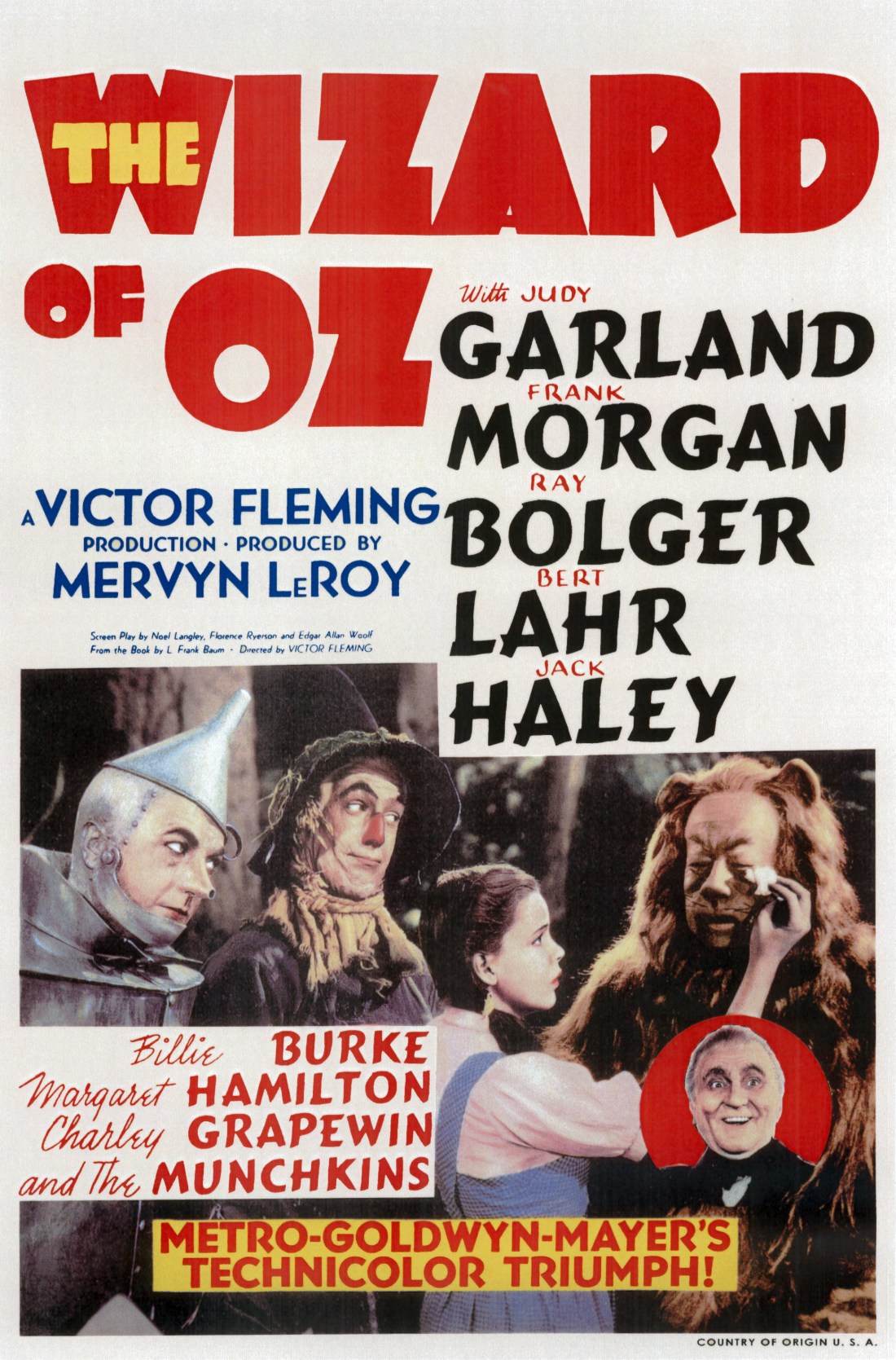
The Wizard of Oz (1939)

THE WIZARD OF OZ

THE WIZARD OF OZ (1939) Four stars

I watched THE WIZARD OF OZ for the first time since my Grandma died and the experience naturally brought on a lot of precious memories.

After all, I watched THE WIZARD OF OZ for the first (and second and third …) time at my Grandma’s house. She loved the movie and every now and then, she also talked about how many times she went to the movies to watch GONE WITH THE WIND. It was several, and I can remember hearing the delight in her voice just talking about it. She turned 10 years old in 1939, one of Hollywood’s hallowed years with MGM productions THE WIZARD OF OZ and GONE WITH THE WIND headlining. GONE WITH THE WIND was the TITANIC of its day, but a 4-hour historical soap opera did not enter my priority list until college. I watched THE WIZARD OF OZ a good dozen times before I got through GONE WITH THE WIND even once.

It was the CBS broadcast of THE WIZARD OF OZ that we watched together and the first time I can remember it I must have been 8 years old. Like IT’S A WONDERFUL LIFE, THE WIZARD OF OZ became an annual TV event for generations of Americans. I first watched IT’S A WONDERFUL LIFE at my Grandma’s house and it assumed the position of a holiday tradition for many years. I want to say that IT’S A WONDERFUL LIFE played on the local NBC affiliate.

Seeing THE WIZARD OF OZ for the 20th or 30th or 40th or 50th time (I lost track) in my life before this review, I found myself singing the songs, yes, every single line of every single darn song, but the most pleasure I experienced came from imitating the Wicked Witch of the West (Margaret Hamilton). I mean, I doubt that anybody who’s ever watched THE WIZARD OF OZ can resist imitating her voice on the all-time classic line “I’ll get you, my little pretty, and your little dog, too.” Hamilton virtually steals the movie and she’s so much more fun than that darn Glinda the Good Witch (Billie Burke), whose goodness decreases over time.

The Wicked Witch finished in fourth place on the American Film Institute’s top 50 villains list (2003), behind Hannibal Lecter, Norman Bates, and Darth Vader and ahead of Nurse Ratched, Mr. Potter, Alex Forrest, Phyllis Dietrichson, Regan MacNeil (when possessed), and the Evil Queen in the top 10.

Ironically enough, Hamilton served as a school teacher before her acting career. She became known for terrifying children … but she retained a lifelong commitment to education.

I wish I could have met Hamilton (1902-85).

“Almost always they want me to laugh like the Witch,” she said. “And sometimes when I go to schools, if we’re in an auditorium, I’ll do it. And there’s always a funny reaction, like they wish they hadn’t asked. They’re scared. They’re really scared for a second. Even adolescents. I guess for a minute they get the feeling they got when they watched the picture. They like to hear it but they don’t like to hear it. And then they go, ‘Oh…’ The picture made a terrible impression of some kind on them, sometimes a ghastly impression, but most of them got over it, I guess. … Because when I talk like the Witch and when I laugh, there is a hesitation, and then they clap. They’re clapping at hearing the sound again.”

THE WIZARD OF OZ served as many people’s introduction to scary movies. (Throw in classic Disney films SNOW WHITE and PINOCCHIO, as well, both of which I remember first watching during roughly the same period as when I first watched THE WIZARD OF OZ.)

Not only the Wicked Witch, but also somebody wanting to take your pet away, running away from home, a tornado, them flying monkeys, et cetera, they’re all terrifying, especially to a small child watching it for the first time. (Please consider the film left out the most gruesome details from the L. Frank Baum source material.)

THE WIZARD OF OZ shows us how much fun it can be to be scared.

That’s just one way the film reaches us.

Hamilton herself talked about its seemingly everlasting appeal.

“THE WIZARD OF OZ keeps coming back every year,” she said, “because it’s such a beautiful film. I don’t think any of us knew how lovely it was at first. But, after a while, we all began to feel it coming together and knew we had something. I can watch it again and again and remember wonderful Judy, Bert, Ray, Jack, Billie, Frank and how wonderful they all were. The scene that always gets to me, though, and I think it’s one of the most appealing scenes I’ve ever seen, is the one where the Wizard gives the gifts to them at the end. Frank (Morgan) was just like that as a person. And every time I see him do it, the tears come to my eyes. I listen to the words. I think of Frank, and I know how much he meant what he said, and how much the words themselves mean.”

I devoted much space to Hamilton and the Wicked Witch, but there are at least six more beloved characters and performers: Dorothy Gale (Judy Garland, 1922-69), the Scarecrow (Ray Bolger, 1904-87), the Tin Man (Jack Haley, 1898-1979), the Cowardly Lion (Bert Lahr, 1895-1967), Toto (Terry, 1933-45), and the Wizard (Frank Morgan, 1890-1949). They go a long way toward making THE WIZARD OF OZ a classic that will persevere down the ages.

On this latest go-around, I again noticed how much of an influence WIZARD OF OZ had on George Lucas when he made STAR WARS.

THE WIZARD OF OZ grabs us early on, precisely at the moment when Garland begins singing “Over the Rainbow,” and it just builds and builds for the next 90-odd minutes.

Eighty years after it premiered (Aug. 25, 1939), I now have one more reason to watch it moving forward. Grandma, it felt like you were right there with me.