Godzilla vs. Kong (2021)

GODZILLA VS. KONG (2021) ****
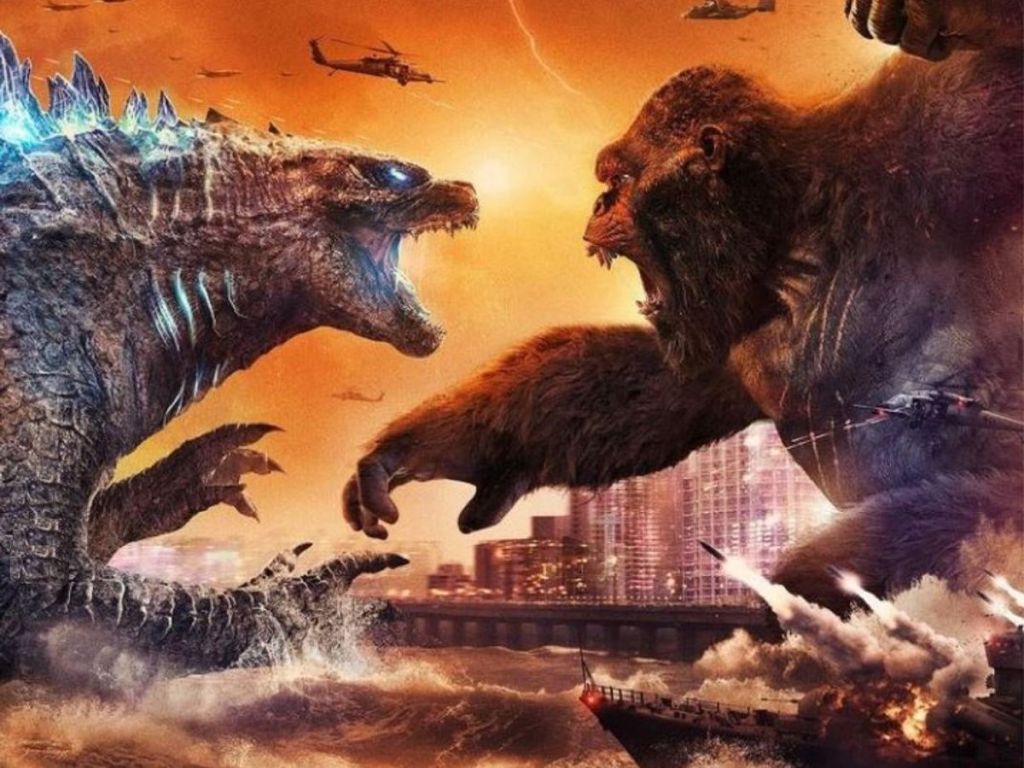
Adam Wingard’s Godzilla vs. Kong got it (mostly) right, especially compared with its immediate predecessor Godzilla: King of the Monsters, and that’s because the film wisely spends more time with protagonist Kong and antagonist Godzilla than its banal human characters and their petty dramas and squabbles and simply functional dialogue.

Also, unlike both Godzilla 2014 and King of the Monsters, we get monster fights shot in broad daylight or neon light. All the monsters and their incredible mayhem are clearly visible, and it makes a huge difference from the disappointing King of the Monsters. Thus, it seems that Wingard and Warner Brothers must have caught wind of the complaints about King of the Monsters, that we didn’t see Godzilla and King Ghidorah and Mothra enough and instead we had to squirm our way through too many family drama scenes involving father Kyle Chandler, mother Vera Farmiga, and daughter Millie Bobby Brown just to get to the monsters. Chandler and Brown return for Godzilla vs. Kong, Farmiga does not for an obvious reason from the end of King of the Monsters, and they’re sidelined for Godzilla and Kong, the nominal stars of the movie, just like they should. We have plenty of new human characters in Godzilla vs. Kong, as well, and they’re not all that important, not as important as Mechagodzilla anyway. Monsters rule Godzilla vs. Kong.

In other words, Godzilla vs. Kong gave me a damn good time at the movies.

I’ve read and heard complaints that Godzilla vs. Kong features too many ridiculous and just plain inexplicable plot elements and developments. What? No way! That’s what I wanted more from Godzilla ’14 and King of the Monsters, to just be silly and ridiculous occasionally and display a lighter touch, esp. King of the Monsters.

The best Godzilla movies work for different reasons: The original 1954 classic has a darker, somber tone unlike any other Godzilla and introduces one of the great movie monsters; Godzilla vs. Hedorah (1971) and Godzilla vs. King Ghidorah (1991) are off-the-wall and so far off-the-wall they could be in another house; Godzilla ’14 gave us a serious Godzilla movie with legitimate actors and it took many of us by surprise, especially with memories of the previous American Godzilla picture.

I’ve watched most all of the 36 Godzilla films — 32 from Japan’s Toho Studios, four from America — and I currently recommend 28 of them, except for Godzilla vs. Gigan (a close miss), All Monsters Attack and Son of Godzilla, and the 1998 Godzilla, the absolute bottom-of-the-barrel cinematic dregs from Roland Emmerich and Dean Devlin that should have been fed to the Smog Monster.

We’ve had many fewer Kong movies over the years, but I’ve loved most of them. The 1933 original remains one of my touchstone movie experiences and it’s something that I am compelled to put on every once in a while just to be dazzled and amazed all over again. I’ll enthusiastically or vehemently defend the 1976 and 2005 remakes, the 1933 sequel could have been so much greater had it not been rushed into release during the same calendar year as the original film, I’ve not seen King Kong Lives from 1986, and I enjoyed Kong: Skull Island more than King of the Monsters, though go figure I gave them both the same three-star rating. Okay, okay, Skull Island edges closer to three-and-a-half and King of the Monsters two-and-a-half, but who needs all that nuance. Apparently, there’s 12 films overall in the King Kong franchise, including the Toho productions King Kong vs. Godzilla and King Kong Escapes. I love King Kong Escapes for most of the reasons I love Godzilla vs. Hedorah and Godzilla vs. King Ghidorah, and they’re all gloriously ridiculous and preposterous. Quite frankly, I wouldn’t have it any other way.

What better space than here and better time than now to put in a word for Marv Newland’s 1969 classic animated short Bambi Meets Godzilla and King Kong knockoff films King Kung Fu and the Shaw Brothers’ The Mighty Peking Man, the former the only monster movie filmed in Wichita, Kansas, and the latter comes to us from dudes known for The One-Armed Swordsman and Five Fingers of Death though they also brought us The Super Inframan and Hammer co-production The Legend of the 7 Golden Vampires. We’re still giving the middle finger to A*P*E and I would be remiss to not mention The Most Dangerous Game from 1932 that was filmed on some of the same sets as King Kong and includes King Kong stars Fay Wray and Robert Armstrong in a dangerous adventure saga on an island and Mighty Joe Young from 1949 with the same creative team as King Kong — Merian C. Cooper and Ernest B. Schoedsack — as well as Armstrong, splendid work from The Lost World and King Kong special effects pioneer Willis O’Brien (assisted by Ray Harryhausen), and a surprisingly touching and involving friendship at the heart of the picture.

The original King Kong vs. Godzilla needed upgraded because, let’s face it, its success or failure hinges on whether or not viewers embrace or reject the cheesy special effects, the preposterous plot, the horrific dubbing (at least in the American version). On first viewing, I rejected King Kong vs. Godzilla yet I’ve warmed to it just a little bit more every time on subsequent viewings. I watched it as the start of a mini-marathon the night before seeing Godzilla vs. Kong in theaters and it remained good, solid fun. Still, though, it’s not some masterpiece that should never be remade and remodeled, like, for example, Psycho (oops, Gus Van Sant didn’t get that memo) and 2001.

I appreciate the nods that Godzilla vs. Kong makes to King Kong vs. Godzilla and King Kong Escapes (I hope a future installment makes room for Mechani-Kong), as well as other elements seen before during Pacific Rim and Tron. Guess what? I have enjoyed Pacific Rim and Tron, films which their critics have dismissed for being cheesy, as well and Godzilla vs. Kong joins their ranks.

— BONUS: I read three reviews of Godzilla vs. Kong before seeing the movie. Two of them reminded me that Emmerich and Devlin inserted characters based on Roger Ebert and Gene Siskel in their Godzilla, but they didn’t have the guts or the nuts to have Mayor Ebert and Gene stomped out by their bad CGI monster.

You don’t even have to read the full review by Armond White to feel like saying Lighten up, Francis. On Apr. 2, White proclaimed Godzilla vs. Kong to be the Shiny Dud of the Week, because it (in White’s words) cheapens the moviegoing habit thru mindless spectacle and shameless formula. Several hours later, White shared his review again and hyped it, If you have a mind, Godzilla vs. Kong is not the movie for you. Ah, it’s mindless entertainment, I see, but, hey wait, my prefrontal and limbic regions of the neocortex, particularly the orbitofrontal region of the prefrontal cortex, anterior cingulate cortex, and the insular cortex, especially object to White’s review.

Web-based film critic James Berardinelli finished his review, I wonder how my eight-year-old self would have reacted to Godzilla vs. Kong. There was a time when I gobbled up anything with monsters, irrespective of the quality of special effects. I didn’t care about the level of destruction and took it as a necessity that the movie would sometimes become bogged down by focusing on underdeveloped humans and their silly concerns. I suspect I might have loved this film in all its overproduced glory. But what works for an eight-year-old doesn’t always work for someone who has evolved to expect more.

Personally, the 42-year-old me is ecstatic the 38-year-old director Wingard and the screenwriting team of 41-year-old Eric Pearson and presumably-40ish-year-old Max Borenstein decided to focus more on Kong and Godzilla and less on inane humans. They could have gone even further. I’d love a Jurassic Park movie, for example, to feature only dinosaurs and prehistoric life — no banal or venal human beings to muddle and bungle it all up — and this ideal dinosaur movie would be made in the style of Luis Bunuel’s The Phantom of Liberty and Richard Linklater’s Slacker.

I find myself closer to Matt Zoller Seitz’s rave on RogerEbert.com, which had me at Godzilla vs. Kong is a crowd-pleasing, smash-’em-up monster flick and a straight-up action picture par excellence. It is a fairy tale and a science-fiction exploration film, a Western, a pro wrestling extravaganza, a conspiracy thriller, a Frankenstein movie, a heartwarming drama about animals and their human pals, and, in spots, a voluptuously wacky spectacle that plays as if the creation sequence in The Tree of Life had been subcontracted to the makers of Yellow Submarine.

Yeah, Godzilla vs. Kong got it about 90 percent right.

Kingdom of the Spiders (1977)

KINGDOM OF THE SPIDERS (1977) ***
John ‘Bud’ Cardos’ Kingdom of the Spiders proved to be a pleasant surprise.

First, I remembered Cardos directed The Dark, one of the worst movies of 1979.

Second, I remembered the last time I saw Kingdom of the Spiders star William Shatner in a cowboy hat, yes, the absolutely ridiculous The Devil’s Rain, one of the worst movies of 1975.

Third, Kingdom of the Spiders starts out with the country number “Pleasant Verde Valley.”

Finally, Kingdom of the Spiders starts out slow, real slow, tipped off by No. 3.

Kingdom of the Spiders, though, kicks into high gear around the hour mark and it’s a whole lot of fun the final 35-40 minutes once the spiders attack Camp Verde, Arizona, and the tarantulas take complete control of the picture, hence being a pleasant surprise.

Kingdom of the Spiders borrows from such motion picture immortals as The Birds, Jaws, and Night of the Living Dead. That’s all part of the fun, when you enjoy something like Kingdom of the Spiders. Otherwise, it’s one more objection to a failure, like, for example, such bombs from the same era as The Giant Spider Invasion, Food of the Gods, and fellow 1977 release Empire of the Ants.

On the other hand, I have a weakness for Nature Attacks movies. There’s Frogs, starring killer amphibians, birds, insects, and reptiles, plus a crotchety old Ray Milland and a topless Sam Elliott. There’s Night of the Lepus, pairing a mutated killer rabbit infestation with a character actor infestation featuring Janet Leigh, Stuart Whitman, Rory Calhoun, and DeForest Kelley. There’s Squirm, where killer worms and a pair of redheads played by Don Scardino and the perky Patricia Pearcy wreak havoc on Fly Creek, Georgia, after one helluva storm. All of them are good fun and I’ve been known to call Frogs — great fun — better than The Godfather. Ditto for Godzilla vs. The Smog Monster.

Anyway, Kingdom of the Spiders works a thousand times more than The Giant Spider Invasion because it decides on real spiders — many spiders, how many exactly, how about 5,000, I mean that fact alone creates shivers down the spine — rather than a Volkswagen Beetle converted into a silly giant spider invasion. The Giant Spider Invasion doesn’t help itself when Alan Hale’s Sheriff exclaims, “You ever see the movie Jaws? It makes that shark look like a goldfish!” Giant mistake.

Also, the characters in Kingdom of the Spiders are far more likable than the ones in The Giant Spider Invasion. I mean, I eventually forgave Shatner for the cowboy hat — it’s better than the one he wore for The Devil’s Rain — and I even got over the fact that his character’s named “Rack Hansen.”

I remember an elementary school teacher calming the nerves of several pupils who were scared silly by a tarantula. She told us they’re harmless, they’re not poisonous anyway, they just look big and scary and very, very frightening indeed, and Kingdom of the Spiders brought me back 30 years to that moment in time. I’m just thankful our teacher did not show us Kingdom of the Spiders afterwards to counteract her moral lesson on tarantulas.

Son of Godzilla (1967)

SON OF GODZILLA (1967) **
I made a terrible mistake.

Not in watching Son of Godzilla, the eighth film in the Godzilla series, per se, but watching it through the most available version online.

Characters begin speaking in dubbed English, of course only the best for us American monster movie aficionados, for a few seconds before a foreign language (presumably Russian) overlays the English. We get two bad dub jobs for the price of one, sure yeah whatever never mind.

I was desperate, though, and needed to watch Son of Godzilla to complete the entire 15-film Godzilla series Japan’s hallowed Toho Studios produced from 1954 to 1975. I sucked it up, buttercup, who cares about the bloody dialogue in a Godzilla movie anyway for crying out loud, and mission accomplished. Yes, I always save the worst for last.

Son of Godzilla marks the beginning of a period of several pictures when Toho made Godzilla a kinder, gentler monster. Like Arnold Schwarzenegger, as Godzilla became a bigger star, a monster if you will, the big guy preferred not playing a villain and so Son of Godzilla and 1969’s All Monsters Attack (a.k.a. Godzilla’s Revenge) are the equivalent of later Schwarzenegger pictures like Kindergarten Cop and Jingle All the Way. Not sure that Schwarzenegger ever made his Godzilla vs. Hedorah (a.k.a. Godzilla vs. The Smog Monster) and that’s a bummer.

The suits at Toho have made Godzilla and the men inside the suit do some awkward bull over a nearly 70-year period, but seeing the big guy try and relate to his adopted son Minilla during Son of Godzilla and All Monsters Attack just might take the cake. Godzilla rescues Minilla from a trio of Kamacuras or a mutated mantis species found on Sollgel Island, and is it in poor taste to say that I wish Minilla had been eaten by the mantis. Minilla’s just so darn cute that it took a great deal of restraint to not puke all over my relatively new laptop.

W.C. Fields died eight years before Godzilla’s screen birth, but we can be sure the famously curmudgeonly performer would have found some choice words for Son of Godzilla and All Monsters Attack, easily the worst of the 15 Showa Era films.

I believe Fields said, “I like children, if they’re properly cooked.”

Night of the Lepus (1972)

NIGHT OF THE LEPUS (1972) Three stars

Janet Leigh (1927-2004) famously said that she never took another shower after her iconic scene in PSYCHO.

Wonder what she said after her performance in William F. Claxton’s NIGHT OF THE LEPUS.

Reportedly, Leigh said “I’ve forgotten as much as I could about that picture.”

Well, Claxton ain’t quite Hitchcock and NIGHT OF THE LEPUS ain’t quite PSYCHO, but this 1972 picture certainly deserves a far better reputation. Like PLAN 9 FROM OUTER SPACE, it’s simply just too darn entertaining to be anywhere near the “worst movie ever made.”

After all, it’s not every day that you see a bad movie featuring Leigh, Stuart Whitman, Rory Calhoun (1922-99), DeForest Kelley (1920-99), Paul Fix (1901-83), and a cast of all-star killer rabbits. They’re playing it straight and not condescending to the material. Give them at least that much credit.

The single biggest gripe against NIGHT OF THE LEPUS: The killer rabbits are not scary. I don’t know if there’s ever been a single review of NIGHT OF THE LEPUS that’s gone without making a major note about the premise itself and then the botched execution of that bad idea.

Claxton and crew obviously worked very hard to make the homicidal rabbits more imposing and terrifying. They constructed miniature sets for regular-sized rabbits to run wild through, filmed them from angles conducive to making the rabbits appear larger-than-life, and cooked up very convincing guttural noises for our furry friends when they’re in full-on beast mode. Basically, our title characters look like they’re running wild on the set of a Western filmed in the back lots of Arizona … and I believe that’s exactly what happened.

Maybe one day they’ll cross NIGHT OF THE LEPUS with THE TERROR OF TINY TOWN.

As far as rabbits not being scary, I do believe these complainers have not encountered that dynamite rabbit from MONTY PYTHON AND THE HOLY GRAIL and Ted “Theodore” Logan’s brush with the Easter Bunny from Hell in BILL AND TED’S BOGUS JOURNEY.

Rabbits can be scary. In theory, anything could be scary, if done right.

Honestly, I don’t know if I could handle a truly scary killer rabbit picture.

The producers did their best to obscure the nature of the killers in promoting NIGHT OF THE LEPUS, apparently booking on the fact that millions did not know the Latin word for rabbit.

They believed that people would not waste their time and money on a killer rabbit picture.

Idiom: “A fool and his money are soon parted.”

Well, here we are at least 47 years after the release of NIGHT OF THE LEPUS and I received a DVD copy of the film for an early Christmas present. It’s a gift that’s already kept on giving.

On first re-watch, I enjoyed NIGHT OF THE LEPUS all over again and I actually enjoyed it more at the age of 41 being able to see all its flaws more clearly than when I first watched the film in late prepubescence. I enjoyed all the melodramatic efforts to make the rabbits scary (especially the bloody aftermath of rabbits on the rampage scenes), all the scientific mumbo-jumbo, all the scenes of the rabbits on their attack route (Pamplona with rabbits and no people), all the blatantly obvious set-ups for blatantly obvious payoffs, the ridiculous final plan to exterminate the rabbits and restore natural order, and I especially loved watching the all-star cast diligently keep a straight face through all the silliness and earn their paychecks.

It’s still a notch below such contemporaneous classics as FROGS, GODZILLA VS. THE SMOG MONSTER, and INVASION OF THE BEE GIRLS.

House (1977)

HOUSE

HOUSE (1977) Four stars

The year 1977 produced four of the definitive WTF movies in the history of cinema: ERASERHEAD, SUSPIRIA, EXORCIST II, and HOUSE, an item from the Japanese studio (Toho) responsible for Akira Kurosawa, Godzilla, Mothra, Rodan, and the H-Man.

Toho really outdid itself with HOUSE, which even surpasses GODZILLA VS. THE SMOG MONSTER in nonstop funky weirdness. Janus Films describes HOUSE as an episode of “Scooby Doo” directed by Dario Argento.

Bottom line: HOUSE just might be even weirder than ERASERHEAD, more colorful than SUSPIRIA, and more whacked out bat shit crazy than EXORCIST II. You have been warned.

First-time director Nobuhiko Obayashi pulls out all the stops in realizing a rather simple tale on the surface: teenage girl Gorgeous (Kimiko Ikegami) and her six friends Prof (Ai Matsubara), Melody (Eriko Tanaka), Mac (Mieko Sato), Kung Fu (Miki Jinbo), Sweet (Masayo Miyako), and Fantasy (Kumiko Oba) pay Gorgeous’ aunt (Yoko Minamida) in the country a visit. It just so happens that the aunt died in this house many years ago waiting on her fiancee to return from World War II and her spirit remains and feasts on unmarried girls. This is a haunted house movie where the house is hungry, very hungry indeed.

Obayashi’s at-the-time pre-teen daughter Chigumi Obayashi contributed ideas to her father. She came up with several childhood fears, her father relayed the fears to screenwriter Chiho Katsura, and they incorporated her ideas into the finished product. You’ll be able to recognize her contributions almost instantly and they contribute to the uniqueness.

Just as a fun exercise, I looked up the plot keywords for HOUSE on IMDb: “refrigerator,” “banana,” “watermelon,” “bloody spray,” “dismemberment,” “decapitation,” “full frontal nudity,” and “severed head” are some of the more interesting 75 keywords and they only scratch at the surface of the overall bizarre nature of the entire enterprise.

More than 30 years after its original release, HOUSE seemingly came from out of nowhere to develop a cult following in the United States, playing first as a midnight movie in Nashville and then at a film festival in Austin in 2009 before heading to DVD.

I first encountered HOUSE through its cover image for the Criterion Collection release on October 26, 2010. Maybe you remember seeing that artwork, as well. Nashville graphic designer and Ben Folds drummer Sam Smith came up with the distinctive image: “I used the first idea that came to me after watching a screener of the film — Blanche the cat’s psycho-screaming mug — and adapted it to stand alone as a symbol of the uncanny and over-the-top assault that our midnight-movie audience was in for,” Smith said. The poster first appeared for the film at the Belcourt Theatre in Smith’s hometown.

Then, I read the reviews for HOUSE and they’re nearly as over-the-top as the film itself.

Online reviewer Dennis Schwartz wrapped up his mixed review, “The director uses freeze-frames, jump-cuts, video effects to change dimensions, spiral effects, color tints, and assorted other techie tricks to play the scary pic card more for laughs than to be gruesome. It’s an experimental visual pic that becomes overwhelmed with low-brow slapstick comedy, a ridiculous killer house and garish visuals. But it’s a one-of-a-kind film that has its admirers, who just can’t resist such weird childish nonsense.”

Michael Atkinson opined in the Village Voice, “But though it plays like a retarded hybrid of ROCKY HORROR and WHISPERING CORRIDORS, it is, moment to moment, its own kind of movie hijinks. It even won a directorial-debut critics’ prize back in the day. Gigglers and cultists, pony up.”

I watched James Rolfe’s review for Monster Madness X from 2016. Rolfe started his review with a pause and a WOW! Of course, Rolfe picked HOUSE for one of the “WTF Wednesday” reviews.

I finally caught up with HOUSE in late summer 2019 and it lived up to expectations. It calls to mind a few pictures: EVIL DEAD II, THE SPIRIT OF THE BEEHIVE, THE 5,000 FINGERS OF DR. T, DAISIES, SUSPIRIA, and MY NEIGHBOR TOTORO. Like those films, though, HOUSE ultimately stands alone as an unique work because it creates its own world. I find that I respond more forcefully to fictional works that do that, rather than just rehash more of the same old already damaged goods. I want to be challenged, inspired, etc. I’ve never seen a haunted house movie quite like HOUSE.

HOUSE haunts one’s thoughts and gains in strength upon deeper reflection. At this moment of typing, I am thinking about Gorgeous’ aunt and how much time she spent waiting alone in that house for the love of her life to return from World War II. He never did, and they both died, she in that darn house and she’s cursed to haunt it for eternity because of her bitterness about the war. Then, I start thinking about the sheer enormity of the loss endured by the human race from Sept. 1, 1939 through Sept. 2, 1945: An estimated 70-85 million people died or three percent of the world’s population in 1940; 50-55 million civilians and 21-25 million soldiers no longer lived on this planet from a variety of causes, death on a mass scale that doubled World War I; the atomic bomb and the Holocaust two of humanity’s depressing advancements in death.

Obayashi was born in Hiroshima in 1938 and he lost all his childhood friends when the United States dropped an atomic bomb on Hiroshima on Aug. 6, 1945. Hiroshima and Nagasaki, as well as post-WWII nuclear testing, inform many Japanese films of the last almost 75 years.

Godzilla vs. Hedorah (1971)

DAY 6, GODZILLA VS. THE SMOG MONSTER

GODZILLA VS. HEDORAH (1971) Three-and-a-half stars
Greg Kihn’s “The Breakup Song” posited that they don’t write ’em like that anymore.

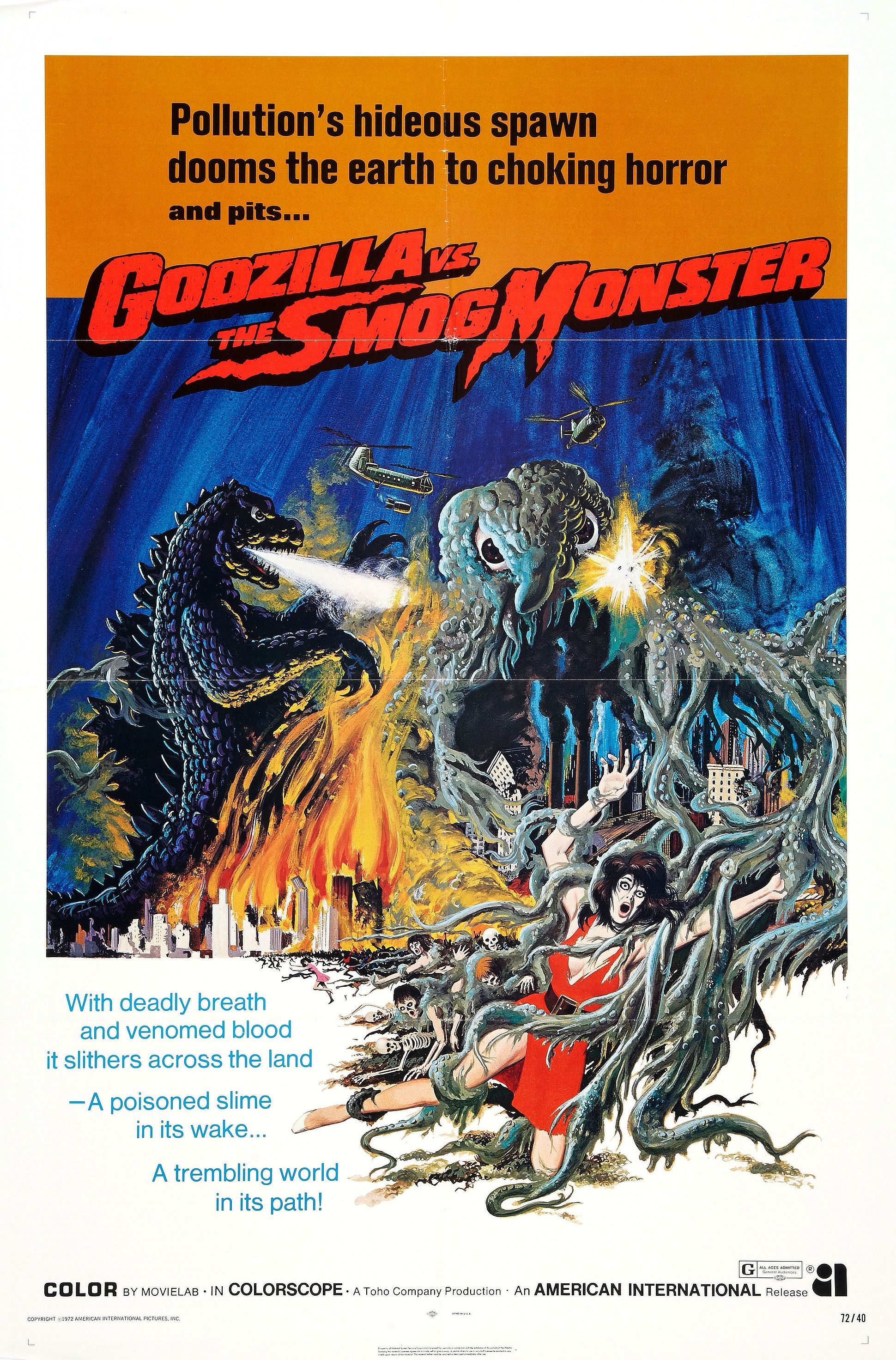
Well, they don’t make movies like GODZILLA VS. HEDORAH (Toho Company title and version in 1971) or GODZILLA VS. THE SMOG MONSTER (American International title and version in 1972) or, for that matter, movies like INVASION OF THE BEE GIRLS and INFRA-MAN anymore. Where do you start with movies like that? Where do you end?

GODZILLA VS. THE SMOG MONSTER must be seen to be or not to be believed. It’s ridiculous, absolutely and sublimely ridiculous, in ways that only a truly great “bad” movie can be.

Honestly, though, I don’t think it’s bad at all and it’s definitely infinitely better than the 1998 American GODZILLA starring Matthew Broderick. I mean, come on, Roland Emmerich and Dean Devlin, you create a pair of characters based on Siskel & Ebert after their negative reviews of your previous movies and then you don’t have the testicular fortitude to kill them off. Wusses!

This is the 11th GODZILLA movie in the series and it honestly features just a little bit of everything.

No, seriously.

The IMDb plot summary: “From Earth’s pollution a new monster is spawned. Hedorah, the smog monster, destroys Japan and fights Godzilla while spewing his poisonous gas to further the damage.”

That only barely scratches the surface of GODZILLA VS. THE SMOG MONSTER. Even if the movie only revolved around that plot summary, I would be interested, but this flick goes the extra mile to entertain us.

Just yesterday I wrote about how I love it when a horror movie takes on more than just being a horror movie and gives us more.

That applies to Godzilla movies or any genre for that matter.

In this 11th Godzilla movie, we have a pro-environmental message replete with a song titled “Save the Earth,” we have a psychedelic freakout in a club with a tripping dude conjuring up partiers adorned with fish heads, we have weird animated interludes, we have little scientific lessons on nebulas and the like, we have a smog monster who looks more like a shit monster, and, last but definitely not least, a flying Godzilla, yes, a flying Godzilla using his atomic breath for jet propulsion. Was the similar scene in ROBOCOP 3 a tribute?

Those are simply the highlights.

Thankfully, the Save-the-Earth message doesn’t get too preachy or smug (it’s not ripe to be mocked by “South Park”) because of everything else surrounding it.

It’s a dark movie overall and genuinely scary in a few parts, because, let’s face it, none of us want to be killed by a shit monster.

Godzilla and Hedorah go 15 rounds in a heavyweight fight.

Godzilla vs. The Smog Monster could have been paired with Ali vs. Frazier, a creature feature before or after the boxing match.

The geniuses at American International ran GODZILLA VS. THE SMOG MONSTER together with FROGS. What a pair! Best pair since Marilyn Monroe, right?

I’ve long been fascinated by what movies are titled in country from country. We’ve already covered a pair of titles for the 11th Godzilla movie and here’s four more. How about HEDORAH, LA BURBUJA TOXICA (Spain) or HEDORAH, THE TOXIC BUBBLE.

GODZILLA CONTRA MONSTRUOS DEL SMOG (Mexico) or GODZILLA AGAINST MONSTERS OF SMOG.

FRANKENSTEIN’S BATTLE AGAINST THE DEVIL’S MONSTER or FRANKSTEINS KAMPF GEGEN DIE TEUFELMONSTER in German.

GODZILLA CONTRE LE MONSTRE DU BROUILLARD (French) or GODZILLA AGAINST THE MONSTER OF FOG.

That’s just a brief international title sampler.