

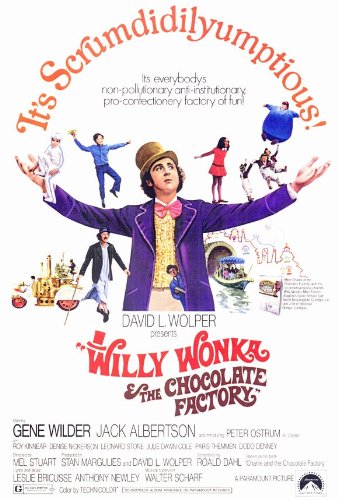
WILLY WONKA & THE CHOCOLATE FACTORY (1971) Three-and-a-half stars
Over the years, many individual performers have walked away with a movie and made it their own. For example, Gene Wilder in WILLY WONKA & THE CHOCOLATE FACTORY.
Wilder provides one of the great movie entrances at about the 45-minute mark of the picture and it’s about darn time because it’s a bit of a slog before we reach the chocolate factory. Our expectations are very high by this point in the picture and Wilder’s Willy Wonka meets and even surpasses them. It was Wilder himself who insisted that he make such an entrance.
“When I make my first entrance, I’d like to come out of the door carrying a cane and then walk toward the crowd with a limp,” Wilder said. “After the crowd sees Willy Wonka is a cripple, they all whisper to themselves and then become deathly quiet. As I walk toward them, my cane sinks into one of the cobblestones I’m walking on and stands straight up, by itself; but I keep on walking, until I realize that I no longer have my cane. I start to fall forward, and just before I hit the ground, I do a beautiful forward somersault and bounce back up, to great applause.”
This entrance establishes Wonka’s unpredictability right from the start.
Wilder magnificently expresses all the sides of Willy Wonka’s personality. It turns on a dime from joy and wonder to malevolent anger at the selfish children who found their golden ticket in a Wonka bar. Their golden tickets earned the children a pass to Wonka’s factory. The five children are Augustus Gloop, Veruca Salt, Violet Beauregarde, Mike Teavee, and Charlie Bucket and they are each joined by one parent or grandparent in the case of final ticket winner Charlie Bucket. The bad children are punished in unspeakable, horrifying ways for their indiscretions. That’ll show ‘em and serves ‘em right, greedy little bastards.
When the beloved Wilder died in 2016 at the age of 83, I thought immediately of his performance as Willy Wonka and his spotlight song “Pure Imagination,” a number written by the British duo of Leslie Bricusse and Anthony Newley. “If you want to view paradise / Simply look around and view it / Anything you want to do it / Wanna change the world / There’s nothing to it / There is no life I know / To compare with pure imagination / Living there you’ll be free / If you truly wish to be.” At its very, very best, WILLY WONKA approaches THE WIZARD OF OZ and Wilder’s on par with Margaret Hamilton and Frank Morgan and gang. They all share a certain joy of performance that’s wonderful to behold.
Like THE WIZARD OF OZ, WILLY WONKA undoubtedly introduced multitudes of children to scary movies. The Haunted Forest, the Wicked Witch of the West, flying monkeys, et cetera, in the 1939 film and the Oompa-Loompas and the boat ride in WILLY WONKA.
“Charlie and the Chocolate Factory” author Roald Dahl (1916-90) absolutely hated the 1971 screen adaptation. Dahl received credit for writing the screenplay, but it was the uncredited David Seltzer who came in and made script changes that raised Dahl’s ire.
What did Mr. Dahl hate about the picture? The shift in focus from Charlie to Willy Wonka. Check. The musical numbers. Check. Casting Gene Wilder rather than Spike Milligan, Dahl’s stated preference. Check. Guess the question should be changed to what didn’t Mr. Dahl hate about WILLY WONKA. This whole situation reminds one that Stephen King hates Stanley Kubrick’s THE SHINING.
I saw WILLY WONKA for the first time in fifth grade (1990) and read Dahl’s novel the next school year. I loved Dahl’s novel, but I have not read it since completing it during sixth grade, roughly the same age as the precocious golden ticket winners. Meanwhile, I have seen the 1971 version several times since that first encounter nearly three decades ago, on cable TV (Teavee), VHS, and DVD. I do think of the film more often than I do the book, and I believe that it has almost everything to do with the Wilder performance.
I have skipped Tim Burton’s 2005 adaptation CHARLIE & THE CHOCOLATE FACTORY & I just remember being appalled from the start by still photographs of Johnny Depp’s take on Willy Wonka. Remember that scene in ANIMAL HOUSE when the older members of Delta Tau Chi pelt that picture of pledge Flounder with beer cans? That’s about how I feel every time I see a picture of Depp as Wonka. (Generally speaking, I have no problem with Burton and Depp movies. I love ED WOOD and like SLEEPY HOLLOW and SWEENEY TODD a lot.)
In a 2013 interview with Turner Classic Movies host Robert Osborne (1932-2017), Wilder shared his true feelings on the 2005 version.
“I think it’s an insult,” he said. “Johnny Depp, I think, is a good actor, but I don’t care for that director [Tim Burton]. He’s a talented man, but I don’t care for him doing stuff like he did.”
 Attack of the Killer Librarian