Bats, Bats, Bats & Jaws with Claws: Nightwing, Prophecy, Grizzly

BATS, BATS, BATS & JAWS WITH CLAWS: NIGHTWING, PROPHECY, GRIZZLY
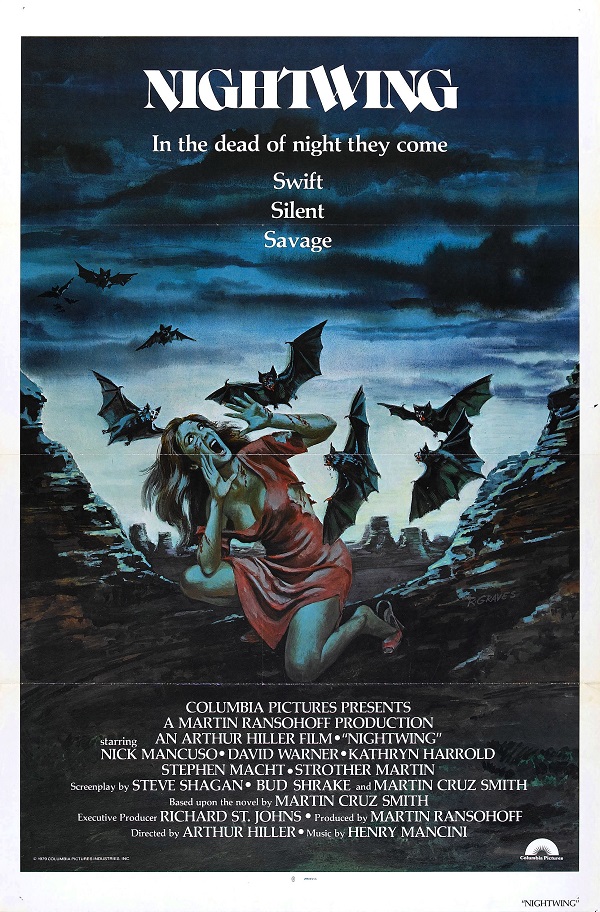
Distinguished character actor David Warner (1941-2022) almost redeems large portions of the 1979 killer vampire bat picture Nightwing, and he’s the reason that it rates out around two stars rather than one or possibly even worse.

Pardon the pun, but Warner truly bites into his dialogue and his monologues are the best moments in Nightwing. Phillip Payne comes across a little batty himself, more often delightfully so than not, and that batty quality would seem to come naturally with the territory of studying and killing plague-infested vampire bats.

The film’s best moments are definitely not the special effects and the vampire bat attack scenes, which almost had me laughing as much as The Bat People or Prophecy or perhaps the ultimate cinematic disaster disaster movie The Swarm.

Generally, I love the prerequisite genre scenes where the scientist explains the phenomenon on the rampage within the movie to a slack-jawed authority figure who usually downplays whatever threat it might be and decides to keep the park / town open.

It rarely ever lets me down, and I enjoyed Nightwing every time Phillip Payne goes all Dr. Sam Loomis on us about vampire bats.

Youngman Duran: It just doesn’t seem natural for a man to spend his life, his entire life, killing bats.

Phillip Payne: Not just bats. Vampire bats. I kill them because they’re evil. There’s a mutual grace and violence in all forms of nature; and each specie of live gives something in return for its own existence. All but one. The freak. The vampire bat alone is that specie. Have you ever seen one of their caves?

YD: No.

PP: I killed over 60,000 of them last year in Mexico. You really understand the presence of evil when you go into their caves. The smell of ammonia alone is enough to kill you. The floor of the cave is a foul syrup of digested blood. And the bats: up high, hanging upside down, rustling, fighting, mating, sending constant messages, waiting for the light to fade, hungry for blood, coaxing the big females to wake up and flex their nightwings to lead the colony out across the land, homing in on any living thing; cattle, sheep, dogs, children, anything with warm blood. And they feast, drinking the blood and pissing ammonia. I kill them because they’re the quintessence of evil. To me, nothing else exists. The destruction of vampire bats is what I live for.

Alrighty then.

Almost none of the small pleasures from Nightwing are to be found in Prophecy, films released only a week apart during June 1979.

Prophecy alternates between a serious, more ambitious movie about ecological concerns and land rights in a dispute between Native Americans and the polluting paper mill, domestic scenes involving a husband (Robert Foxworth) and his wife (Talia Shire), and silly monster attack scenes that belong in something like Food of the Gods or Bigfoot, two bad monster movies from earlier in the ’70s.

Rather, I meant laughably bad monster attack scenes.

None of the elements gel well together in Prophecy.

Prophecy gets awful preachy at times, maybe not too much of a surprise given the film’s title, and Foxworth’s Dr. Robert Verne makes for a rather lackluster and thus unlikable protagonist. Foxworth does not give Prophecy a jolt like Warner does in Nightwing, and his scientific explanatory scenes are pedestrian.

Dr. Verne and his wife Maggie do not have the relationship that, let’s see here, pugilist protagonist Rocky Balboa (Sylvester Stallone) and Adrian (Shire) do in Rocky and Rocky II, ironic considering that Rocky II and Prophecy were both released June 15, 1979.

Their domestic scenes are a drag, and I think less of Foxworth’s Dr. Verne from early on because of the way he treats his wife.

Veteran character actor Richard Dysart (1929-2015) gives the best performance in Prophecy, and it’s not even close. Dysart plays the role of the detestable paper mill company man Isely so effectively that it’s one of the film’s greatest disappointments when it cuts away from his graphic dismemberment by mercury mutant bear Katahdin late in the picture. We’ll have to settle instead for Dysart’s grisly death scene in John Carpenter’s The Thing.

The Katahdin we actually get in the finished product and the one in the promotional material (and dialogue) are not exactly one and the same, which hearkens Prophecy back to low-budget precursors like The Giant Claw and The Wasp Woman more than contemporaries like Alien and Dawn of the Dead, but without the fun of any of those movies.

Leonard Maltin described the monster as a giant salami, Isely said that it’s larger than a dragon with the eyes of a cat, Time reportedly said that it’s Smokey the Bear with an advanced acne condition, and Gene Siskel and Roger Ebert called it a cross between an earthworm and a bear (Siskel) and a grizzly bear and Godzilla (Ebert).

Given that it’s Kevin Peter Hall as the man in the monster suit, one might be tempted to call it a cross between Predator and Harry and the Hendersons.

Manbearpig!

Grizzly, a killer bear picture released three years before Prophecy, works a lot better than Prophecy because it succeeds at a much more modest level of ambition.

It’s required by law that every review mention Grizzly is a Jaws rip-off or we can go right on ahead and call it Jaws with Claws.

We have a law enforcement officer (park ranger), a military veteran (helicopter pilot), and a scientist (naturalist) on the hunt for a giant killer animal (grizzly bear). We also have a park supervisor who refuses to close down the national park despite a series of brutal deaths. The park supervisor allows hunters into the forest to hunt and kill the bear, while media converge on the scene for sensational coverage, but eventually our three main characters must try and do the deed themselves.

I honestly don’t mind too much that Grizzly follows the Jaws formula because Christopher George, Richard Jaeckel, and Andrew Prine are good in their roles and I care about them in their battle against a primal beast.

Honestly, it’s as simple as that, whereas I didn’t particularly care about the overwhelming majority of the human characters in Prophecy and did not care one way or another whether they lived or died just as long as the end credits rolled.

Grizzly, thankfully, is also not preachy, it’s endearing and entertaining on a basic level, and it’s a pleasant way to spend 90 minutes.

Granted, the three main actors and characters are not anywhere near the same level as Roy Scheider’s Sheriff Brody, Richard Dreyfuss’ Matt Hooper, and Robert Shaw’s Captain Quint, just like William Girdler’s no Steven Spielberg, but I still think Grizzly has earned a place right alongside such ’70s killer animal staples as Night of the Lepus, Frogs, Squirm, Kingdom of the Spiders, and Piranha.

Nightwing (1979) **; Prophecy (1979) *; Grizzly (1976) ***

Blackenstein (1973)

BLACKENSTEIN (1973) No stars
Blackenstein just might possibly be the worst horror movie I have ever seen and off the top of my head, that means it competes alongside such turkey bombs as Jaws: The Revenge, Monster a Go-Go, and Robot Monster. Now, that would be one way to do a horror movie marathon.

Poor Eddie. Dude lost both arms and both legs in Vietnam and he’s bullied in a Veterans Hospital near the beginning of Blackenstein over ice cream. He does have the love of the lovely Dr. Winifred Walker, who hooks Eddie up with the brilliant surgeon and DNA researcher Dr. Stein. Dr. Stein can attach new limbs to Eddie and he’ll be walking just like you and I in no time says this preeminent doctor. Not so fast, my fiend, not with Dr. Stein’s dastardly assistant Malcomb around.

This super creep Malcomb falls instantly in love, well he calls it love anyway, with Dr. Winifred, and by the way, the actor who plays Malcomb (Roosevelt Jackson) gives one of the most subtle performances ever. He does not foreshadow any upcoming plot developments by staring a hole right through Dr. Winifred the first half-dozen scenes they share. That’s why I called him super creep just a couple moments ago, because he’s super creepy.

Malcomb declares his lust, er, love for Dr. Winifred, Dr. Winifred tells Malcomb no because she loves Eddie, Malcomb becomes all spurned and switches Eddie’s DNA with that of a caveman, and Eddie becomes, you guessed it, the title character. That’s when Blackenstein really takes a dive for the dumpster, as it departs from soap opera to horrible horror with soul music interludes that quite frankly belong in another movie.

Blackenstein first wanted to cash in on the coattails of the 1972 hit Blacula and I have read that American International, one of the best exploitation film outlets, chose Scream Blacula Scream over Blackenstein. Gene Siskel reviewed Blackenstein in 1975, when distributors tried passing it off as Black Frankenstein with their fervent Malcomb-like desire to siphon off the success of the Mel Brooks satire / affectionate tribute Young Frankenstein. Siskel managed to be extremely generous when he rated Blackenstein one-half star.

Blackenstein, in short, has got no soul and that’s why it failed then and fails now or any moment in time. Not only does it have no soul, which is certainly bad enough, it’s got no joy of filmmaking like Edward R. Wood’s Plan 9 from Outer Space and Ray Dennis Steckler’s The Incredibly Strange Creatures Who Stopped Living and Became Mixed-Up Zombies, both of which are somehow considered worse than Blackenstein. The director of Blackenstein should be glad we cannot remember his name without an Internet search party.

Kickboxer 2 (1991)

KICKBOXER 2

KICKBOXER 2 (1991) *1/2

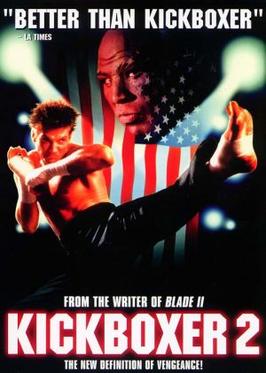
En route to the cinematic crapper, Albert Pyun’s KICKBOXER 2 abuses two of the worst cinematic devices: slow motion and an offscreen death.

On their review program, Gene Siskel and Roger Ebert pointed out how much Pyun and the picture relied on slow motion during the fight scenes. Ebert claimed they used slow motion for every single moment of every single fight scene in the movie, including for the voices of the announcer and the referee, but that the sound effects guy must not have got the same memo because all the punches and kicks sounded like they were in regular motion. Siskel accused Ebert of eating spiked popcorn. Bottom line: If only KICKBOXER 2 had been half as entertaining as the Siskel & Ebert review.

Let’s take the fight that’s right smack dab in the middle of the picture, between our principled, reluctant-to-fight hero David Sloan’s former protege Brian “The Hammer” Wagner (Vince Murdocco) and the super villainous Tong Po (Michel Qissi) who’s back from KICKBOXER: THE MOTION PICTURE (not its real title). Brian Wagner dies in the ring from a series of brutal slow motion kicks and punches and other blows to the body. Coming that slow, he should have seen it coming and got out of the way. No, no, no, of course not, Brian Wagner wanted to die. Okay, maybe not wanted to die per se, but he was destined to die in that post-Apollo Creed ROCKY IV way. Anyway, we knew he was going to die from early in the picture, when his worried mother told David Sloan (Sasha Mitchell) that she’s afraid for her son and made Mr. Sloan promise to look after him. Brian Wagner further sealed his cinematic doom by walking away from David Sloan and cursing him on the way to greener pastures, by taking the easy fights and that cheap nickname, by allowing himself to be pumped full of steroids, and finally by his defiant overconfidence and his blatant refusal to surrender to his opponent. Yes, yes, he deserved to die.

The final buildup to Wagner’s death hits us over the head with a slow-moving sledge hammer. Not only are Tong Po and Brian Wagner in super duper excruciating slow motion, but Wagner’s poor mother and David Sloan are both moving like that in the crowd … in a cinematic technique derived especially from the later ROCKY pictures, you know when Clubber Lang and Ivan Drago are beating the brain stuffing out of Rocky (or Apollo Creed) and Rocky’s corner men or even his poor, poor wife Adrian are laboriously freaking out but ultimately helpless in the face of slow motion annihilation. I am so, so glad this overdone cinematic technique eventually faded away.

Offscreen deaths are usually cheap and sometimes, they’re even worse. For example, Hicks and Newt at the beginning of ALIEN 3. That one left millions reeling and they’re still talking about it today flabbergasted and frustrated.

In KICKBOXER 2, we are informed that Tong Po killed both David Sloan’s older brothers, including KICKBOXER protagonist Kurt Sloane (Jean-Claude Van Damme), after the events of the first movie and before the events of the second one. And to think Kurt avenged his paralyzed older brother Eric Sloane (played by former world kickboxing champion Dennis Alexio) against Tong Po for the big thrilling conclusion of KICKBOXER.

Yes, that’s right, Sloan and Sloane, that’s what really confused this unfrozen caveman writer. Sloan’s older brothers each have an ‘e’ on the end of their surname. Fascinating. Let’s see here: Van Damme speaks with a thick Franco-Belgian accent, while Sasha Mitchell, why he’s just a poor man’s Keanu Reeves. Bizarre family that must really get around. Ironically enough, though, Mitchell has been called both a poor man’s Keanu and a poor man’s Jean-Claude. Mitchell’s not without a slight charm, however, and he’s definitely not the biggest problem in KICKBOXER 2. The film’s biggest problem is that we’ve seen it all done before … and better numerous times.

KICKBOXER 2 lacks the off-the-wall qualities of a Shaw Brothers spectacular or a truly batty WTF exploitation picture like NINJA III: THE DOMINATION and SAMURAI COP, as well as the genuine pathos of ROCKY and THE KARATE KID. It is neither truly good enough nor bad enough to be any good.

Alice, Sweet Alice (1976)

ALICE, SWEET ALICE (1976) ***

They really tried hard with ALICE, SWEET ALICE, the horror film that’s best known for being Brooke Shields’ film debut.

It appeared in November 1976 at the Chicago International Film Festival, where it competed against such films as ALLEGRO NON TROPPO, GREY GARDENS, SMALL CHANGE, THE DEVIL’S PLAYGROUND, and Best Feature winner KINGS OF THE ROAD.

It received theatrical release (and mostly negative reviews) in 1977, 1978, and 1981. Viewers might have seen it as either ALICE, SWEET ALICE or COMMUNION (the original title) or HOLY TERROR depending on when they watched it.

The promotional forces especially played on the Brooke Shields angle in ‘78 and ‘81.

One of the ‘78 ALICE, SWEET ALICE ads proclaimed at its top, “PRETTY BABY Brooke Shields, America’s New Star,” a reference to Shields being in Louis Malle’s contemporaneous PRETTY BABY.

Three years later, the film returned as HOLY TERROR with a hard sell promotional campaign again built around exploiting Shields’ notoriety from her Calvin Klein advertisements and her film projects like THE BLUE LAGOON. Shields put up a fight, though, because she had more clout and ENDLESS SUMMER coming down the pike; “Brooke was concerned that film goers could only be disappointed if led into the theater with the promise that the film was of recent vintage or that she had a central part in it,” said her attorney. See, the original HOLY TERROR ads used a photo of Shields circa ‘81 rather than one of her from the film that was made during a different administration. Those naughty ad men, they did a bad, bad thing.

Roger Ebert made the advertising campaign for HOLY TERROR his “Dog of the Week.” “The ads promise that it stars Brooke Shields,” Ebert said. “That’s where the trouble begins, because HOLY TERROR was first released five years ago under the title of COMMUNION and then it was released three years ago as ALICE, SWEET ALICE. Now, when this movie was originally shot, Brooke Shields was a little girl, only 10 years old, and as Calvin Klein can tell you, she’s not 10 years old anymore. Shields has a supporting role in the movie as an apparently demented little girl and it’s an effective thriller alright, but how many title changes is it going to go through in an attempt to cash in on Brooke Shields’ recent popularity?” Gene Siskel replied, “Maybe they ought to try GONE WITH THE WIND.”

Truth in advertising: Shields, listed 10th in the cast in the end credits, appears in the picture for about the first 10 minutes. For those of us who think she’s one of the worst mainstream actresses ever committed to celluloid, that’s a major blessing in disguise. She’s not a demented little girl, though, but the first murder victim. Attending her first communion, her character Karen gets killed real good before she can receive it, strangled to death and then incinerated by a masked figure in a costume that should make one think back to the superior thriller DON’T LOOK NOW. Only this raincoat is yellow rather than red like DON’T LOOK NOW.

Deceptive promotional campaigns are not anything new. They’ve happened before and they will happen again. It happens all the time, and not only (but especially) during election years.

For example, John Travolta made his debut (briefly) in the ridiculous 1975 thriller THE DEVIL’S RAIN, which features Ernest Borghine, Eddie Albert, Ida Lupino, Tom Skerritt, William Shatner, and Keenan Wynn in the cast, as well as the special participation of Anton LaVey, high priest of the Church of Satan. Anyway, in the original 1975 ads, not a mention of Travolta. Instead, we have mug shots of “Satan on Earth” (Borghine), “Devil Destroyer” (Albert), “Demon Sacrifice” (Lupino), “Tortured Soul” (Shatner), and “Faceless Follower” (Wynn) right above the claim “Absolutely the most incredible ending of any motion picture ever!”

Preying on Travolta’s success in SATURDAY NIGHT FEVER and GREASE, THE DEVIL’S RAIN made a comeback. Siskel named it a “Dog of the Week” the same week in 1978 his colleague Ebert picked that awful monster movie SLITHIS. “My dog this week is a four-year old film named THE DEVIL’S RAIN that’s suddenly come back to a lot of theaters advertised as starring John Travolta,” Siskel said. “Well, that’s a complete lie. THE DEVIL’S RAIN stars Ernest Borghine as a Devil’s helper trying to hang on to some lost souls. Travolta is on screen for less than a minute, this was his first film. He had only one line of dialogue in it. Most of the time, he has red and green wax melting all over his face. Looks like he fell asleep on a pizza. … Beware of films you’ve never heard of promising big stars. One reason you’ve never heard of them, they’re lousy.”

These promotional campaigns definitely backfired in the case of ALICE, SWEET ALICE, because it’s a good little thriller often compared with the works of Alfred Hitchcock and called a prototype of the slasher film. That should have been more than enough to sell the film.

ALICE, SWEET ALICE involves a series of murders in 1961 in Paterson, New Jersey, around a church and an apartment building. Our title character, a 12-year-old girl played by a 18- or 19-year-old Paula Sheppard, becomes the first suspect and she’s sent to a psychiatric institution for evaluation. She was always mean to her little sister and besides, she’s just plain “weird.” Their parents are divorced and they live with their mother Catherine (Linda Miller) and attend St. Michael’s Parish Girls’ School. We also have the girls’ father Dom (Niles McMaster) and their aunt (Jane Lowry), Father Tom (Rudolph Willrich), his housekeeper Mrs. Tredoni (Mildred Clinton), the creepy obese landlord (Alphonso DeNoble), and assorted policemen and minor characters. Dom leaves behind his new wife to more or less become a detective on behalf of his oldest daughter, and that leads to his demise in a scene that echoes Donald Sutherland’s death at the end of DON’T LOOK NOW.

ALICE, SWEET ALICE reminds one of not only DON’T LOOK NOW, but also any number of giallos or Italian thrillers because of the anti-Catholic themes, dark humor, and familial dysfunction. Lucio Fulci’s DON’T TORTURE A DUCKLING and Dario Argento’s PROFONDO ROSSO quickly come to mind. Of course, all these films have their roots in Hitchcock.

Director, producer, and co-writer Alfred Sole, who shared the screenplay with Rosemary Ritvo, reveals the real killer around the two-thirds mark and that’s a departure from the modus operandi of the thriller.

ALICE, SWEET ALICE stands up long after the promotional campaign has become a faded memory. Anyway, I’ll still call it Brooke Shields’ best movie.

The Last Dragon (1985)

THE LAST DRAGON

THE LAST DRAGON (1985) Three stars

Gene Siskel included THE LAST DRAGON among his “Guilty Pleasures” in a 1987 “Siskel & Ebert” show and he gave it one of his funniest reviews, highlighted by “I’m a sucker for glowing fingers. Roger, I see glowing fingers in a movie, I tend to like the movie. … Just one finger (in E.T.), that’s how much I like it. In this one, you get 20. Two men, Roger, 20. Can you imagine the ads? ‘20 times the entertainment value of E.T.’” Siskel gave it three-and-a-half stars in his 1985 print review.

Roger Ebert gave it a mixed negative review and two-and-a-half stars, “THE LAST DRAGON turns into a funny, high-energy combination of karate, romance, rock music and sensational special effects. It’s so entertaining that I could almost recommend it … if it weren’t for an idiotic subplot about a gangster and his girlfriend, a diversion that brings the movie to a dead halt every eight or nine minutes. … They’ve been borrowed from a hundred other movies, they say things that have been said a hundred other times, and they walk around draining the movie of its vitality. They’re tired old cliches getting in the way of the natural energy of Taimak, Vanity and the Shogun character.”

I find myself occupying the middle ground between Siskel and Ebert. They both agreed on the strengths and the weaknesses of THE LAST DRAGON, but Siskel found the strengths to be stronger and Ebert the weaknesses to be weaker. LAST DRAGON co-stars Taimak, Vanity, and Julius J. Carry III are the strengths and Chris Murney as comic gangster Eddie Arkadian and Faith Prince as his aspiring singer girlfriend Angela Viracco are the weaknesses.

Taimak (full name Taimak Guarriello) stars as Leroy Green, who’s inspired by the works of Bruce Lee to such a degree that he’s called “Bruce Leroy.” He’s in pursuit of “The Glow,” referenced memorably by Siskel — see, only a true martial arts master can exhibit “The Glow” over his entire body and that’s Leroy’s No. 1 goal. Scenes like “Don’t think, feel! It’s like a finger pointing away to the moon. Do not concentrate on the finger or you will miss all of the heavenly glory” from ENTER THE DRAGON undoubtedly warmed the heart of Mr. Leroy … and possibly Motown mogul Berry Gordy, whose Motown Productions sponsored THE LAST DRAGON.

He’s opposed by Sho’nuff (Carry III), a.k.a. “The Shogun of Harlem,” who sees Leroy in his way for ultimate martial arts mastery. Sho’nuff interrupts a showing of the sacred text ENTER THE DRAGON in an urban theater and he throws down the gauntlet, “Well well, well. If it ain’t the serious, elusive Leroy Green. I’ve been waiting a long time for this, Leroy. I am sick of hearing these bullshit Superman stories about the — Wassah! — legendary Bruce Leroy catching bullets with his teeth. Catches bullets with his teeth? Nigga please.” Leroy counters with two platitudes that he might have gleaned from the “Kung Fu” TV show, then Sho’nuff throws it down again, “See, now it is mumbo jumbo like that, and skinny little lizards like you thinkin’ they the last dragon that gives kung fu a bad name. Get up, Leroy, I got somethin’ real fo’ yo’ ass in these hands.” Carry III (1952-2008) undoubtedly prepared for his role as Sho’nuff by playing in both DISCO GODFATHER, his debut feature, and THE FISH THAT SAVED PITTSBURGH.

All roads lead to a final showdown between Leroy and Sho’nuff when, sure enough, they both have “The Glow.” Leroy, though, finally exhibits true martial arts mastery.

Bruce Leroy also becomes the protector of television personality Laura Charles (Vanity) against them comic gangsters. She tells Leroy, “I thought that maybe it would be a great idea if I got myself a bodyguard. You know, like someone to guard my body? What girl could do worse than to have her own real life kung fu master?”

THE LAST DRAGON is a lot of fun, especially for viewers who are fans of martial arts spectaculars, particularly Bruce Lee. During the 1985 episode they reviewed THE LAST DRAGON, Siskel and Ebert lamented the lack of quality martial arts entertainment in a special “X-ray segment.” They singled out three “better” martial arts films that predated THE LAST DRAGON: ENTER THE DRAGON, THE OCTAGON starring Chuck Norris, and THE KARATE KID, the surprise blockbuster from 1984. I felt bad for Siskel and Ebert, because it seemed like they missed a great many great martial arts films like DRUNKEN MASTER and THE 36TH CHAMBER OF SHAOLIN, for example, and instead they made several “Dogs of the Week” (their picks for worst movie each episode until September ‘82) from seeing obviously inferior martial arts imports with lousy prints and horrific dubbing. It would be difficult for anybody not to form a negative opinion about martial arts films from seeing only the mass-produced bargain-basement rip-offs that almost immediately came in the wake of Bruce Lee’s death in 1973.

Thankfully, through ventures like the Dragon Dynasty, we can see classics like THE 36TH CHAMBER, KING BOXER (a.k.a. FIVE FINGERS OF DEATH), THE ONE-ARMED SWORDSMAN, FIST OF LEGEND, MAD MONKEY KUNG FU, FIVE DEADLY VENOMS, and EIGHT DIAGRAM POLE FIGHTER in quality prints and not dubbed in dodgy English. Films like these have provided me a ridiculous amount of enjoyment over the years.

The Delta Force (1986)

THE DELTA FORCE

THE DELTA FORCE (1986) Three stars

Watching THE DELTA FORCE for the first time in 30 years, it surprised me in three ways.

First, it accumulates a running time of 2 hours, 5 minutes.

Second, the heavy action does not kick in until about 1 hour, 15 minutes in.

Third, it’s more thoughtful than expected, given that it is a Golan-Globus production starring Chuck Norris and featuring a cast of many highlighted by hostages Martin Balsam, Joey Bishop, Lainie Kazan, George Kennedy, and Shelley Winters, actors who initially suggest the movie would quickly become AIRPORT ‘86.

About that running time, let’s see here, RAMBO: FIRST BLOOD PART II and COMMANDO, both from 1985, clock in at approximately 96 and 92 minutes, respectively. Then again, Norris’ previous cinematic crusade against terrorism, INVASION U.S.A., lasts 110 minutes.

Once the action does kick in, it kicks in real good in THE DELTA FORCE and it especially delivers the goods with shit blown up real good just like an old school action movie should. Of course, I hope the demolition experts were paid real good.

The action truly begins with a chase: Major Scott McCoy (Norris) and his Delta Force colleague are pursued by Lebanese terrorists through Beirut and one terrorist vehicle crashes into a poor defenseless fruit cart and melons fly everywhere. Ah, yes, this is one of the better fruit cart scenes in history because they used both slow motion and big melons. I say the bigger the melons, the better the fruit cart scene.

I have argued the best Chuck Norris movies are the ones with the best supporting casts and THE DELTA FORCE definitely upholds that argument. Other cast members include Robert Forster, Hanna Schygulla (it’s a long way from Rainer Werner Fassbinder melodramas to Chuck Norris action spectaculars), Susan Strasberg, Bo Svenson, and Robert Vaughn. The great Lee Marvin (1924-87) also plays a key role in his final movie performance. Of course, Marvin brings his association with THE DIRTY DOZEN.

This is Norris’ best supporting cast, though I still rate THE DELTA FORCE slightly below LONE WOLF MCQUADE and CODE OF SILENCE overall.

Palestine born Menahem Golan (1929-2014) wrote, produced, and directed the film, which takes an undeniable pro-Israeli, pro-Jewish position. Golan served in the Israeli Air Force as a young man, long before he and his younger cousin and business partner Yoram Globus attempted to conquer the international film market.

Call me a fool and slap me silly, but it seems that Golan paid a lot more attention and dedicated more craft to THE DELTA FORCE than the average run-of-the-mill Cannon production, like, for example, Norris’ other 1986 film, FIREWALKER. Granted, J. Lee Thompson directed that one, but it’s doubtful that Golan would have evinced any passion in a watered down third-rate Indiana Jones retread like he did for THE DELTA FORCE.

THE DELTA FORCE ripped its plot from the real-life hijacking of Trans World Airlines Flight 847 on June 14, 1985. There’s a real-life Delta Force who have engaged in Operation Eagle Claw, Operation Enduring Freedom, the Iraq War, Operation Inherent Resolve, and Operation Kayla Mueller, among many other specialized missions incorporating counter-terrorism, hostage rescue, and direct action.

THE DELTA FORCE began production in July 1985 and filming in September 1985. The shoot lasted until early November. The filming took place in predominantly Israel. THE DELTA FORCE opened February 14, 1986, 245 days after the hijacking.

We have about the same number of passengers and crew members in the movie as in real life, the same number of terrorists behind the hijacking, a purser based on flight service manager Uli Derickson, the singling out of the Jewish passengers and the Navy divers and the eventual murder of one of them, and a similar flight pattern.

In real life, though, diplomats brought about the release of the hostages, not the Delta Force. Of course, that’s not what anybody wants to see in an action movie. I mean, you don’t cast Chuck Norris and Lee Marvin for that.

THE DELTA FORCE can be a wish fulfillment fantasy particularly for those who feel the United States perpetually takes a soft position on international terrorism and that we should go right into the heart of the Middle East and “Kill all the A-rabs” once and forever. Never mind that all our prior and ongoing efforts in the Middle East have seemingly only compounded matters and created more terrorists. One just might be left to conclude the War on Terrorism will never end, just like the War on Drugs.

The Arab characters in THE DELTA FORCE, terrorists one and all, earned their place in Jack G. Shaheen’s book “Reel Bad Arabs: How Hollywood Vilifies a People.” Vincent Canby of the New York Times wrote, “[DELTA FORCE] will be the 1986 film all others will have to beat for sheer, unashamed, hilariously vulgar vaingloriousness.”

Subaru customized a motorcycle just for Norris’ late picture heroics. Gene Siskel wrote in his one-star review for the Chicago Tribune, “The action in Beirut is more appropriate for a bad James Bond film than for a subject that has been all too real lately. Norris gets off shooting rocket launchers from his specially built motorcycle, and we sit there stunned at the movie industry’s ability to make money off of any tragedy.”

Israeli filmmaker Rafi Bukai said that he hated films like THE DELTA FORCE because they do not show Arabs as human beings.

Veteran character actor Robert Forster (1941-2019) plays the main terrorist Abdul Rafai. Forster was born in Rochester, New York, to parents of Italian, English, and Irish descent. His father trained elephants for the Ringling Bros. and Barnum & Bailey Circus. File this casting alongside John Wayne as Genghis Khan in the 1956 THE CONQUEROR. Along this same line, how many ethnicities and nationalities have character actors like Alfred Molina and Armand Assante played over the years?

I give THE DELTA FORCE a positive review because I enjoy it as a big, dumb, and even stupid action movie and it is an effective time capsule piece with Golan-Globus, Cannon Films, Chuck Norris, Lee Marvin, and all those older character actors. Not because it is a sobering, thoughtful, and balanced consideration of Middle East politics and international terrorism. Thankfully, I have read several books just like that on those subjects.

Friday the 13th (1980)

FRIDAY THE 13TH (1980).jpg

FRIDAY THE 13TH (1980) One-and-a-half stars

Of all the horror movies over the decades that have been labelled “classic,” FRIDAY THE 13TH is the one arguably least deserving of that label.

Plain and simple, it’s a bad movie. One-dimensional characters, corny dialogue that even makes references to much much much better movies like CASABLANCA, filler scenes, and perhaps the least convincing mass murderer in screen history are some of its crimes against cinema.

Harry Manfredini’s musical score derived from PSYCHO and JAWS and Tom Savini’s make-up and special effects are both very good, and their work earns the film one half-star each.

I can only see FRIDAY THE 13TH being considered a classic if you count all the sequels and imitations.

My personal favorite FRIDAY THE 13TH movies are PART III, THE FINAL CHAPTER (perhaps the most schizophrenic movie ever made, a cross between leering teenage sex comedy and brutal violence), and JASON LIVES. They succeed more at having a sense of humor and a sense of fun than all the other installments. The rest of the movies all have their isolated moments.

If you have seen the sequels before the original, you might be shocked by the film that started it all. It is very sluggish, at times, and there’s no hockey-masked homicidal maniac in the middle of the mayhem.

Sean Cunningham (director) and Victor Miller (screenwriter) made FRIDAY THE 13TH to cash in on HALLOWEEN, which earned $60-70 million on a $300,000 budget. When there’s an unexpected runaway success like that, naturally the clones and variations start appearing in droves and they did after HALLOWEEN for at least five years.

Cunningham and Miller worked together previously on a family film called MANNY’S ORPHANS, released nearly two months before HALLOWEEN. Cunningham began with adult movies THE ART OF MARRIAGE and TOGETHER, produced Wes Craven’s THE LAST HOUSE ON THE LEFT, and directed a sexploitation comedy named CASE OF THE FULL MOON MURDERS before consecutive family pictures in 1978.

In other words, he saw FRIDAY THE 13TH as the way to make inroads in the brutal movie business. Honestly, who could blame Cunningham, especially as many others had a similar brainstorm.

Cunningham, of course, lacked the finesse and skill of HALLOWEEN director-writer-composer John Carpenter. FRIDAY THE 13TH does benefit, however, from its own low budget production — $550,000 — so it is effective in fits and starts despite itself. It is far more of an exploitation film than HALLOWEEN, and proved nearly as profitable. We saw FRIDAY THE 13TH movies in every year of the 1980s except for 1983 and 1987.

What FRIDAY THE 13TH did was establish a campground setting, add more corpses, er, characters, and amplify the gore, elements that quickly became the norm for an onslaught of “dead teenager” movies. Like virtually every horror movie since CARRIE (1976), it also has one final jump scare. The sequels — namely PART 2, THE FINAL CHAPTER, and THE NEW BEGINNING — upped the nudity and sex quotient. (FRIDAY THE 13TH fans should check out Mario Bava’s BAY OF BLOOD, a 1971 film that undoubtedly influenced the first two FRIDAY THE 13TH installments. If you’ve not seen the Bava film before, you might be surprised. It’s also much better than any of the FRIDAY THE 13TH movies.)

The original FRIDAY THE 13TH exists in that post-HALLOWEEN storytelling mode, where there’s a prologue detailing terrible events that happened in the past and will dovetail with the events of the present. Just about every horror film made after HALLOWEEN includes a bloody, sordid back story.

In FRIDAY THE 13TH, we head back in time to Friday, June 13, 1958, Camp Crystal Lake, when camp counselors Barry and Claudette sneak inside a storage cabin for a little lovin’ and they are murdered. We come to find out that one year before, a 11-year-old boy named Jason Voorhies apparently drowned in Camp Crystal Lake, due to negligent camp counselors.

You could build a nifty little collection of these back story / terrible event in the past scenes.

Let’s see, HALLOWEEN began on Halloween 1963 with 6-year-old Michael Myers killing his older sister Judith.

In PROM NIGHT, it’s 1974 when 11-year-olds Wendy, Jude, Kelly, and Nick cause the accidental death of 10-year old Robin.

In TERROR TRAIN, a sexual initiation prank at a college fraternity’s New Year’s Eve party leads a young man named Kenny to become traumatized and committed to a psychiatric hospital.

In THE BURNING, it’s a fiery prank on a cruel, alcoholic summer camp caretaker named Cropsy that leads to five years in the hospital before his release and revenge.

MY BLOODY VALENTINE waits a bit to spring its 20 years ago flashback story on us.

Anyway, you get the point.

Steve Christy (Peter Brouwer) decides that he will reopen a renovated Camp Crystal Lake. That’s his big mistake, one that results in eight deaths — seven of them Christy and his staff — on Friday, June 13, 1979.

Final Girl Adrienne King does have a great scream and some of the same wholesome All-American appeal as Jamie Lee Curtis. We also find out that she’s very talented at making coffee. Alice Hardy is virtually the only likable character among the lot, although we’re aghast that she ever had a love affair with the creepy Steve Christy. Girl, what were you thinking? There goes the whole idea of the Final Girl being a virgin.

As far as the boys go, Kevin Bacon later became a big star but he’s not around long in FRIDAY THE 13TH. Harry Crosby, son of the legendary actor and singer Bing (1903-77), attended the London Academy of Music and Dramatic Art and earned his MBA from the Fordham Graduate School of Business Administration before becoming a successful investment banker. Anyway, he’s killed in FRIDAY THE 13TH.

That all leads us to Mrs. Pamela Voorhees, played by Betsy Palmer (1926-2015), who we find out committed all the murders in a final act reveal. This middle-aged, albeit crazy, middle-aged lady, who at first seems like a kindly middle-aged lady, created all that mayhem. Early in this review, I called Mrs. Voorhees “perhaps the least convincing mass murderer in screen history” and I stand behind that claim. I just don’t believe that she could have accomplished such murderous feats, especially as she begins her attack on Alice by slapping her silly. Palmer brings on the camp — as in campy — during her screen time.

Film critic Gene Siskel (1946-99) hated FRIDAY THE 13TH so much that he first gave away the movie’s reveal and Palmer’s fate and then he provided the addresses for the chairman of the board of Gulf & Western Industries (who owned Paramount back then) and Palmer. Siskel rated FRIDAY THE 13TH “no stars.”

Palmer herself thought very little initially of the film and took on the assignment so she could buy a Volkswagen Scirocco. She called the script “a piece of shit” and she thought no one would go see FRIDAY THE 13TH.

In her later years, Palmer embraced the film and the role.

Nowadays, the next FRIDAY THE 13TH might be a documentary on the legal copyright battle between Miller and Cunningham.

As of Oct. 19, 2019, 655 folks have signed the change.org petition “Victor Miller & Sean Cunningham, End The Lawsuit and Work Together To Let Jason Live Again.”

The petition reads, “We, the fans of Friday the 13th ask both Victor Miller, Sean Cunningham along with Horror Inc to end the lawsuit and find resolution over the copyright claim by working together.

“Allowing the battle to take place in court helps no one, especially not the fans of the series. Relying on a courts decision will take years with neither side truly profiting within that time frame. Even after the courts decision one side will likely appeal the case and that will lead to even more years of not profiting on the franchise.

“By coming to a mutual agreement you both compromise and get something you want. You find common ground and you can work together to profit both sides. You’d also be supporting the fans that have supported you and the franchise for so many years. We want to continue to watch the franchise grow under your direction. Please support us as we have supported you. Thank you.”