Happy Birthday to Me (1981)

HAPPY BIRTHDAY TO ME (1981) ***
Happy Birthday to Me stands out from the early ’80s slasher film craze pack because a) it has superior production values with a name director (J. Lee Thompson, who directed The Guns of Navarone and Cape Fear) and a good cast including an unhappy Glenn Ford, b) it has a longer running time than the average 85- and 90-minute slasher film, and c) it has one of the most bizarre twist endings this side of Sleepaway Camp.

Just like fellow 1981 Canadian slasher My Bloody Valentine, also produced by John Dunning and André Link with distinctive elements for a slasher, Happy Birthday to Me calls to mind a prestigious Academy Award for Best Picture winner, 1980’s Ordinary People. (My Bloody Valentine recalled The Deer Hunter from the coal mine setting and overall working-class milieu, the prodigious beer drinking, and the more adult-like plot and romantic triangle.)

Let’s see, Happy Birthday to Me and Ordinary People both have the same elite upper middle class suburban prep school environment, traumatic events in the past, troubled teenagers, and a therapist who works with our troubled teen protagonist.

Happy Birthday to Me plays more like a glossy, lurid soap opera at times punctuated with some creative, gruesome murder set pieces.

Melissa Sue Anderson makes her motion picture feature debut in Happy Birthday to Me as protagonist Virginia Wainwright. She had nearly a decade of experience on TV by that point, though, most notably as Mary Ingalls / Mary Ingalls Kendall on the hit show Little House on the Prairie. You can bet playing a blind Mary for a number of seasons prepared an 18-year-old Anderson for her flashbacks, brain operation, therapy sessions, memory loss, and traumatic blackouts throughout Happy Birthday to Me.

Slasher films often pursued at least one name actor for their cast: Betsy Palmer (Friday the 13th), Ben Johnson (Terror Train), Leslie Nielsen (Prom Night), Lauren Bacall, James Garner, and Maureen Stapleton (The Fan), and Farley Granger (The Prowler).

Glenn Ford accumulated 110 acting credits from 1937 through 1991, highlighted by Gilda, The Big Heat, Blackboard Jungle, 3:10 to Yuma, Midway, and Superman. Ford (1916-2006) wouldn’t have wanted to be remembered for Happy Birthday to Me and he was reportedly a very unhappy camper making the film, heavily drinking throughout and hitting the assistant director after he called for a lunch break during the middle of one of Ford’s scenes.

He’s not all that big a role in Happy Birthday to Me.

Ginny Wainwright attends the snobby Crawford Academy and she’s a member of the school’s Top 10 clique, only the best and brightest. They are systematically eliminated apparently by Ginny, and we find out that none of the Top Ten attended Ginny’s birthday party four years before the start of the movie. They attended instead another party for a Top 10 member and Ginny and her mother are then involved with an auto accident that kills Ginny’s mother and leaves the surviving Ginny needing her experimental brain tissue restoration.

Ginny was originally planned to be revealed as the killer possessed by the spirit of her dead mother, but the film instead chose a shocking twist ending that remains the main reason why fans of the film remember it so fondly 40 years later.

Thompson (1914-2002) reportedly got so much into the spirit of the enterprise that he was throwing around buckets of blood on set. The final 40 minutes pile up the corpses.

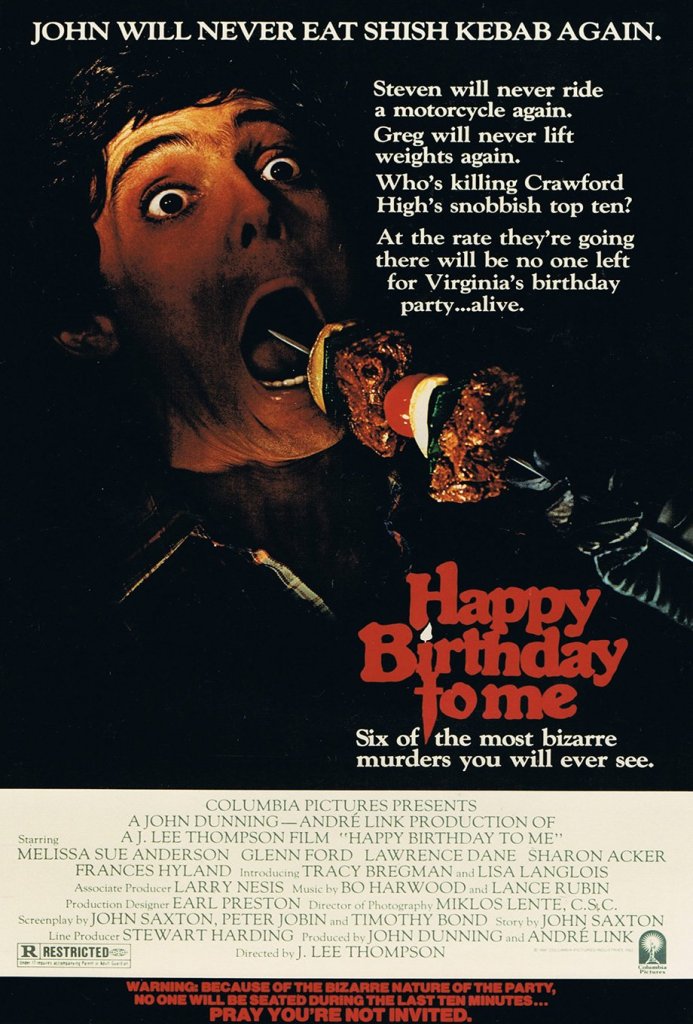
Columbia Pictures went for both the bloody and bizarre in promoting Happy Birthday to Me, a minor hit in the summer of 1981.

The poster has an image of the most famous murder set piece of the movie.

JOHN WILL NEVER EAT SHISH KEBAB AGAIN.

Steven will never ride a motorcycle again.

Greg will never lift weights again.

Who’s killing Crawford High’s snobbish top ten?

At the rate they’re going there will be no one left for Virginia’s birthday party … alive.

Happy Birthday to Me … Six of the most bizarre murders you will ever see.

WARNING: BECAUSE OF THE BIZARRE NATURE OF THE PARTY, NO ONE WILL BE SEATED DURING THE LAST TEN MINUTES … PRAY YOU’RE NOT INVITED.

Factual accuracy is not this poster’s strong suit, since there’s nine deaths in the movie, there’s no John character in the movie, Steven’s the one killed by kebab, and Etienne’s the one done in by a motorcycle.
Friday the 13th Part VIII: Jason Takes Manhattan

FRIDAY THE 13TH PART VIII: JASON TAKES MANHATTAN (1989) *
The tragically titled Friday the 13th Part VIII: Jason Takes Manhattan just might be the first movie that I ever considered a bust, a disappointment, and a great big ripoff.

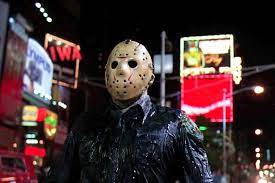
I remember looking forward to Jason Takes Manhattan because I had already seen Part III and Jason Lives on video and liked them a good deal and, let’s face it, I got all hyped up on promotional material that included the trailer and TV spots, the poster and print ads, and Jason Voorhees himself making a guest appearance on The Arsenio Hall Show on Friday, July 28, 1989, the date of the film’s release.

At that very point in time, I thought Jason Takes Manhattan would be the greatest thing ever in the whole wide world.

Boy, would I ever be wrong on that one!

Let’s see here, where to start, other than none of the human characters are exactly likable in the slightest degree, just like most of the later Friday the 13th sequels starting with A New Blood and running through both New Line Cinema films and the 2009 remake.

Uncle Charles, played by veteran character actor Peter Mark Richman (1927-2021), just might possibly be the most reprehensible character in the Friday series. Other worthy contenders right off the old head are Axel from The Final Chapter and Roy Burns from A New Beginning, but there’s so many loathsome characters in the later Friday films.

Jason Takes Manhattan almost feels like an episode of The Love Boat … seriously, the movie spends far more time on a boat than it does Manhattan. It’s unfortunate that Jason Takes Manhattan came out 30 years before Lonely Island’s I’m on a Boat.

Takes Manhattan? Seriously, are you kidding? More like Barely Walks Through Manhattan! It takes more than an hour of the longest entry in the Friday series to even get to Manhattan, and it’s disappointing even after we get there.

Director and screenwriter Rob Hedden possessed a vision to incorporate landmarks like the Statue of Liberty, the Brooklyn Bridge, and Madison Square Garden, naturally, but parent studio Paramount decided to be the Grinch and slash the budget for what turned out to be the final Paramount entry after a series of declining returns starting with A New Beginning and continuing through Jason Lives, A New Blood, and finally Jason Takes Manhattan.

They spent very little time in the actual Manhattan, and of course Vancouver stands in for the Big Apple most of the time.

Guess you could say Jason Takes Manhattan paved the way for Rumble in the Bronx, which makes up for featuring even less of the Bronx than Manhattan’s featured in Jason Takes Manhattan by having some absolutely fantastic Jackie Chan action scenes.

The kill scenes in Jason Takes Manhattan are disappointing, just like about every other single thing during the 100-minute motion picture.

In the film’s most famous scene, Lakeview High School boxing champion Julius Gaw engages our anti-hero Jason Voorhees in a boxing match and punches Jason many, many, many times before Jason knocks Julius’ block off with just a single punch.

I’ve always been underwhelmed by that scene, and I far prefer a similar scene the year before in Killer Klowns from Outer Space.

I don’t even want to think about another one of those patented beyond weird Friday endings that leave viewers dumbfounded and stupefied.

Here instead is a transcript of the Arsenio interview.

A: How are you?

That’s good.

You know what I’ve noticed. I see all your movies, man, and you know what I’ve really noticed. You’re angry.

I don’t mean to laugh. Excuse me, it’s just the way I am, but you’re you’re you’re angry.

What happened, man, where did it all begin?

[Long pause]

You know what I mean? Was it a woman? Did you get cut from the hockey team in high school?

What happened? What’s up?

Let me ask you this.

I saw the new movie, Jason Takes Manhattan.

You killed 16 people … I don’t know why I’m laughing.

You killed 16 people and you were responsible for the death of eight others. Total, that’s less than what you usually kill in a movie.

Are you getting soft? Are you losing a step?

You’re trembling, man.

Oh, you brought a clip.

Would you set it up for us?

Set up the clip, like tell them you know how this fits into the movie and what they’re about to see and all that kind of stuff.

Jason Takes Manhattan, here’s his clip.

[Times Square clip plays.]

Working on the streets of New York, did you get a lot of people come up to you to ask for your autograph and stuff like that?

Ever think about doing a musical?

[Another pause.]

I’m running out of questions, man.

Oh, I know what I wanted to ask you.

You didn’t kill anybody with that big knife you used to kill people with, did you change because you were afraid of being typecast as just being a big knife killer?

So what’s next, man?

Some more of Jason Part Nine, I got some great titles I put together.

Jason and the Three Babies. What do you think of that?

Jason’s Big Top would be funny.

Oh … Jason Rabbit.

That would be great.

Oh … When Jason Met Sally … would that be funny?

You don’t do many comedies, do you?

Um … I’d like to thank you for coming by. It’s a pleasure.

(Jason shakes Arsenio’s hand very, very, very strongly.)

Jason, ladies and gentlemen.

Definitely another case where the promotion is a whole lot better than the picture.

Friday the 13th: The Final Chapter (1984)

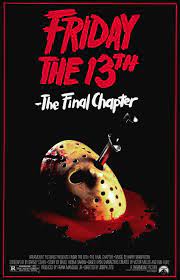
FRIDAY THE 13TH: THE FINAL CHAPTER (1984) ***
Once upon a time, I called Friday the 13th: The Final Chapter the most schizophrenic movie ever made and what I mean by this bit of hyperbole is that The Final Chapter largely alternates being a rather brutal, occasionally mean-spirited horror movie sequel and a jovial teenage sex comedy especially made explicit in casting Lawrence The Last American Virgin Monoson in one of the key supporting roles.

The Final Chapter has some of the best and also some of the worst moments in the entire 12-movie Friday series, easily the best cast and most likable characters from (almost) top to bottom, Tom Savini’s return as makeup artist, Harry Manfredini’s first-rate musical score, Ted White’s brutal conviction selling his kill scenes as Jason Voorhees, and it’s arguably the quintessential Friday the 13th movie.

Let’s hit a couple of the high points first.

The Final Chapter introduces us to Tommy Jarvis (Corey Feldman), a 12-year-old boy with a hyperactive imagination and penchant for monster make-up and masks not unlike Savini; Trish Jarvis (Kimberly Beck), Tommy’s older sister and our Final Girl; Mrs. Jarvis (Joan Freeman), Tommy’s and Trish’s single mother; Gordon the Family Dog, the golden retriever whose fate remains uncertain. Anyway, this family dynamic is something fresh and new for the Friday series.

Crispin Glover, one of the great movie eccentrics, makes his mark on The Final Chapter and his Jimmy becomes one of the most unforgettable horny (dead) teenagers in a series that served them up by the hundreds as fodder for the slaughter. Jimmy and his buddy Ted (Monoson) especially feel like refugees from a teenage sex comedy, like they continued playing their characters from My Tutor (Glover) and The Last American Virgin (Monoson). Jimmy’s dance and exit line in this movie have become the stuff of slasher movie legend.

Feldman and Glover provide us two of the most likable characters in any of the dozen Friday movies, something that’s ironic given the fact The New Beginning (which arrived in theaters around 11 months after The Final Chapter) has almost no likable characters among the largest cast of corpses in series history. Never mind that Tommy did not exactly pan out in The New Beginning and Jason Lives like the endings of The Final Chapter and The New Beginning seemed to promise.

I almost forgot Rob (E. Erich Anderson), the older brother of a character killed by potato sack Jason in Part 2. Rob seeks revenge against Jason and fortunately he meets Trish and Tommy first, though ultimately it does not matter because Rob represents one of the great missed opportunities. Here’s a character who could have served as a basis for an entire movie and The Final Chapter makes him completely underwhelming. His death scene, designed to be poignant, instead becomes laughable (‘He’s killing me. He’s killing me’) and it wishes it could be as enjoyably bad as the bookseller’s death in Dario Argento’s Inferno. You might recall that the creepy old book retailer’s done in by rats and a homicidal Central Park hot dog vendor.

Now, we’ve moved on to the more negative.

Our first two new corpses in The Final Chapter represent one of my least favorite scenarios that’s commonly found in Friday movies. We spend several minutes, it feels even longer, much much much longer, with super horny morgue attendant Axel (Bruce Mahler) and super uninterested Nurse Morgan (Lisa Freeman) before they are massacred by Jason. Maybe it’s only a few minutes, but I never want to watch their scenes ever again to find out. I’ll use their introduction as my cue to go make some scrumptious butter popcorn.

Like the beginning of Part III and the obligatory murder of the lakefront store owners, these are minutes of my life that could have been attended to better things, even during a Friday movie.

The Final Chapter loves breaking glass and characters falling through windows.

The Final Chapter gets straight at the heart of the ambivalent relationship between parent company Paramount Pictures and the Friday movies.

One immediately gets the feeling that Paramount wanted The Final Chapter, you know, to be the end of Jason once and forever because the studio hotshots were ashamed to be associated with such a disreputable and sleazy franchise, but, alas, at the same time, The Final Chapter leaves the door open for more sequels with one of the series’ trademark endings. Paramount walked through that very door — actually, more like sprinted — when The Final Chapter returned a hefty profit.

The Final Chapter finished in the top 25 box office for 1984 and put together a $11.1M opening during the weekend of April 13.

Friday, April 13, 1984. The Challenger returned to Earth from their 11th space shuttle mission. India beat Pakistan by 54 runs to win the first Asia Cricket Cup in Sharjah, United Arab Emirates.

Paramount released A New Beginning on March 22, 1985, and 1983 and 1987 are the only years of the ’80s without a Friday the 13th movie. Do 1983 and 1987 belong to another decade?

I more or less grew up with the Friday movies, so I might be more forgiving of them for all their numerous faults than people who grew up in different times.

Then again, I might not be, because I only consider Jason Lives (the best made and the only entry that deserves a place near second- or third-tier classic horror movies like Frankenstein Meets the Wolf Man), Part III (the most suspenseful and the one where Jason acquires his legendary hockey mask), and The Final Chapter even worth recommending. Most of the rest of them have their isolated moments, all of them are excuses for reels of sex and violence and vulgarity, and the movies definitely created their own distinctive space in the cinematic marketplace.

How did the world end up with 12 Friday the 13th movies and legendary status for both the series overall and serial killer Jason Voorhees specifically, when similar movies like My Bloody Valentine, The Burning, Happy Birthday to Me, and Madman failed to produce one sequel among them. Granted, the original Friday finished 15th in the 1980 American box office sweepstakes and the first three sequels also proved to be solid hits among strong competition, while The Burning grossed $700 thousand, Madman $1.3M, My Bloody Valentine $5.7M, and Happy Birthday to Me $10.6M.

Money obviously talked for Jason.

Invasion U.S.A. (1985)

INVASION U.S.A. (1985) *
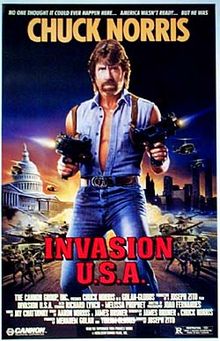
Joseph Zito made a logical progression from directing mad slasher films The Prowler and The Final Chapter (Jason Voorhees’ third screen entry) to Chuck Norris action spectaculars Missing in Action and Invasion U.S.A for the Cannon Films Group, one of the ultimate purveyors of schlock all through the ’80s.

Their schlock includes Ninja III: The Domination and Breakin’ 2: Electric Boogaloo, both from 1984 and directed by Sam Firstenberg.

Anyway, I digress, which is something that I will invariably do whenever discussing Invasion U.S.A. Yes, I admit upfront this review will be filled with digressions.

The plot: Multinationals with guns (sometimes with subtitles, sometimes without) invade the United States, actually Florida but Invasion Florida doesn’t quite ring the same liberty bell, and one-man army Chuck Norris stops them with bloody ballyhoo. Named Matt Hunter in a fit of poetic fancy, perhaps by one of the writers of this garbage, Norris could have killed ’em all with denim.

Basically, Invasion U.S.A is Red Dawn dumbed down even more and it substitutes teeny bopper Commie scum killers Patrick Swayze, Charlie Sheen, C. Thomas Howell, Jennifer Grey, and Lea Thompson for Norris, who laughably tells us that he works alone. No joke, we know this after ’bout 50 Norris films where his character informs us that he kills scumbags all on his lonesome. I mean, wasn’t one of Norris’ better movies even called Lone Wolf McQuade for crying out loud?

The best Norris pictures have strong supporting characters and casts, who make up for the sometimes personality deficient Norris. Alas, Invasion U.S.A gives us one of the worst characters in not only a Norris movie but all movies in general — an apparent photojournalist named McGuire (Melissa Prophet) who probably should have been named Molly Magsnarl instead. She’s not the least bit grateful for Hunter saving her, and I would have let her meet her ultimate demise after the first time she snarls at me Cowboy. She blows out the tires on Invasion U.S.A every time she’s on screen.

Seeing her camera made me laugh, though, because I thought about how it was John Rambo’s assignment to only take photos of the POWs — not to rescue them — in Rambo: First Blood Part 2.

Speaking of First Blood Part 2, released a few months before Invasion U.S.A, it and Arnold Schwarzenegger’s Commando (released just after Invasion U.S.A) both blow away Invasion U.S.A in the great 1985 One-Man Army Movie Sweepstakes.

I also found a worse movie than Star Trek V: The Final Frontier that includes characters singing Row, Row, Row Your Boat.

Silent Rage (1982)

SILENT RAGE (1982) ***
Michael Miller’s 1982 feature Silent Rage combines several American movie hallmarks into one barely coherent package: Chuck Norris, a small Texas town (never sleepy when Norris plays Sheriff), a madman killer, mad scientists, shots borrowed straight from John Carpenter’s Halloween, two love scenes, Stephen Furst basically playing his character from Animal House again, bar fights, roundhouse kicks, biker gangs, breasts (inc. Norris but not Furst), and a schizophrenic musical score, not in any particular order.

We also have at least five wildly different acting styles for the price of one. We’ve already covered Norris and Furst, then there’s Ron Silver and he’s playing it straight in easily the best dramatic acting that one can find in anything starring Chuck Norris. Silver plays the voice of reason and let’s do the right thing scientist, whereas his colleagues played by Steven Keats and William Finley are variants on Universal horror archetypes updated for a new generation. Keats, of course, wants to push science further than any one ever before even when it’s not prudent and Finley, best known for his roles in Brian De Palma and Tobe Hooper films Phantom of the Paradise and Eaten Alive, occupies the middle ground between Silver and Keats. Brian Libby’s madman killer continues in the proud screen tradition of Frankenstein’s Monster and Michael Myers, especially after our mad scientists flat out turn him posthumously into an indestructible killing machine whose stalking does all the talking. I wanted Dr. Loomis to show up and say THIS ISN’T A MAN. Bummer that it didn’t happen.

Norris battles the mad killer and later the virtually indestructible mad killer in the opening and concluding scenes. Otherwise, he alternates between mentoring and supporting unsure and unsteady rookie cop Furst, rekindling his romance with a former lover played by Toni Kalem, and questioning Silver and Keats. For Norris fans, apparently the scariest parts of Silent Rage involved Kalem’s bare breasts and Norris favoring jazz music because our favorite roundhouse specialist returned to only love scenes between men for the rest of his career, barring his rolling around in the mud with the sultry Barbara Carrera in the 1983 Walker, Texas Ranger precursor Lone Wolf McQuade. I for one like Silent Rage because it’s nice to see more chests on display than just Chuck’s for a change.

Silent Rage unfortunately drags at two main points. The death of Silver’s wife literally feels like it takes forever, like one of the filler killings in a Friday the 13th sequel. Ditto for the bar fight, which are drags both in real life and in the movies. A couple moments in this otherwise humdrum bar fight sequence redeem it, just barely though. If you’ve seen Silent Rage, you know exactly what I mean.

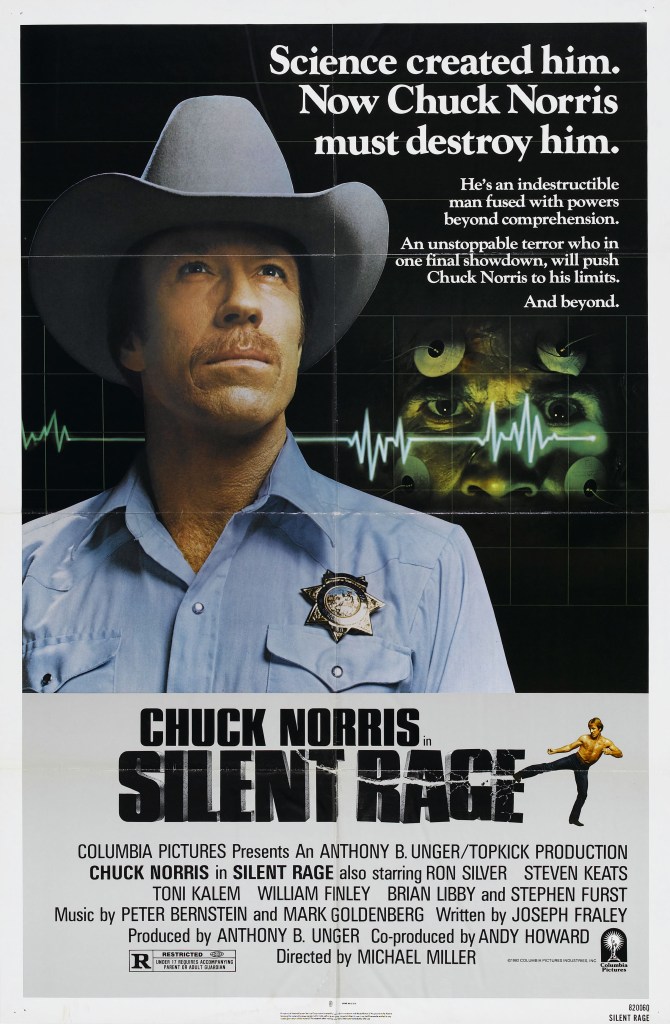
The poster for Silent Rage rates with Breaker! Breaker as the best Norris film poster. There’s really no arguing with a mini-Norris roundhouse cracking the movie’s title and the promotional hype Science created him. Now Chuck Norris must destroy him. He’s an indestructible man fused with powers beyond comprehension. An unstoppable terror who in one final showdown, will push Chuck Norris to his limits. And beyond.

Once upon a review, I believe I wrote that I wanted to see Chuck Norris vs. Jason Voorhees and Silent Rage is the closest that I will ever get to seeing that dream come true.

Chopping Mall (1986)

CHOPPING MALL (1986) ***1/2

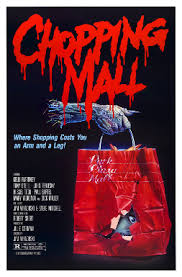
Jim Wynorski’s CHOPPING MALL has just about everything anybody would ever want from a mid-80s horror film.

— An iconic shopping mall shooting location.

— Three killer robots who shoot real frickin’ laser beams. By the way, these kill-bots could eat Paul Blart for breakfast, lunch, dinner, and three desserts, plus in-between snacks.

— Big hair and big boobs.

— A Barbara Crampton topless scene that rates below RE-ANIMATOR and FROM BEYOND. Still, though, it’s topless Barbara Crampton.

— Other familiar teeny bopper horror movie bods and faces.

— The great character actor Dick Miller playing a character named Walter Paisley (his character’s name from BUCKET OF BLOOD).

— A Corman Factory production with posters from previous cult classics (including one directed by Wynorski, his debut film LOST EMPIRE) and clips from Roger Corman’s 1957 epic ATTACK OF THE CRAB MONSTERS.

— Cameos from Corman favorites Paul Bartel and Mary Woronov playing their characters from EATING RAOUL.

— Outdated special effects that were outdated even before the movie’s release. However, that’s all part of their charm.

— Gore galore highlighted by a gnarly head explosion.

— A plot that plays like a fast and loose combination of FAST TIMES AT RIDGEMONT HIGH, FRIDAY THE 13TH, and THE TERMINATOR.

CHOPPING MALL does not muck around, giving us our first killer robot scene right from the start and hey, let’s face it, it breezes past in 76 minutes. For crying out loud, that’s a running time straight from an earlier time in cinematic history. That not mucking around quality is one of the most admirable traits of CHOPPING MALL, that and its desire to give the people what they want in terms of meeting and exceeding the demands of an exploitation film.

It has a basic plot: Three security robots go haywire after a lightning storm, turn rogue and run amok in Park Plaza Mall, actually the Sherman Oaks Galleria in the Sherman Oaks neighborhood in Los Angeles. The galleria, on the corner of Ventura and Sepulveda Boulevards, has been given credit for inspiring the Frank and Moon Unit Zappa satirical hit single “Valley Girl” and FAST TIMES and COMMANDO famously utilized the location.

Of course, with this genre and location, we have four teenage couples who stay after hours to frolic and fool around inside a furniture store, naturally and predominantly hot and horny couples who make up the majority of our body count. That contributes the FRIDAY THE 13TH element, and the presence of Russell Todd aids and abets that mental connection. Todd played Scott in FRIDAY THE 13TH PART 2, a real smug horny bastard adept with a slingshot. Not that did him any bit of damn good against burlap sack Jason Voorhees.

CHOPPING MALL has a good cast and Kelli Maroney and Alan O’Dell make for appealing, likeable female and male leads, especially Maroney. With her big hair, her struggles working in a restaurant, her spunky attitude, and her way around weaponry, Maroney’s Alison Parks feels very reminiscent of Sarah Conner (Linda Hamilton) from the first TERMINATOR.

What I especially like about the teenagers in CHOPPING MALL is that they load up on guns (echoes of DAWN OF THE DEAD) almost immediately after discovering the killer robots. They are far more proactive than the average horror movie teenager, and that helps separate CHOPPING MALL from the pack of run-of-the-mill exploitation films.

File CHOPPING MALL right alongside cult classics from that moment in time like RE-ANIMATOR, FROM BEYOND, and NIGHT OF THE CREEPS.

Friday the 13th Part VI: Jason Lives (1986)

JASON LIVES

FRIDAY THE 13TH PART VI: JASON LIVES (1986) Three stars

I find the FRIDAY THE 13TH movies that I like the most are the ones with the best sense of humor.

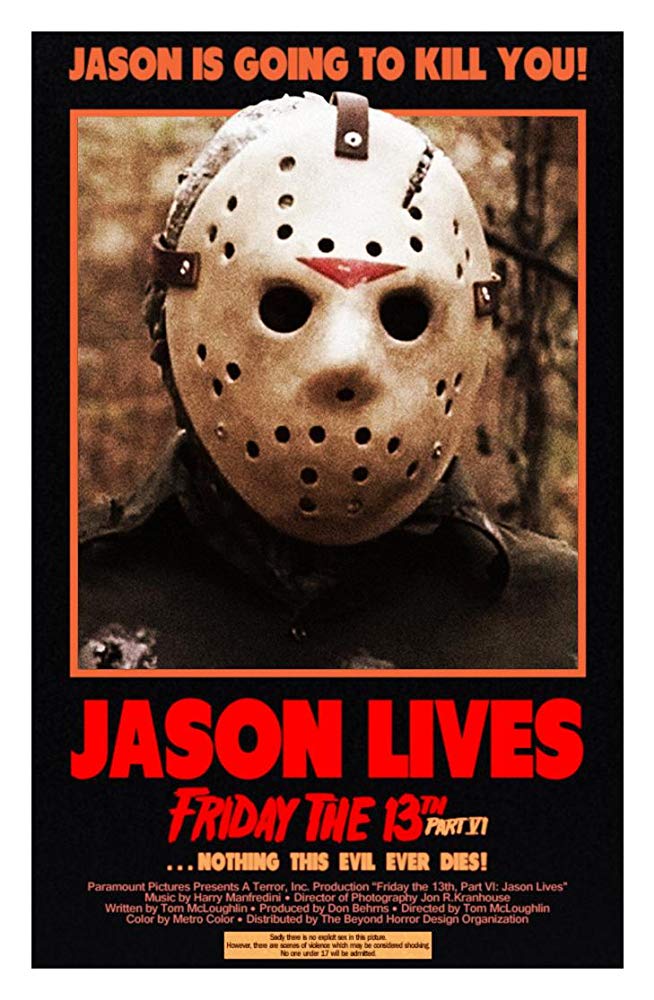
That’s why I’ll call PART VI: JASON LIVES the best film in the entire series, beating out PART III and THE FINAL CHAPTER. JASON LIVES includes several intentionally funny scenes and that helps its 86 minutes go down smoothly.

Director and writer Tom McLoughlin wanted to satirize a slasher movie all while making one, turn Jason into a supernatural zombie, and not simply churn out a carbon copy of the five previous movies in the series. There are moments intended to recall classic horror movies, like the beginning scene in the cemetery echoes the grave robbers at the beginning of FRANKENSTEIN MEETS THE WOLF MAN. Jason’s revival from the dead courtesy lightning also recalls Frankenstein’s Monster.

“I set up a lot of visual gags,” McLoughlin said in the book “A Strange Idea of Entertainment — Conversations with Tom McLoughlin.” “Like when my wife Nancy is killed by Jason. She tries to bribe him, offering him her wallet to keep him from killing her. She’s got money and a credit card in her wallet, and when Jason kills her in this giant mud puddle, the money sinks and the American Express card floats. I held on that shot for a few extra beats because I knew there would always be some joker in the theater that would yell, ‘Don’t leave home without it!’ And someone always did.”

McLoughlin’s background proved to have a strange influence on Jason Voorhees.

“I was recently interviewed about it, and someone said, ‘Your Jason seemed to be much more communicative,’” McLoughlin said. “I said, ‘That’s because I was dealing with a mime character.’ When he sees the motor home bouncing up and down because a couple are having sex in there, Jason just stands there and stares, with his head tilting back and forth — like a dog trying to figure out what’s going on. It got a big laugh. I wasn’t making fun of Jason … I just figured he would be processing what was going on in that motor home. Whenever I find a way to put my mime training to use in storytelling, I do it.”

Marcel Marceau influenced Jason Voorhees. Makes perfect sense to me.

McLoughlin sang in a rock band before he went to Paris to study mime under Marceau. Back in the States, several years later, McLoughlin had a part as the mutant bear monster in the 1979 horror film PROPHECY directed by John (MANCHURIAN CANDIDATE) Frankenheimer. All these experiences seemingly fed McLoughlin more insight into Jason than any other director.

Alice Cooper provided three songs for JASON LIVES:  “Teenage Frankenstein,” “Hard Rock Summer,” and “He’s Back (The Man Behind the Mask).” Unfortunately, they are not classic Alice Cooper songs, a la the four-album period from “I Love It to Death” through “Billion Dollar Babies” when the band cranked out some of the greatest hard rock ever made, but I still enjoy “He’s Back.” SCREAM later made great use of the Alice classic “School’s Out.”

Speaking of SCREAM, apparently screenwriter Kevin Williamson wanted McLoughlin to direct his hot commodity screenplay, before the project ended up with Wes Craven. Williamson told McLoughlin that JASON LIVES and its humor made a huge impact on Williamson during his youth, so much so that it served as one of the inspirational springboards for SCREAM.

There’s a James Bond gun barrel sequence parody, dialogue that breaks the proverbial fourth wall, a camper reading Jean-Paul Sartre’s existentialist play “No Exit,” a camper praying to God for the first (and only) time in the series, and even Jason surprised at his own astonishing strength. Also, for the first and only time in the series, young campers are in attendance at Camp Forest Green, er, Camp Crystal Lake.

“I’ve seen enough horror movies to know any weirdo wearing a mask is never friendly” and “Some folks sure got a strange idea of entertainment” are lines that display how JASON LIVES influenced SCREAM.

The young children, who Jason does not harm, have their moments, as well, especially when one boy asks his little friend, “So, what were you gonna be when you grew up?”

All these words so far and I have not even mentioned protagonist Tommy Jarvis, who figured in THE FINAL CHAPTER, A NEW BEGINNING, and JASON LIVES. He’s responsible for reviving Jason in the opening sequence and Tommy even makes sure to bring that infamous hockey mask with him. Originally, it had been planned for Tommy to become the antagonist, but it was the extremely negative reaction to A NEW BEGINNING and its non-Jason killer which truly brought Jason back from the dead. Tommy never panned out like he should have and part of the problem is that he’s played by three different actors, Corey Feldman (THE FINAL CHAPTER), John Shepherd (A NEW BEGINNING), and Thom Mathews (JASON LIVES).

Anyway, definitely by this point in the series, Jason became the focus of attention and the antihero extraordinaire of the late ‘80s. Dan Bradley played Jason in the paintball massacre sequence, but former soldier C.J. Graham handled the rest of the duties. He’s a lot more interesting than Tommy Jarvis. That’s why the series moved forward with Jason (Kane Hodder the man behind the mask for four more sequels) and without Tommy Jarvis.

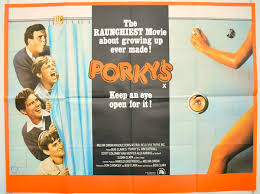
Porky’s (1981)

PORKY'S

PORKY’S (1981) Three stars

“Nobody ever went broke underestimating the intelligence of the American public,” H.L. Mencken famously said.

Mencken said that long before the success of PORKY’S, PORKY’S II: THE NEXT DAY, and PORKY’S REVENGE!, comedies which combined for over $200 million in box office and rental returns. Mencken died in 1956.

PORKY’S earned the vast majority of that $200 million and it came from out of seemingly nowhere to place fifth at the American box office in 1982, behind only breakaway winner E.T., ROCKY III, ON GOLDEN POND, and AN OFFICER AND A GENTLEMAN. PORKY’S sat on top of the American box office from late March through early May and it was dethroned by Arnold Schwarzenegger and CONAN THE BARBARIAN.

Unlike those other films, however, critics absolutely detested PORKY’S and aligned it with FRIDAY THE 13TH and THE CANNONBALL RUN in an unholy trinity of films that would no doubt lead to the downfall of Western Civilization. PORKY’S exhibits more than most how a film can be hated by critics and loved by the masses.

The success of the first PORKY’S spawned a whole slew of teenage sex comedies, often nostalgic and especially set in either the 1950s or 1960s.

I claimed a copy of PORKY’S as one of my first VHS purchases in my late teenage years and it quickly became a favorite movie of my rowdy group of friends. We loved it, as well as NATIONAL LAMPOON’S ANIMAL HOUSE, CADDYSHACK, KINGPIN, and THE BIG LEBOWSKI.

Every time I watch PORKY’S, I find a few big laughs and that’s why I am giving the film a passing grade. As far as the sequels are concerned, they are dreadful and deserve their horrible reputation. I remember seeing all of them in heavily edited form on “USA Up All Night,” before catching up with them all on video or pay TV.

Of course, our seven high school horn balls in PORKY’S are all played by older actors: Dan Monahan turned 26 in 1981, Mark Herrier 27, Wyatt Knight 26, Roger Wilson 25, Cyril O’Reilly 23, Tony Ganios 22, and Scott Colomby 29. That’s not anything new for a Hollywood film. For example, in GREASE, another highly successful nostalgia piece, John Travolta was 23 when he made it and Olivia Newton-John was 28 almost 29, Stockard Channing 33, Jeff Conaway 27, Barry Pearl 27, and Michael Tucci 31 when they were playing high school students.

Speaking of GREASE, one could describe PORKY’S as GREASE with T&A and rednecks instead of PG and greasers and without musical numbers.

PORKY’S includes sex jokes, condom jokes, sex jokes, size jokes, sex jokes, nude jokes, sex jokes, penis jokes, sex jokes, virgin jokes, sex jokes, and fat jokes, especially at the expense of villains Porky (Chuck Mitchell, a 6-foot-3, nearly 400-pound man) and Ms. Beulah Balbricker (Nancy Parsons).

Porky is a real vile piece of work, a saloon and brothel owner who is the most powerful man in his county. Every public official seems to be related to Mr. Wallace, namely his brother Sheriff Wallace (former NFL great Alex Karras). Mitchell wraps his best redneck goon around such dialogue as “I was givin’ the old place an enema and this pile of shit come floatin’ up to the surface” and “Where are these five little virgins who think they reached manhood? You wanna tangle ass with me? Come up here, you sawed-off punk! I’ll educate ya! I’ll wrap this right around your damn neck!” It is to Mitchell’s credit that he creates such a nasty character that we do root for his comeuppance in the final reel.

Balbricker embodies the worst killjoy or she’s basically portrayed as the Carrie Nation of the teenage sex comedy. Less successful, though, much less successful. After all, Carrie Nation (1846-1911) said things like “I felt invincible. My strength was that of a giant. God was certainly standing by me. I smashed five saloons with rocks before I ever took a hatchet” and “I want all hellions to quit puffing that hell fume in God’s clean air.” Balbricker (also called “Ball-breaker” and “King Kong” by other characters) develops an obsession with one character’s penis. Please can we call it a tallywhacker? Penis is so personal. Parsons, like Mitchell, gives a very good performance, one that rates with John Vernon in ANIMAL HOUSE.

Kim Cattrall must have used her work here as Miss Honeywell (“Lassie”) during her audition for “Sex and the City.” It definitely beats MANNEQUIN.

Writer and director Bob Clark (1939-2007) has a very interesting story and filmography, since his credits include the 1974 proto-slasher BLACK CHRISTMAS, the beloved A CHRISTMAS STORY, and the first two PORKY’S films, as well as even more diverse entries like MURDER BY DECREE, TRIBUTE, RHINESTONE, TURK 182!, LOOSE CANNONS, and BABY GENIUSES.

His entry in “Take One’s Essential Guide to Canadian Film” from 2001 : “Clark turned down bids to play pro football to complete a drama major at the University of Miami. With the success of his low-budget horror classic CHILDREN SHOULDN’T PLAY WITH DEAD THINGS, Clark moved to Montreal in 1973 and came to dominate Canadian commercial filmmaking for a decade. He followed CHILDREN with BLACK CHRISTMAS, a box-office hit starring Margot Kidder, and then, from 1978 to 1981, he directed MURDER BY DECREE, TRIBUTE, and PORKY’S – three of the most successful films produced in the tax-shelter era. Sad to say, the sophomoric PORKY’S remains the Canadian box-office champ. Clark returned to the United States in 1984; his career, like his locale, has gone south since.”

I read that Clark gathered the material for PORKY’S over a 15-year period, combining stories from other males of his generation with his own experiences. Every Hollywood studio passed on PORKY’S and it was produced by the Canadian company Astral Bellevue Pathe and Melvin Simon Productions (Mr. Simon, who died in 2009 at the age of 82, developed Mall of America, co-owned the Indiana Pacers along with his brother Herbert, and produced films including PORKY’S, THE STUNT MAN, and ZORRO, THE GAY BLADE), but 20th Century Fox picked up the U.S. distribution and a slick marketing campaign, combined with strong word-of-mouth, produced a monster hit on a $4 million budget.

Clark passionately defended the film amid the constant cries of misogyny and racism.

Those critics are missing that Wendy, played by Kaki Hunter, is often the sunniest presence and that Clark set his film in the Deep South in 1954. One character does overcome his initial anti-Semitism and becomes friends with a Jewish classmate.

THE NEXT DAY seems to address both criticisms, though, with one thoughtful dialogue scene between Wendy and main horn ball Pee-Wee (Monahan) and then adds a fanatical reverend, hypocritical politicians, a Native American, and the Ku Klux Klan to the mix. All the latter material simply does not mesh with the juvenile sex comedy.

Clark did not return to direct REVENGE and director James Komack and screenwriter Ziggy Steinberg wanted the third installment to return to the pure sex farce of the first movie. All the actors simply look too long in the tooth to be partaking in such adolescent shenanigans. I mean, for crying out loud, Colomby was nearly in his mid-30s by the point they made this third PORKY’S film; he graduated from Beverly Hills High School in 1970. Bottom line: I laughed not a single time at PORKY’S REVENGE, maybe once at NEXT DAY.


PORKY’S II: THE NEXT DAY (1983) One star; PORKY’S REVENGE! (1985) No stars

Friday the 13th (1980)

FRIDAY THE 13TH (1980).jpg

FRIDAY THE 13TH (1980) One-and-a-half stars

Of all the horror movies over the decades that have been labelled “classic,” FRIDAY THE 13TH is the one arguably least deserving of that label.

Plain and simple, it’s a bad movie. One-dimensional characters, corny dialogue that even makes references to much much much better movies like CASABLANCA, filler scenes, and perhaps the least convincing mass murderer in screen history are some of its crimes against cinema.

Harry Manfredini’s musical score derived from PSYCHO and JAWS and Tom Savini’s make-up and special effects are both very good, and their work earns the film one half-star each.

I can only see FRIDAY THE 13TH being considered a classic if you count all the sequels and imitations.

My personal favorite FRIDAY THE 13TH movies are PART III, THE FINAL CHAPTER (perhaps the most schizophrenic movie ever made, a cross between leering teenage sex comedy and brutal violence), and JASON LIVES. They succeed more at having a sense of humor and a sense of fun than all the other installments. The rest of the movies all have their isolated moments.

If you have seen the sequels before the original, you might be shocked by the film that started it all. It is very sluggish, at times, and there’s no hockey-masked homicidal maniac in the middle of the mayhem.

Sean Cunningham (director) and Victor Miller (screenwriter) made FRIDAY THE 13TH to cash in on HALLOWEEN, which earned $60-70 million on a $300,000 budget. When there’s an unexpected runaway success like that, naturally the clones and variations start appearing in droves and they did after HALLOWEEN for at least five years.

Cunningham and Miller worked together previously on a family film called MANNY’S ORPHANS, released nearly two months before HALLOWEEN. Cunningham began with adult movies THE ART OF MARRIAGE and TOGETHER, produced Wes Craven’s THE LAST HOUSE ON THE LEFT, and directed a sexploitation comedy named CASE OF THE FULL MOON MURDERS before consecutive family pictures in 1978.

In other words, he saw FRIDAY THE 13TH as the way to make inroads in the brutal movie business. Honestly, who could blame Cunningham, especially as many others had a similar brainstorm.

Cunningham, of course, lacked the finesse and skill of HALLOWEEN director-writer-composer John Carpenter. FRIDAY THE 13TH does benefit, however, from its own low budget production — $550,000 — so it is effective in fits and starts despite itself. It is far more of an exploitation film than HALLOWEEN, and proved nearly as profitable. We saw FRIDAY THE 13TH movies in every year of the 1980s except for 1983 and 1987.

What FRIDAY THE 13TH did was establish a campground setting, add more corpses, er, characters, and amplify the gore, elements that quickly became the norm for an onslaught of “dead teenager” movies. Like virtually every horror movie since CARRIE (1976), it also has one final jump scare. The sequels — namely PART 2, THE FINAL CHAPTER, and THE NEW BEGINNING — upped the nudity and sex quotient. (FRIDAY THE 13TH fans should check out Mario Bava’s BAY OF BLOOD, a 1971 film that undoubtedly influenced the first two FRIDAY THE 13TH installments. If you’ve not seen the Bava film before, you might be surprised. It’s also much better than any of the FRIDAY THE 13TH movies.)

The original FRIDAY THE 13TH exists in that post-HALLOWEEN storytelling mode, where there’s a prologue detailing terrible events that happened in the past and will dovetail with the events of the present. Just about every horror film made after HALLOWEEN includes a bloody, sordid back story.

In FRIDAY THE 13TH, we head back in time to Friday, June 13, 1958, Camp Crystal Lake, when camp counselors Barry and Claudette sneak inside a storage cabin for a little lovin’ and they are murdered. We come to find out that one year before, a 11-year-old boy named Jason Voorhies apparently drowned in Camp Crystal Lake, due to negligent camp counselors.

You could build a nifty little collection of these back story / terrible event in the past scenes.

Let’s see, HALLOWEEN began on Halloween 1963 with 6-year-old Michael Myers killing his older sister Judith.

In PROM NIGHT, it’s 1974 when 11-year-olds Wendy, Jude, Kelly, and Nick cause the accidental death of 10-year old Robin.

In TERROR TRAIN, a sexual initiation prank at a college fraternity’s New Year’s Eve party leads a young man named Kenny to become traumatized and committed to a psychiatric hospital.

In THE BURNING, it’s a fiery prank on a cruel, alcoholic summer camp caretaker named Cropsy that leads to five years in the hospital before his release and revenge.

MY BLOODY VALENTINE waits a bit to spring its 20 years ago flashback story on us.

Anyway, you get the point.

Steve Christy (Peter Brouwer) decides that he will reopen a renovated Camp Crystal Lake. That’s his big mistake, one that results in eight deaths — seven of them Christy and his staff — on Friday, June 13, 1979.

Final Girl Adrienne King does have a great scream and some of the same wholesome All-American appeal as Jamie Lee Curtis. We also find out that she’s very talented at making coffee. Alice Hardy is virtually the only likable character among the lot, although we’re aghast that she ever had a love affair with the creepy Steve Christy. Girl, what were you thinking? There goes the whole idea of the Final Girl being a virgin.

As far as the boys go, Kevin Bacon later became a big star but he’s not around long in FRIDAY THE 13TH. Harry Crosby, son of the legendary actor and singer Bing (1903-77), attended the London Academy of Music and Dramatic Art and earned his MBA from the Fordham Graduate School of Business Administration before becoming a successful investment banker. Anyway, he’s killed in FRIDAY THE 13TH.

That all leads us to Mrs. Pamela Voorhees, played by Betsy Palmer (1926-2015), who we find out committed all the murders in a final act reveal. This middle-aged, albeit crazy, middle-aged lady, who at first seems like a kindly middle-aged lady, created all that mayhem. Early in this review, I called Mrs. Voorhees “perhaps the least convincing mass murderer in screen history” and I stand behind that claim. I just don’t believe that she could have accomplished such murderous feats, especially as she begins her attack on Alice by slapping her silly. Palmer brings on the camp — as in campy — during her screen time.

Film critic Gene Siskel (1946-99) hated FRIDAY THE 13TH so much that he first gave away the movie’s reveal and Palmer’s fate and then he provided the addresses for the chairman of the board of Gulf & Western Industries (who owned Paramount back then) and Palmer. Siskel rated FRIDAY THE 13TH “no stars.”

Palmer herself thought very little initially of the film and took on the assignment so she could buy a Volkswagen Scirocco. She called the script “a piece of shit” and she thought no one would go see FRIDAY THE 13TH.

In her later years, Palmer embraced the film and the role.

Nowadays, the next FRIDAY THE 13TH might be a documentary on the legal copyright battle between Miller and Cunningham.

As of Oct. 19, 2019, 655 folks have signed the change.org petition “Victor Miller & Sean Cunningham, End The Lawsuit and Work Together To Let Jason Live Again.”

The petition reads, “We, the fans of Friday the 13th ask both Victor Miller, Sean Cunningham along with Horror Inc to end the lawsuit and find resolution over the copyright claim by working together.

“Allowing the battle to take place in court helps no one, especially not the fans of the series. Relying on a courts decision will take years with neither side truly profiting within that time frame. Even after the courts decision one side will likely appeal the case and that will lead to even more years of not profiting on the franchise.

“By coming to a mutual agreement you both compromise and get something you want. You find common ground and you can work together to profit both sides. You’d also be supporting the fans that have supported you and the franchise for so many years. We want to continue to watch the franchise grow under your direction. Please support us as we have supported you. Thank you.”