
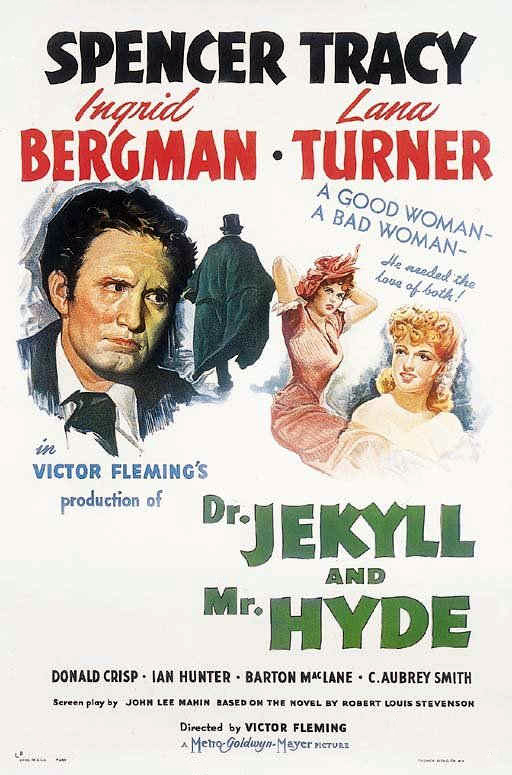
Dr. Jekyll and Mr. Hyde (1941)

DR. JEKYLL AND MR. HYDE (1941) **
Casting the wrong actor can be fatal to any motion picture.

Take for instance the 1941 horror film Dr. Jekyll and Mr. Hyde directed by Victor Fleming (credited director for Gone with the Wind and The Wizard of Oz) and starring Spencer Tracy, Ingrid Bergman, and Lana Turner, who are wrong for three of the four main roles.

Tracy (1900-67) could play the idealistic Dr. Jekyll in his sleep, but he’s simply not believable as the malevolent Mr. Hyde and that’s a major strike against the film because the duality of man theme flies right out the window without a convincing Mr. Hyde.

Bergman (1915-82) sought out the bad girl role Ivy Pearson and she’s plainly just wrong for a lower class trollop and saloon girl, even before Casablanca, Gaslight, and The Bells of St. Mary’s placed Bergman in the popular imagination as the ideal woman. Ironically, Bergman and Tracy dated during Dr. Jekyll and Mr. Hyde and director Fleming reportedly fell in love with her. Her image as the ideal woman cracked and her career in America ended for the better part of a decade circa 1949 after her affair with married Italian director Roberto Rossellini dominated headlines.

Turner (1921-95) plays against type as the good girl Beatrix Emery and she becomes such a nonentity during Dr. Jekyll and Mr. Hyde that we forget she’s even in the picture. Turner later made her enduring fame playing a femme fatale, a la The Postman Always Rings Twice.

Throughout cinematic history, more than 120 adaptations of Robert Louis Stevenson’s 1886 novella Strange Case of Dr. Jekyll and Mr. Hyde exist, with seemingly a major one every decade.

I vote for the superiority of the 1931 version produced by Paramount, directed by Rouben Mamoulian, and starring Fredric March and Miriam Hopkins. It blows the MGM version made 10 years later right straight out of the water and it’s not even close. Ditto for March and Hopkins, as well as Mamoulian, in comparison against Tracy, Bergman, and Fleming.

The 1931 Dr. Jekyll and Mr. Hyde benefited from being made before the Production Code that came into play around 1934 and being made at Paramount rather than MGM.

Hopkins’ Ivy showing March’s Jekyll her leg still stands up as one of the great erotic moments. March never fails to convince us as both Dr. Jekyll and Mr. Hyde, and he deserved to win the Academy Award for Best Actor for his performance. Mamoulian’s creativity shines throughout.

In the early ’30s, Paramount released such films as Morocco, Unfaithful, Dishonored, Tarnished Lady, Tabu, Million Dollar Legs, Horse Feathers, Island of Lost Souls, She Done Him Wrong, Murders in the Zoo, I’m No Angel, Duck Soup, and Design for Living. Paramount also distributed Fritz Lang’s 1931 all-time classic M in March 1933.

By comparison with the wild-and-crazy Paramount, where the Marx Brothers and Mae West once held court, MGM seemed awful stodgy and strange films like Tod Browning’s Freaks, Mark of the Vampire, and The Devil-Doll feel like aberrations on the studio’s permanent record. The folks around MGM reportedly treated Freaks cast members like, well, freaks.

So, in essence, if you have a chance and you’ve not seen it before, please go find the 1931 Dr. Jekyll and Mr. Hyde and watch it as soon as possible.

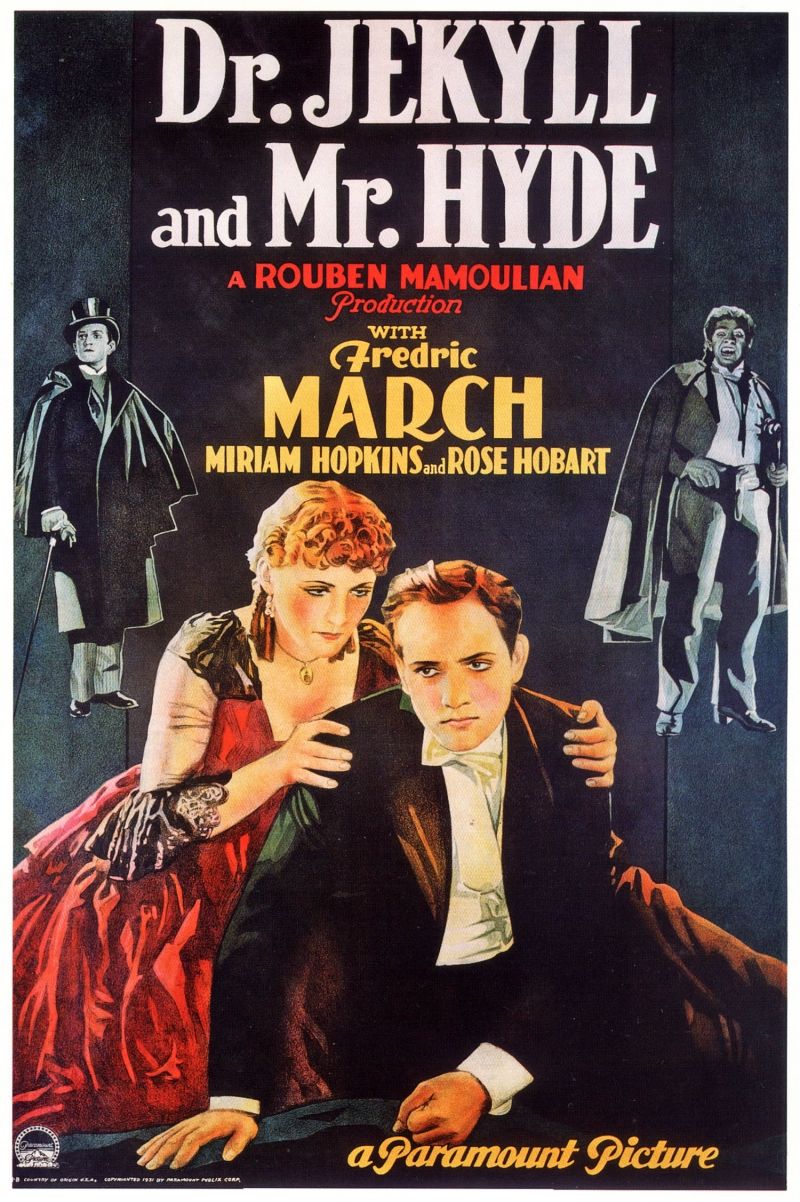
The Stepfather (1987)

THE STEPFATHER (1987) ****

Every now and then, a horror film will feature a performance that earns widespread critical acclaim and official recognition typically not bestowed on actors or actresses within horror films.
For example, we’ve had Fredric March in Dr. Jekyll and Mr. Hyde, Anthony Perkins in Psycho, Sissy Spacek in Carrie, Anthony Hopkins in Magic, and Jeff Goldblum in The Fly. We should include The Stepfather star Terry O’Quinn with those distinguished performances. He’s so magnificently malevolent that he elevates The Stepfather a notch or two above the average horror thriller and makes it a transcendent exploitation film.

O’Quinn is one of those veteran character actor types who creates the stereotypical reaction, “Hey, I know that guy! He looks so familiar and he was in. …” But most people can’t quite name him! That joke told about John Malkovich in Being John Malkovich applies even more to O’Quinn. Let’s see, aside from a pair of Stepfather movies, O’Quinn appeared in Young Guns, The Rocketeer, and Tombstone, as well as numerous TV shows and movies.

O’Quinn plays a real piece of work in The Stepfather and the movie begins with him assuming his next guise Jerry Blake, after he murdered his family. We see the bloody aftermath, so there’s no doubt about the identity of the killer and we’re left waiting for the moment Blake again explodes into violence. We’re also waiting for when his new family discovers his old identity and his bloody murders, all roads leading to a final showdown that seems obligatory for any thriller since Halloween. That macabre interest level starts with the standard One Year Later title card.

O’Quinn effectively shows that he wants to be a straight, clean-cut, self-effacing man with the All-American nuclear family traditionally identified with Father Knows Best, Leave It to Beaver, and The Adventures of Ozzie and Harriet, also familiar through many, many other sitcoms. At the same time, we know that it’s 99.9 percent likely he’ll gradually snap, crack, and pop when familial disappointment hits dear old Dad again, so a lot of the fun involves Blake’s tension between establishing or slaughtering his new family.

Jill Schoelen’s spitfire teenage stepdaughter Stephanie naturally sees right through Jerry Blake and her character earns our sympathy and empathy almost immediately after we learn her biological father died only a year before this Blake fellow entered the picture and romanced her mother. Of course, nobody quite believes Stephanie, who gets expelled from school for her latest punch out, when she expresses that something’s not quite right about her stepfather. Schoelen plays a 16-year-old girl, so it’s a little creepy when director Joseph Ruben and screenwriter Donald E. Westlake give her a nude scene late in the picture; granted, Schoelen carried on the grand old movie tradition of a teenager portrayed by somebody at least several years older.

Shelley Hack complements O’Quinn and Schoelen and completes the trio of solid performances, in the role of the new Mrs. Blake. She plays a tricky role, perhaps just as tricky as the title role, because her discovery of the truth must be timed absolutely perfect. Otherwise, we see that she’s a dolt and feel she deserves her fate. The Stepfather times it just perfect, and it gets so many things right that we bask in the presence of a superior horror film.

Dr. Jekyll & Mr. Hyde (1931)

day 16, dr. jekyll and mr. hyde

DR. JEKYLL AND MR. HYDE (1931) Four stars
The duality of man.

It was featured in a memorable conversation in FULL METAL JACKET between a colonel and Private Joker:
Colonel: Marine, what is that button on your body armor?
Private Joker: A peace symbol, sir.
Colonel: Where’d you get it?
Private Joker: I don’t remember, sir.
Colonel: What is that you’ve got written on your helmet?
Private Joker: “Born to Kill,” sir.
Colonel: You write “Born to Kill on your helmet and you wear a peace button. What’s that supposed to be, some kind of sick joke?
Private Joker: No, sir.
Colonel: You’d better get your head and your ass wired together, or I will take a giant shit on you.
Private Joker: Yes, sir.
Colonel: Now answer my question or you’ll be standing tall before the man.
Private Joker: I think I was trying to suggest something about the duality of man, sir.
Colonel: The what?
Private Joker: The duality of man. The Jungian thing, sir.

The duality of man is at the heart of DR. JEKYLL AND MR. HYDE in every form, be it Robert Louis Stevenson’s 1886 novella STRANGE CASE OF DR. JEKYLL AND MR HYDE and the 1931 and 1941 film versions with Fredric March and Spencer Tracy, respectively.

Dr. Henry Jekyll (March) believes that every man possesses two inside him (one good and one bad) and he puts this belief to the test with his creation of a formula that separates his good from his bad. He believes that if good and bad are separated, men will become truly liberated. Jekyll’s downfall will be his arrogance and his contempt for both his peers and the bounds for which one should not go.

Jekyll transforms into Mr. Edward Hyde, unleashing his inner demons on the world, especially a down-on-her-luck cabaret singer named Ivy Pearson (Miriam Hopkins). Jekyll saves Miss Pearson one night from a mugging and the very attractive young woman shows her appreciation to Jekyll in ways (bare legs, a kiss) that hasten Jekyll’s transformation into Hyde. It’s that leg that sticks with Jekyll, who’s engaged to be married to the socially respectable Muriel Carew (Rose Hobart) and you can go ahead and read socially respectable as dull. (The movie takes full advantage of coming before the Production Code that would have downplayed the sexual angle.)

Jekyll’s suave and sophisticated, well-respected, and known for both his decency and charitable works, but Hyde’s more a Neanderthal than a 19th Century Man with violent outbursts common and incredible physicality like brute strength and super jumping ability. Hyde is the darker side of Jekyll’s personality that he has repressed for so long, as a man of science turns into a homicidal maniac even without any potion.

Like many scientists in the movies, Jekyll messes around with things no man should and he pays the price dearly. There’s a dialogue scene between Jekyll and his friend Dr. Lanyon that gets to the gist of it:

Lanyon: You’re a rebel, and see what it has done for you. You’re in the power of this monster that you have created.
Jekyll: I’ll never take that drug again!
Lanyon: Yes, but you told me you became that monster tonight not of your own accord. It will happen again.
Jekyll: It never will. I’m sure of it. I’ll conquer it!
Lanyon: Too late. You cannot conquer it. It has conquered you!

March (1897-1975) was one of the best actors of his era on both stage and screen, winning two Academy Awards for Best Actor and two Tony Awards, and he gives two of the greatest performances in any horror film as Jekyll and Hyde, because they both take up residence in our mind.

For his work as Jekyll and Hyde, March tied with Wallace Beery (THE CHAMP) for the Academy Award for Best Actor. Should he not have won outright for playing two roles masterfully?

(Alas, March received one more vote than Beery. Unfortunately, though for March, Academy rules at that point in time considered an one-vote margin to be a tie. Thus, March and Beery tied for the award. This would not be the case any longer under Academy rules.)

DR. JEKYLL AND MR. HYDE, like many horror movies from the 1930s and 1940s, sticks with you long after it’s over and not only for its compelling themes and March’s performances but also for the use of POV shots and lap dissolves, transformation scenes, Hopkins’ performance as Ivy, and its evocation of a Victorian London that made Jekyll say “London is so full of fog, that it has penetrated our minds, set boundaries for our vision.”

Atmospheric has been used to describe the film directed quite masterfully by Rouben Mamoulian only a couple times.

Mamoulian pulls out all the stops in realizing the movie creatively.

Mamoulian on the transformation scene, “I asked, ‘What kind of sound can we put with this? The whole thing is fantastic. You put a realistic sound and it will get you nowhere at all.’ So again, you proceed from imagination and theory and if it makes sense, do it. I said, ‘We’re not going to have a single sound in this transformation that you can hear in life.’ They said, ‘What are you going to use?’ I said, ‘We’ll light the candle and photograph the light, high frequencies, low frequencies, direct from light into sound. Then we’ll hit a gong, cut off the impact, run it backward, things like that.’ So I had this terrific kind of stew, a melange of sounds that do not exist in nature or in life. It was eerie but it lacked a beat, and that’s where I had to introduce rhythm.

“So I said, ‘We need a beat.’ We tried all sorts of drums, but they all sounded like drums. When you run all out of ideas, something always pops into your head. I said, ‘I’ve got it.’ I ran up and down the stairway for two minutes until my heart was really pounding … and said, ‘Record me.’ And that’s the rhythm of the big transformation. So when I say my heart was in JEKYLL AND HYDE, it’s literally true.”