Dracula (1931)

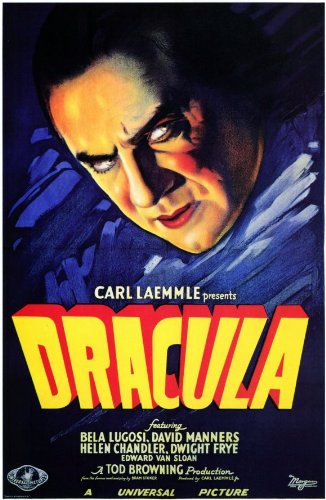
DRACULA (1931) ****
I remember being first disappointed by the 1931 Dracula and that disappointment carried over for more than two decades.

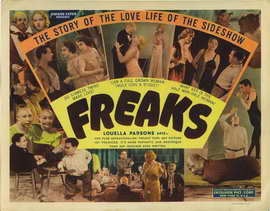
Around the turn of the 21st Century, I bought the 1999 VHS release and that’s what I first watched, the one with Classic Monster Collection across the top and then New Music by Philip Glass and Performed by Kronos Quartet immediately below. Of course, I thought Bela Lugosi as Dracula and Dwight Frye as Renfield were absolutely incredible, David Manners as Jonathan Harker and Edward Van Sloan as Professor Van Helsing and Helen Chandler as Mina Harker less so, and I loved director Tod Browning’s 1932 Freaks at first sight contemporaneous with Dracula. Freaks remains one of my absolute favorite movies, so obviously some movies hit people right from the start and others just simply take more time or sometimes they never make that deep, personal connection others do.

For the longest time, at least a decade if not longer, I thought Dracula was overrated and paled in comparison against Freaks, Frankenstein, The Bride of Frankenstein, and The Wolf Man, all of which I first saw around the same time as Dracula and I loved, absolutely loved, and still do love all of them. At the time, I also loved Abbott and Costello Meet Frankenstein more than Dracula.

It was that darn Philip Glass / Kronos Quartet score that stank up Dracula and I still get a big kick out of the Triumph the Insult Comic Dog couplet, Philip Glass, atonal ass, you’re not immune / Write a song with a fucking tune. I remember my wife complained about Glass’ score for the experimental non-narrative film Koyaanisqatsi and I bristled at his score for Candyman upon revisiting that 1992 film for the first time in several years.

Revisiting the 1931 Dracula in recent years, without the Glass / Kronos score and back closer to how it first appeared in theaters on Feb. 14, 1931, it’s risen in stock from three to three-and-a-half and finally four stars. I cannot deny that it still has a fair share of faults, like those performances I mentioned earlier and the stage-bound production quality since it’s based off the 1924 stage play adapted from Bram Stoker’s 1897 novel, but I’ve grown appreciation for everything that works from the opening scenes in Transylvania to Lugosi (1882-1956) and Frye (1899-1943), who inspired later songs from Bauhaus (Bela Lugosi’s Dead) and Alice Cooper (The Ballad of Dwight Fry).

It also helps one to catch up with the Spanish language Dracula from the same year and the same sets but a different cast, a different language, and a different director. This Spanish version, rediscovered first in 1978 and then later on video in 1992, lasts 30 minutes longer and it’s better in almost every respect than its famous counterpart. Better shot and better looking, vastly superior cleavage and far sexier women (Lupita Tovar over Helen Chandler any day of the millennium), and less wimpy men in the Spanish version, but Lugosi still prevails against Carlos Villarias.

Several lines had already entered the lexicon decades before I first watched Dracula: I never drink … wine. For one who has not lived even a single lifetime, you’re a wise man, Van Helsing. Listen to them. Children of the night. What music they make. Even I am Dracula belongs somewhere in the pantheon near Bond, James Bond. Lugosi’s ability or lack thereof speaking the English language actually benefits the otherworldly nature of his Dracula and I hold his performance in high regard alongside Max Schreck in Nosferatu, Christopher Lee in Dracula, and Gary Oldman in Dracula.

I have a long relationship with vampires.

I remember the 1985 Fright Night being the highlight of a boy slumber party circa 1988 and third or fourth grade.

I must have been 11 or 12 years old and in the fifth or sixth grade when reading the Stoker novel. Right around that point in time, I also read Sir Arthur Conan Doyle’s The Hound of the Baskervilles and Roald Dahl’s Charlie and the Chocolate Factory. I loved all three of them and they each fired up my imagination and creative spirit.

A few years later, I caught up with the Francis Ford Coppola version and talk about a movie that wowed a 14-year-old boy. I remember staying up late and sneaking around (somewhat) to watch this Dracula on my bedroom TV, captivated by all the nudity and sexuality and violence and Winona Ryder and Sadie Frost and it recalled some of what I liked about the novel all while becoming a cinematic extravaganza. I know critics of the 1992 Dracula blasted the film for being all style, no substance and for being overblown, but I think it’s overflowing with creativity and sheer cinematic beauty. I rate it right up there with F.W. Murnau’s Nosferatu as one of the best vampire films ever.

Some things simply transcend Keanu Reeves’ horrible accent and Dracula’s at one point beehive hairdo.

The vampire genre itself transcends such duds as Dracula 2000 and New Moon.

Hunger (1974)

HUNGER (1974) Four stars

Over a span of many decades, there have been several great dinner scenes in the movies.

The Wedding Feast in FREAKS, the cannibal family dinner in TEXAS CHAINSAW MASSACRE, and that famous plate throwing in AMERICAN BEAUTY are three that spring quickly to mind.

Oh, of course, there’s Mr. Creosote from MONTY PYTHON’S THE MEANING OF LIFE and Peter Greenaway’s THE COOK, THE THIEF, HIS WIFE & HER LOVER. (Perhaps, on the next episode, I’ll cover great diner scenes in the movies, everything from DINER to SUPERMAN II and SUDDEN IMPACT.)

In that Mr. Creosote spirit, we now turn our attention toward Peter Foldes’ historic computer animated short from 1974. We use historic not because of the appetite of the main character but historic works here because HUNGER broke ground in using computer animation. Please keep in perspective it was some two decades before TOY STORY and it took Foldes and his National Research Council’s Division of Radio and Engineering’s Data Systems Group well over a year to make this nearly 12-minute film.

This is essentially a silent film, with no dialogue, no narration, not even intertitles. Just instrumental music and images.

That makes HUNGER all the more effective as a cautionary tale about greed and gluttony in contemporary society. It does not get preachy because of the lack of words or tiresome because of the length of a short. The animation holds our interest and it also gives Foldes no limits (except for the limits of his own imagination) in showing this greed and gluttony. Images rapidly dissolve and their perpetually changing nature points out some striking differences.

In HUNGER, our main character evolves from a skinny office worker into a monster.

A couple minutes in, our main character grabs a bite from the delicatessen before dinner and then he goes through a pig, two fish, everything else on the menu, and the dinner table itself before he takes home the waitress who served him. He sits back down to eat and repeats his business from the restaurant in the privacy of his own home. He really likes swine and then he starts developing a multitude of mouths on his body, as well as more hands to fill all those hungry mouths. Of course, he grows bigger and bigger and even bigger, until finally he’s mobbed by a hungry horde of emaciated figures.

This short came out roughly a decade before the Ethiopian famine of 1983 through 1985 that claimed 1.2 million lives and brought images of starving children to living rooms around the world. How many of us now adults remember from our childhood when our parents, confronted by a plate with food left uneaten, usually something not favored by a child, scolded us by reminding us there’s starving children in Africa. Since it’s approximately 13,000 km between Kansas and Ethiopia, sadly I did not let this scolding affect me in the slightest and I wasted all that food. I’m still a stubborn, picky eater.

Both the images of starving children and the main character in HUNGER stick with me, though, and I am not alone in that respect.

HUNGER earned a nomination for the 1974 Academy Award for Best Animated Short Film and it competed against THE FAMILY THAT DWELT APART, VOYAGE TO NEXT, WINNIE THE POOH AND TIGGER TOO, and the winner CLOSED MONDAYS (co-directed by Will Vinton). It won a jury prize at Cannes in 1974, the Norman McLaren Award and the Silver Hugo at the 1974 Chicago International Film Festival, and the Best Animation Film at the 1975 British Academy of Film & Television Awards (BAFTA), according to its National Film Board of Canada bio.


FIVE MORE HIGHLY RECOMMENDED ANIMATED SHORT FILMS

  1. A CHRISTMAS CAROL (1971, Richard Williams)
  2. THE DOT AND THE LINE: A ROMANCE IN LOWER MATHEMATICS (1965, Chuck Jones)
  3. THE FLY (1980, Ferenc Rofusz)
  4. THE OLD MILL (1937, Wilfred Jackson)
  5. THUMB SNATCHERS FROM THE MOON COCOON (2012, Bradley Schaffer)

NOTE: All five shorts, as well as HUNGER, can be found through online sources.

Freaks (1932)

day 13, freaks

FREAKS (1932) Four stars
Tod Browning’s 1932 one-of-a-kind masterpiece had incredible difficulty passing muster with the British Board of Film Classification, failing twice before the third time’s a charm in 1963 when it was slapped with an X rating and the caveat “People should be warned of the nature of the film so that those to whom such sights are displeasing will not see it.”

That’s amazing, since 30 minutes of even more shocking content were excised after a disastrous test screening in January 1932. Apparently, one woman threatened suing MGM for giving her a miscarriage. Removed scenes and sequences possibly lost forever include a longer attack on female villain Cleopatra, her conspirator Hercules being castrated, several comedy sequences, and the original epilogue (replaced by a more traditional happy ending). When the film debuted February 20, 1932, it was 64 minutes in length and that’s what we have always seen.

It’s also amazing, of course, the film was even made in the first place, but MGM desperately wanted a piece of the horror market. Keep in mind that 1932 was a glorious year for horror: THE OLD DARK HOUSE, THE MUMMY, WHITE ZOMBIE, ISLAND OF LOST SOULS, VAMPYR, MURDERS IN THE RUE MORGUE, THE MASK OF FU MANCHU, and THE MOST DANGEROUS GAME.

Browning had the opportunity to direct anything he wanted after the Universal Studios hit DRACULA (1931) and his career would never be the same after FREAKS. Browning did not direct again until 1935’s MARK OF THE VAMPIRE.

What made the film so damn shocking? Perhaps it’s because the so-called straight characters are the freaks and the so-called freaks are everyday people just like you and I. Of course, there would be many people made to feel uncomfortable with the freaks’ matter-of-fact treatment.

Speaking of folks made uncomfortable, there’s always the account of MGM Studios’ reaction to the FREAKS cast from an article called “The Making of Freaks” (originally 1973 by Mark Frank).

“By late October 1931, carloads of freaks were beginning to arrive at M-G-M studio, much to the consternation of the personnel there, most of whom did not expect such a materialization of ‘talent.’ While the newcomers were getting acquainted with their new surroundings, popping in and out of alleyways, the weak-hearted secretaries went scurrying about in the opposite direction. During those first days of the freaks’ immigration, opposition to the production grew to alarming proportions. Louis B. Mayer, executive president, who had somehow allowed this enterprise to slip through his fingers, was now furiously against allowing the project to continue. Many of his executives, spurred on by producer Harry Rapf, were trying to organize a petition calling on (Irving) Thalberg to halt the ugly venture. Their argument concerned the Metro commissary, where they believed it would become unbearable to dine with Prince Randian or Zip the Pin-Head.

“Thalberg, having complete faith in his strange little undertaking, stood fast against the barrage of criticism, and continued his ardent support for the film. Within a few days, word came from the higher-ups that the freaks, with the exceptions of Harry and Daisy Earles and the Hilton Twins, were banned from the commissary. In order to accommodate them a private room, especially fitted for them to dine in, was constructed just off the set. Metro also had the cast quartered in a hotel in Culver City, where they were shipped every night as soon as work was over.”

Just another case of life imitating art or art imitating life, since one of the centerpiece scenes in FREAKS involves a wedding feast for “straight” Cleopatra (Olga Baclanova) and “freak” Hans (Harry Earles). Cleopatra and her real lover Hercules have conspired to kill Hans for his fortune, slipping poison into his wine. Straights are the real freaks, indeed. Hans’ sideshow friends have joined him for this special occasion and they decide they will accept Cleopatra as one of them. They pass “a loving cup” around the table and begin chanting “We accept her, one of us. We accept her, one of us. Gooble-gobble, gooble-gobble” (later inspiration for the chant in the Ramones’ “Pinhead”). Cleopatra is so disgusted by this development that, with the loving cup finally in hand, she goes on a rant, “You dirty, slimy freaks! Freaks, freaks, freaks! You fools! Make me one of you, will you?,” and she tosses the wine literally back in their faces.

FREAKS leaves an indelible mark on viewers and that’s mainly because of its unforgettable characters. That’s definitely why it’s one of my very favorite films and has been since I first watched it on video nearly 20 years ago.

Here’s a few briefs on some of these incredible characters:

• English born conjoined twins Daisy and Violet Hilton (1908-69) play basically themselves in FREAKS. They were born joined at their hips and buttocks and they shared blood circulation but no major organs. Their showbiz career began early, touring Britain at age 3, and they were exploited by their various managers throughout their careers; they formed their own jazz band and had been a hit on the vaudeville circuit. Their great moment in FREAKS involved one twin kissing her lover passionately while the other just stood there vicariously pleasured. The Hilton Sisters (better than Paris and Nicky) ended up working at a grocery store in Charlotte, North Carolina, and they were found dead at their home after neither reported for work on January 4, 1969.

• Johnny Eck (1911-91) was born Johnny Eckhardt in Baltimore, Maryland, 20 minutes after a twin brother. Johnny was born with no lower half, while his twin brother Robert was born a normal and healthy child. Eck not only appeared in sideshows and films, but he found time to be (most notably) an artist, a musician, and a photographer. Eck, hyped as “The Most Remarkable Man Alive,” performed for the Ripley’s Believe It or Not Odditorium at the 1933 World’s Fair in Chicago, to help support his family during the Great Depression. Eck and Browning became close friends.

• Prince Randian (1871-1934) plays “The Living Torso” in FREAKS and he gets another one of the great moments when he lights up a cigarette. This longtime carnival and circus performer earned names like “The Snake Man,” “The Human Torso,” and “The Human Caterpillar.” He fathered four children (three daughters and one son) with his wife, known as Princess Sarah.

• Real-life siblings Harry (1902-85) and Daisy Earles (1907-80) play Hans and Frieda, who are engaged before Cleopatra steals away Hans. Harry and Daisy were part of four siblings, along with Gracie and Tiny, known and billed as either The Doll Family or The Earles Family. They were all featured in the Ringling Brothers and Barnum and Bailey Circus for decades. Harry appeared in films THE UNHOLY THREE (both the 1925 silent and the 1930 sound remake, the first directed by Browning and both featuring Lon Chaney) and THE WIZARD OF OZ (where he’s a member of the Lollipop Guild). Daisy made her final screen appearance with a small part in Cecil B. DeMille’s THE GREATEST SHOW ON EARTH.

• Then there’s the iconographic Schlitzie (1901-71), a microcephalic who inspired Bill Griffith’s “Zippy the Pinhead” comic and the Ramones’ “Pinhead” (inspired by the film in general but especially Schlitzie and the wedding feast). Microcephalics were normally promoted as “pinheads” or “missing links.” From “The Making of Freaks”: “One of those selected (to be in FREAKS) was Schlitzie, the Pin-Head, who was a most unusual character. In a conquest of personality, it was claimed that she was a woman, since she dressed like one, but it was also rumored that she was a man. Furthermore, it was said that Schlitzie was neither one nor the other. This conflict of identity did not seem to affect her zeal to work in pictures, especially FREAKS, for on any day that she was not scheduled for filming she would make such a fuss at the hotel that they would have to bring her over to the set and let her sit there. She could very well afford this sort of behavior because, being very well managed, she had amassed a sizeable wealth in diamond rings and apartment houses.” Billed as female, Schlitzie was in fact male.