The Universal Frankenstein Movies

THE UNIVERSAL FRANKENSTEIN MOVIES
Of all the horror movie series, there’s not one I like more than Universal Studios’ Frankenstein cycle which started with the immortal 1931 classic Frankenstein and continued through The Bride of Frankenstein, Son of Frankenstein, The Ghost of Frankenstein, Frankenstein Meets the Wolf Man, House of Frankenstein, House of Dracula, and finally concluded with Abbott and Costello Meet Frankenstein in 1948.

Seven of the eight films are stone cold classics and I rate Frankenstein, The Bride of Frankenstein, Son of Frankenstein, and Abbott and Costello Meet Frankenstein at four stars and The Ghost of Frankenstein, Frankenstein Meets the Wolf Man, and House of Frankenstein three-and-a-half, with House of Dracula ranked two-and-a-half and it’s the only one that I would even slightly hesitate to recommend to people.

I watched Frankenstein, The Bride of Frankenstein, and Abbott and Costello Meet Frankenstein around roughly the same time in the late ’90s and early ’00s. I caught up with the others much later on during a marathon of Universal horror films. I liked The Ghost of Frankenstein, Frankenstein Meets the Wolf Man, and House of Frankenstein upon first viewing, as well Abbott and Costello Meet Frankenstein a lot, but they’ve all grown on me to where I bumped up their rating one-half star.

I have a feeling that watching the eight films in close proximity to one another will become a tradition, like it has for who knows how many people over the last 90 years.

Here’s a look at the film series that seemingly started it all in the horror genre.

Frankenstein (1931; James Whale): The one that started it all, Edward Van Sloan, who plays Dr. Van Helsing in Dracula and Doctor Waldman in Frankenstein, begins the picture, How do you do? Mr. Carl Laemmle feels it would be a little unkind to present this picture without just a word of friendly warning. We’re about to unfold the story of Frankenstein, a man of science who sought to create a man after his own image without reckoning upon God. It is one of the strangest tales ever told. It deals with the two great mysteries of creation: life and death. I think it will thrill you. It may shock you. It might even horrify you. So if any of you feel that you do not care to subject your nerves to such a strain, now is your chance to, uh … well, we’ve warned you!

Colin Clive and Dwight Frye are great in their roles as mad scientist Henry Frankenstein and hunchbacked assistant Fritz, Van Sloan is much better in Frankenstein than in Dracula, and Boris Karloff is not even credited as Karloff yet for playing The Monster. The opening credits have it The Monster — ?

The work done by makeup artist Jack Pierce and set designer Herman Rosse is just as definitive and influential as the characters and performances by Clive, Frye, and Karloff.

We’ve all seen Frankenstein time and time again in the thousands if not hundreds of thousands of films that have been influenced by James Whale’s first horror masterpiece.

The Bride of Frankenstein (1935; James Whale): One of the greatest horror films and greatest sequels ever made, I rate The Bride of Frankenstein as the best Frankenstein and it’s not even all that close, despite the fact that it shares the same star rating as Frankenstein, Son of Frankenstein, and Abbott and Costello Meet Frankenstein.

The Bride of Frankenstein has a more wicked sense of humor than any of the other films in the series, and that’s including Abbott and Costello Meet Frankenstein, and it’s undeniably the most fun to watch. It’s just as iconic and influential as the original Frankenstein, from the more sympathetic, speaking Monster to the makeup and the sets.

Mad scientists do not come madder than Ernest Thesiger’s Doctor Pretorius, and he’s a devious hoot throughout The Bride of Frankenstein. He’s so mad that he makes Colin Clive’s Doctor Frankenstein seem almost sane. You think I’m mad. Perhaps I am. But listen, Henry Frankenstein. While you were digging in your graves, piecing together dead tissues, I, my dear pupil, went for my material to the source of life. I grew my creatures, like cultures, grew them as nature does, from seed.

I wish they would have done more with the title character, that’s just about my only gripe against The Bride of Frankenstein.

Son of Frankenstein (1939; Rowland V. Lee): Easily the longest of the series, the third Frankenstein entry benefits tremendously from the presence of four absolute legends of the genre in Lionel Atwill, Boris Karloff, Bela Lugosi, and Basil Rathbone. Atwill and Lugosi are especially fantastic.

I would make the argument that Lugosi never had a better role than Ygor and never gave better performances than he did in Son of Frankenstein and The Ghost of Frankenstein. He’s the driving engine in both films and helps make them so entertaining. They hanged me once Frankenstein. They broke my neck. They said I was dead. Then they cut me down. They threw me in here, long ago. They wouldn’t bury me in holy place like churchyard. Because I stole bodies, eh they said. So, Ygor is dead! So, Dr. Frankenstein. Nobody can mend Ygor’s neck. It’s alright.

Atwill became the most versatile and most important supporting player in the Frankenstein series, playing Inspector Krogh in Son of Frankenstein, Doctor Theodore Bohmer in The Ghost of Frankenstein, the Mayor in Frankenstein Meets the Wolf Man, Inspector Arnz in House of Frankenstein, and Police Inspector Holtz in House of Dracula.

He’s at his best as Inspector Krogh, and this character will ring a bell to Young Frankenstein fans, as will Ygor. Most vivid recollection of my life. I was but a child at the time, about the age of your own son Herr Baron. The Monster had escaped and was … ravaging the countryside, killing, maiming, terrorizing. One night he burst into our house. My father took a gun and fired at him but the savage brute sent him crashing to a corner. Then he grabbed me by the arm!

Karloff gives his final performance as Frankenstein’s Monster and he’s given less to do than Frankenstein and especially The Bride of Frankenstein. He returns to not speaking in Son of Frankenstein after the strides the Monster made in Bride, but Karloff had the innate ability to communicate much without dialogue.

The Ghost of Frankenstein (1942; Erle C. Kenton): This is the first downturn in quality in the series after the triple triumph of Frankenstein, The Bride of Frankenstein, and Son of Frankenstein, but The Ghost of Frankenstein still proves to be loads of fun with the return of Ygor, the brain transplant and mad scientist plot, and plenty of action during one of the shortest running times in the entire series.

Ygor could take a hanging before Son of Frankenstein and take a shooting in Son and keep on ticking in The Ghost of Frankenstein. He’s still got his one true friend in Ghost, Frankenstein’s Monster, though it’s no longer Boris Karloff but Lon Chaney Jr in his first and only appearance. Chaney became a big horror movie star after The Wolf Man and Universal cast him as Frankenstein’s Monster, Dracula, and Kharis. Not sure how they missed him for The Invisible Man and The Phantom of the Opera.

Anyway, Lugosi dominates The Ghost of Frankenstein, despite the fact that Ygor’s not as menacing as he was in Son of Frankenstein. You cannot take my friend away from me. He’s all that I have. Nothing else. You’re going to make him your friend and I’ll be alone. Ygor plots to have his brain transplanted inside Frankenstein’s Monster, so he can rule the world, and finds a willing conspirator in Atwill’s Doctor Theodore Bohmer. As Doctor Ludwig Frankenstein says, You’re a cunning fellow, Ygor. Do you think I would put your sly and sinister brain into the body of a giant? That would be a monster indeed. You will do as I tell you or I will not be responsible for the consequences.

The Ghost of Frankenstein has one of the better casts in the series with Cedric Hardwicke as Ludwig Frankenstein and The Wolf Man cast members Ralph Bellamy and Evelyn Ankers join Chaney and Lugosi. The original Frankenstein (Colin Clive) makes an archive footage cameo appearance; Clive passed away in 1937 at the age of 37.

Frankenstein Meets the Wolf Man (1943; Roy William Neill): The fifth installment of the series begins with arguably the best seven minutes of the entire franchise and the film takes a steady dip in quality for the next hour until we get to the last few minutes.

Lawrence Talbot and The Wolf Man make their first appearance in the series, and his tortured soul number makes sweet music especially as played by Chaney Jr. I only want to die. That’s why I’m here. If I ever find peace I’ll find it here. Lugosi plays Frankenstein’s Monster, but one might remember from the end of The Ghost of Frankenstein that our Monster speaks like Ygor because of the brain transplant operation late in the picture. He’s still blind, as well, respecting continuity for a change in any of these sequels, but it’s all rendered moot because Universal muted Lugosi’s speaking voice as the Monster. He’s not the worst Monster, and they all became interchangeable after Karloff left the role anyway.

Before King Kong vs. Godzilla and long before Freddy vs. Jason, there was Frankenstein Meets the Wolf Man.

Isn’t it an interesting coincidence that Frankenstein Meets the Wolf Man came out in 1943, the American version of King Kong vs. Godzilla in 1963, and Freddy vs. Jason in 2003?

House of Frankenstein (1944; Erle C. Kenton): The sixth installment piles on the monster characters and the acting talent.

Boris Karloff returns to the series for the final time as the mad doctor Gustav Niemann and not Frankenstein’s Monster, Chaney returns as Lawrence Talbot and The Wolf Man, John Carradine and Glenn Strange make their debuts as Dracula and Frankenstein’s Monster, and J. Carrol Naish almost steals the show as the hunchbacked henchman Daniel.

There’s also Lionel Atwill, George Zucco, and Sig Ruman, so there’s no shortage of talent in the cast even in the smallest roles.

Where’s Lugosi? No, seriously, where’s Lugosi?

Carradine and Strange are major downgrades as Dracula and Frankenstein’s Monster, it’s great to have Karloff back in a speaking and a mad doctor role though I’d still prefer him as Frankenstein’s Monster, Chaney plays his tortured soul number again, and Naish joins Dwight Frye and Lugosi in the lexicon of scene-stealing servant characters.

This is as good a place as any to mention Frye, who passed away in 1943 and who appeared in Frankenstein as Fritz, The Bride of Frankenstein as Karl, Son of Frankenstein as a villager, The Ghost of Frankenstein as a village, and Frankenstein Meets the Wolf Man as Rudi, a nice little supporting role for Frye.

House of Frankenstein is a step down from The Ghost of Frankenstein and Frankenstein Meets the Wolf Man and closer to a three-star rating.

House of Dracula (1945; Erle C. Kenton): This is the only film in the series that I’ve not been able to warm into a positive review after repeat viewings. Apparently, I’ve made three attempts over the last couple years.

Unfortunately, by this point in the series, House of Dracula feels like we’ve been here before … and in better films.

The title, the poster, and the cast of characters echo House of Frankenstein.

The Wolf Man, Dracula, and Frankenstein’s Monster all return and we have a new mad doctor and a new hunchback after Karloff and Naish in House of Frankenstein.

I must state again that I don’t particularly care for Carradine and Strange in the roles of Dracula and Frankenstein’s Monster. They are many grades below Lugosi and Karloff. Especially Carradine, who I unfortunately watched playing Dracula first in Billy the Kid vs. Dracula from 1966. I had no idea back then Carradine had played Dracula before he revisited the role for director William Beaudine in a toothless cross between a western and a horror film. Anyway, Carradine does this thing with his eyes that’s supposed to be hypnotic, but it always comes across like somebody’s just squirted him in the eyes. They wisely gave Strange absolutely little to do in House of Frankenstein, House of Dracula, and Abbott and Costello Meet Frankenstein.

Chaney is still pretty good in House of Dracula, and he’s the main positive reason for the film’s mixed review.

Abbott and Costello Meet Frankenstein (1948; Charles Barton): The comedic duo of Bud Abbott and Lou Costello and the monsters like Frankenstein’s Monster, Dracula, and The Wolf Man were the main cash cows for Universal throughout the 1940s.

Universal squeezed from the teets for a big hit in Abbott and Costello Meet Frankenstein — we have Bud and Lou as Chick and Wilbur, Lugosi for the second and final time as Dracula, Chaney once more as tortured soul Lawrence Talbot and The Wolf Man, and Strange as Frankenstein’s Monster. The monsters do make for great straight men and Costello’s fright never proved more convincing or delightful or funny than it is throughout Abbott and Costello Meet Frankenstein.

Lenore Aubert and Jane Randolph are both quite fetching as women with ulterior motives for their interest in Wilbur.

I reviewed Abbott and Costello Meet Frankenstein at length earlier in the month, and I stand 100 percent behind that four-star review.

The Universal Frankenstein Movies, Ranked
1. The Bride of Frankenstein (1935) ****
2. Frankenstein (1931) ****
3. Son of Frankenstein (1939) ****
4. Abbott and Costello Meet Frankenstein (1948) ****
5. Frankenstein Meets the Wolf Man (1943) ***1/2
6. The Ghost of Frankenstein (1942) ***1/2
7. House of Frankenstein (1944) ***1/2
8. House of Dracula (1945) **1/2

The Fog (1980)

THE FOG (1980) **1/2
Fog has been a critical element in many horror movies and the 1939 Hound of the Baskervilles, The Wolf Man, Frankenstein Meets the Wolf Man, and The Return of the Vampire immediately leap to mind as films made definitely better from their use of fog effects to create a foreboding atmosphere.

Edgar Allan Poe died at the age of 40 in 1849 but his writing and his influence live on forever. Is all that we see or seem / But a dream within a dream?

Ghost stories around the campfire have been around longer than The Legend of Sleepy Hollow, and I believe that’s how Washington Irving first heard about Ichabod Crane, Brom Bones, and the Headless Horseman.

John Carpenter directed, co-wrote, and scored the original Halloween in 1978, one of the great transcendent low-budget shockers with a boogeyman killer.

Carpenter’s The Fog, his first horror film after Halloween, combines the title character, a Poe quote before the opening credits, a ghost story around the campfire told by distinguished actor John Houseman, and some grisly murder set pieces that far surpass the relatively tame and nearly entirely bloodless Halloween, but I remain steadily down the middle of the road in my reaction to it.

I want to like it a lot more than I do, believe me, and maybe I will get there next time.

I liked it more during the most recent viewing of the film and I definitely understand why it’s developed a cult following and a much better reputation in recent years.

It does create quite the foreboding atmosphere at times, it bears all the trademarks of a Carpenter film with his penchant for great composition both in the sense of framing and the music present throughout, and I do like the story of this small California town celebrating their centenary with a dark secret about the founding discovered, discussed, and confronted during the film as the dead men return 100 years to the day for their revenge.

Still, all the same, it’s underwhelming.

I believe it’s mainly because I don’t particularly connect to any of the characters and thus, I don’t really care about their fates particularly all that much.

I come the closest to connecting with radio station owner and host Stevie (played by Carpenter’s former wife Adrienne Barbeau) and Father Patrick Malone (Hal Holbrook), but they’re not on the same level as Dr. Loomis and Laurie Strode in Halloween, Kurt Russell’s characters in Escape from New York and The Thing, Keith Gordon’s Arnie Cunningham in Christine, Karen Allen’s and Jeff Bridges’ characters in Starman, and Roddy Piper’s George Nada in They Live, some of Carpenter’s best characters and best films.

While it is comforting to see Carpenter regulars like Barbeau, Jamie Lee Curtis, Tom Atkins, Charles Cyphers, Nancy Kyes, and good old ‘Buck’ Flower, they’ll still all be remembered first for other characters in other Carpenter films.

We simply don’t get enough of any of the main characters.

The Fog lacks a certain something, energy perhaps first and foremost, to really take it over the top and into the stratosphere like Halloween.

All that said, The Fog still has some very good even almost great moments.

I especially like the scene when Father Malone reads four entries from his grandfather’s journal and then delivers the best line of the film, The celebration tonight is a travesty. We’re honoring murderers.

Speaking of a travesty, I watched the 2005 remake in a theater and I have to believe that it’s one of the 10 worst movies I’ve ever watched in a multiplex near you.

Frankenstein Meets the Wolf Man (1943)

FRANKENSTEIN MEETS THE WOLF MAN (1943) ***1/2
Frankenstein Meets the Wolf Man starts with an absolute big bang and we have possibly the greatest five minutes in any classic Universal monster movie.

That includes such immortal movies as Frankenstein, The Bride of Frankenstein, Son of Frankenstein, Dracula, The Mummy, The Invisible Man, and The Creature from the Black Lagoon, all stone cold classics essential to every horror movie lover.

The opening gets everything absolutely right: two grave robbers, a cemetery in the middle of the night, Larry The Wolf Man Talbot’s crypt, a full moon, a whole bunch of wolfbane, the revived Wolf Man’s hand, and enough overall spooky atmosphere for approximately 50 scary movie scenes. Yeah, it’s such a phenomenal sequence that director Tom McLoughlin revived it for his opening in Jason Lives, the one film during that long-running series most influenced by classic monster movies.

The rest of Frankenstein Meets the Wolf Man does not quite measure up, especially once Frankenstein’s Monster enters the picture, but it’s still a great deal of fun.

Of course, it doesn’t hurt any that Lon Chaney Jr. (1906-73) returns as Larry Talbot, one of the greatest horror movie characters. Chaney Jr. played Talbot five times from 1941 through 1948 — the original Wolf Man, Frankenstein Meets the Wolf Man, House of Frankenstein, House of Dracula, and Abbott and Costello Meet Frankenstein.

Talbot’s a tortured soul — in fact, mondoshop.com hypes its Wolf Man poster, The most tortured soul in the Universal Monsters universe is unquestionably that suffering bastard Larry Talbot, a.k.a. The Wolf Man — and we feel great empathy for this character because he essentially doesn’t want any damn part of being the Wolf Man. Your own son Bela was a werewolf. He attacked me. He changed me into a werewolf. He’s the one that put this curse on me. You watched over him until he was permitted to die. Well, now I want to die to. Won’t you show me the way?

In that way, he’s different from Dracula, Frankenstein’s Monster, the Mummy, and the Invisible Man. Lon Chaney’s Phantom in the 1925 classic The Phantom of the Opera inspires similar feelings as Talbot and the Wolf Man. To his enduring credit, Boris Karloff (1887-1969) worked some pathos into Frankenstein’s Monster, especially in Frankenstein and The Bride of Frankenstein. Still, Talbot stands apart from most cinematic monsters and maybe it’s because he’s the most explicitly human.

Bela Lugosi (1882-1956) passed on Frankenstein’s Monster in Frankenstein, much to his eternal regret, and so he signed on for the Monster in Frankenstein Meets the Wolf Man after playing Ygor in Son of Frankenstein and The Ghost of Frankenstein. During the latter film, one might remember that Dr. Ludwig Frankenstein accidentally put Ygor’s brain into the Monster’s head — he speaks poetically at one point in the film, I am Ygor. In a series that paid minuscule attention to continuity from one film to the next, the Monster originally spoke and explained his plight in Frankenstein Meets the Wolf Man, but Universal studio heads apparently laughed their heads off at Lugosi’s dialogue and demanded it be excised from the final cut, rendering the monster absolutely ridiculous and his scenes basically a washout. I am not sure why Lugosi’s voice suddenly became laughable. Lugosi’s stunt double stands in for the 61-year-old man in many scenes. Ironically, though, whenever people imitate Frankenstein’s Monster, it’s the Lugosi version from Frankenstein Meets the Wolf Man. (Lugosi played Bela in The Wolf Man and Chaney Jr. was Frankenstein’s Monster in The Ghost of Frankenstein after Karloff bowed out.)

We’re not sure exactly why the Monster’s encased in ice or why there’s a production number that must have moseyed on over from MGM. The second half of Frankenstein Meets the Wolf Man often leaves us feeling awful perplexed.

Frankenstein Meets the Wolf Man finishes strong, thankfully, and we do see our titular monsters slug it out, though it presents an internal struggle because while we’d love more battle royale between the monsters we do love the 90 seconds they give us. This movie paved the highway for King Kong vs. Godzilla and Freddy vs. Jason.

In most every way possible, Frankenstein Meets the Wolf Man proves to be a red hot mess, but a lovable and thoroughly entertaining one nonetheless.

The Vampire Bat (1933)

THE VAMPIRE BAT (1933) ***
The Vampire Bat would otherwise be a forgotten horror entry were it not for the presence of four members of the Horror Movie Hall of Fame, three of them surefire first ballot inductees.

Fay Wray (1907-2004) earned her claim to be the First Lady of Horror and the first scream queen through her work alone in the 1933 classic King Kong. Ann Darrow gave Wray instantaneous immortality, but she also starred in Doctor X, The Most Dangerous Game, The Vampire Bat, and Mystery of the Wax Museum in a year period leading up to King Kong. She was no one-hit wonder.

Lionel Atwill (1885-1946) appeared in a variety of horror movie roles over a 15-year period, in such entries as Doctor X, The Vampire Bat, Mystery of the Wax Museum, Mark of the Vampire, Son of Frankenstein, The Ghost of Frankenstein, Frankenstein Meets the Wolf Man, House of Frankenstein, and House of Dracula. He generally played a mad doctor or an authority figure, be it Inspector Krogh (Son of Frankenstein) or the Mayor (Frankenstein Meets the Wolf Man). Atwill essayed an inspector in several Universal horror flicks.

Salina, Kansas born Dwight Frye (1899-1943) received a tribute nearly 30 years after his death when Alice Cooper released “Ballad of Dwight Fry” on the 1971 album Love It to Death, one of those classic Cooper morbid ballads / epics. Babe Ruth once said that he was paid more than Herbert Hoover because he had a better year than the President and Frye should have been able to say the same in 1931, between his roles in Dracula and Frankenstein, but it’s doubtful Universal paid a supporting actor in any movie more than the greatest home run hitter. Renfield’s presence certainly would have made the Kamala Harris-Mike Pence vice-presidential debate more interesting.

Melvyn Douglas (1901-81) enjoyed a 50-year acting career and he won Academy Awards for his supporting performances in Hud and Being There, but he earned his spot in the hallowed halls of horror history by appearing in the 1932 classic The Old Dark House.

In other words, Wray, Atwill, Frye, and Douglas elevate The Vampire Bat.

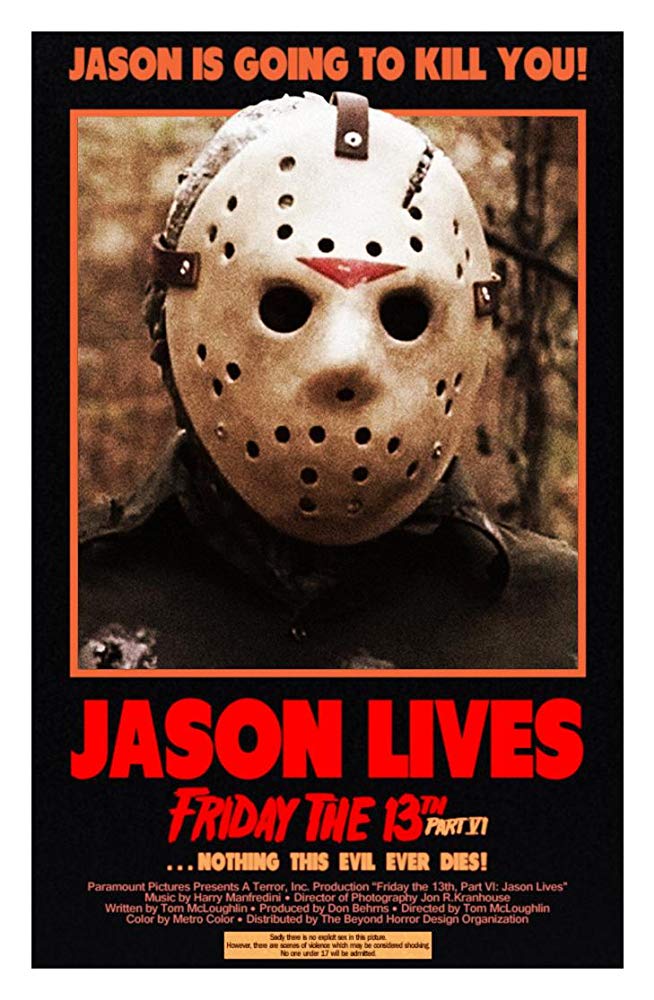
Friday the 13th Part VI: Jason Lives (1986)

JASON LIVES

FRIDAY THE 13TH PART VI: JASON LIVES (1986) Three stars

I find the FRIDAY THE 13TH movies that I like the most are the ones with the best sense of humor.

That’s why I’ll call PART VI: JASON LIVES the best film in the entire series, beating out PART III and THE FINAL CHAPTER. JASON LIVES includes several intentionally funny scenes and that helps its 86 minutes go down smoothly.

Director and writer Tom McLoughlin wanted to satirize a slasher movie all while making one, turn Jason into a supernatural zombie, and not simply churn out a carbon copy of the five previous movies in the series. There are moments intended to recall classic horror movies, like the beginning scene in the cemetery echoes the grave robbers at the beginning of FRANKENSTEIN MEETS THE WOLF MAN. Jason’s revival from the dead courtesy lightning also recalls Frankenstein’s Monster.

“I set up a lot of visual gags,” McLoughlin said in the book “A Strange Idea of Entertainment — Conversations with Tom McLoughlin.” “Like when my wife Nancy is killed by Jason. She tries to bribe him, offering him her wallet to keep him from killing her. She’s got money and a credit card in her wallet, and when Jason kills her in this giant mud puddle, the money sinks and the American Express card floats. I held on that shot for a few extra beats because I knew there would always be some joker in the theater that would yell, ‘Don’t leave home without it!’ And someone always did.”

McLoughlin’s background proved to have a strange influence on Jason Voorhees.

“I was recently interviewed about it, and someone said, ‘Your Jason seemed to be much more communicative,’” McLoughlin said. “I said, ‘That’s because I was dealing with a mime character.’ When he sees the motor home bouncing up and down because a couple are having sex in there, Jason just stands there and stares, with his head tilting back and forth — like a dog trying to figure out what’s going on. It got a big laugh. I wasn’t making fun of Jason … I just figured he would be processing what was going on in that motor home. Whenever I find a way to put my mime training to use in storytelling, I do it.”

Marcel Marceau influenced Jason Voorhees. Makes perfect sense to me.

McLoughlin sang in a rock band before he went to Paris to study mime under Marceau. Back in the States, several years later, McLoughlin had a part as the mutant bear monster in the 1979 horror film PROPHECY directed by John (MANCHURIAN CANDIDATE) Frankenheimer. All these experiences seemingly fed McLoughlin more insight into Jason than any other director.

Alice Cooper provided three songs for JASON LIVES:  “Teenage Frankenstein,” “Hard Rock Summer,” and “He’s Back (The Man Behind the Mask).” Unfortunately, they are not classic Alice Cooper songs, a la the four-album period from “I Love It to Death” through “Billion Dollar Babies” when the band cranked out some of the greatest hard rock ever made, but I still enjoy “He’s Back.” SCREAM later made great use of the Alice classic “School’s Out.”

Speaking of SCREAM, apparently screenwriter Kevin Williamson wanted McLoughlin to direct his hot commodity screenplay, before the project ended up with Wes Craven. Williamson told McLoughlin that JASON LIVES and its humor made a huge impact on Williamson during his youth, so much so that it served as one of the inspirational springboards for SCREAM.

There’s a James Bond gun barrel sequence parody, dialogue that breaks the proverbial fourth wall, a camper reading Jean-Paul Sartre’s existentialist play “No Exit,” a camper praying to God for the first (and only) time in the series, and even Jason surprised at his own astonishing strength. Also, for the first and only time in the series, young campers are in attendance at Camp Forest Green, er, Camp Crystal Lake.

“I’ve seen enough horror movies to know any weirdo wearing a mask is never friendly” and “Some folks sure got a strange idea of entertainment” are lines that display how JASON LIVES influenced SCREAM.

The young children, who Jason does not harm, have their moments, as well, especially when one boy asks his little friend, “So, what were you gonna be when you grew up?”

All these words so far and I have not even mentioned protagonist Tommy Jarvis, who figured in THE FINAL CHAPTER, A NEW BEGINNING, and JASON LIVES. He’s responsible for reviving Jason in the opening sequence and Tommy even makes sure to bring that infamous hockey mask with him. Originally, it had been planned for Tommy to become the antagonist, but it was the extremely negative reaction to A NEW BEGINNING and its non-Jason killer which truly brought Jason back from the dead. Tommy never panned out like he should have and part of the problem is that he’s played by three different actors, Corey Feldman (THE FINAL CHAPTER), John Shepherd (A NEW BEGINNING), and Thom Mathews (JASON LIVES).

Anyway, definitely by this point in the series, Jason became the focus of attention and the antihero extraordinaire of the late ‘80s. Dan Bradley played Jason in the paintball massacre sequence, but former soldier C.J. Graham handled the rest of the duties. He’s a lot more interesting than Tommy Jarvis. That’s why the series moved forward with Jason (Kane Hodder the man behind the mask for four more sequels) and without Tommy Jarvis.