The Texas Chainsaw Massacre 2

THE TEXAS CHAINSAW MASSACRE 2 (1986) ***
I wanted to like The Texas Chainsaw Massacre 2 considerably more than I did, because of the way director Tobe Hooper (1943-2017) and screenwriter Kit Carson (1941-2014) mixed in satire and dark comedy with all the material that seems like a prerequisite for a sequel to only one of the most infamous movies ever made, 1974’s The Texas Chain Saw Massacre.

Unfortunately, though, leading lady Caroline Williams’ harried disc jockey Stretch — yes, even women from Texas have names that play right alongside Slim and Tex — spends a good 75 percent of her screen time screaming. Williams screams more than Fay Wray in The Most Dangerous Game and King Kong and Mystery of the Wax Museum combined, more than Jamie Lee Curtis in Halloween and The Fog and Prom Night and Terror Train and Halloween II combined, and more than all the heroines combined who have faced Jason and Freddy and Michael over the last couple decades. Williams probably wishes they paid her by the scream.

All that infernal screaming begins to bog Massacre 2 down in the middle stretches of a film that both starts and finishes rather strongly.

Massacre 2 also features a Dennis Hopper performance that rates a distant fourth behind River’s Edge, Blue Velvet, and Hoosiers in the unofficial Hopper-portrays-an-epic-burnout-not-totally-unlike-himself (though, to be fair to Hopper, his Blue Velvet character goes beyond, way beyond, the pale of the normal cinematic psychopath) in 1986 competition.

Since Hopper (1936-2010) portrays former Texas Ranger and Sally and Franklin Hardesty-Enright’s uncle Lt. Boude ‘Lefty’ Enright and Cannon Films released Massacre 2, wouldn’t it have been absolutely fantastic if Cannon action hero Chuck Norris played the ranger pursuing vigilante justice against the ripped, twisted, absolutely positively deranged (not to mention cannibalistic) Sawyer family.

Both Chainsaw movies start with narration and an opening crawl.

The original: The film which you are about to see is an account of the tragedy which befell a group of five youths, in particular Sally Hardesty and her invalid brother, Franklin. It is all the more tragic in that they were young. But, had they lived very, very long lives, they could not have expected nor would they have wished to see as much of the mad and macabre as they were to see that day. For them an idyllic summer afternoon drive became a nightmare. The events of that day were to lead to the discovery of one of the most bizarre crimes in the annals of American history, The Texas Chain Saw Massacre.

The sequel: On the afternoon of August 18, 1973, five young people in a Volkswagen van ran out of gas on a farm road in South Texas. Four of them were never seen again. The next morning the one survivor, Sally Hardesty-Enright, was picked up on a roadside, blood-caked and screaming murder. Sally said she had broken out of a window in Hell. The girl babbled a mad tale: a cannibal family in an isolated farmhouse … chainsawed fingers and bones … her brother, her friends hacked up for barbecue … chairs made of human skeletons … Then she sank into catatonia. Texas lawmen mounted a month-long manhunt, but could not locate the macabre farmhouse. They could find no killers and no victims. No facts; no crime. Officially, on the records, The Texas Chainsaw Massacre never happened. But during the last 13 years, over and over again reports of bizarre, grisly chainsaw mass-murders have persisted all across the state of Texas. The Texas Chainsaw Massacre has not stopped. It haunts Texas. It seems to have no end.

Made on an estimated $80-140,000 production budget, the original deserves such descriptive phrases as grainy and gritty. Gory, no. Disturbing, yes definitely, terrifying, for sure, with a more than macabre sense of humor, especially during the best dinner table scene this side of Tod Browning’s Freaks. I about lose it every time the family wants the 124-year-old Grandpa Sawyer to end Sally’s life with one crushing blow of a hammer and this cannibalistic codger just can’t find the strength to do it, ultimately giving Sally the opportunity for escape.

More than a decade later, Hooper wanted Massacre 2 to be a dark comedy, accentuating those elements from the original. Meanwhile, naturally, Cannon desired a finished product more along the lines of The Texas Chainsaw Massacre or at least its shocking reputation.

The finished product plays more like a compromise.

Both films are reflective of the times they were made. The original, released on the first day of October 1974, came out in the midst of Richard Nixon’s resignation speech, the Watergate scandal that brought Nixon down, the final year of the Vietnam War, the Oil Embargo 1973-74, and general discord in the land. The sequel, released on Aug. 22, 1986, gives us cannibals with ‘family values’ a few months before former Hollywood actor turned politician Ronald Reagan’s speech centered around the family unit and giddy excess in every single frame to produce a bigger but not better Texas Chainsaw Massacre.

The original has this insidious way of getting underneath our skin and dominating our thought patterns, and none of the slicker sequels, remakes or imitations even come remotely close to its power to provoke.

NOTE: The parody of The Breakfast Club earns the film’s poster four stars.

The Vampire Bat (1933)

THE VAMPIRE BAT (1933) ***
The Vampire Bat would otherwise be a forgotten horror entry were it not for the presence of four members of the Horror Movie Hall of Fame, three of them surefire first ballot inductees.

Fay Wray (1907-2004) earned her claim to be the First Lady of Horror and the first scream queen through her work alone in the 1933 classic King Kong. Ann Darrow gave Wray instantaneous immortality, but she also starred in Doctor X, The Most Dangerous Game, The Vampire Bat, and Mystery of the Wax Museum in a year period leading up to King Kong. She was no one-hit wonder.

Lionel Atwill (1885-1946) appeared in a variety of horror movie roles over a 15-year period, in such entries as Doctor X, The Vampire Bat, Mystery of the Wax Museum, Mark of the Vampire, Son of Frankenstein, The Ghost of Frankenstein, Frankenstein Meets the Wolf Man, House of Frankenstein, and House of Dracula. He generally played a mad doctor or an authority figure, be it Inspector Krogh (Son of Frankenstein) or the Mayor (Frankenstein Meets the Wolf Man). Atwill essayed an inspector in several Universal horror flicks.

Salina, Kansas born Dwight Frye (1899-1943) received a tribute nearly 30 years after his death when Alice Cooper released “Ballad of Dwight Fry” on the 1971 album Love It to Death, one of those classic Cooper morbid ballads / epics. Babe Ruth once said that he was paid more than Herbert Hoover because he had a better year than the President and Frye should have been able to say the same in 1931, between his roles in Dracula and Frankenstein, but it’s doubtful Universal paid a supporting actor in any movie more than the greatest home run hitter. Renfield’s presence certainly would have made the Kamala Harris-Mike Pence vice-presidential debate more interesting.

Melvyn Douglas (1901-81) enjoyed a 50-year acting career and he won Academy Awards for his supporting performances in Hud and Being There, but he earned his spot in the hallowed halls of horror history by appearing in the 1932 classic The Old Dark House.

In other words, Wray, Atwill, Frye, and Douglas elevate The Vampire Bat.

Son of Kong (1933)

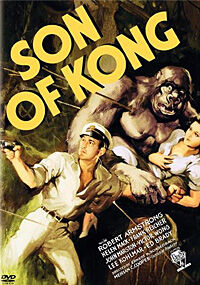
SON OF KONG

Son of Kong (1933) Two stars

Released on Mar. 7, 1933, in New York City and a month later nationally, King Kong quickly took the nation by storm and became a cinematic landmark.

Nine months later, incredibly, RKO released the sequel Son of Kong and Hollywood did not make another Kong picture for more than 40 years.

Son of Kong just might be Hollywood’s first rush job and one of its first sequels*. It is a pleasant enough movie to watch, but obviously it’s not a patch on an all-time classic. I’ve watched the original numerous times, but I doubt I’ll want to return to Son of Kong a second time.

That’s because it’s virtually dull as dishwater. It takes approximately 45 minutes to get to our title character. That’s way too long for a movie that lasts only 69 minutes. Despite the return of Carl Denham, the most interesting human character in King Kong, played by the reliably entertaining Robert Armstrong, Son of Kong does not maintain the interest level high enough for a Kong movie. Of course, the original set the bar incredibly high.

They give Denham a potential romantic interest, because lovebirds Ann Darrow (Fay Wray) and John Driscoll (Bruce Cabot) quite naturally did not return for the sequel after their harrowing experiences, and Helen Mack’s Helene Peterson epitomizes the movie as a whole, since she’s pleasant but dull. She’s a singer, not an actress like the lovely Miss Darrow, and gets a production number. Again, pleasant but dull.

Kong co-directors Ernest B. Schoedsack and Merian C.Cooper returned as director and producer. Special effects guru Willis O’Brien and composer Max Steiner also returned, as did some of the supporting cast.

They were on a tight budget, an even tighter schedule, and they obviously knew there was no way they could topple King Kong. Armstrong himself preferred Son of Kong, but that’s because Denham received greater character arc. He’s probably the only person to ever prefer Son over its father. Both the son and the sequel are kinder, gentler — not good for a creature feature.

Sequels very rarely even approach their predecessors, and that was true in 1933 every bit as it is this very day.

For every Bride of Frankenstein and The Empire Strikes Back, we have a million failures and footnotes, like Son of Kong.

*United Artists released Don Q, Son of Zorro in 1925, a sequel to the 1920 classic Mark of Zorro. Swashbuckler supreme Douglas Fairbanks starred in both films. Son of Zorro also predates Son of Kong, Son of Frankenstein, Son of Godzilla, and Son of the Mask. To be fair, though, the sound of a toilet flushing predates Son of the Mask.

The Mighty Peking Man (1977)

THE MIGHTY PEKING MAN

THE MIGHTY PEKING MAN (1977) ***

The Shaw Brothers (Runme 1901-85 and Run Run 1907-2014) have rarely ever let me down and they provided some of the greatest entertainments of all-time, like THE ONE-ARMED SWORDSMAN, FIVE FINGERS OF DEATH, INFRA-MAN, THE 36TH CHAMBER OF SHAOLIN, and CLAN OF THE WHITE LOTUS.

The Shaw Brothers did not (and still do not, in death) cheat us.

For example, in THE MIGHTY PEKING MAN, their 1977 spin on King Kong, Mighty Joe Young, and Tarzan (not to mention Godzilla) that’s not quite peak but still good Shaw Brothers, we don’t have to wait very long whatsoever to see the title character. No, life is short, time is precious, so director Ho Meng-hua gives us our first monster encounter in the first minute of screen time. Okay, to be exact, it’s 1:45 into the movie, but that still beats most every other entry in this distinguished genre.

That establishes a tone for a very generous entertainment package. Find a copy and buy it for somebody, and it’s the gift that keeps on giving.

THE MIGHTY PEKING MAN not only provides a sympathetic monster in the grand tradition, but also (in no particular order) a plucky explorer hero (Danny Lee) who’s been betrayed by his lover with his playboy brother so he’s drowning his sorrows in booze when he’s recruited for a jungle mission, a scantily-clad leading lady (Evelyne Kraft, a regular Swedish Fay Wray) who’s grown up with the animals in the jungle after her parents died in a plane crash (she’s been raised by the Mighty Peking Man, in fact), an earthquake, elephants, tigers and leopards (oh my!), a fight between a leopard and a snake, quicksand, vine swinging, flashbacks to key moments in both the hero’s and the leading lady’s life, callous and shady businessmen, heartless authority figures, mucho destruction of miniatures galore, and a grand finale that boggles the mind even after everything that came before.

My favorite scene, however, begins around the 33-minute mark.

It involves the Semi-Obligatory Lyrical Interlude, a term made famous by the late Roger Ebert. Here’s the definition from Ebert: “Scene in which soft focus and slow motion are used while a would-be hit song is performed on the sound track and the lovers run through a pastoral setting. Common from the mid-1960s to the mid-1970s; replaced in 1980s with the Semi-Obligatory Music Video.”

The Simon and Garfunkel songs in THE GRADUATE epitomize the Semi-OLI.

The one in THE MIGHTY PEKING MAN rates below Louis Armstrong singing “We Have All the Time in the World” over George Lazenby and Diane Rigg in ON HER MAJESTY’S SECRET SERVICE and the foreboding use of Roberta Flack’s “The First Time Ever I Saw Your Face” in Clint Eastwood’s PLAY MISTY FOR ME. Ebert himself said Eastwood filmed the first Semi-OLI that works.

In THE MIGHTY PEKING MAN, our hero and leading lady embrace and lock lips for the first time (watch her eyes after this first kiss) and they unleash the awesomely banal love song “Could It Be I’m in Love, Maybe.”

This is one helluva old-fashioned love song and one helluva Semi-OLI.

I mean, I believe it’s the only Semi-OLI in the history of motion pictures to incorporate a leopard.

Not only that, but the leading lady seems more interested in the leopard than our poor, poor hero. You really sympathize for this guy even more after this scene.

Let’s get back to those lyrics for a second here.

“The love you gave me then showed me a thing or two / I guess I saw it in your eyes / And the look of love upon your face is too hard to disguise / Maybe just a smile will say [cannot make out, even after watching this scene 500 times] / Could it be I’m in love (Maybe? Baby?)” (To hell with it, I already chose “Maybe.” Why does life have to be so difficult?)

“I can’t begin to say what makes me feel like this / I never knew what love could do / But if this is love, it’s here to stay / [Don’t want to make this part out] / So all I have to hear is I’ll give it all to you.”

There’s more lyrics, but we all catch the drift and there’s not any need to drown in banality.

It all totals about 3:30 of pure junk food cinema bliss.

I definitely love it because it’s so utterly ridiculous.

Then again, utterly ridiculous describes THE MIGHTY PEKING MAN.

I should end this review with a consideration of the ending of THE MIGHTY PEKING MAN. Just imagine the ending of KING KONG times 10 times 10.

King Kung Fu (1976)

KING KUNG FU (1976) Three stars

The Empire State Building, completed just a couple years earlier, played a key role in the 1933 classic KING KONG. At this very moment, we can picture Kong fighting off them darn airplanes from the highest spot in the modern world. Very few endings in movie history can even approach the final minutes in KING KONG. Remains awesome nearly 90 years later.

Meanwhile, our gorilla King Kung Fu takes shapely Pizza Hut waitress Rae Fay to the top of the Holiday Inn Plaza, the tallest building in Wichita at a majestic height of 262 feet, for the grand finale of KING KUNG FU. King Kung Fu battles a stop-motion helicopter piloted by a police captain with a bad John Wayne impersonation. Awesome, in a completely different way.

You win some, you lose some, and often times it seems like Kansas loses on the cultural front, while New York City wins and wins again and again and wins forever more.

Both the Empire State and the Holiday Inn are no longer their cities’ tallest buildings. Heck, the latter is not even the Holiday Inn any more, it’s the 250 Douglas Place Apartments (a.k.a. the Garvey Center). They both are doing quite well for themselves, however, with the Empire State Building in the news in late 2019 for $165 million renovation and being a top tourist destination.

The duo of producer Bob Walterscheid and director Lance D. Hayes started filming KING KUNG FU in 1974 and finished in 1976, but it took another 11 years for Walterscheid to wrangle up the necessary funds to complete the editing on this half-King Kong, half-Kung Fu spoof that has its tongue planted firmly within its cheek. Hell, maybe every cheek in Wichita.

I watched the Korean KING KONG rip-off A*P*E and KING KUNG FU within basically the same 24-hour period.

Objectively, both are “bad” movies, but there’s a world of difference in what both achieve.

A*P*E plays exactly like a cheap, cynical KING KONG rip-off and it’s quite telling that its most famous scene is of the title character flipping the bird.

KING KUNG FU, meanwhile, feels more like a labor of love, an affectionate tribute to King Kong and Kung Fu. Plus, it has this undeniable goofball charm as it tries every lowbrow gag, at least one per minute. Most fail, others succeed, but that’s part and parcel with any sense of humor. I laughed out loud a few times during KING KUNG FU and that’s definitely far more than what I can say for A*P*E.

I laughed at the “Simian Scope” gag at the beginning of KING KUNG FU. This is the first and last movie filmed in “Simian Scope.” We’ve had many variations on CinemaScope over the years: The Shaw Brothers’ “Shaw Scope” being my all-time favorite. Also worth seeking out: The Shaw Brothers released their own take on KING KONG in 1977, MIGHTY PEKING MAN.

I laughed at the John Wayne impersonation, which eradicates the whole “bad” judgment I wrote a few paragraphs back about that impersonation since I believe it was intended to be funny … and … (for a third time) I laughed. We could have used even more scenes with this character played by Tom Leahy, a favorite in the Wichita area for his many years of work in radio and television. Since we have a subordinate officer surnamed Pilgrim, well, you can already guess about half of the dialogue from Mr. Leahy as Captain J.W. Duke. Leahy died in 2010.

The plot: Two would-be reporters Bo (Billy Schwartz) and Herman (Tim McGill) hatch a master plan to free King Kung Fu, a great big gorilla from China whose goodwill tour of the United States stops in Wichita and the Sedgwick County Zoo. Of course, having seen KING KONG, Bo and Herman bait King Kung Fu with Rae Fay (not Fay Wray or Link Wray, for that matter). Sounds like Bo and Herman want to make a movie, one with a happy ending.

Unfortunately, the movie drags just a little bit in the middle section. Plain and simple, it takes way too long for King Kung Fu to be unleashed on Wichita. We get too many scenes with Bo and Herman and their slapstick shenanigans, as the filmmakers seem to have forgotten their own title. Granted, Bo and Herman are likeable oddballs, but they do push endurance levels to breaking point with their schtick in this middle section.

Because we want to see King Kung Fu wreak good-natured havoc on the Old Cowtown Museum, the Joyland Amusement Park (no longer in operation), and Lawrence-Dumont Stadium (demolished for a new facility that will host a new Triple-A franchise named The Wichita Wind Surge, beginning 2020). These scenes are worth their weight in gold.

Never mind Bo’s line, “… Me as the karater and him as the karatee.”

Or the genius in Washington who says, “As you can see, Wichita is located in the center of this great country of ours and it means quite simply we have him surrounded.” That look on his face when he says “It means quite simply we have him surrounded,” I mean, wow, if you watch it now it would be great preparation for the next electoral season.

Guess it should be mentioned King Kung Fu utters dialogue like “I gotta make like a banana and split.” I once told somebody, “Why don’t you make like Michael Jackson and just beat it!”

Believe it or not, KING KUNG FU received a ‘G’ rating. Not many movies are ‘G.’ The Washington Post ran “Rated ‘G’ — For Gone?” in 1992, because a ‘G’ rating became at some point a kiss of death just like X or NC-17 on the other extreme of taste. Disney animated movies survive a ‘G,’ no problem, but little else can break through the stigma associated with ‘G.’

This ‘G’ rating was not a mistake for KING KUNG FU, like, for example, it was for the 1968 Hammer film DRACULA HAS RISEN FROM THE GRAVE. There’s no blood in KING KUNG FU.

You might never look at Wichita quite the same way again after seeing KING KUNG FU.

A*P*E (1976)

A*P*E (1976) One-half star

Finally, now I can mark this one off the bucket list.

I have wanted to watch A*P*E ever since I bought an used copy of John Wilson’s “The Official Razzie Movie Guide” more than 12 years ago. The infamous shot of the man-in-a-suit ape flying the middle finger graces the front cover of the book and of course, I surrendered the hardly-earned on that beautiful book. Wilson wrote of the ape suit, “(It) looks more like your grandmother’s lamb’s wool coat collar than an actual simian.”

On December 2, 2019, a date that will live in Internet infamy, I watched A*P*E and it was even worse than I thought possible, believe it or not. Not sure why it even received a half-star.

This joint South Korean and American production cost an incredible $23,000, including a reported $1,200 for miniatures, and they filmed this 87-minute craptacular in a mere 14 days. Please keep in mind that Robert Rodriguez made EL MARIACHI for $7,000, so I am not knocking A*P*E because of its budget.

It was a quickie exploitation picture designed to cash in on the much hyped KING KONG released in late 1976. A*P*E originally announced itself as THE NEW KING KONG, but RKO filed a $1.5 million suit against Kukje Movies, the Lee Ming Film Co., and Worldwide Entertainment, the producers of A*P*E. They changed the title to APE (we are no longer stylizing a title of a movie with very, very, very little style) and added the tag “Not to be confused with KING KONG.”

APE (a.k.a. “Attacking Primate monstEr”) is so bad that it makes KING KONG ‘76 look much, much, much better.

Let’s start taking down APE flaw by flaw.

Prerequisite screen ingenue Marilyn Baker (Joanna Kerns) and reporter Tom Rose (Rod Arrants) suck face through a lot of APE. I mean, get a room, for crying out loud. When they’re not sucking face, their mouths are utilized for uttering mushy-mouthed dialogue so bad that we prefer them sucking face.

There’s a scene where Miss Baker screams for what feels like an eternity. She probably screams more during this scene than Fay Wray, Jessica Lange, and Naomi Watts did in all their scenes combined in their respective KONG movies.

Between Miss Baker’s screams and two Korean children laughing for another eternity, I was blessed to not have a pencil nearby, because it’s quite possible that I would have grabbed it and jabbed both my eardrums until I could no longer hear.

I love how when they’re evacuating South Korean cities, the voice over the loud speakers speaks English. Guess that’s how imperialism works and this cheap KING KONG rip-off was the cinematic wing.

I shall regroup here and move away from imperialism. They filmed APE in 3-D and even if we did not know that coming in, we could figure it out for ourselves very quickly considering all the objects coming at us, including arrows, boulders, and that infamous middle finger.

The title character not only looks like a shoddy rug, but it is very distracting when he changes in size from scene-to-scene. He’s supposed to be 36 feet tall, but we don’t believe it for a single fleeting second.

In an early scene, the ape kills a shark, just another jab at JAWS. APE joins a club that includes GIANT SPIDER INVASION, THE HILLS HAVE EYES, and ORCA THE KILLER WHALE.

APE arrived in theaters in October ‘76, beating KING KONG by two months. That’s the only thing APE had on KING KONG.

Predator and The Most Dangerous Game


PREDATOR (1987) & THE MOST DANGEROUS GAME (1932)

It’s been duly noted over the years that PREDATOR combines elements from ALIENS and RAMBO into one blockbuster.

Until only recently, I did not realize PREDATOR also updated a 1932 horror movie named THE MOST DANGEROUS GAME for modern times and weaponry. That relatively unknown classic centers around the concept of a big game hunter (Leslie Banks) who moved on from animals to humans on his own island reserve. The big game hunter finally meets his match in another legendary hunter (Joel McCrea) shipwrecked on the island, due to the big game hunter’s dastardly design of sabotaging ships and hosting then hunting the shipwrecked survivors. The two great hunters contest their most dangerous game on the same jungle sets as KING KONG. Ernest B. Schoedsack co-directed both MOST DANGEROUS GAME and KING KONG, films released several months apart. Fay Wray and Robert Armstrong appeared in both. I say go check out THE MOST DANGEROUS GAME.

In a two-star review for THE PREDATOR, I summed up the difference between the 1987 original and the 2018 retread.

“PREDATOR ‘87 does not have perfunctory dialogue and dead weight, and it does not drag. It plays like ‘a lean, mean fighting machine’ (in the great words from STRIPES) and it’s a streamlined entertainment that moves faster than this, er, last year’s model (an Elvis Costello reference following STRIPES).

“The cast of the original PREDATOR amounted to 16 actors.

“By comparison, THE PREDATOR features approximately 50 credited and 20 uncredited cast members.

“Favorite character: ‘Sobbing veterinarian.’ Second favorite: ‘Cantina bartender.’ Show: ‘Halloween mom.’”

Let’s face it: PREDATOR star Arnold Schwarzenegger could do very little wrong at this stage in his career and he’s a presence missing from the PREDATOR movies that have followed. This is a different Schwarzenegger film in one key aspect: When his Dutch faces off against the title character in the final act, it’s an incredibly tense final showdown because, for a change, we are not sure Schwarzenegger’s character will make it out alive. Kevin Peter Hall’s Predator knocks Schwarzenegger around real good, something that we just don’t see every day. Hall stood at 7-foot-2 and he towers over everybody, including Schwarzenegger.

The film’s marketing campaign proved to be misleading, since Schwarzenegger is not the predator, he’s the prey.

The supporting cast around Schwarzenegger forms one of the most macho in history, with such luminaries as Carl Weathers, Jesse Ventura, and Bill Duke around to chew the scenery. Their machismo ultimately descends into terror as the title character begins systematically eliminating them. They sure do make great trophies for the intergalactic hunter. They’re the best of the best, at least on this planet.

PREDATOR director John McTiernan (DIE HARD) and crew made the film in the real jungles of Mexico rather than some back lot. Like PLATOON, PREDATOR turns the jungle into another character and it exerts a force seemingly every bit as potent as the title character. If that intergalactic hunter don’t kill you, then the damn jungle will for sure.

Like JAWS, behind-the-scenes difficulties benefited the finished product. Originally, Jean-Claude Van Damme signed on to play the Predator, but was fired during production for reasons that nobody has ever been able to agree on. Apparently, some of his footage survived and made the final cut. The 5-foot-10 Van Damme would have made a radically different Predator, one definitely not quite as imposing and intimidating and one more ninja-like than Hall, who played the role in the first two PREDATOR movies before his 1991 death.

The first Predator suit failed, so the filmmakers called on special effects guru Stan Winston (1946-2008) to solve the problem. Winston is another one of those behind-the-scenes figures who developed a legendary reputation and just reading some of his credits justify the legend: PREDATOR, ALIENS, THE TERMINATOR and TERMINATOR 2, STARMAN, A.I., FRIDAY THE 13TH PART III (uncredited), THE THING, and PUMPKINHEAD (Winston also made his directorial debut with this 1988 horror feature).

Like a classic horror movie, we have a gradual build-up to the full reveal of the monster in PREDATOR. Characters also build him up in our imaginations with their dialogue. Of course, we see the effects of an escalating body count and this only fuels our anticipation for seeing this predator in his true form. When we do see this intergalactic villain, it’s worth the wait. The final showdown between Schwarzenegger and Predator definitely lives up to our expectations, and it’s on par with the big fights in KING KONG VS. GODZILLA and FREDDY VS. JASON, though PREDATOR is overall a better film than both KING KONG VS. GODZILLA and FREDDY VS. JASON.

You have not lived a full cinematic life until you have seen Schwarzenegger’s Dutch tell the Predator, “You’re one ugly motherfucker,” as he takes off his mask.

PREDATOR (1987) Three-and-a-half stars; THE MOST DANGEROUS GAME (1932) Three-and-a-half stars