
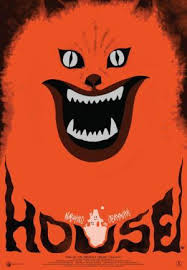
House (1977)

HOUSE

HOUSE (1977) Four stars

The year 1977 produced four of the definitive WTF movies in the history of cinema: ERASERHEAD, SUSPIRIA, EXORCIST II, and HOUSE, an item from the Japanese studio (Toho) responsible for Akira Kurosawa, Godzilla, Mothra, Rodan, and the H-Man.

Toho really outdid itself with HOUSE, which even surpasses GODZILLA VS. THE SMOG MONSTER in nonstop funky weirdness. Janus Films describes HOUSE as an episode of “Scooby Doo” directed by Dario Argento.

Bottom line: HOUSE just might be even weirder than ERASERHEAD, more colorful than SUSPIRIA, and more whacked out bat shit crazy than EXORCIST II. You have been warned.

First-time director Nobuhiko Obayashi pulls out all the stops in realizing a rather simple tale on the surface: teenage girl Gorgeous (Kimiko Ikegami) and her six friends Prof (Ai Matsubara), Melody (Eriko Tanaka), Mac (Mieko Sato), Kung Fu (Miki Jinbo), Sweet (Masayo Miyako), and Fantasy (Kumiko Oba) pay Gorgeous’ aunt (Yoko Minamida) in the country a visit. It just so happens that the aunt died in this house many years ago waiting on her fiancee to return from World War II and her spirit remains and feasts on unmarried girls. This is a haunted house movie where the house is hungry, very hungry indeed.

Obayashi’s at-the-time pre-teen daughter Chigumi Obayashi contributed ideas to her father. She came up with several childhood fears, her father relayed the fears to screenwriter Chiho Katsura, and they incorporated her ideas into the finished product. You’ll be able to recognize her contributions almost instantly and they contribute to the uniqueness.

Just as a fun exercise, I looked up the plot keywords for HOUSE on IMDb: “refrigerator,” “banana,” “watermelon,” “bloody spray,” “dismemberment,” “decapitation,” “full frontal nudity,” and “severed head” are some of the more interesting 75 keywords and they only scratch at the surface of the overall bizarre nature of the entire enterprise.

More than 30 years after its original release, HOUSE seemingly came from out of nowhere to develop a cult following in the United States, playing first as a midnight movie in Nashville and then at a film festival in Austin in 2009 before heading to DVD.

I first encountered HOUSE through its cover image for the Criterion Collection release on October 26, 2010. Maybe you remember seeing that artwork, as well. Nashville graphic designer and Ben Folds drummer Sam Smith came up with the distinctive image: “I used the first idea that came to me after watching a screener of the film — Blanche the cat’s psycho-screaming mug — and adapted it to stand alone as a symbol of the uncanny and over-the-top assault that our midnight-movie audience was in for,” Smith said. The poster first appeared for the film at the Belcourt Theatre in Smith’s hometown.

Then, I read the reviews for HOUSE and they’re nearly as over-the-top as the film itself.

Online reviewer Dennis Schwartz wrapped up his mixed review, “The director uses freeze-frames, jump-cuts, video effects to change dimensions, spiral effects, color tints, and assorted other techie tricks to play the scary pic card more for laughs than to be gruesome. It’s an experimental visual pic that becomes overwhelmed with low-brow slapstick comedy, a ridiculous killer house and garish visuals. But it’s a one-of-a-kind film that has its admirers, who just can’t resist such weird childish nonsense.”

Michael Atkinson opined in the Village Voice, “But though it plays like a retarded hybrid of ROCKY HORROR and WHISPERING CORRIDORS, it is, moment to moment, its own kind of movie hijinks. It even won a directorial-debut critics’ prize back in the day. Gigglers and cultists, pony up.”

I watched James Rolfe’s review for Monster Madness X from 2016. Rolfe started his review with a pause and a WOW! Of course, Rolfe picked HOUSE for one of the “WTF Wednesday” reviews.

I finally caught up with HOUSE in late summer 2019 and it lived up to expectations. It calls to mind a few pictures: EVIL DEAD II, THE SPIRIT OF THE BEEHIVE, THE 5,000 FINGERS OF DR. T, DAISIES, SUSPIRIA, and MY NEIGHBOR TOTORO. Like those films, though, HOUSE ultimately stands alone as an unique work because it creates its own world. I find that I respond more forcefully to fictional works that do that, rather than just rehash more of the same old already damaged goods. I want to be challenged, inspired, etc. I’ve never seen a haunted house movie quite like HOUSE.

HOUSE haunts one’s thoughts and gains in strength upon deeper reflection. At this moment of typing, I am thinking about Gorgeous’ aunt and how much time she spent waiting alone in that house for the love of her life to return from World War II. He never did, and they both died, she in that darn house and she’s cursed to haunt it for eternity because of her bitterness about the war. Then, I start thinking about the sheer enormity of the loss endured by the human race from Sept. 1, 1939 through Sept. 2, 1945: An estimated 70-85 million people died or three percent of the world’s population in 1940; 50-55 million civilians and 21-25 million soldiers no longer lived on this planet from a variety of causes, death on a mass scale that doubled World War I; the atomic bomb and the Holocaust two of humanity’s depressing advancements in death.

Obayashi was born in Hiroshima in 1938 and he lost all his childhood friends when the United States dropped an atomic bomb on Hiroshima on Aug. 6, 1945. Hiroshima and Nagasaki, as well as post-WWII nuclear testing, inform many Japanese films of the last almost 75 years.

Exorcist II: The Heretic (1977)

day 100, exorcist ii the heretic

EXORCIST II: THE HERETIC (1977) Three-and-a-half stars
There’s movies that are hated and then there’s EXORCIST II: THE HERETIC, a movie that received hate on an epic, violent level since it’s considered the worst sequel ever made and one of the worst films ever.

Sequels are often penalized for being too much like the original and then ironically enough, EXORCIST II has been lambasted for being nothing like the original mass phenomenon known as THE EXORCIST.

EXORCIST II director John Boorman admitted to not even liking the original film and his sequel is a direct challenge to the film that came before it.

I just want to know, did Boorman and fellow director William Friedkin ever get into a shouting match that degenerated into fisticuffs?

In a 2017 interview with IndieWire, Friedkin said, “I saw a few minutes of EXORCIST II, but that was only because I was in the Technicolor lab timing a film that I had directed — I forget which one — and one of the color timers at Technicolor said, ‘Hey, we just made a a print of EXORCIST II, would you like to have a look at it?’ I said OK. I went in, and after five minutes, it just blasted me. I couldn’t take it. I thought it was just ridiculous and stupid. But that was only five minutes, so I can’t make an ultimate judgement about it. It just seemed to me to have nothing to do with THE EXORCIST.”

Friedkin was also famously quoted, “And I looked at half an hour of it and I thought it was as bad as seeing a traffic accident in the street. It was horrible. It’s just a stupid mess made by a dumb guy — John Boorman by name, somebody who should be nameless, but in this case should be named. Scurrilous. A horrible picture.”

Boorman articulated on EXORCIST II in a 2005 interview with Film Freak Central, “The film that I made, I saw as a kind of riposte to the ugliness and darkness of THE EXORCIST — I wanted a film about journeys that was positive, about good, essentially. And I think that audiences, in hindsight, were right. I denied them what they wanted and they were pissed off about it — quite rightly, I knew I wasn’t giving them what they wanted and it was a really foolish choice. The film itself, I think, is an interesting one ­— there’s some good work in it — but when they came to me with it I told John Calley, who was running Warners then, that I didn’t want it. ‘Look,’ I said, ‘I have daughters, I don’t want to make a film about torturing a child,’ which is how I saw the original film. But then I read a three-page treatment for a sequel written by a man named William Goodhart and I was really intrigued by it because it was about goodness. I saw it then as a chance to film a riposte to the first picture. But it had one of the most disastrous openings ever — there were riots! And we recut the actual prints in the theatres, about six a day, but it didn’t help of course and I couldn’t bear to talk about it, or look at it, for years.”

Boorman lived out the Jean-Luc Godard quote “In order to criticize a movie, you have to make another movie.”

The critical (and audience) reaction to EXORCIST II seems based on whether or not you liked or hated THE EXORCIST. If you liked it, you hated EXORCIST II; if you hated it, you liked EXORCIST II.

For example, BBC critic Mark Kermode called EXORCIST II the worst film ever made because it trashed the greatest film ever made (THE EXORCIST). Leonard Maltin called it a “preposterous sequel” and Gene Siskel, who rated it no stars, chimed in with “the worst major motion picture I’ve seen in almost eight years on the job.” Siskel ranked THE EXORCIST No. 3 on his Top 10 list for 1973, behind only THE EMIGRANTS / THE NEW LAND and LAST TANGO IN PARIS.

Pauline Kael, a fan of Boorman and a Friedkin detractor, wrote of the original, “The demonic possession of a child, treated with shallow seriousness. The picture is designed to scare people, and it does so by mechanical means: levitations, swivelling heads, vomit being spewed in people’s faces. A viewer can become glumly anesthetized by the brackish color and the senseless ugliness of the conception. Neither the producer-writer, William Peter Blatty, nor the director, William Friedkin, show any feeling for the little girl’s helplessness and suffering, or for her mother’s. It would be sheer insanity to take children.”

Kael on the sequel, “This picture has a visionary crazy grandeur (like that of Fritz Lang’s loony METROPOLIS). Some of its telepathic sequences are golden-toned and lyrical, and the film has a swirling, hallucinogenic, apocalyptic quality; it might have been a horror classic if it had had a simpler, less ritzy script. But, along with flying demons and theology inspired by Teilhard de Chardin, the movie has Richard Burton, with his precise diction, helplessly and inevitably turning his lines into camp, just as the cultivated, stage-trained actors in early-30s horror films did. … But it’s winged camp — a horror fairy tale gone wild, another in the long history of moviemakers’ king-size follies. There’s enough visual magic in it for a dozen good movies; what it lacks is judgment — the first casualty of the moviemaking obsession.”

When I finally caught up with EXORCIST II in the late ’00s, I liked it and liked it enough that it held a spot on my top 10 list for 1977 for a few years. Yeah, I seem to be one of those crazy, wacky people who likes both THE EXORCIST and EXORCIST II. I’ll go ahead and be a heretic, and I’ll step up in defense of THE HERETIC.

— First and foremost, I have never seen a dull or non-visually captivating and compelling John Boorman film. His credits include POINT BLANK, DELIVERANCE, ZARDOZ, EXORCIST II, EXCALIBUR, and THE EMERALD FOREST. As Kael said in her review, EXORCIST II has enough visual magic in it for a dozen good movies. I mostly enjoy EXORCIST II on the level of a first-rate sound and light show. I see the film’s looniness as a virtue, but I can see where that would be a problem with viewers who love the Friedkin picture. Never even on a dare (let alone a review) do I hope to have to explain the plot of EXORCIST II.

— Boorman’s beef with THE EXORCIST centered on its treatment of Regan. Blair earned an Academy Award nomination for Best Supporting Actress for her work in THE EXORCIST, although credit should be given to stunt double Eileen Dietz and actress Mercedes McCambridge, who performed the most controversial scenes (Dietz) and provided the voice of the demon (McCambridge). EXORCIST II gives us a Blair in a transitional period between her child star past and her exploitation film future. She’s absolutely radiant, glowing even in EXORCIST II.

“Finally, one day, the script appears,” Blair said of EXORCIST II. “And I felt like, ‘Wow, this project is amazing, it’s perfect, it’s fabulous.’ They presented a really good next step, for the film, for the project, for Regan. You give me these amazing actors. Richard Burton, for me, that was what got me. To work with Richard Burton, that’s still, to this day, is one of the highlights of my life.”

— Ah yes, Burton (1925-84), an actor reputed to be one of the best actors on his best days and one of the worst actors on his worst days. You can virtually smell the alcohol on Burton during EXORCIST II, so you can guess which end of the Burton performance spectrum covers EXORCIST II. However, I’ll take a Burton train wreck performance over Sir Laurence Olivier’s later “take the money and run” career work in, for example, MARATHON MAN, THE BOYS FROM BRAZIL, and DRACULA, where Olivier (1907-89) stands out for his mannered (tortured) accent.

— I am fascinated by sequels that go in the opposite direction or even comment and criticize the previous entry, like BACK TO THE FUTURE 2 and GREMLINS 2: THE NEW BATCH. They’re far more interesting than sequels that are more or less just inferior copies of the original film, like, for example, JAWS 2 and OMEN II and many, many, many others.

I would even say that EXORCIST II has a more original, more daring vision than THE EXORCIST.