
The Fog (1980)

THE FOG (1980) **1/2
Fog has been a critical element in many horror movies and the 1939 Hound of the Baskervilles, The Wolf Man, Frankenstein Meets the Wolf Man, and The Return of the Vampire immediately leap to mind as films made definitely better from their use of fog effects to create a foreboding atmosphere.

Edgar Allan Poe died at the age of 40 in 1849 but his writing and his influence live on forever. Is all that we see or seem / But a dream within a dream?

Ghost stories around the campfire have been around longer than The Legend of Sleepy Hollow, and I believe that’s how Washington Irving first heard about Ichabod Crane, Brom Bones, and the Headless Horseman.

John Carpenter directed, co-wrote, and scored the original Halloween in 1978, one of the great transcendent low-budget shockers with a boogeyman killer.

Carpenter’s The Fog, his first horror film after Halloween, combines the title character, a Poe quote before the opening credits, a ghost story around the campfire told by distinguished actor John Houseman, and some grisly murder set pieces that far surpass the relatively tame and nearly entirely bloodless Halloween, but I remain steadily down the middle of the road in my reaction to it.

I want to like it a lot more than I do, believe me, and maybe I will get there next time.

I liked it more during the most recent viewing of the film and I definitely understand why it’s developed a cult following and a much better reputation in recent years.

It does create quite the foreboding atmosphere at times, it bears all the trademarks of a Carpenter film with his penchant for great composition both in the sense of framing and the music present throughout, and I do like the story of this small California town celebrating their centenary with a dark secret about the founding discovered, discussed, and confronted during the film as the dead men return 100 years to the day for their revenge.

Still, all the same, it’s underwhelming.

I believe it’s mainly because I don’t particularly connect to any of the characters and thus, I don’t really care about their fates particularly all that much.

I come the closest to connecting with radio station owner and host Stevie (played by Carpenter’s former wife Adrienne Barbeau) and Father Patrick Malone (Hal Holbrook), but they’re not on the same level as Dr. Loomis and Laurie Strode in Halloween, Kurt Russell’s characters in Escape from New York and The Thing, Keith Gordon’s Arnie Cunningham in Christine, Karen Allen’s and Jeff Bridges’ characters in Starman, and Roddy Piper’s George Nada in They Live, some of Carpenter’s best characters and best films.

While it is comforting to see Carpenter regulars like Barbeau, Jamie Lee Curtis, Tom Atkins, Charles Cyphers, Nancy Kyes, and good old ‘Buck’ Flower, they’ll still all be remembered first for other characters in other Carpenter films.

We simply don’t get enough of any of the main characters.

The Fog lacks a certain something, energy perhaps first and foremost, to really take it over the top and into the stratosphere like Halloween.

All that said, The Fog still has some very good even almost great moments.

I especially like the scene when Father Malone reads four entries from his grandfather’s journal and then delivers the best line of the film, The celebration tonight is a travesty. We’re honoring murderers.

Speaking of a travesty, I watched the 2005 remake in a theater and I have to believe that it’s one of the 10 worst movies I’ve ever watched in a multiplex near you.
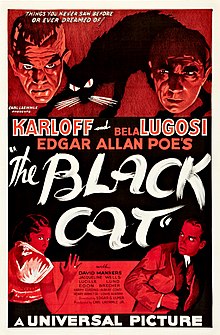
Karloff Meets Lugosi Meets Poe: The Black Cat, The Raven

KARLOFF MEETS LUGOSI MEETS POE: THE BLACK CAT, THE RAVEN
Boris Karloff (1887-1969) and Bela Lugosi (1882-1956) endure as two icons of horror and their best movies remain essential to a greater understanding of the horror genre long after their death.

Karloff and Lugosi starred in many classic films. Dracula. Frankenstein. Island of Lost Souls. The Mummy. White Zombie. Old Dark House. Murders in the Rue Morgue. The Mask of Fu Manchu. Chandu the Magician. The Bride of Frankenstein. Mark of the Vampire. The Black Room. The Man They Could Not Hang. The Wolf Man. Frankenstein Meets the Wolf Man. The Return of the Vampire. House of Frankenstein. Isle of the Dead. Bedlam. Abbott and Costello Meet Frankenstein. Targets.

That list grows once the several films they made together are considered: The Black Cat, The Raven, The Invisible Ray, Son of Frankenstein, Black Friday (not a classic), You’ll Find Out (not seen this one), and The Body Snatcher.

The Black Cat and The Raven, generally paired together in greatest hits packages, are the films where Karloff and Lugosi are most evenly matched on screen. They’re both immortal movie classics based on that mere fact alone; Lugosi nearly walks away with Son of Frankenstein as Ygor, while it’s sad to see how much of a nonentity part Lugosi received in The Body Snatcher, especially when compared against Karloff’s meaty role as John Gray and perhaps his best performance.

Young American lovers on their honeymoon in Hungary, a train ride beginning and ending the picture, a dark and rainy night, a road accident, an old dark house, an enigmatic doctor, a Satan worshipping priest, a story suggested by the work of Edgar Allan Poe with story and direction from Edgar G. Ulmer, and The Black Cat flies past in about 65 minutes, like a lot of the early horror classics.

Of course, there’s Karloff credited merely as Karloff, David Manners as one of the young American lovers, and Karloff and Lugosi find themselves at each other’s throat by the end of the picture.

Like the Frankenstein pictures and the Mary Shelley source material, The Black Cat departs almost entirely from Poe’s short story originally published in The Saturday Evening Post on August 19, 1843. I am okay with that, because Ulmer has a style all his own like James Whale in Frankenstein and The Bride of Frankenstein and The Black Cat pairs two movie legends for the first time.

The Raven gets done faster than even The Black Cat at 61 minutes, credits both Karloff and Lugosi with their surnames alone, and it has a lot of the same elements as The Black Cat.

Lugosi plays arguably his most diabolical and evil character in Dr. Richard Vollin, the archetype for the brilliant but troubled surgeon who has this, let’s say, morbid obsession with instruments of torture. He’s not your average doctor, obviously. Lugosi chews through the scenery, especially in the final reel, and relishes lines like Death is my talisman, I like torture, I tear torture out of myself by torturing you, and Poe, you are avenged!

Yes, he’s also obsessed with Edgar Allan Poe. The Pit and the Pendulum even makes a cameo appearance!

The Raven tilts more toward being Lugosi’s show because Karloff doesn’t even show up for his first scene until 17 minutes into the picture.

Karloff is great though, of course, and brings a certain poignancy to the tortured murderer on the run Edmond Bateman, who just wants the doctor to fix his ugly face.

EB: I’m saying, Doc, maybe because I look ugly … maybe if a man looks ugly, he does ugly things.

DRV: You are saying something profound.

Naturally, Vollin makes Bateman’s face even uglier and enlists him in a diabolical scheme.

The rest of the cast doesn’t measure up against Lugosi and Karloff, especially Irene Ware as the screaming socialite Jean Thatcher, but it doesn’t really matter because Lugosi and Karloff are so damn great.

I heartily recommend The Black Cat and The Raven, both Poe and Universal.

The Black Cat (1934) ****; The Raven (1935) ****


Picnic at Hanging Rock (1975 / 1998)

PICNIC AT HANGING ROCK (1975 / 1998) Four stars

Imagine a mystery ending unsolved.

That’s the challenge for readers of Joan Lindsay’s original 1967 novel and viewers of the 1975 Australian film adaptation by screenwriter Cliff Green and director Peter Weir.

Lindsay’s editor Sandra Forbes made the suggestion to remove the final chapter and Lindsay did so before publication. In 1987, three years after Lindsay’s death, “The Secret of Hanging Rock,” the infamous final chapter, Chapter 18, finally appeared.

Weir’s 1998 Director’s Cut trimmed eight minutes from the original film, 115 down to 107 minutes.

In turn of the 20th Century Australia, three Appleyard College school girls and one teacher do not return from their picnic at former volcano Hanging Rock near Mount Macedon in Victoria. The girls’ curiosity about exploring Hanging Rock obviously gets the best of them. One of the girls, Irma, returns every bit as mysteriously as she disappeared one week earlier and she’s no good for answers in the heart of the picture, “I remember — nothing! Nothing! I remember nothing!” Irma’s fellow characters become every bit as frustrated with her as we do in the audience, because all of us (they and we) demand a solution and an explanation. People desperately want rationality in an often irrational world.

School girls Miranda (Anne-Louise Lambert) and Marion (Jane Vallis) and Miss McGraw (Vivean Gray) remain missing, despite the best efforts of both official and unofficial search parties. For example, there’s Michael Fitzhubert (Dominic Guard), a young man who becomes obsessed with finding Miranda.

Seems like virtually everybody’s obsessed with this Miranda, who Mlle. De Poitiers (Helen Morse) describes as a Botticelli angel before her disappearance. The film is very suggestive and hints at terrible, unspeakable events. Imaginations may run wild, as they do within the film.

Miranda provides a line vital to understanding PICNIC AT HANGING ROCK, “What we see and what we seem are but a dream, a dream within a dream,” a quote from Edgar Allan Poe’s 1849 poem “A Dream Within a Dream.” It is quite possible that Poe (1809-49) would have admired PICNIC AT HANGING ROCK.

Take this kiss upon the brow!

And, in parting from you now,

Thus much let me avow —

You are not wrong, who deem

That my days have been a dream;

Yet if Hope has flown away

In a night, or in a day,

In a vision, or in none,

Is it therefore the less gone?

All that we see or seem

Is but a dream within a dream


I stand amid the roar

Of a surf-tormented shore,

And I hold within my hand

Grains of the golden sand —

How few! yet how they creep

Through my fingers to the deep,

While I weep — while I weep!

O God! can I not grasp

Them with a tighter clasp?

O God! can I not save

One from the pitiless wave?

Is all that we see or seem

But a dream within a dream?


Guess we should discuss this Hanging Rock, which becomes a character and even more of an impenetrable mystery in its own right than the central mystery. Australian New Wave films — like PICNIC AT HANGING ROCK — received (and deserved) much praise for their depictions of the natural landscape.

Hanging Rock quickly becomes mythical, powerful, before we even take one look.

Mrs. Appleyard (Rachel Roberts) builds it up within our minds in an early scene, “The rock itself is extremely dangerous. You are therefore forbidden of any tomboy foolishness in the matter of exploration, even on the lowest slopes. I also wish to remind you, the vicinity is renowned for its venomous snakes and poisonous ants of various species. It is, however, a geological marvel.”

Miss McCraw contributes, “The rocks all round — Mount Macedon itself — must be all of 350 million years old. Siliceous lava, forced up from deep down below. Soda trachytes extruded in a highly viscous state, building the steep sided mamelons we see in Hanging Rock. And quite young geologically speaking. Barely a million years.” These dialogue passages remind one of how Dr. Sam Loomis (Donald Pleasence) played up Michael Myers in HALLOWEEN.

The watches of coachman Mr. Hussey (Martin Vaughan) and Miss McGraw both freeze at the stroke of noon. They speculate about the magnetic powers of Hanging Rock.
That’s before the girls decide to go explore Hanging Rock.

PICNIC AT HANGING ROCK derives considerable power from the juxtaposition of the young women and Hanging Rock. Also, Hanging Rock itself cannot be interrogated about what happened on that fateful day or explain how one girl returned. What did Hanging Rock do to and then with these women?

Hanging Rock remains a marvel and tourist hot spot today.

Check out the sales pitch: “Where else in Australia will you find the Black Hole of Calcutta, The Eagle, The Chapel and Lover’s Leap … let the secrets of Hanging Rock unfold before your eyes as you wind your way up to the pinnacle where spectacular views await” and “The unexplained disappearance of a group of schoolgirls at Hanging Rock in 1901 is just one of the legends of this mysterious area, and many visitors say they can feel the spirit of the girls as they climb the Rock. Joan Lindsay’s book and Peter Weir’s film about the ‘Picnic at Hanging Rock’ ensures that the mystery lives on. …”

No evidence has been found to prove the novel and the movie are based on a true story.
PICNIC AT HANGING ROCK sticks with many viewers, just like the surviving characters are haunted.

The technical aspects are first-rate: cinematographer Russell Boyd, editor Max Lemon, art director David Copping, costume designer Judith Dorsman, makeup artist Elizabeth Mitchie and makeup supervisor Jose Luis Perez, composer Bruce Smeaton, and musician Gheorghe Zamfir, in particular.

Zamfir’s pan flute later influenced Ennio Morricone’s work for Sergio Leone’s ONCE UPON A TIME IN AMERICA.

After writing this review, I know that I want to watch PICNIC AT HANGING ROCK again.