The Car (1977)

THE CAR

THE CAR (1977) *

The Devil and cars were huge in the movies of the 1970s.

Building on the momentum of ROSEMARY’S BABY in 1968, we saw THE BROTHERHOOD OF SATAN, THE EXORCIST (the biggest hit of them all that spawned many imitators and successors), THE DEVIL’S RAIN, THE DEVIL WITHIN HER, BEYOND THE DOOR, BEYOND THE DOOR II, THE OMEN and DAMIEN: OMEN II, and THE AMITYVILLE HORROR.

As far as cars, we had TWO-LANE BLACKTOP, DUEL, THE SUGARLAND EXPRESS, GONE IN 60 SECONDS, DEATH RACE 2000, THE GUMBALL RALLY, EAT MY DUST, GRAND THEFT AUTO, and SMOKEY AND THE BANDIT.

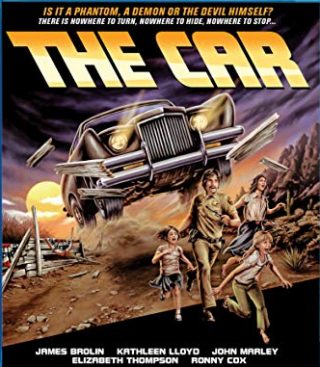
THE CAR, directed by Elliot Silverstein and distributed by Universal, combines The Devil and cars to make one stupefying, awful, patently ridiculous horror movie.

Yes, that’s right, a homicidal maniac automobile seemingly possessed … or just having a really, really, really bad day. Maybe the latter was just me watching THE CAR.

This movie just doesn’t know when to quit and it starts early with the murders of two bicycling teenagers in the majestic desert of Utah. We’re talking first few minutes and the film wastes absolutely no time in establishing its basic pattern. Maybe I should have turned off the subtitles, because they provided the evocative forewarning “Ominous instrumental music.” I knew the bludgeoning music was coming, though, because I’ve seen a movie or two before, especially a horror movie. Ominous instrumental music indeed, especially when it sounds like 50 horror film musical scores piled up into one super bad score. Forget the killer car next time, I want the movie about the killer musical score. Tagline: “They could not believe their ears, until it was too late. … THE MUSICAL SCORE FROM HELL will make your eardrums bleed. Coming soon to a theater near you.”

Every 10-15 minutes, at least, we are beaten with a ridiculous death scene or, barring that, a scene of peril just for variety. That ominous instrumental music, all them close-ups of the customized 1971 Lincoln Continental Mark III (built by George Barris, who previously brought us the Batmobile for the 1966 BATMAN), and Silverstein’s overall poor handling of action. At times, the vehicles look like they’re being artificially sped up.

Unfortunately, in between those violent scenes, we are served a steady diet of banalities and unpleasantries, only adding insult to injury.

For example, just about every scene with veteran character actor R.G. Armstrong (1917-2012) applies the unpleasant extra thick. He beats on his wife and insults just about everybody in sight. Never mind his slurs against Native American character Chas (played by Henry O’Brien in his final feature film). He’s a nasty old man. Honestly, why is his character Amos not killed? You’re right, it must have something to do with the explosives needed for the grand finale … and, before that, Sheriff Everett (John Marley) needs to be killed rather than Amos so Wade (James Brolin, who seems to be hired when Sam Elliott is unavailable), our main human protagonist, can take charge. It all makes sense.

Our title character is maddening to the nth degree and we have already touched on why, but let’s pursue it more.

Sure, it can kill a main character by driving through her house in the ultimate display of supernatural power. This character, Lauren (Kathleen Lloyd), the lover of the protagonist, turns her back to the window as she speaks to Wade on the phone. This means, however, that we can see the car coming straight for her through her window. This scene is supposed to be a highlight, a real heart breaker or at least a real tense moment since we see the murderous car well before her, but, like virtually every other scene in THE CAR, it’s laughably bad in a bad way.

Just like the scene that establishes the car’s need for revenge against Lauren. Safe on the hollowed grounds of a cemetery, Lauren really lets our title character have it, resorting to chickenshit and a son of a bitch. That’s obviously going too far, even before she tosses a tree branch at it. She asked for her auto demise. I should mention that she’s a school teacher whose marching band students were chased into that cemetery by you know who. We have seen that scene archetype before, namely in Alfred Hitchcock’s 1963 classic THE BIRDS. THE CAR just drags this entire sequence out.

Then again, dragging it out describes the entire movie.

Our title character is especially maddening because it wastes two perfect opportunities to flatten Wade like a pancake. What’s that all about? We get the feeling that were it any other character and not the protagonist, it would be “Sayonara, sucker!” The first opportunity even gives us a cut from Wade in danger in the desert to being safe in a hospital bed. I hate cheap tricks like that.

Was there anything I liked about THE CAR? Fleeting moments, like glimpses of the Utah scenery as seen through filming locations St. George, Snow Canyon, Zion National Park, Glen Canyon, Hurricane, the Mount Carmel Tunnel, and Kanab. I would have preferred a 96-minute nature documentary on this area over THE CAR.

I knew I was in trouble when THE CAR starts out with a quote from Church of Satan leader Anton LaVey (1930-97) and The Satanic Bible.

LaVey also previously had a hand in the making of THE DEVIL’S RAIN, another godawful horror movie.

Sometimes, it seems like even the Devil just can’t buy a break.
Grand Theft Auto (1977)

GRAND THEFT AUTO

GRAND THEFT AUTO (1977) Three stars

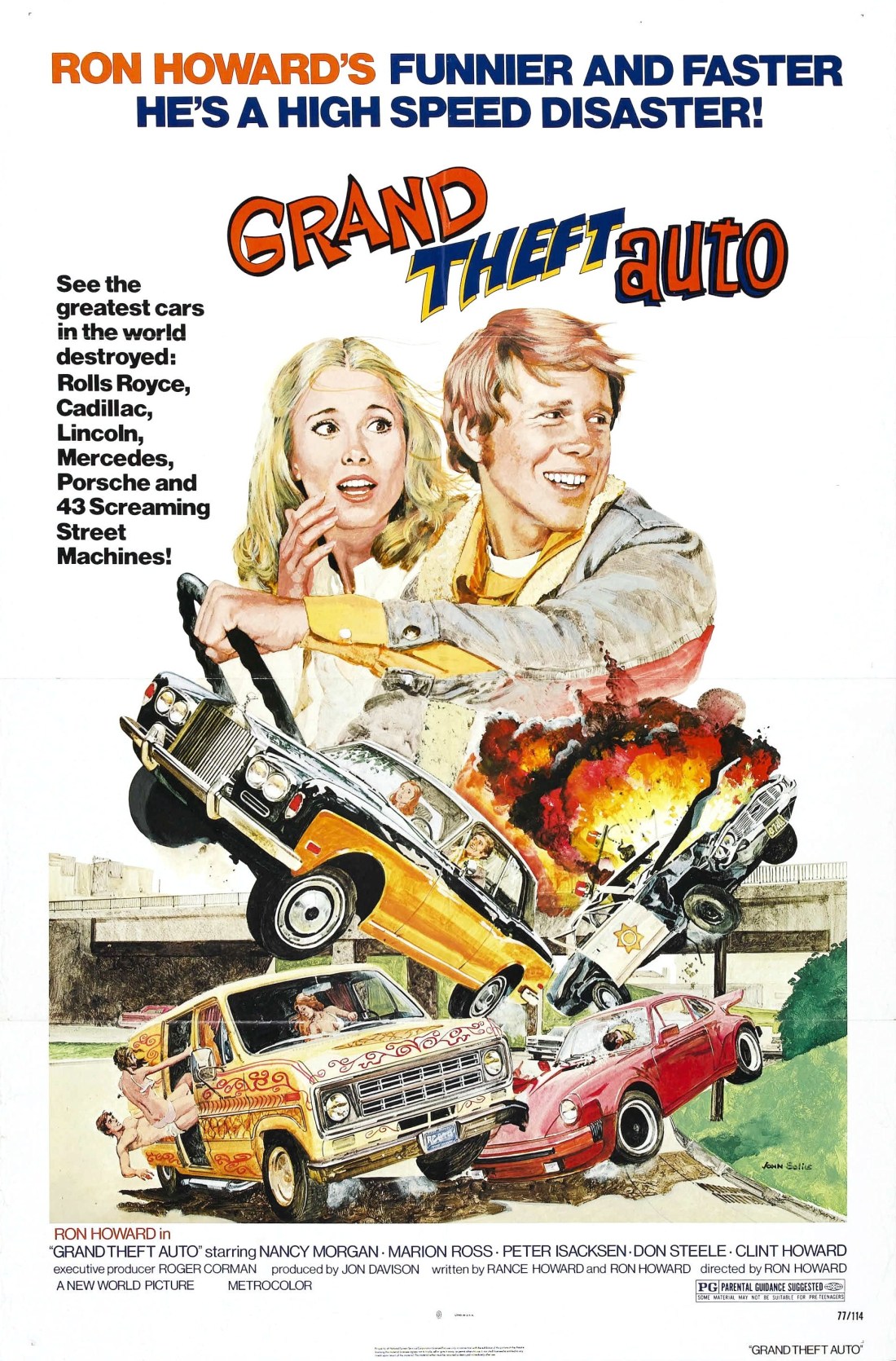
I just love the poster for GRAND THEFT AUTO, Ron Howard’s feature debut as director.

It advertises “See the greatest cars in the world destroyed: Rolls Royce, Cadillac, Lincoln, Mercedes, Porsche and 43 Screaming Street Machines.”

Sounds like my kind of picture.

RON HOWARD’S FUNNIER AND FASTER

HE’S A HIGH SPEED DISASTER!

A drawing of Nancy Morgan aghast and Howard with that All-American smile on his face and his left hand on the steering wheel. Below the young lovebirds are flames and crashes. Sure does resemble a drive-in movie from 1977.

Howard directed, starred in, and co-wrote this picture for New World, produced by Jon Davison and executive produced by Roger Corman. Howard kept some of GRAND THEFT AUTO in the family with father Rance a co-star and co-writer and brother Clint a co-star. It’s no small wonder that Howard earned a reputation for being one of the nicest guys in Hollywood.

Howard did not sell his soul to the Devil to get the picture made. No, instead, he made a deal with Mr. Corman. Howard agreed to star in EAT MY DUST! from 1976 if he could have a crack at directing. The rest is history and Howard’s directorial credits number 32, including Academy Award for Best Picture winner A BEAUTIFUL MIND. His other credits include NIGHT SHIFT, SPLASH, PARENTHOOD, FAR AND AWAY, THE PAPER, APOLLO 13, and FROST/NIXON.

Made for a reported $600,000 on down time for Howard from “Happy Days” (No. 1 show on TV in 1976-77 and No. 2 in 1977-78), GRAND THEFT AUTO tells a simple story.

Paula Powers (Morgan) loves her boyfriend Sam Freeman (Howard) and they want to get married, but her wealthy parents, especially her gubernatorial candidate father, oppose this pairing, taking Mr. Freeman for a gold digger. Paula’s parents want her to marry the wealthy Collins Hedgeworth (Paul Linke), who’s such a blasted tool he spends the movie in his jockey outfit. Paula steals her father’s Rolls Royce and Sam, and they plan to get married in Vegas. There ends up being a $25,000 reward for Paula and then a $25,000 price tag for Collins.

Seemingly all of California (and Nevada) pursues Paula and Sam, as well as Collins.

Collins alone goes through at least three cars in his first few minutes of screen time. What a schmuck! His overprotective mother, played by America’s Sweetheart and Howard’s TV mother Marion Ross, is the one responsible for the reward for Collins and it is one of the undeniable highlights of the movie to hear Marion Ross say “Piss off!” Even a preacher (Hoke Howell) goes after the money. Sleazy DJ Curly Q. Brown (Don Steele) eventually takes to the air in a whirlybird and he tells Mr. Freeman on the air, “Well, if you have it, I’m going to report it. Because every time you turn around and fart, it’s news.” The film especially picks up once Curly Q. Brown starts his play-by-play of the chase across California and Nevada.

The plot also includes a Helicopter vs. Rolls Royce showdown, a bridge blown up real good, and a Demolition Derby. The 1970s were the glory days for the car chase and GRAND THEFT AUTO belongs alongside DUEL, MAD MAX, CONVOY (both movie and song), SMOKEY AND THE BANDIT, THE FRENCH CONNECTION (chase scene), and several other pics.

Do Paula and Sam get married (and live happily ever after)? Well, I would never dream of revealing such an ending, although I told my wife after she asked me if they got married. I will compromise, though, and duly note GRAND THEFT AUTO saves its best demolition for last.

Duel (1971)

duel

DUEL (1971) Three-and-a-half stars

24-year-old Steven Spielberg’s first feature film premiered November 13, 1971 on ABC.

Richard Matheson (1926-2013) wrote the script, based on his nightmarish experience on November 22, 1963 (the date of JFK’s assassination). A trucker tailgated Matheson on his return home following a golf match against friend and fellow writer Jerry Sohl. Matheson turned his experience into a short story that originally ran in Playboy.

Spielberg directed on a $450,000 budget and production ran 13 days, three days over schedule, and it played as the “ABC Movie of the Week” lasting 74 minutes. A later theatrical release covered nearly 90 minutes.

Spielberg wanted and got character actor Dennis Weaver (1924-2006). Of course, most of us know the Joplin-born actor for his work on TV series “Gunsmoke” and “McCloud,” but Spielberg admired Weaver for his work in Orson Welles’ TOUCH OF EVIL and in DUEL, Weaver’s character repeats a bit of verbal business from TOUCH OF EVIL. You got another think coming, indeed.

It’s a very basic premise at the center of DUEL: An unnamed truck driver stalks our protagonist David Mann (Weaver), a middle-aged salesman returning home from a business trip.

Mann passes the truck early on and that begins his 90-minute nightmare.

Oh sure, I bet you believe that driver sure as hell gets bent over being passed.

You might even say to yourself that it’s preposterous, but then again, in this day and rage, you might not.

I definitely believe that it’s not and I recall my own bizarre experience from November 2016.

“Driving home from work last night/this morning around 2 a.m., this car began following me from about the Highway 43/96 roundabout. It would creep up, then fall back and never pass despite multiple opportunities. There was no tailgating or attempt to run me off the road. A couple times, I looked back and the car swerved all over the place. At some point, I figured out it was definitely not a cop. That some point had already been reached when I turned on to Highway H toward Jasper, a destination 11 miles from Highway 43. I took a real slow, hesitant turn with a stop at the end and the creeper car behind me matched that slow, hesitant turn with a stop at the end. OK, it’s a creeper. We’re about halfway to Jasper when I turn into a random driveway. I sit in my car for a couple minutes, debating my next move. The car following me backs up a little bit and leaves me room to reverse and turn around. I see that it’s a dude driving the car. He’s alone. I back out, turn around, drive toward him, and engage him in what turned out to be one of the weirdest conversations I’ve ever known. But just like a character said to Inspector Harry Callahan in DIRTY HARRY, ‘I gots to know.’

“Anyway, I now know for sure what it’s like to have a conversation with someone orbiting Planet X. I could only understand bits and pieces of his stammered mutterings, something ‘bout him being from Wichita and then wanting to know if I wanted to make a contribution. No, sorry, I gave at the office.

“The Creepy Crawler: Thought we could talk for 10 minutes.

“Me: No, and we’ve already talked for 5.

“TCC: No, we haven’t.

“Me: It’s late and I just want to get home from working all night.

“(voice tails off quickly)

“TCC: So you don’t want to have a conversation?

“[I drive off into the sunset. No, wait, it’s 2 a.m. There’s no sunset. The sun rises in the opposite direction. Ah, hell, we’re not getting anywhere with this digression into stage direction.]

“Back on the road and that holy quest to make it home safe, I drove about 85 over those crazy little hills of Highway H until I reached Highway 43. No creeper. Very little active human life of any kind. Very few lights. I felt like saying, ‘It’s 30 miles to Arcadia, I’ve got a three-quarters full tank of gas, half a reporter’s notebook, it’s dark out and I am wearing a Star Wars T-shirt.’”

Watching it for the first time in full the other day, DUEL brought on a flashback to that 2016 incident and I certainly felt all the sympathy in the world for the plight of David Mann.

DUEL represented a test run for JAWS, Spielberg’s third feature. Both productions often masterfully exploit our fear of the unknown, but I’ll say that DUEL scares me more than JAWS because I drive a whole helluva lot more than I swim in the ocean.