Six Weeks (1982)

SIX WEEKS (1982) *
My wife awoke in the middle of the night, it took her quite some time falling back asleep, and so naturally she joined me for about the last 30 minutes or so of Six Weeks. She asked me some basic journalistic questions like ‘What’s the little girl dying from?’ ‘I believe it’s leukemia.’ ‘No, it can’t be. It’s got to be something else. I don’t think she’d just suddenly die like that.’

At some point during our discussion, I said that actually this poor little girl has got the dread movie disease where the invariably dead-by-the-end-of-the-movie character becomes ever more beautiful and noble until her big death scene. Yes, the late film critic Roger Ebert named this affliction ‘Ali MacGraw Disease’ after the star of Love Story, the film based on the best-selling novel that one might say started it all way back in 1970.

Movies derived in way or another from Love Story invariably pour it on awful darn thick with the sentiment, until the movie in question becomes a real maudlin exercise. Six Weeks pulls out the stops more than most in this dubious category and that’s why I was utterly amazed that it did not feature a hot-air balloon scene like fellow maudlin tearjerkers Bobby Deerfield, Yes Giorgio, and Just the Way You Are. That’s about the only restraint practiced by Six Weeks.

Casting 101 pairs Dudley Moore (1935-2002) and Mary Tyler Moore (1936-2017), fresh off critical and commercial hot commodities Arthur and Ordinary People, respectively. Yes, wow, how far out, both actors have the same last name and they’re apparently not related. They don’t even have the same national origin. Anyway, like Walter Matthau and Jill Clayburgh in the turkey bomb First Monday in October, Moore and Moore do not share the slightest bit chemistry either, that’s for darn sure. Dudley plays a California politician who’s running for Congress, Mary’s a wealthy cosmetics heiress with the precocious 12-year-old daughter already discussed in the opening paragraph. Dudley’s hopelessly lost in an early scene, very late to a political fundraiser where he’s the featured speaker, and the 12-year-old gives him directions and a whole lot more. She wants Dudley to win his election and Moore² to hook up and become the ultimate happy family for her life’s remaining duration.

Katherine Healy plays the dying little girl and she’s a bit, what’s the word, insufferable. She’s one of those movie children with an unlimited supply of wannabe sharp dialogue and snappy comebacks. She’s dying, remember, and that makes her dialogue even worse and her fantasies ever more powerful. Yes, that’s right, she’s got six weeks left and she’s going to live out as many of her fantasies as possible within the production budget of a 107-minute feel good extravaganza.

Moore² and the little girl hit the bright lights of New York City because what better place to live out fantasies on the big screen and little Niki skates at The Rink at Rockefeller Center, takes on the lead in The Nutcracker, and rounds up Moore² for a smug little cutesy pie wedding ceremony that almost extracted wholesale vomit from the pit of my stomach. Not exactly in that order, though, because the wedding ceremony happens before the grandstanding grand finale ballet number. Niki performed her ballet number on center stage, I looked at my wrist like there’s a watch attached to it and said to my wife, ‘It’s about time for the little girl to die.’ Sure enough, that’s what happened in the very next scene.

I left out the part (until now, anyway) about Dudley’s family, his dutiful wife and teenage son. That’s OK, because they’re not that important and don’t stand in the way of the main body of the plot. Speaking of the plot, Six Weeks pushes and pulls so many emotional levers that it becomes one of the most shameful tearjerkers ever made. They finally resorted to yanking them emotions with pliers. Thankfully, I still resisted and this review signals my protest on aesthetic and emotional grounds.

Big (1988)

BIG (1988) Three-and-a-half stars

Twelve-year-old Joshua Baskin (David Moscow) cannot gain admittance on a roller coaster ride because he’s not tall enough, so the embarrassed young man finds a Zoltar Speaks machine and it grants his wish that he were big. Overnight, Joshua Baskin becomes 30 years old and he’s played by Tom Hanks for basically the rest of the movie.

BIG is by far the best of the body switch movies that were all the rave during the Reagan administration. Anybody sentient during that era can surely remember a body switch pic or two. Let’s see, we had OH! HEAVENLY DOG from 1980, whose July 11 release date predates Reagan and which gives us Chevy Chase trapped inside Benji … Chase provides voice-over for Benji in a rather dull murder mystery. Then, there’s LIKE FATHER LIKE SON from 1987 pairing Dudley Moore and Kirk Cameron, who just scream father and son, in one of the worst movies of all-time had it not come out during the same year as such cinematic landmarks as THE GARBAGE PAIL KIDS MOVIE, LEONARD PART 6, JAWS THE REVENGE, MANNEQUIN, and TEEN WOLF TOO. Never mind, it’s still one of the worst movies of all-time.

BIG streamlined and more or less perfected the body switch, because we stick with one character (Joshua Baskin) the whole time and there’s less of a suspension of disbelief required for the movie to work. For example, in LIKE FATHER LIKE SON, we have to picture Dudley Moore inside Kirk Cameron and vice-versa (pun and reference to another body switch movie intended), but it’s almost impossible since their speaking voices remain the same. Movies like LIKE FATHER LIKE SON are why the late Roger Ebert coined the phrase “The Idiot Plot.”

Hanks gives a strong performance, especially in conveying the whole child trapped inside a grown man’s body through body language, facial gestures, boyish enthusiasm, wide-eyed reactions. He works his predicament for laughs, for pathos, for drama, and there’s a compelling sequence during his first “big” day when he’s staying at this seedy New York City hotel and he’s scared by the real world. Hanks broke away from his poor man’s Bill Murray for the first time in his career and established his own niche that would culminate in playing Forrest Gump.

Elizabeth Perkins is just terrific in BIG and I don’t think she’s ever been either better or more beautiful than as Susan. Perkins matches Hanks every step of the way during their complicated romance and please go back and watch her during the farewell scene with Baskin. She kisses him on the forehead and strokes behind his ear, in a tender and more motherly fashion. She makes the scene work, as Hanks reverts back to Moscow as Baskin.

Robert Loggia (1930-2015) and John Heard (1946-2017) were two of the best character actors during their respective careers.

Loggia plays against type here as MacMillan, the owner of a toy company who takes a major liking to the way Baskin looks at toys; phooey to marketing reports, Baskin and MacMillan test toys the old-fashioned way by going straight to the biggest toy store. They pair together for a toy piano duet and create one of the most iconic movie scenes of the late 80s. It’s known quite simply as the “Big Piano Scene.”

There was often an edge to Heard during his performances and he taps into that edge a great deal in BIG. Heard creates a real jerk.

Penny Marshall became a name director after BIG and she and Hanks reunited for A LEAGUE OF THEIR OWN. Anne Spielberg and Gary Ross wrote the script and Barry Sonnenfeld worked as cinematographer; Ross later directed PLEASANTVILLE and Sonnenfeld’s directorial credits include GET SHORTY and MEN IN BLACK.

There seems to be a certain nostalgia for BIG, just like at times it seems like that’s all true for anything (the good and the bad, and the ugly) from the 80s.

How far can that nostalgia go? Well, there’s the Nostalgic Zoltar Speaks machine for sale on the Zoltar site. One machine comes equipped with a $10,500 price tag and that’s not counting any customization like a wireless microphone to talk through Zoltar ($425 without remote control, $520 with), breathing movement for Zoltar ($625), motion activated attract ($75), custom fortune cards, custom audio messages, and traveling case ($1,500 plastic, $650 wood).

If you do buy that Nostalgic Zoltar Speaks machine for a major chunk of change, do you dare make a wish, “I wish I were big.” I say you better for that level of investment.


Foul Play (1978)

FOUL PLAY

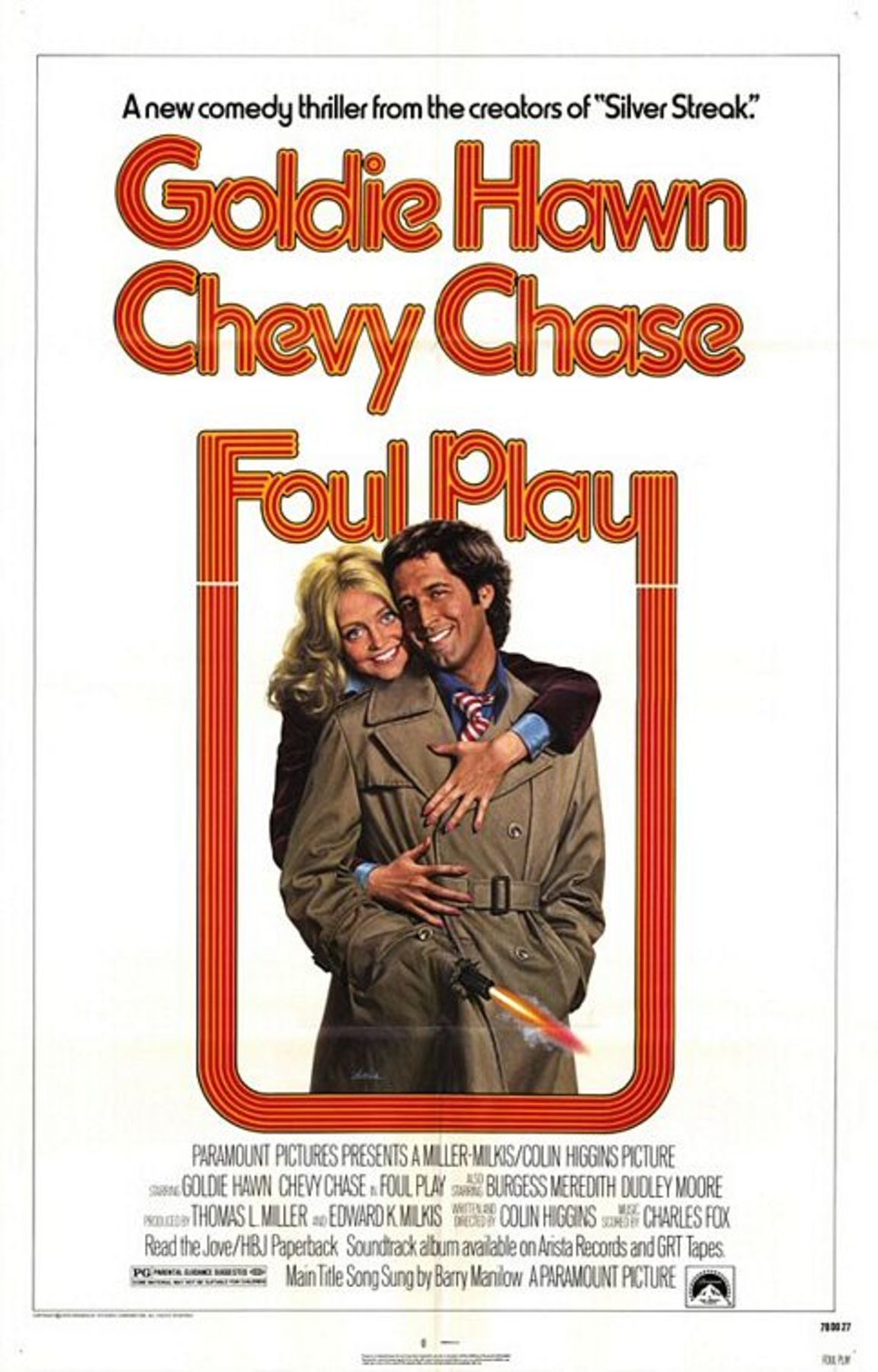
FOUL PLAY (1978) Three stars

Universal Studios demanded that Chevy Chase, the first breakout star from “Saturday Night Live,” be cast in NATIONAL LAMPOON’S ANIMAL HOUSE. However, in a lunch between ANIMAL HOUSE director John Landis, producers Matty Simmons and Ivan Reitman, and Chase, Landis played a Jedi mind trick on Chase, telling him that ANIMAL HOUSE would be an ensemble piece whereas FOUL PLAY would let Chase be a star. Chase stayed with FOUL PLAY and ANIMAL HOUSE cast Tim Matheson in the Otter role.

FOUL PLAY debuted July 14, 1978, and ANIMAL HOUSE came out two weeks later.

ANIMAL HOUSE made $141.6 million on a $3 million budget and changed the face of comedy forever. Yes, every year we get at least one comedy that would not have been possible without the example set by ANIMAL HOUSE. Meanwhile, FOUL PLAY generated $45 million and has been consigned to the margins of history.

It’s certainly not a bad movie by any stretch of the imagination, but it does pale in comparison when stacked up against ANIMAL HOUSE. Granted, FOUL PLAY chased different goals than the undeniably anarchic, anti-establishment ANIMAL HOUSE.

FOUL PLAY is the byproduct of writer and director Colin Higgins (1941-88). He’s one of those cases where you just might not know the name but you definitely know his movies. He made his name in Hollywood by penning the screenplay for the legendary cult favorite HAROLD AND MAUDE (1971). Five years later, he wrote the screenplay to SILVER STREAK, a comedic thriller hit pairing Gene Wilder and Richard Pryor. Higgins made his directorial debut with FOUL PLAY and would end with three directorial credits, 9 TO 5 and THE BEST LITTLE WHOREHOUSE IN TEXAS his second and third efforts. Additionally, Higgins wrote the screenplay for all three comedies he directed. All five comedies enjoyed some level of success.

Nominally Chase and Goldie Hawn are the stars of FOUL PLAY, but the writing and directing style of Higgins should not go unappreciated.

Both SILVER STREAK and FOUL PLAY stand out from HAROLD AND MAUDE, 9 TO 5, and THE BEST LITTLE WHOREHOUSE, in the fact they are heavily influenced by Alfred Hitchcock. SILVER STREAK screams Hitchcock’s 1938 thriller THE LADY VANISHES and FOUL PLAY references THE 39 STEPS, SABOTEUR, NORTH BY NORTHWEST, THE MAN WHO KNEW TOO MUCH, NOTORIOUS, VERTIGO, and PSYCHO. Fans of the Master of Suspense will also be delighted by Higgins’ inclusion of what the maestro called “The MacGuffin,” which is a roll of film hidden in a pack of cigarettes in FOUL PLAY.

I know that Hitchcock himself loved Mel Brooks’ HIGH ANXIETY, a 1977 affectionate spoof of suspense films mostly focused on Hitchcock’s SPELLBOUND, VERTIGO, PSYCHO, and THE BIRDS, so it is quite possible that he enjoyed FOUL PLAY.

In FOUL PLAY, librarian Gloria Mundy (Hawn) finds herself in the midst of a bizarre plot that ultimately involves an assassination attempt on the pope. We have a dwarf, an albino, a wild and crazy guy who attempts to seduce Miss Mundy, a karate fight between two highly unlikely combatants, an endless chase scene, and a pair of Japanese tourists who are big fans of Kojak and bang, bang! This is a pleasantly silly concoction and Hawn takes us through what turns out to be an overlong motion picture at 115 minutes. Or maybe it just felt that way every single damn time I heard the song “Ready to Take a Chance Again,” which predated the similar use of the song “That’s What Friends Are For” a few years later in NIGHT SHIFT. In both cases, I was ready to hear another song again instantly.

What about Chase? He’s part of an ensemble and he almost gets lost in the shuffle at times in his first movie leading role, but this is one of his better performances and his best films. Chase plays a capable leading man paired with Hawn.

Dudley Moore (1935-2002) basically steals every scene that he’s in and his work here led to his being cast in Blake Edwards’ 10, Burgess Meredith (1907-97) made four movies in 1978 and this is the one where his character knows martial arts, and Rachel Roberts’ last screen credit before FOUL PLAY was the eccentric Australian thriller PICNIC AT HANGING ROCK. Moore and Brian Dennehy, Chase’s partner, appeared together in 10.

FOUL PLAY is a minor film with minor charms, but sometimes that’s more than enough or just enough to hit the spot.