
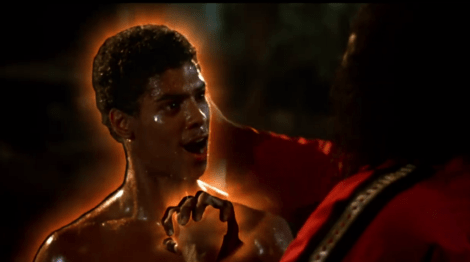
The Last Dragon (1985)

THE LAST DRAGON

THE LAST DRAGON (1985) Three stars

Gene Siskel included THE LAST DRAGON among his “Guilty Pleasures” in a 1987 “Siskel & Ebert” show and he gave it one of his funniest reviews, highlighted by “I’m a sucker for glowing fingers. Roger, I see glowing fingers in a movie, I tend to like the movie. … Just one finger (in E.T.), that’s how much I like it. In this one, you get 20. Two men, Roger, 20. Can you imagine the ads? ‘20 times the entertainment value of E.T.’” Siskel gave it three-and-a-half stars in his 1985 print review.

Roger Ebert gave it a mixed negative review and two-and-a-half stars, “THE LAST DRAGON turns into a funny, high-energy combination of karate, romance, rock music and sensational special effects. It’s so entertaining that I could almost recommend it … if it weren’t for an idiotic subplot about a gangster and his girlfriend, a diversion that brings the movie to a dead halt every eight or nine minutes. … They’ve been borrowed from a hundred other movies, they say things that have been said a hundred other times, and they walk around draining the movie of its vitality. They’re tired old cliches getting in the way of the natural energy of Taimak, Vanity and the Shogun character.”

I find myself occupying the middle ground between Siskel and Ebert. They both agreed on the strengths and the weaknesses of THE LAST DRAGON, but Siskel found the strengths to be stronger and Ebert the weaknesses to be weaker. LAST DRAGON co-stars Taimak, Vanity, and Julius J. Carry III are the strengths and Chris Murney as comic gangster Eddie Arkadian and Faith Prince as his aspiring singer girlfriend Angela Viracco are the weaknesses.

Taimak (full name Taimak Guarriello) stars as Leroy Green, who’s inspired by the works of Bruce Lee to such a degree that he’s called “Bruce Leroy.” He’s in pursuit of “The Glow,” referenced memorably by Siskel — see, only a true martial arts master can exhibit “The Glow” over his entire body and that’s Leroy’s No. 1 goal. Scenes like “Don’t think, feel! It’s like a finger pointing away to the moon. Do not concentrate on the finger or you will miss all of the heavenly glory” from ENTER THE DRAGON undoubtedly warmed the heart of Mr. Leroy … and possibly Motown mogul Berry Gordy, whose Motown Productions sponsored THE LAST DRAGON.

He’s opposed by Sho’nuff (Carry III), a.k.a. “The Shogun of Harlem,” who sees Leroy in his way for ultimate martial arts mastery. Sho’nuff interrupts a showing of the sacred text ENTER THE DRAGON in an urban theater and he throws down the gauntlet, “Well well, well. If it ain’t the serious, elusive Leroy Green. I’ve been waiting a long time for this, Leroy. I am sick of hearing these bullshit Superman stories about the — Wassah! — legendary Bruce Leroy catching bullets with his teeth. Catches bullets with his teeth? Nigga please.” Leroy counters with two platitudes that he might have gleaned from the “Kung Fu” TV show, then Sho’nuff throws it down again, “See, now it is mumbo jumbo like that, and skinny little lizards like you thinkin’ they the last dragon that gives kung fu a bad name. Get up, Leroy, I got somethin’ real fo’ yo’ ass in these hands.” Carry III (1952-2008) undoubtedly prepared for his role as Sho’nuff by playing in both DISCO GODFATHER, his debut feature, and THE FISH THAT SAVED PITTSBURGH.

All roads lead to a final showdown between Leroy and Sho’nuff when, sure enough, they both have “The Glow.” Leroy, though, finally exhibits true martial arts mastery.

Bruce Leroy also becomes the protector of television personality Laura Charles (Vanity) against them comic gangsters. She tells Leroy, “I thought that maybe it would be a great idea if I got myself a bodyguard. You know, like someone to guard my body? What girl could do worse than to have her own real life kung fu master?”

THE LAST DRAGON is a lot of fun, especially for viewers who are fans of martial arts spectaculars, particularly Bruce Lee. During the 1985 episode they reviewed THE LAST DRAGON, Siskel and Ebert lamented the lack of quality martial arts entertainment in a special “X-ray segment.” They singled out three “better” martial arts films that predated THE LAST DRAGON: ENTER THE DRAGON, THE OCTAGON starring Chuck Norris, and THE KARATE KID, the surprise blockbuster from 1984. I felt bad for Siskel and Ebert, because it seemed like they missed a great many great martial arts films like DRUNKEN MASTER and THE 36TH CHAMBER OF SHAOLIN, for example, and instead they made several “Dogs of the Week” (their picks for worst movie each episode until September ‘82) from seeing obviously inferior martial arts imports with lousy prints and horrific dubbing. It would be difficult for anybody not to form a negative opinion about martial arts films from seeing only the mass-produced bargain-basement rip-offs that almost immediately came in the wake of Bruce Lee’s death in 1973.

Thankfully, through ventures like the Dragon Dynasty, we can see classics like THE 36TH CHAMBER, KING BOXER (a.k.a. FIVE FINGERS OF DEATH), THE ONE-ARMED SWORDSMAN, FIST OF LEGEND, MAD MONKEY KUNG FU, FIVE DEADLY VENOMS, and EIGHT DIAGRAM POLE FIGHTER in quality prints and not dubbed in dodgy English. Films like these have provided me a ridiculous amount of enjoyment over the years.

Message from Space (1978)

MESSAGE FROM SPACE

MESSAGE FROM SPACE (1978) *

It took two tries to make it all the way through Kinji Fukasaku’s MESSAGE FROM SPACE, one of the first of many STAR WARS rip-offs that only make you appreciate more what George Lucas and gang did in their movies.

How does MESSAGE FROM SPACE rip off STAR WARS? Let us count the ways. A soap, er, space opera, characters named Meia and Hans, a robot, interplanetary strife and destruction, aerial dogfights in space, laser beams, and a musical score by Kenichiro Morioka that should have been enough for grounds for a lawsuit from 20th Century Fox, John Williams, and the London Symphony Orchestra.

I struggled through MESSAGE FROM SPACE and it was a real cinematic endurance contest to get through its 105 minutes. I only made it through about 30 minutes the first try.

At one point in time, I thought about cutting MESSAGE FROM SPACE a little slack for its often lousy special effects, until I read that MESSAGE FROM SPACE cost $5-6 million. Okay, that’s about half of what 20th Century Fox spent on STAR WARS the previous year, but the budget for MESSAGE FROM SPACE apparently established a record (long since broken, of course) for largest budget for a Japanese movie. There went the slack, she be gone.

Vic Morrow (1929-82) sadly found himself at that stage in his career when he appeared in awful movies like HUMANOIDS FROM THE DEEP, GREAT WHITE, and MESSAGE FROM SPACE. Work is work is work, right? In MESSAGE FROM SPACE, Morrow plays a character named General Garuda and receives top billing in the cast above Sonny Chiba. Garuda Indonesia is the airline of Indonesia. Morrow seems to be drinking in every scene and if you had to act with an imitation R2-D2 named Beba, you’d be a full-blown alcoholic too.

This is one of those films not exactly helped out by a bad dubbing job.

I am normally one equipped with more empathy and enthusiasm than the average cinematic pleasure seeker for movies like MESSAGE FROM SPACE. I mean, for crying out loud, I have given four stars to INFRA-MAN, DRUNKEN MASTER, and PLAN 9 FROM OUTER SPACE, three incredibly ridiculous movies that immediately came to mind.

I just found scant pleasure to be experienced from MESSAGE FROM SPACE.

Hard to believe, right, when MESSAGE FROM SPACE features eight Liabe seeds. They resemble walnuts, glowing, magical walnuts that are the unifying plot device; bet Nuts.com would do killer business with a MESSAGE FROM SPACE remake. Rather than The Force, MESSAGE FROM SPACE only manages doze nuts. Bad joke, I know right, but the bad movie made me do it. I promise, I promise, I would never write anything like that otherwise.

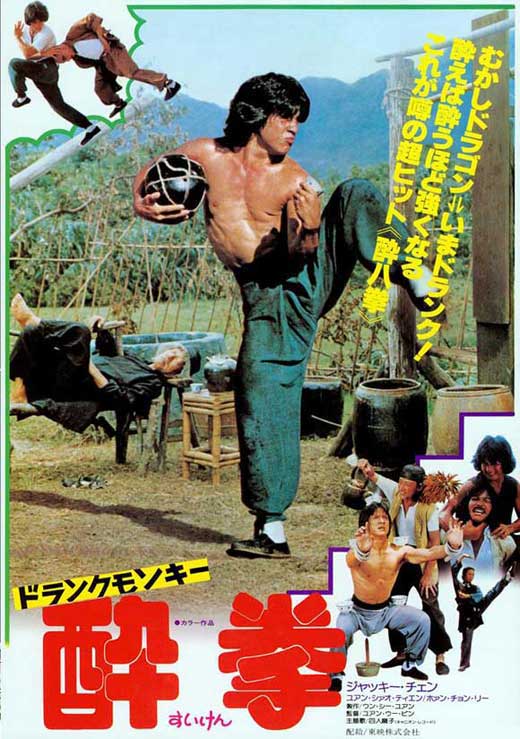
Drunken Master (1978)

DAY 35, DRUNKEN MASTER

DRUNKEN MASTER (1978) Four stars
There’s at least one more DRUNKEN MASTER fan out there in this great big world: 11-year-old Isaac Gonzalez from Carthage, Missouri.

Looking for a movie to watch one night, bored out of his skull after being grounded from his PlayStation 4 and his tablet, Mr. Gonzalez started thumbing around through hundreds of “old” and “older” movies, finally discovering a run of martial arts films, namely Jackie Chan films.

A wise old man finally asked Mr. Gonzalez, “Don’t you like THE KARATE KID?”

Mr. Gonzalez said, “Yeah.”

The wise old man then declared, “Well, I’ve got a movie that’s much better than THE KARATE KID. It’s awesome.”

Mr. Gonzalez said, “OK, put it on.”

Mr. Gonzalez, after subtitles were retired and the English dub reinstated early on, sat back and watched DRUNKEN MASTER in an apparent state of joy.

He laughed at the slapstick comedy, the vulgar humor, the silly banter, and the drunken boxing shenanigans. After all, doesn’t the Three Stooges’ humor transcend?

He enjoyed all the fight scenes and the great wide world variety of fighters thrown at Chan’s Wong Fei-hung.

The wise old man, after the 110 minutes were over and right before the 11-year-old boy had to go to bed on a school night, asked Mr. Gonzalez how the movie was and he said, “You were right, it’s better than THE KARATE KID. It’s awesome.”

Watching the film again with Mr. Gonzalez, paying attention to his reaction to it as well as my own, I was reminded that DRUNKEN MASTER rates as one of the most entertaining movies ever made.

It’s a blast.

This was still relatively early in Chan’s long career and two films released in 1978 helped make Chan a star, at least in Hong Kong, SNAKE IN THE EAGLE’S SHADOW and DRUNKEN MASTER. Both films have the same director and the same three actors in hero and villain roles.

I prefer DRUNKEN MASTER because, let’s see, it’s ROCKY meets ANIMAL HOUSE meets Bruce Lee.

It’s sublime ridiculousness.

Just imagine if Rocky Balboa drank alcohol before he came out against Apollo Creed and if Rocky’s trainer Mickey threw him a bottle in the middle of the fight and Rocky downed every single drop of it before knocking out Apollo.

Or if Bluto Blutarsky threw down and kicked the holy living hell out of Marmalard and Neidermeyer in a karate fight rather than start a food fight or throw a toga party. (Not that ANIMAL HOUSE had any influence on DRUNKEN MASTER. Both were released in 1978: ANIMAL HOUSE on July 28 in the United States and DRUNKEN MASTER on October 5 in Hong Kong. However, I would pair them in a double feature or perhaps group them with ROCKY for a triple feature.)

Lee tried some relatively bawdy humor early on during THE WAY OF THE DRAGON, but alas, that style worked better for Chan.

Just as it worked better for Chan developing his own brand of martial arts theater and not becoming “the next Bruce Lee.” Not possible, anyway.

DRUNKEN MASTER mixes raunch, slapstick, and (of course) great fight scenes in a way that I had never seen before.

It must have been almost 20 years ago when I first saw it; I rented a dubbed copy on VHS and was blown away.

Like I said not that long ago (certainly not been 20 years), I had never seen anything like DRUNKEN MASTER before and it especially enthralled me with its bountiful supply of colorful fighters with distinct fighting styles. Seems like there’s a great fight scene every few minutes, and they just keep getting better every single fight.

Yes, virtually every single character in this action spectacular can fight and these characters each get their moment in the sun over 110 minutes.

It also has a fantastic “Eight Drunken Gods” training montage.

Speaking of training, before we leave one should mention THE KARATE KID (1984) features a watered-down, more feel-good version of the mentor by comparison with the one in DRUNKEN MASTER. Beggar So (Yuen Siu-Tien) can be cruel and sadistic, at times, but he and Chan’s Wong Fei-Hung do form enough of a bond that helps carry us through.
Ironic that Chan played the mentor role in THE KARATE KID remake (2010).

With DRUNKEN MASTER, Chan started to find his niche as one of the most enduring of action movie stars.

He’s so damn likable partly because he gives you value for money. You know you’re likely to get your money’s worth when you put it down on Chan, through action or humor or both and you know that it’s Chan performing all those stunts himself. That man certainly risked life and limb to entertain us.

Chan also brought his influences from silent movie comedians like Buster Keaton, Charlie Chaplin, and Harold Lloyd, unique sources for inspiration. Chan even replicated a pair of the most famous stunts from Keaton and Lloyd, respectively.

Having a small role in CANNONBALL RUN, Chan was influenced by that Burt Reynolds-starring, Hal Needham-directed, cast-of-thousands car race comedy to feature a gag reel in his own movies, but rather than blown lines, Chan’s end credits often highlight stunts gone awry.

Chan belongs in the upper echelon of action stars, alongside such luminaries as Clint Eastwood, Arnold Schwarzenegger, Bruce Lee, Paul Newman, and Sylvester Stallone, who at their very best deliver the goods at a high level.