Abbott and Costello Meet the Mummy (1955)

ABBOTT AND COSTELLO MEET THE MUMMY (1955) Two stars
Bud Abbott (1897-1974) and Lou Costello (1906-59) enjoyed a phenomenal run for Universal Studios from 1941’s Buck Privates through 1955’s Abbott and Costello Meet the Mummy.

They made lots of pictures that made lots and lots of money and they met lots and lots of interesting people (and monsters) in their pictures.

Their career meeting people for Universal took off with the 1948 hit Abbott and Costello Meet Frankenstein, a title which sells Larry Talbot / The Wolf Man (Lon Chaney Jr.), Dracula (Bela Lugosi), and even for one gag the Invisible Man (Vincent Price) short. After that, let’s see, Abbott and Costello meet the Killer, Boris Karloff (not the killer), the Invisible Man (not Vincent Price), Captain Kidd, Dr. Jekyll and Mr. Hyde, the Keystone Kops, and the Mummy. We should pause right here and mention Abbott and Costello visited Jack and his beanstalk, Africa, Mexico, and Mars.

I wanted to like Abbott and Costello Meet the Mummy.


I wanted to laugh at Abbott and Costello Meet the Mummy.

I had a mixed reaction instead.

I liked it without laughing at it once.

Since it’s a comedy and I didn’t laugh even once, I guess I don’t really like it.

I call it a forced smile picture more than anything else, where I see the joke, understand the joke, and finally smile with a sense of resignation.

Maybe I have seen too many Abbott and Costello films in close proximity during quarantine, not to mention imitation Abbott and Costello Don Knotts and Tim Conway in The Private Eyes, but I failed to laugh at humor frequently predicated on Costello fumbling bumbling stumbling into or through someone or something, being terrified beyond the capacity for rational thought or a coherent sentence, and then most often failing to make the skeptical Abbott believe him. I swear, Abbott and Costello must play their favorite routine about 100 times during Meet the Mummy.

Abbott and Costello only call each other by name throughout Meet the Mummy. During the final credits, they’re listed playing Pete Patterson and Freddie Franklin, respectively. That’s about the high point of the humor in Meet the Mummy.

Of all the Universal classic monsters, I must admit that I like the Mummy series the least, namely the four pictures Universal rattled off like machine gun fire in the 1940s — The Mummy’s Hand, The Mummy’s Tomb, The Mummy’s Ghost, and The Mummy’s Curse. I like Hand alright, find Tomb elevated by Lon Chaney Jr.’s debut as Kharis, and Ghost and Curse have already blended into monotonous goo in my brain after seeing them back-to-back recently. Don’t even get me started on the Indiana Jones wannabe Brendan Fraser CGI monstrosities and I blissfully missed Tom Cruise’s so-called abomination completely.

Chaney Jr. proved to be the most menacing Mummy on screen, and he’s not in Meet the Mummy. It could be any other guy wrapped in gauze and affecting a lumbering pace. Yeah, it’s a guy named Eddie Parker. Oh, sure, probably a nice guy, but still no Chaney Jr. They call the Mummy ‘Claris’ — not Kharis — anyway in Meet the Mummy.

Meet Frankenstein and Meet the Invisible Man worked because the actors portraying the monsters played it straight rather than knowing they were in a comedy. It’s similar to the acting in Airplane, Top Secret, and The Naked Gun, in that it never received the credit it deserved.

As for Abbott and Costello, there’s always Hold That Ghost, Meet Frankenstein, Meet the Invisible Man, and “Who’s on First.”

Boris, Boris, Boris: The Man They Could Not Hang, The Man with Nine Lives, The Boogie Man Will Get You

BORIS, BORIS, BORIS: THE MAN THEY COULD NOT HANG, THE MAN WITH NINE LIVES, THE BOOGIE MAN WILL GET YOU

I am a big fan of the horror movies of the 1930s and 1940s and I am a big Boris Karloff (1887-1969) fan.

Older horror movies often stand out for two main reasons: atmosphere and wit. Just think DR. JEKYLL AND MR. HYDE and THE BRIDE OF FRANKENSTEIN.

Karloff’s film career began in the silent era and he was already 80 movies deep into his career when he portrayed Frankenstein’s Monster in James Whale’s 1931 FRANKENSTEIN. Karloff’s career exploded and he (along with such figures as Bela Lugosi, Peter Lorre, Basil Rathbone, Lionel Atwill, and Lon Chaney Jr.) became synonymous with a certain vintage of horror thrillers.

Watching his early Universal films like FRANKENSTEIN and THE OLD DARK HOUSE and then his work for Columbia like THE MAN THEY COULD NOT HANG, THE MAN WITH NINE LIVES, and THE BOOGIE MAN WILL GET YOU, it is fascinating to observe Karloff’s evolution from menacing mutes to mad scientists with mad elocution. In fact, during THE BOOGIE MAN WILL GET YOU, I wanted Karloff’s Professor Nathaniel Billings to just the heck shut up for a darn minute. He’s a blabbermouth, and it’s amazing to even think of Karloff playing that way after FRANKENSTEIN and THE OLD DARK HOUSE made the actor famous for playing silent but deadly.

THE MAN THEY COULD NOT HANG contains one of Karloff’s best performances. He plays Dr. Henryk Savaard, a genius who can bring the dead back to life, a feat that might come in handy for a film titled THE MAN THEY COULD NOT HANG. You guessed it, that man would be Dr. Savaard. Anyway, a medical student volunteers for Dr. Savaard and before he can be returned to life, them darn proper authorities interrupt Dr. Savaard. Call it “cadaver reanimatus interruptus.” They bring Dr. Savaard up for murder, convict him, and sentence him to death by hanging. They do in fact hang the good doctor, but his incredibly trustworthy assistant claims the body and brings the doctor back to life to enact his revenge against the judge and the jury responsible for convicting him and sentencing him to his death.

THE MAN THEY COULD NOT HANG basically splits into three movies: mad scientist, courtroom drama, and revenge thriller. It all works extremely well predominantly because of Karloff, whose performance dominates the movie. His courtroom defense scene is a thing of absolute beauty and it just might be his best single scene.

By the way, I absolutely love it when horror movies are not afraid to venture into other genres and become more than a horror movie while simultaneously maintaining the bulk of their body within the genre.

THE MAN WITH NINE LIVES tells a similar tale and Karloff plays a similar character to his role in THE MAN THEY COULD NOT HANG. Both pictures also have the same director (Nick Grinde) and the same writer (Karl Brown), as well as the same cinematographer (Benjamin Kline).

NINE LIVES picks up once we find Karloff’s Dr. Leon Kravaal frozen in an ice chamber deep in a secret passage within his home. Also found are Dr. Kravaal’s accusers … and might I add the plot of THE MAN WITH NINE LIVES gets very loopy even for its genre, despite its ties to real life.

Both THE MAN THEY COULD NOT HANG and THE MAN WITH NINE LIVES are rooted in Dr. Robert E. Cornish and his famous resuscitation experiments. Cornish successfully revived two dogs (Lazarus IV and V) and he wanted to expand his testing on humans. San Quentin inmate Thomas McMonigle, on Death Row, contacted Cornish and offered his body for experimentation, but California denied Cornish and McMonigle their petition because law enforcement officials feared a reanimated McMonigle would have to be freed due to “double jeopardy.” McMonigle was executed in early 1948. Cornish (1903-63) himself appeared in the 1935 film LIFE RETURNS, playing himself.

THE BOOGIE MAN WILL GET YOU plays around with similar material as the other Karloff films he made for Columbia, only more for laughs this fifth time. Yes, Karloff plays yet another mad scientist.

The presence of Karloff and Peter Lorre (1904-64) guarantees at minimum a certain quality and THE BOOGIE MAN WILL GET YOU definitely finds that minimum and nothing less or nothing more. The less said about it the better, and I wish the movie would have followed that policy.


THE MAN THEY COULD NOT HANG ***1/2; THE MAN WITH NINE LIVES ***; THE BOOGIE MAN WILL GET YOU **

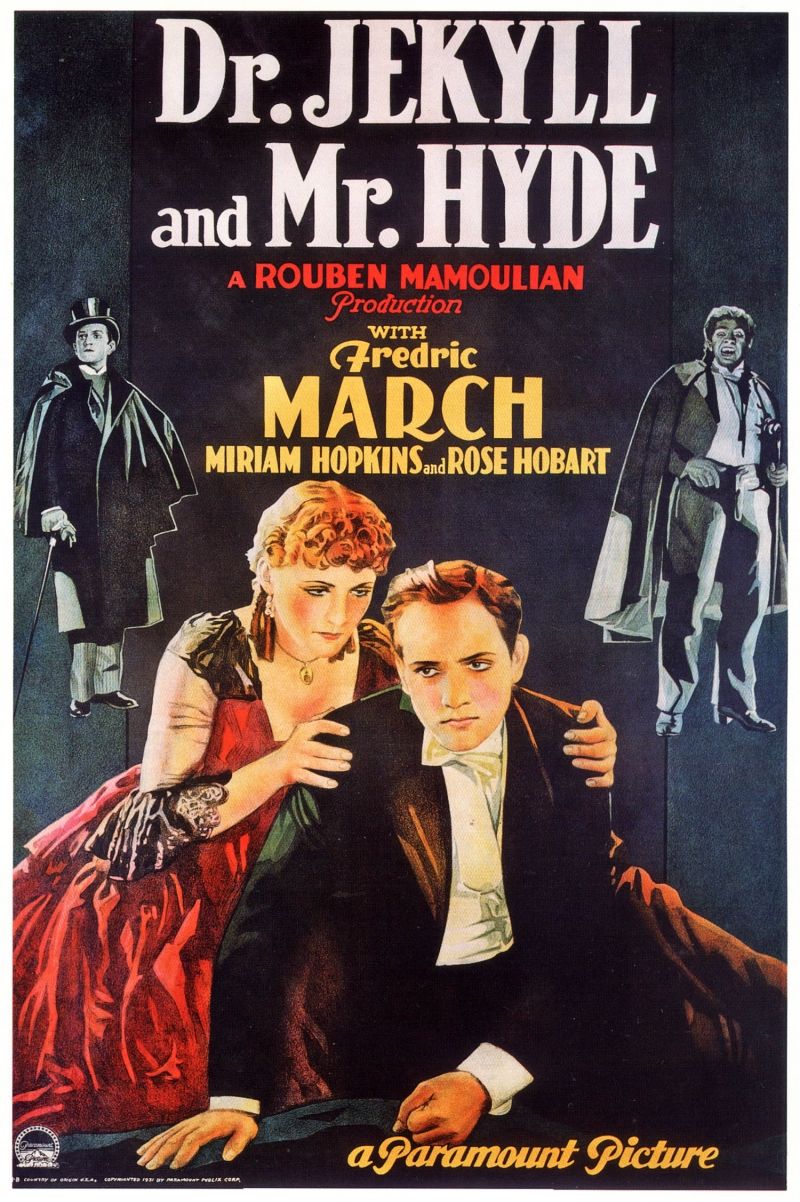
Dr. Jekyll & Mr. Hyde (1931)

day 16, dr. jekyll and mr. hyde

DR. JEKYLL AND MR. HYDE (1931) Four stars
The duality of man.

It was featured in a memorable conversation in FULL METAL JACKET between a colonel and Private Joker:
Colonel: Marine, what is that button on your body armor?
Private Joker: A peace symbol, sir.
Colonel: Where’d you get it?
Private Joker: I don’t remember, sir.
Colonel: What is that you’ve got written on your helmet?
Private Joker: “Born to Kill,” sir.
Colonel: You write “Born to Kill on your helmet and you wear a peace button. What’s that supposed to be, some kind of sick joke?
Private Joker: No, sir.
Colonel: You’d better get your head and your ass wired together, or I will take a giant shit on you.
Private Joker: Yes, sir.
Colonel: Now answer my question or you’ll be standing tall before the man.
Private Joker: I think I was trying to suggest something about the duality of man, sir.
Colonel: The what?
Private Joker: The duality of man. The Jungian thing, sir.

The duality of man is at the heart of DR. JEKYLL AND MR. HYDE in every form, be it Robert Louis Stevenson’s 1886 novella STRANGE CASE OF DR. JEKYLL AND MR HYDE and the 1931 and 1941 film versions with Fredric March and Spencer Tracy, respectively.

Dr. Henry Jekyll (March) believes that every man possesses two inside him (one good and one bad) and he puts this belief to the test with his creation of a formula that separates his good from his bad. He believes that if good and bad are separated, men will become truly liberated. Jekyll’s downfall will be his arrogance and his contempt for both his peers and the bounds for which one should not go.

Jekyll transforms into Mr. Edward Hyde, unleashing his inner demons on the world, especially a down-on-her-luck cabaret singer named Ivy Pearson (Miriam Hopkins). Jekyll saves Miss Pearson one night from a mugging and the very attractive young woman shows her appreciation to Jekyll in ways (bare legs, a kiss) that hasten Jekyll’s transformation into Hyde. It’s that leg that sticks with Jekyll, who’s engaged to be married to the socially respectable Muriel Carew (Rose Hobart) and you can go ahead and read socially respectable as dull. (The movie takes full advantage of coming before the Production Code that would have downplayed the sexual angle.)

Jekyll’s suave and sophisticated, well-respected, and known for both his decency and charitable works, but Hyde’s more a Neanderthal than a 19th Century Man with violent outbursts common and incredible physicality like brute strength and super jumping ability. Hyde is the darker side of Jekyll’s personality that he has repressed for so long, as a man of science turns into a homicidal maniac even without any potion.

Like many scientists in the movies, Jekyll messes around with things no man should and he pays the price dearly. There’s a dialogue scene between Jekyll and his friend Dr. Lanyon that gets to the gist of it:

Lanyon: You’re a rebel, and see what it has done for you. You’re in the power of this monster that you have created.
Jekyll: I’ll never take that drug again!
Lanyon: Yes, but you told me you became that monster tonight not of your own accord. It will happen again.
Jekyll: It never will. I’m sure of it. I’ll conquer it!
Lanyon: Too late. You cannot conquer it. It has conquered you!

March (1897-1975) was one of the best actors of his era on both stage and screen, winning two Academy Awards for Best Actor and two Tony Awards, and he gives two of the greatest performances in any horror film as Jekyll and Hyde, because they both take up residence in our mind.

For his work as Jekyll and Hyde, March tied with Wallace Beery (THE CHAMP) for the Academy Award for Best Actor. Should he not have won outright for playing two roles masterfully?

(Alas, March received one more vote than Beery. Unfortunately, though for March, Academy rules at that point in time considered an one-vote margin to be a tie. Thus, March and Beery tied for the award. This would not be the case any longer under Academy rules.)

DR. JEKYLL AND MR. HYDE, like many horror movies from the 1930s and 1940s, sticks with you long after it’s over and not only for its compelling themes and March’s performances but also for the use of POV shots and lap dissolves, transformation scenes, Hopkins’ performance as Ivy, and its evocation of a Victorian London that made Jekyll say “London is so full of fog, that it has penetrated our minds, set boundaries for our vision.”

Atmospheric has been used to describe the film directed quite masterfully by Rouben Mamoulian only a couple times.

Mamoulian pulls out all the stops in realizing the movie creatively.

Mamoulian on the transformation scene, “I asked, ‘What kind of sound can we put with this? The whole thing is fantastic. You put a realistic sound and it will get you nowhere at all.’ So again, you proceed from imagination and theory and if it makes sense, do it. I said, ‘We’re not going to have a single sound in this transformation that you can hear in life.’ They said, ‘What are you going to use?’ I said, ‘We’ll light the candle and photograph the light, high frequencies, low frequencies, direct from light into sound. Then we’ll hit a gong, cut off the impact, run it backward, things like that.’ So I had this terrific kind of stew, a melange of sounds that do not exist in nature or in life. It was eerie but it lacked a beat, and that’s where I had to introduce rhythm.

“So I said, ‘We need a beat.’ We tried all sorts of drums, but they all sounded like drums. When you run all out of ideas, something always pops into your head. I said, ‘I’ve got it.’ I ran up and down the stairway for two minutes until my heart was really pounding … and said, ‘Record me.’ And that’s the rhythm of the big transformation. So when I say my heart was in JEKYLL AND HYDE, it’s literally true.”