Bats, Bats, Bats & Jaws with Claws: Nightwing, Prophecy, Grizzly

BATS, BATS, BATS & JAWS WITH CLAWS: NIGHTWING, PROPHECY, GRIZZLY
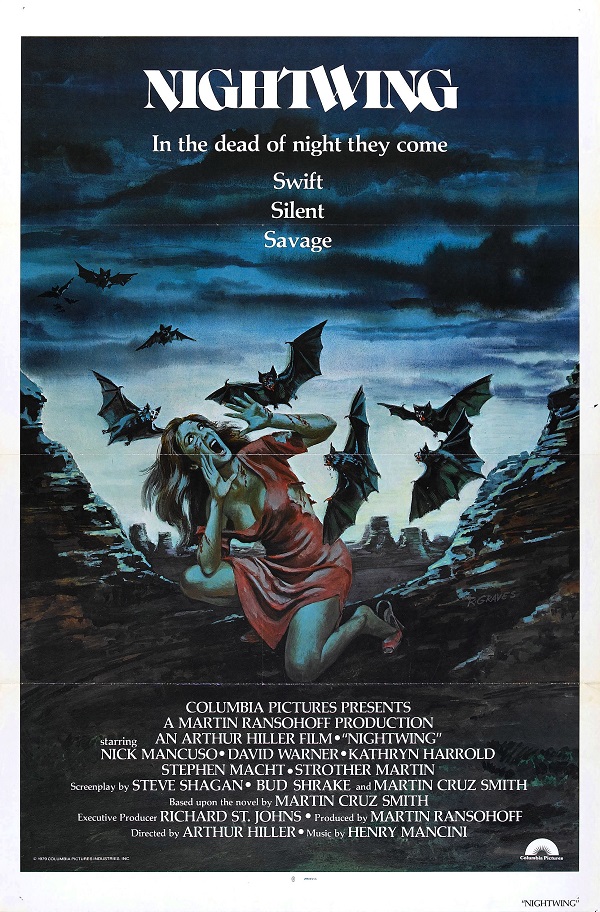
Distinguished character actor David Warner (1941-2022) almost redeems large portions of the 1979 killer vampire bat picture Nightwing, and he’s the reason that it rates out around two stars rather than one or possibly even worse.

Pardon the pun, but Warner truly bites into his dialogue and his monologues are the best moments in Nightwing. Phillip Payne comes across a little batty himself, more often delightfully so than not, and that batty quality would seem to come naturally with the territory of studying and killing plague-infested vampire bats.

The film’s best moments are definitely not the special effects and the vampire bat attack scenes, which almost had me laughing as much as The Bat People or Prophecy or perhaps the ultimate cinematic disaster disaster movie The Swarm.

Generally, I love the prerequisite genre scenes where the scientist explains the phenomenon on the rampage within the movie to a slack-jawed authority figure who usually downplays whatever threat it might be and decides to keep the park / town open.

It rarely ever lets me down, and I enjoyed Nightwing every time Phillip Payne goes all Dr. Sam Loomis on us about vampire bats.

Youngman Duran: It just doesn’t seem natural for a man to spend his life, his entire life, killing bats.

Phillip Payne: Not just bats. Vampire bats. I kill them because they’re evil. There’s a mutual grace and violence in all forms of nature; and each specie of live gives something in return for its own existence. All but one. The freak. The vampire bat alone is that specie. Have you ever seen one of their caves?

YD: No.

PP: I killed over 60,000 of them last year in Mexico. You really understand the presence of evil when you go into their caves. The smell of ammonia alone is enough to kill you. The floor of the cave is a foul syrup of digested blood. And the bats: up high, hanging upside down, rustling, fighting, mating, sending constant messages, waiting for the light to fade, hungry for blood, coaxing the big females to wake up and flex their nightwings to lead the colony out across the land, homing in on any living thing; cattle, sheep, dogs, children, anything with warm blood. And they feast, drinking the blood and pissing ammonia. I kill them because they’re the quintessence of evil. To me, nothing else exists. The destruction of vampire bats is what I live for.

Alrighty then.

Almost none of the small pleasures from Nightwing are to be found in Prophecy, films released only a week apart during June 1979.

Prophecy alternates between a serious, more ambitious movie about ecological concerns and land rights in a dispute between Native Americans and the polluting paper mill, domestic scenes involving a husband (Robert Foxworth) and his wife (Talia Shire), and silly monster attack scenes that belong in something like Food of the Gods or Bigfoot, two bad monster movies from earlier in the ’70s.

Rather, I meant laughably bad monster attack scenes.

None of the elements gel well together in Prophecy.

Prophecy gets awful preachy at times, maybe not too much of a surprise given the film’s title, and Foxworth’s Dr. Robert Verne makes for a rather lackluster and thus unlikable protagonist. Foxworth does not give Prophecy a jolt like Warner does in Nightwing, and his scientific explanatory scenes are pedestrian.

Dr. Verne and his wife Maggie do not have the relationship that, let’s see here, pugilist protagonist Rocky Balboa (Sylvester Stallone) and Adrian (Shire) do in Rocky and Rocky II, ironic considering that Rocky II and Prophecy were both released June 15, 1979.

Their domestic scenes are a drag, and I think less of Foxworth’s Dr. Verne from early on because of the way he treats his wife.

Veteran character actor Richard Dysart (1929-2015) gives the best performance in Prophecy, and it’s not even close. Dysart plays the role of the detestable paper mill company man Isely so effectively that it’s one of the film’s greatest disappointments when it cuts away from his graphic dismemberment by mercury mutant bear Katahdin late in the picture. We’ll have to settle instead for Dysart’s grisly death scene in John Carpenter’s The Thing.

The Katahdin we actually get in the finished product and the one in the promotional material (and dialogue) are not exactly one and the same, which hearkens Prophecy back to low-budget precursors like The Giant Claw and The Wasp Woman more than contemporaries like Alien and Dawn of the Dead, but without the fun of any of those movies.

Leonard Maltin described the monster as a giant salami, Isely said that it’s larger than a dragon with the eyes of a cat, Time reportedly said that it’s Smokey the Bear with an advanced acne condition, and Gene Siskel and Roger Ebert called it a cross between an earthworm and a bear (Siskel) and a grizzly bear and Godzilla (Ebert).

Given that it’s Kevin Peter Hall as the man in the monster suit, one might be tempted to call it a cross between Predator and Harry and the Hendersons.

Manbearpig!

Grizzly, a killer bear picture released three years before Prophecy, works a lot better than Prophecy because it succeeds at a much more modest level of ambition.

It’s required by law that every review mention Grizzly is a Jaws rip-off or we can go right on ahead and call it Jaws with Claws.

We have a law enforcement officer (park ranger), a military veteran (helicopter pilot), and a scientist (naturalist) on the hunt for a giant killer animal (grizzly bear). We also have a park supervisor who refuses to close down the national park despite a series of brutal deaths. The park supervisor allows hunters into the forest to hunt and kill the bear, while media converge on the scene for sensational coverage, but eventually our three main characters must try and do the deed themselves.

I honestly don’t mind too much that Grizzly follows the Jaws formula because Christopher George, Richard Jaeckel, and Andrew Prine are good in their roles and I care about them in their battle against a primal beast.

Honestly, it’s as simple as that, whereas I didn’t particularly care about the overwhelming majority of the human characters in Prophecy and did not care one way or another whether they lived or died just as long as the end credits rolled.

Grizzly, thankfully, is also not preachy, it’s endearing and entertaining on a basic level, and it’s a pleasant way to spend 90 minutes.

Granted, the three main actors and characters are not anywhere near the same level as Roy Scheider’s Sheriff Brody, Richard Dreyfuss’ Matt Hooper, and Robert Shaw’s Captain Quint, just like William Girdler’s no Steven Spielberg, but I still think Grizzly has earned a place right alongside such ’70s killer animal staples as Night of the Lepus, Frogs, Squirm, Kingdom of the Spiders, and Piranha.

Nightwing (1979) **; Prophecy (1979) *; Grizzly (1976) ***
Auto Pilot Cinema: The Airport Movies

AUTO PILOT CINEMA: THE AIRPORT MOVIES
When thinking of the worst series in movie history, I am tempted to start with Saw and Fast and the Furious then move back through time with The Omen and Amityville Horror and finally go way way way back to the Dead End Kids, er, Bowery Boys.

In piecing through all this cinematic carnage, I should not leave behind the four Airport movies that were churned out by Universal Pictures from 1970 to 1979. Maybe I should leave them behind.

Airport, based on Arthur Hailey’s 1968 novel of the same name, made a killing at the box office upon its late May release in 1970 and it even received 10, yes, believe it or not, 10 Academy Award nominations, including Best Picture, and 70-year-old Helen Hayes won Best Supporting Actress.

The three subsequent films — helpfully labeled 1975, ’77, and ’79 — got worse and worse, naturally, and the last film in the series, The Concorde … Airport ’79, is so bad (and so aggressively stupid) in fact that it could kill off any series. That’s despite the fact that it reportedly made $65 million, a much better take than, for example, Irwin Allen productions The Swarm ($7.7 million), Beyond the Poseidon Adventure ($2.1 million), and When Time Ran Out ($3.8 million). Regardless, Universal stopped making Airport movies after The Concorde and I’m almost dumbfounded why there’s not been a remake or a reboot loaded with today’s stars.

Hey, wait, did somebody mention stars? Yes, stars, that’s what these Airport movies were about — speculating which ones would emerge at the end of the picture relatively intact and which ones would die spectacularly. Grand Hotel in the sky, not exactly, since none of the careers in the Airport movies were at their peak like the ones in Grand Hotel, but the idea of stuffing the screen with stars in every scene applies just the same.

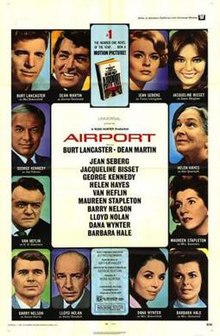
Airport: Burt Lancaster, Dean Martin, Jean Seberg, Jacqueline Bisset, George Kennedy, Hayes, Van Heflin, Maureen Stapleton, Barry Nelson, Dana Wynter, Lloyd Nolan.

Airport 1975: Charlton Heston, Karen Black, Kennedy, Efrem Zimbalist Jr., Susan Clark, Helen Reddy, Linda Blair, Dana Andrews, Roy Thinnes, Sid Caesar, Myrna Loy, Gloria Swanson.

Airport ’77: Jack Lemmon, Lee Grant, Branda Vaccaro, Joseph Cotten, Olivia de Havilland, Darren McGavin, Christopher Lee, Robert Foxworth, Kathleen Quinlan, James Stewart.

Airport ’79: Alain Delon, Susan Blakely, Robert Wagner, Sylvia Kristel, Kennedy, Eddie Albert, Bibi Andersson, Charo, John Davidson, Andrea Marcovicci, Martha Raye, Cicely Tyson, Jimmie Walker, David Warner, Mercedes McCambridge.

More like Hollywood Squares in the Sky? Yeah, believe so, especially since Davidson hosted a Hollywood Squares revival in the late ’80s.

Beside Airport in the titles, Kennedy (1925-2016) proved to be the connective tissue between all four pictures, meaning he’s the inverse of the Brody boys (Jaws) and the Griswold children (Vacation). Kennedy played Joe Patroni — first as mechanic, then as vice president of operations (1975), a consultant (’77), and finally an experienced pilot (’79). Regardless of position or rank, the character got worse and worse over the course of the films, not that he or the films started out all that hot. I found even his cigar was guilty of overacting in the original film and Patroni was so odiously obnoxious in the fourth film, especially after he utters the line that articulates the sexism of the entire series, They don’t call it the cockpit for nothing, honey. George Kennedy as sex symbol? Sure, I’ll believe anything, nearly anything except for, oh, the entire plot of The Concorde.

I’ll talk more about The Concorde and the original because they’re fresher in my memory. To be honest, though, I probably won’t even feel like discussing the original because …

Movies rarely come any dumber than The Concorde: Let’s see, this is going to be fun, not really, anyway TV reporter Susan Blakely comes across some highly incriminating evidence against defense contractor (and covert arms dealer) Robert Wagner. Wagner decides that he’s going to attempt to blow up real good the plane she’s on en route from Washington to Paris. Okay, okay, his plot to blow up the Concorde real good fails and they have dinner together in Paris during the middle section of the movie, because, you know, they have a history together and they still love each other. She still has this incriminating evidence, naturally, she’s going to eventually go public with it, of course, and what does he do? Kill her? He lets her walk away safe and unharmed, so he’ll have to go after the plane again. That’s right, she gets back on the Concorde for the final leg of the flight from Paris to Moscow. Guilt stricken, Wagner commits suicide very late in the picture and I believe it’s not because his secret’s been discovered and will be exposed regardless of whether he’s alive or not, but more that he’s one of the worst villains in cinematic history.

The Concorde is so laughable in so many ways, as if that whole plot discussed in the last paragraph wasn’t enough. The Concorde stops over in Paris for a night, and every single passenger gets back on the plane the next morning. They all seem way too calm and collected after the events of the first half of the movie. I would love to have just heard one character say ‘Hell no, I’m not getting back on that damn plane!’ They all deserved to die, but we know that’s not happening.

At one critical point during the first attack on the Concorde, the Übermensch George Kennedy proves that he’s truly The Übermensch by sticking his hand out the window of the Concorde and throwing a flare. Unbelievable, utterly unbelievable even in this preposterous movie. If only the first Airport had been the in-flight movie on The Concorde, especially that scene where Patroni discusses the effects of a bomb on a 707 and concludes, When I was a mechanic in the Air Force, I was being transferred on a MATS plane. At 20,000 feet, one of the windows shattered. The guy sitting next to it was about 170 pounds. He went through that little space like a hunk of hamburger going down a disposal, and right after him coats, pillows, blankets, cups, saucers. That was just a MATS plane, not the fastest plane in the universe.

I’m done, I can’t take it anymore, and I’m bailing out on the Airport movies.

Airport (1970) **; Airport 1975 (1974) **1/2; Airport ’77 (1977) *; The Concorde: Airport ’79 (1979) 1/2*

Time After Time (1979)

TIME AFTER TIME

TIME AFTER TIME (1979) Three-and-a-half stars

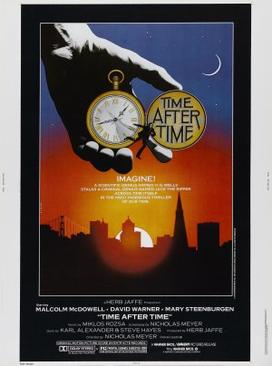
Screenwriter and director Nicholas Meyer created some nifty concepts for his 1979 directorial debut TIME AFTER TIME: what if writer Herbert George Wells (1866-1946) really did invent a time machine, what if surgeon John Stephenson (“Jack the Ripper”) steals Wells’ time machine and travels from 1893 London to 1979 San Francisco, what if Wells tracks down Stephenson in San Francisco and becomes more like Sherlock Holmes (Meyer wrote the novel and screenplay THE SEVEN-PER-CENT SOLUTION), and what if Wells falls in love with a modern woman and they find themselves in danger from Mr. Stephenson.

Malcolm McDowell as Wells, David Warner as Stephenson, and Mary Steenburgen as Amy Robbins flesh out Meyer’s concepts.

McDowell brought a devilish charm to Alex in A CLOCKWORK ORANGE, another high concept picture with literary roots, and he’s a lovable English eccentric in TIME AFTER TIME.

Warner makes for a suitably menacing antagonist, who’s more in his element in late 20th Century America than he was in late 19th Century England. Meyer works the juxtaposition of Wells and Stephenson to maximum impact.

Steenburgen plays a character who almost instantly falls in love with Wells. There’s just something about the way that she tells Wells that she will believe him. She later played basically the same character in Robert Zemeckis’ BACK TO THE FUTURE PART THREE, and it works in both films.

McDowell and Steenburgen fell in love making TIME AFTER TIME together and they were married from 1980 to 1990.

They do have that extra special glow during TIME AFTER TIME, and they do create a screen couple that we fervently desire to stay together.

I have at least liked virtually every movie I have ever seen that incorporates time travel, from BACK TO THE FUTURE and TIME AFTER TIME to THE TERMINATOR, MEN IN BLACK 3, and X-MEN: DAYS OF FUTURE PAST. I find time travel movies endearingly silly and goofy in the best possible way, if nothing else, and the best ones are profound.

TIME AFTER TIME especially has fun with Wells being a stranger in a strange land … and time. Mileage will invariably vary on these gags. Of course, we have to keep in mind this Wells (1893 model) would not know about the 1906 San Francisco earthquake or about the Golden Gate Bridge which opened in 1937.

Meyer’s other credits include writing the delightfully whacked out INVASION OF THE BEE GIRLS and writing the two best STAR TREK films, THE WRATH OF KHAN and THE VOYAGE HOME. Meyer said that he tried out ideas for THE VOYAGE HOME that he did not use in TIME AFTER TIME.

TIME AFTER TIME works as comedy, science fiction, romance, and thriller. I revisited it recently as the second half of a double feature with BREAKING AWAY and both films left me feeling all nice and fuzzy inside.

NOTE: Of course, it must be a September 21 thing, since H.G. Wells, Stephen King, Bill Murray, Chuck Jones, Leonard Cohen, Ethan Coen, and David Coulier were all born Sept. 21 in their respective years.