
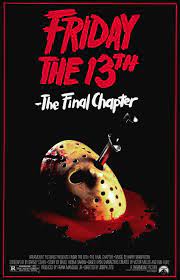
Friday the 13th: The Final Chapter (1984)

FRIDAY THE 13TH: THE FINAL CHAPTER (1984) ***
Once upon a time, I called Friday the 13th: The Final Chapter the most schizophrenic movie ever made and what I mean by this bit of hyperbole is that The Final Chapter largely alternates being a rather brutal, occasionally mean-spirited horror movie sequel and a jovial teenage sex comedy especially made explicit in casting Lawrence The Last American Virgin Monoson in one of the key supporting roles.

The Final Chapter has some of the best and also some of the worst moments in the entire 12-movie Friday series, easily the best cast and most likable characters from (almost) top to bottom, Tom Savini’s return as makeup artist, Harry Manfredini’s first-rate musical score, Ted White’s brutal conviction selling his kill scenes as Jason Voorhees, and it’s arguably the quintessential Friday the 13th movie.

Let’s hit a couple of the high points first.

The Final Chapter introduces us to Tommy Jarvis (Corey Feldman), a 12-year-old boy with a hyperactive imagination and penchant for monster make-up and masks not unlike Savini; Trish Jarvis (Kimberly Beck), Tommy’s older sister and our Final Girl; Mrs. Jarvis (Joan Freeman), Tommy’s and Trish’s single mother; Gordon the Family Dog, the golden retriever whose fate remains uncertain. Anyway, this family dynamic is something fresh and new for the Friday series.

Crispin Glover, one of the great movie eccentrics, makes his mark on The Final Chapter and his Jimmy becomes one of the most unforgettable horny (dead) teenagers in a series that served them up by the hundreds as fodder for the slaughter. Jimmy and his buddy Ted (Monoson) especially feel like refugees from a teenage sex comedy, like they continued playing their characters from My Tutor (Glover) and The Last American Virgin (Monoson). Jimmy’s dance and exit line in this movie have become the stuff of slasher movie legend.

Feldman and Glover provide us two of the most likable characters in any of the dozen Friday movies, something that’s ironic given the fact The New Beginning (which arrived in theaters around 11 months after The Final Chapter) has almost no likable characters among the largest cast of corpses in series history. Never mind that Tommy did not exactly pan out in The New Beginning and Jason Lives like the endings of The Final Chapter and The New Beginning seemed to promise.

I almost forgot Rob (E. Erich Anderson), the older brother of a character killed by potato sack Jason in Part 2. Rob seeks revenge against Jason and fortunately he meets Trish and Tommy first, though ultimately it does not matter because Rob represents one of the great missed opportunities. Here’s a character who could have served as a basis for an entire movie and The Final Chapter makes him completely underwhelming. His death scene, designed to be poignant, instead becomes laughable (‘He’s killing me. He’s killing me’) and it wishes it could be as enjoyably bad as the bookseller’s death in Dario Argento’s Inferno. You might recall that the creepy old book retailer’s done in by rats and a homicidal Central Park hot dog vendor.

Now, we’ve moved on to the more negative.

Our first two new corpses in The Final Chapter represent one of my least favorite scenarios that’s commonly found in Friday movies. We spend several minutes, it feels even longer, much much much longer, with super horny morgue attendant Axel (Bruce Mahler) and super uninterested Nurse Morgan (Lisa Freeman) before they are massacred by Jason. Maybe it’s only a few minutes, but I never want to watch their scenes ever again to find out. I’ll use their introduction as my cue to go make some scrumptious butter popcorn.

Like the beginning of Part III and the obligatory murder of the lakefront store owners, these are minutes of my life that could have been attended to better things, even during a Friday movie.

The Final Chapter loves breaking glass and characters falling through windows.

The Final Chapter gets straight at the heart of the ambivalent relationship between parent company Paramount Pictures and the Friday movies.

One immediately gets the feeling that Paramount wanted The Final Chapter, you know, to be the end of Jason once and forever because the studio hotshots were ashamed to be associated with such a disreputable and sleazy franchise, but, alas, at the same time, The Final Chapter leaves the door open for more sequels with one of the series’ trademark endings. Paramount walked through that very door — actually, more like sprinted — when The Final Chapter returned a hefty profit.

The Final Chapter finished in the top 25 box office for 1984 and put together a $11.1M opening during the weekend of April 13.

Friday, April 13, 1984. The Challenger returned to Earth from their 11th space shuttle mission. India beat Pakistan by 54 runs to win the first Asia Cricket Cup in Sharjah, United Arab Emirates.

Paramount released A New Beginning on March 22, 1985, and 1983 and 1987 are the only years of the ’80s without a Friday the 13th movie. Do 1983 and 1987 belong to another decade?

I more or less grew up with the Friday movies, so I might be more forgiving of them for all their numerous faults than people who grew up in different times.

Then again, I might not be, because I only consider Jason Lives (the best made and the only entry that deserves a place near second- or third-tier classic horror movies like Frankenstein Meets the Wolf Man), Part III (the most suspenseful and the one where Jason acquires his legendary hockey mask), and The Final Chapter even worth recommending. Most of the rest of them have their isolated moments, all of them are excuses for reels of sex and violence and vulgarity, and the movies definitely created their own distinctive space in the cinematic marketplace.

How did the world end up with 12 Friday the 13th movies and legendary status for both the series overall and serial killer Jason Voorhees specifically, when similar movies like My Bloody Valentine, The Burning, Happy Birthday to Me, and Madman failed to produce one sequel among them. Granted, the original Friday finished 15th in the 1980 American box office sweepstakes and the first three sequels also proved to be solid hits among strong competition, while The Burning grossed $700 thousand, Madman $1.3M, My Bloody Valentine $5.7M, and Happy Birthday to Me $10.6M.

Money obviously talked for Jason.
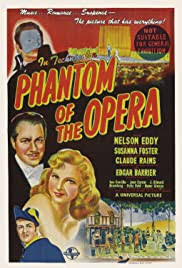
Phantom of the Opera (1943)

PHANTOM OF THE OPERA (1943) **
I put off watching a sound version of Phantom of the Opera for the longest time and the 1943 Phantom of the Opera only confirmed that suspicion and doubt.

Claude Rains did not even remotely approach what Lon Chaney accomplished in the 1925 silent version and I have to face the fact that I am definitely not the world’s biggest opera fan.

Yes, I do realize that I made it through A Night at the Opera and Opera with relative ease, but predominantly because I am big fans of both the Marx Brothers and Dario Argento, not opera.

Allan Jones’ production numbers in both A Night at the Opera and A Day at the Races, as well as James Whale’s Show Boat, are why they invented the fast-forward and skip buttons. The Marx Brothers’ numbers are infinitely better on the ears.

As for Argento, he goes so far over the top (especially in the murder sequences) that I find his operatic excess in Opera enjoyable.

Universal Studios invested $1.75 million on Phantom of the Opera (both Phantom and fellow 1943 release Frankenstein Meets the Wolf Man received much larger production budgets than previous Universal releases, like, for example, the $180,000 Wolf Man from 1941) and the film accomplished something unique for an Universal horror film — win an Academy Award, for Best Art Direction and Best Cinematography, and it was nominated in two more categories.

Phantom of the Opera, the first adaptation of the 1910 Gaston Leroux novel filmed in Technicolor, became a hit, especially in France.

Sorry to say, though, it’s not deserving of classic status.

Universal released 25 horror films from 1931’s Dracula through 1948’s Abbott and Costello Meet Frankenstein that are grouped together in the Classic Monsters series and I rank Phantom of the Opera only ahead of The Mummy’s Ghost, The Mummy’s Curse, and The Invisible Woman.

Lon Chaney Jr. (1906-73) felt slighted Universal did not consider him for his father’s most legendary role. Granted, he was an incredibly busy actor. Chaney Jr. had starring roles in the three films immediately surrounding Phantom of the Opera in 1942 and 1943 — his first time playing Kharis in The Mummy’s Hand, his second time as Larry Talbot / The Wolf Man in Frankenstein Meets the Wolf Man, and his first and only time as Dracula in Son of Dracula. Chaney Jr. previously took on Frankenstein’s Monster in The Ghost of Frankenstein (1942) and he proved himself Universal’s most versatile monster thespian, only missing the Invisible Man and the Phantom from his credits.

Chaney Jr. especially worked as Larry Talbot / The Wolf Man, and I am imagining what he could have done in Phantom of the Opera.

Rains killed it as Dr. Jack Griffin in the 1933 James Whale classic The Invisible Man. In Phantom of the Opera, not so much, because he’s just not scary, even without his ridiculous mask when his mutilated face is revealed in the laughable grand finale. He’s not the film’s main problem, though, believe it or not.

I mean, Rains plays the freaking title character in Phantom of the Opera and he’s third-billed, for crying out loud, behind our singing leads Nelson Eddy and Susanna Foster. This never happened to Lon Chaney, who’s billed above both Mary Philbin and Norman Kerry. Rains’ Phantom becomes less of a factor and that just about sums up the failure of this particular Phantom of the Opera — too heavy on the opera and too light on the phantom.

Suspiria (1977)

DAY 24, SUSPIRIA

SUSPIRIA (1977) Four stars
This is one of those rare films where what would normally be weaknesses actually turn out to be strengths and help the film become a seminal work.

For example, older actors playing high school students (Jessica Harper and Stefania Casini were both in their late 20s) and dubbing only add to the weirdness and disorienting nature of SUSPIRIA, director and writer Dario Argento’s first installment in the “Three Mothers” trilogy.

SUSPIRIA is first and foremost a visceral experience, a treat for the eyes and the ears with first-rate production and sound design. It was one of the last films to use imbition Technicolor (used previously for THE WIZARD OF OZ and GONE WITH THE WIND) and it looks absolutely marvelous with its vivid colors.

You won’t be able to keep your eyes off the screen, even if you want to cover them during some of the more squeamish moments. Just remember the film’s tagline: “The only thing more terrifying than the last 12 minutes of this film are the first 92.”

Italian progressive rock band Goblin, who previously scored Argento’s 1975 classic giallo DEEP RED and later scored TENEBRE (1982), adds tremendously to the disorientating effect; Goblin’s scores for DEEP RED and SUSPIRIA rank with John Carpenter’s main HALLOWEEN theme and Bernard Herrmann’s work for Alfred Hitchcock’s thrillers.

Disorientation is what SUSPIRIA achieves thematically above anything else. We’re never quite sure what’s going to happen next, despite the fact that we think we know what to expect, even in an Argento movie, from all our experience watching scary movies. We know that everything will be heightened in an Argento movie, just like other Italian horror movies by such maestros as Mario Bava and Lucio Fulci.

However, like a lot of those other films, all the elements in SUSPIRIA work together even if logically nothing makes any sense in the moment.

Urban Dictionary lists SUSPIRIA as “One of the greatest movies ever made — Dario Argento’s 1977 horror film, about a young girl at a German dancing academy, who discovers that the faculty are witches, plotting against her life in a series of ritual voodoo killings, involving sacrifices and vestal virgins on a pagan altar. … I first saw SUSPIRIA at the age of 10, and was terrified.”

Guess that’s one way to use “Suspiria” in a sentence.

NOTE: The 2018 remake directed by Luca Guadagnino was released October 26. The movie stars Dakota Johnson and Tilda Swinton, as well as Jessica Harper and Chloe Grace Moretz, and Thom Yorke (Radiohead) provided the soundtrack.

Profondo Rosso (1975)

DAY 25, DEEP RED.jpg

PROFONDO ROSSO (1975) Four stars
Giallo is the Italian word for yellow.

In fiction terms, though, quoting from Wikipedia, giallo means “a 20th century Italian thriller genre of literature and film. Especially outside Italy, giallo refers specifically to a particular Italian thriller-horror genre that has mystery or detective elements and often contains slasher, crime fiction, psychological thriller, psychological horror, exploitation, sexploitation, and, less frequently, supernatural horror elements. In Italy, the term generally denotes thrillers, typically of the crime fiction, mystery, and horror subgenres, regardless of the country of origin.”

An Italian publishing company named Mondadori began releasing crime and mystery novels in 1929 and the series became known as “Il Giallo Mondadori,” distinguished by their heavily yellow front covers. Especially popular were the works of Agatha Christie, Dashiell Hammett, and Raymond Chandler. Mondadori still prints “Il Giallo Mondadori” novels today.

Giallo movies started appearing in the mid-1960s and became a fixture especially in the late 1960s and 1970s through directors like Mario Bava, Dario Argento, and Lucio Fulci, who achieved the greatest international notoriety.

Argento’s PROFONDO ROSSO, also known as DEEP RED or THE HATCHET MURDERS, was the director’s fifth movie and it’s a transitional film, before Argento’s work verged on the fantastical like SUSPIRIA and INFERNO. It and THE BIRD WITH THE CRYSTAL PLUMAGE, his first film, are his best giallos.

Watching PROFONDO ROSSO for the first time, one will be struck by how much you feel like you’ve seen this movie before through later films it influenced such as John Carpenter’s HALLOWEEN and David Cronenberg’s SCANNERS. For example, Goblin’s main theme for PROFONDO ROSSO and Carpenter’s for HALLOWEEN are first cousins. Cronenberg modeled the lead-in to the famous head explosion scene after the early lecture sequence in Argento’s film. Rick Rosenthal’s HALLOWEEN II (produced by Carpenter) featured a death by scalding water scene inspired by Amanda Righetti’s death in PROFONDO ROSSO.

Like the best Argento films, PROFONDO ROSSO sticks with you.

Argento films usually give us a protagonist who’s a writer, a musician, a creative person of some form. In THE BIRD WITH THE CRYSTAL PLUMAGE, it’s American writer Sam Dalmas. In CAT O’NINE TAILS, it’s reporter Carlo Giordani. In FOUR FLIES ON GREY VELVET, it’s rock drummer Roberto Tobias. In PROFONDO ROSSO, it’s pianist Marcus Daly. In SUSPIRIA, it’s American dance student Suzy Bannion. In INFERNO, it’s music student Mark Elliott.

These characters provide us a rooting interest and keep us hanging on through all the convolutions of the plot. They become our surrogate, because they’re normality (just like us) in a mad, mad, mad world. They (and we) are just trying to survive another day. They live out our detective fantasies.

In any mystery, it’s vital that we find that rooting interest.

Argento protagonists normally get in way, way, way over their heads like the ones in Hitchcock films so often do … of course, we see David Hemmings playing Marcus Daly and we cannot help but think of Michelangelo Antonioni’s BLOW-UP, where Hemmings’ very Swinging London photographer believes he may have accidentally photographed a murder in a park. There’s no doubt, though, in PROFONDO ROSSO.

On his way home early in the film, Marcus sees psychic medium Helga Ulmann (Macha Meril) being attacked in her apartment. They live in the same building. He rushes up the stairs and down the hall to her apartment and finds her dead body.

The chief witness becomes the star witness, thanks to female reporter Gianna Brezzi (Daria Nicoladi) and her coverage of the murder, and the reporter and the pianist become partners, both in the romantic and detective sense.

PROFONDO ROSSO is one of those mysteries that rewards our interest to the very end.