Ted White Cast a Giant Shadow

TED WHITE CAST A GIANT SHADOW
Stuntman and actor Ted White passed away October 14, 2022, at the age of 96.

White, born January 25, 1926, as Alex Bayouth in the small Oklahoma town Krebs known for being Oklahoma’s Little Italy, accumulated more than 160 credits from both stunts and acting over a long career, beginning with the 1949 war film Sands of Iwo Jima where he appeared uncredited as a marine and continuing through his final credited stunt work in 2006’s The Fast and the Furious: Tokyo Drift.

White, though not always credited and never a featured performer, bridged the gap between multiple eras of Hollywood filmmaking.

Tedwhite.com begins, I was born January 25, 1926 in a small town in Texas.

I enlisted in the marine corps at the age of 17 and joined the fourth marine division after finishing boot camp in San Diego. My first campaign took me to the Marshall Islands and after that I returned to Maui on the Hawaiian islands. After several months of rough training the division was sent to Iwo Jima.

After 6 years in the marine corps I resigned my commission as a second lieutenant.
I had a scholarship at the university of Oklahoma to play football and I also boxed in Golden Gloves and AAU. After 4 years of college I got married and moved to California where I began my career as a stuntman and actor.

I could go on and on but if you come to one of my conventions I would be more than happy to tell you the rest.

White’s films include Creature from the Black Lagoon, Giant, Rio Bravo, The Alamo, Cat Ballou, The Cincinnati Kid, Point Blank, Planet of the Apes, King Kong, 1941, Used Cars, Cutter’s Way, Escape from New York, History of the World, Major League, and Road House for stunts and Rio Bravo, The Alamo, Cat Ballou, Point Blank, Cutter’s Way, History of the World, Tron, Silverado, The Hidden, and Major League for acting.

White doubled most notably for John Wayne, Fess Parker, Clark Gable, and Richard Boone, and he appeared on quite a few TV shows to go along with all the films.

His peak year was obviously 1984, though, with appearances in Against All Odds, Romancing the Stone, The Wild Life, Starman, and easily his most famous role as Jason Voorhees in Friday the 13th: The Final Chapter.

Not bad for a 58-year-old man.

White refused screen credit for The Final Chapter because he thought it would do his career no good. Like Betsy Palmer and the original Friday, White apparently thought absolutely very little of the project initially but later turned around and embraced the series, their individual film, and their specific role at conventions and in retrospective interviews.

By the way, Palmer, who played Jason’s slightly protective mother Pamela Voorhees, was born on November 1, 1926 (nearly 10 months after White), and she died May 29, 2015.

When you see Jason chase after Kimberly Beck’s Trish Jarvis late in the picture, it’s obvious that he definitely could not catch her in a foot race.

White sells the kills very well in The Final Chapter befitting the status of a seasoned stuntman who stood at 6-foot-4, and they have a brutal conviction all their own in this long, long, long-running series that has finally been surpassed by Halloween in installments since there’s not been a Friday movie since 2009. (Halloween now owns a 13-12 edge on Friday.)

The combination of White and make-up artist Tom Savini, as well as the best cast in a Friday movie, contributed to The Final Chapter being widely considered the definitive Friday film, or the one recommended most often to people who have never seen a Friday film before and want to know which one they should watch first.

Not only did he refuse a screen credit, White also refused talking with the other actors during production because he thought any socialization with them would minimize their fear of him as Jason.

White thought child star Corey Feldman was a spoiled little brat, and so his acting toward Feldman’s Tommy Jarvis late in the film was borderline non-acting. Feldman posted a photo of himself and White on Twitter in 2014, 4 those who haven’t figured it out that’s Ted White who played Jason n F13pt4 n said he h8ed me….LOL!

White also famously looked after his much younger co-stars — in the most famous example, director Joseph Zito raised White’s ire when the 19-year-old Judie Aronson had to film her nude death scene in the dead of winter. Zito pressed on for the scene, and White demanded the director allow Aronson to get out of the lake between takes and let her warm up or else he would not carry on as Jason.

Aronson posted a photo of herself and White on Twitter in 2014, Having a good laugh with JasonHe killed me once in a raft, now with charm!

White passed on returning for both A New Beginning and Jason Lives after The Final Chapter proved untrue.

Savini posted on Twitter after White’s death, I’m 75 and I still want to be Ted White when I grow up. Tough as nails with a heart of gold. Pure class. He will be missed.

White obviously lived a life that could become a movie on its own.

From the introduction to his 2017 biography Cast a Giant Shadow: Hollywood Movie Great Ted White and the Evolution of American Movies and TV in the 20th Century by Larry K. Meredith:
Ted White says he can’t count the times he’s been shot and killed in films or television productions. He has (in the movies) gone into space, fought alongside Spartacus, fenced with King Arthur, stood side-by-side with Custer on the Little Big Horn, served as a Texas Ranger and robbed trains with Jesse James. He has ridden in the Oklahoma Land Rush, been shot by Danny Glover, joined Robin Hood and his band as they saved Maid Marian, helped establish the nation of Israel and knocked Jeff Bridges out cold. He’s played one of the world’s great ‘slashers,’ been an American Indian, shot and killed himself (in two different roles) from the walls of the Alamo, set the Lone Ranger on his path of doing good and righting wrongs, and helped capture King Kong.

Now, that’s quite the life.

Friday the 13th: The Final Chapter (1984)

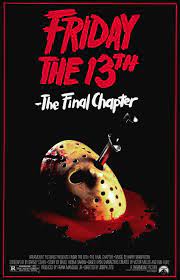
FRIDAY THE 13TH: THE FINAL CHAPTER (1984) ***
Once upon a time, I called Friday the 13th: The Final Chapter the most schizophrenic movie ever made and what I mean by this bit of hyperbole is that The Final Chapter largely alternates being a rather brutal, occasionally mean-spirited horror movie sequel and a jovial teenage sex comedy especially made explicit in casting Lawrence The Last American Virgin Monoson in one of the key supporting roles.

The Final Chapter has some of the best and also some of the worst moments in the entire 12-movie Friday series, easily the best cast and most likable characters from (almost) top to bottom, Tom Savini’s return as makeup artist, Harry Manfredini’s first-rate musical score, Ted White’s brutal conviction selling his kill scenes as Jason Voorhees, and it’s arguably the quintessential Friday the 13th movie.

Let’s hit a couple of the high points first.

The Final Chapter introduces us to Tommy Jarvis (Corey Feldman), a 12-year-old boy with a hyperactive imagination and penchant for monster make-up and masks not unlike Savini; Trish Jarvis (Kimberly Beck), Tommy’s older sister and our Final Girl; Mrs. Jarvis (Joan Freeman), Tommy’s and Trish’s single mother; Gordon the Family Dog, the golden retriever whose fate remains uncertain. Anyway, this family dynamic is something fresh and new for the Friday series.

Crispin Glover, one of the great movie eccentrics, makes his mark on The Final Chapter and his Jimmy becomes one of the most unforgettable horny (dead) teenagers in a series that served them up by the hundreds as fodder for the slaughter. Jimmy and his buddy Ted (Monoson) especially feel like refugees from a teenage sex comedy, like they continued playing their characters from My Tutor (Glover) and The Last American Virgin (Monoson). Jimmy’s dance and exit line in this movie have become the stuff of slasher movie legend.

Feldman and Glover provide us two of the most likable characters in any of the dozen Friday movies, something that’s ironic given the fact The New Beginning (which arrived in theaters around 11 months after The Final Chapter) has almost no likable characters among the largest cast of corpses in series history. Never mind that Tommy did not exactly pan out in The New Beginning and Jason Lives like the endings of The Final Chapter and The New Beginning seemed to promise.

I almost forgot Rob (E. Erich Anderson), the older brother of a character killed by potato sack Jason in Part 2. Rob seeks revenge against Jason and fortunately he meets Trish and Tommy first, though ultimately it does not matter because Rob represents one of the great missed opportunities. Here’s a character who could have served as a basis for an entire movie and The Final Chapter makes him completely underwhelming. His death scene, designed to be poignant, instead becomes laughable (‘He’s killing me. He’s killing me’) and it wishes it could be as enjoyably bad as the bookseller’s death in Dario Argento’s Inferno. You might recall that the creepy old book retailer’s done in by rats and a homicidal Central Park hot dog vendor.

Now, we’ve moved on to the more negative.

Our first two new corpses in The Final Chapter represent one of my least favorite scenarios that’s commonly found in Friday movies. We spend several minutes, it feels even longer, much much much longer, with super horny morgue attendant Axel (Bruce Mahler) and super uninterested Nurse Morgan (Lisa Freeman) before they are massacred by Jason. Maybe it’s only a few minutes, but I never want to watch their scenes ever again to find out. I’ll use their introduction as my cue to go make some scrumptious butter popcorn.

Like the beginning of Part III and the obligatory murder of the lakefront store owners, these are minutes of my life that could have been attended to better things, even during a Friday movie.

The Final Chapter loves breaking glass and characters falling through windows.

The Final Chapter gets straight at the heart of the ambivalent relationship between parent company Paramount Pictures and the Friday movies.

One immediately gets the feeling that Paramount wanted The Final Chapter, you know, to be the end of Jason once and forever because the studio hotshots were ashamed to be associated with such a disreputable and sleazy franchise, but, alas, at the same time, The Final Chapter leaves the door open for more sequels with one of the series’ trademark endings. Paramount walked through that very door — actually, more like sprinted — when The Final Chapter returned a hefty profit.

The Final Chapter finished in the top 25 box office for 1984 and put together a $11.1M opening during the weekend of April 13.

Friday, April 13, 1984. The Challenger returned to Earth from their 11th space shuttle mission. India beat Pakistan by 54 runs to win the first Asia Cricket Cup in Sharjah, United Arab Emirates.

Paramount released A New Beginning on March 22, 1985, and 1983 and 1987 are the only years of the ’80s without a Friday the 13th movie. Do 1983 and 1987 belong to another decade?

I more or less grew up with the Friday movies, so I might be more forgiving of them for all their numerous faults than people who grew up in different times.

Then again, I might not be, because I only consider Jason Lives (the best made and the only entry that deserves a place near second- or third-tier classic horror movies like Frankenstein Meets the Wolf Man), Part III (the most suspenseful and the one where Jason acquires his legendary hockey mask), and The Final Chapter even worth recommending. Most of the rest of them have their isolated moments, all of them are excuses for reels of sex and violence and vulgarity, and the movies definitely created their own distinctive space in the cinematic marketplace.

How did the world end up with 12 Friday the 13th movies and legendary status for both the series overall and serial killer Jason Voorhees specifically, when similar movies like My Bloody Valentine, The Burning, Happy Birthday to Me, and Madman failed to produce one sequel among them. Granted, the original Friday finished 15th in the 1980 American box office sweepstakes and the first three sequels also proved to be solid hits among strong competition, while The Burning grossed $700 thousand, Madman $1.3M, My Bloody Valentine $5.7M, and Happy Birthday to Me $10.6M.

Money obviously talked for Jason.

Friday the 13th Part VI: Jason Lives (1986)

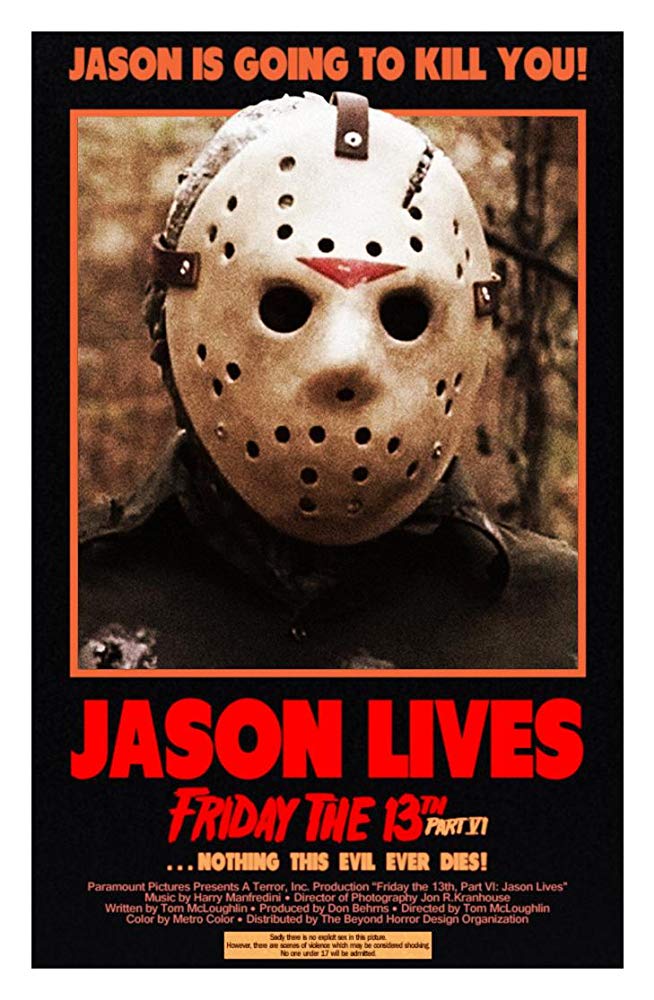
JASON LIVES

FRIDAY THE 13TH PART VI: JASON LIVES (1986) Three stars

I find the FRIDAY THE 13TH movies that I like the most are the ones with the best sense of humor.

That’s why I’ll call PART VI: JASON LIVES the best film in the entire series, beating out PART III and THE FINAL CHAPTER. JASON LIVES includes several intentionally funny scenes and that helps its 86 minutes go down smoothly.

Director and writer Tom McLoughlin wanted to satirize a slasher movie all while making one, turn Jason into a supernatural zombie, and not simply churn out a carbon copy of the five previous movies in the series. There are moments intended to recall classic horror movies, like the beginning scene in the cemetery echoes the grave robbers at the beginning of FRANKENSTEIN MEETS THE WOLF MAN. Jason’s revival from the dead courtesy lightning also recalls Frankenstein’s Monster.

“I set up a lot of visual gags,” McLoughlin said in the book “A Strange Idea of Entertainment — Conversations with Tom McLoughlin.” “Like when my wife Nancy is killed by Jason. She tries to bribe him, offering him her wallet to keep him from killing her. She’s got money and a credit card in her wallet, and when Jason kills her in this giant mud puddle, the money sinks and the American Express card floats. I held on that shot for a few extra beats because I knew there would always be some joker in the theater that would yell, ‘Don’t leave home without it!’ And someone always did.”

McLoughlin’s background proved to have a strange influence on Jason Voorhees.

“I was recently interviewed about it, and someone said, ‘Your Jason seemed to be much more communicative,’” McLoughlin said. “I said, ‘That’s because I was dealing with a mime character.’ When he sees the motor home bouncing up and down because a couple are having sex in there, Jason just stands there and stares, with his head tilting back and forth — like a dog trying to figure out what’s going on. It got a big laugh. I wasn’t making fun of Jason … I just figured he would be processing what was going on in that motor home. Whenever I find a way to put my mime training to use in storytelling, I do it.”

Marcel Marceau influenced Jason Voorhees. Makes perfect sense to me.

McLoughlin sang in a rock band before he went to Paris to study mime under Marceau. Back in the States, several years later, McLoughlin had a part as the mutant bear monster in the 1979 horror film PROPHECY directed by John (MANCHURIAN CANDIDATE) Frankenheimer. All these experiences seemingly fed McLoughlin more insight into Jason than any other director.

Alice Cooper provided three songs for JASON LIVES:  “Teenage Frankenstein,” “Hard Rock Summer,” and “He’s Back (The Man Behind the Mask).” Unfortunately, they are not classic Alice Cooper songs, a la the four-album period from “I Love It to Death” through “Billion Dollar Babies” when the band cranked out some of the greatest hard rock ever made, but I still enjoy “He’s Back.” SCREAM later made great use of the Alice classic “School’s Out.”

Speaking of SCREAM, apparently screenwriter Kevin Williamson wanted McLoughlin to direct his hot commodity screenplay, before the project ended up with Wes Craven. Williamson told McLoughlin that JASON LIVES and its humor made a huge impact on Williamson during his youth, so much so that it served as one of the inspirational springboards for SCREAM.

There’s a James Bond gun barrel sequence parody, dialogue that breaks the proverbial fourth wall, a camper reading Jean-Paul Sartre’s existentialist play “No Exit,” a camper praying to God for the first (and only) time in the series, and even Jason surprised at his own astonishing strength. Also, for the first and only time in the series, young campers are in attendance at Camp Forest Green, er, Camp Crystal Lake.

“I’ve seen enough horror movies to know any weirdo wearing a mask is never friendly” and “Some folks sure got a strange idea of entertainment” are lines that display how JASON LIVES influenced SCREAM.

The young children, who Jason does not harm, have their moments, as well, especially when one boy asks his little friend, “So, what were you gonna be when you grew up?”

All these words so far and I have not even mentioned protagonist Tommy Jarvis, who figured in THE FINAL CHAPTER, A NEW BEGINNING, and JASON LIVES. He’s responsible for reviving Jason in the opening sequence and Tommy even makes sure to bring that infamous hockey mask with him. Originally, it had been planned for Tommy to become the antagonist, but it was the extremely negative reaction to A NEW BEGINNING and its non-Jason killer which truly brought Jason back from the dead. Tommy never panned out like he should have and part of the problem is that he’s played by three different actors, Corey Feldman (THE FINAL CHAPTER), John Shepherd (A NEW BEGINNING), and Thom Mathews (JASON LIVES).

Anyway, definitely by this point in the series, Jason became the focus of attention and the antihero extraordinaire of the late ‘80s. Dan Bradley played Jason in the paintball massacre sequence, but former soldier C.J. Graham handled the rest of the duties. He’s a lot more interesting than Tommy Jarvis. That’s why the series moved forward with Jason (Kane Hodder the man behind the mask for four more sequels) and without Tommy Jarvis.