An Eye for an Eye (1981)

AN EYE FOR AN EYE (1981) ***
An Eye for an Eye is one of the better Chuck Norris movies and that’s because it fits the bill for what helps define a better Chuck Norris movie — the quality of the supporting cast, something it has in common with Lone Wolf McQuade, Code of Silence, The Delta Force, and Silent Rage.

Let’s see, we have Christopher Lee, Richard Roundtree, Matt Clark, Mako, Maggie Cooper, Rosalind Chao, Professor Toru Tanaka, Stuart Pankin, Terry Kiser and Mel Novak, and they’re basically all good in their standard hero and villain roles.

Lee (1922-2015) enjoyed a truly marvelous career that intersected with Sherlock Holmes, Dracula, James Bond, Star Wars, Ichabod Crane, Kharis, Victor Frankenstein, Gandalf, and Hercules. Never mind acting alongside Slim Pickens and Toshiro Mifune in Steven Spielberg’s 1941. Often playing the villain, Lee had the ability to maximize his minimal screen time and An Eye for an Eye benefits from his presence.

Roundtree made his fame as the title character in Shaft and sequels Shaft’s Big Score and Shaft in Africa, and so I must admit to being somewhat amused that he’s played a cop so often throughout his career. It was both amusing and frustrating to watch his police superior character bust Norris’ chops. I told my wife during An Eye for an Eye, ‘At least he’s not killed by a winged serpent in this movie.’

Cooper plays Norris’ obligatory romantic interest and she gets a rare female nude scene in a Norris movie. Writing on Silent Rage, I noted that it was refreshing to see somebody’s chest other than Norris and I second that emotion after An Eye for an Eye.

Tanaka’s dossier begins, ‘Was an American professional wrestler, professional boxer, college football player, soldier, actor, and martial artist.’ What did the Professor earn his degree in? Judging by An Eye for an Eye and the vast majority of his filmography and his professions, it’s safe to say Tanaka earned a doctorate in pain. Like others in the An Eye for an Eye cast, he’s good at maximizing minimal screen time and in his case, minimal dialogue. Norris vs. Tanaka proved to be one of the film’s greatest highlights.

Before she went to sleep, I told my wife that Norris’ partner will be dead very shortly and it did not help the character’s survival odds being played by Terry Kiser, an actor best known for playing a corpse. Bernie from Weekend at Bernie’s and Weekend at Bernie’s II ring any bells? Yeah, I still argue that dead Bernie still shows more life than nominal leads Andrew McCarthy and Jonathan Silverman. For a man later hacked and whacked by Jason Voorhees, Kiser’s character died spectacularly in An Eye for an Eye — shot in the chest, crushed between not one but two cars, and caught on fire. His death haunts Norris’ Sean Kane during two flashback scenes.

An Eye for an Eye director Steve Carver died in January 2021 of complications from COVID-19 and he was 75. Carver also directed arguably Norris’ best picture, Lone Wolf McQuade, and the infamous 1974 Roger Corman / New World Productions films The Arena and Big Bad Mama. No doubt that Pam Grier and Angie Dickinson, as well as William Shatner, prepared Carver for Chuck Norris.

Code of Silence (1985)

CODE OF SILENCE

CODE OF SILENCE (1985) Three-and-a-half stars

CODE OF SILENCE and LONE WOLF McQUADE are the best Chuck Norris movies.

They are the ones for people who otherwise grunt and groan at the possibility of watching a Chuck Norris movie. You know, individuals who go, “Ugh, I don’t like Chuck Norris, his movies are so dumb and stupid. They’re ridiculous and redneck.” Then, there’s other people who only want to watch Norris on “Walker, Texas Ranger” re-runs 24 hours a day 365 days a year because they have little tolerance for movie violence and vulgarity.

Let’s get a few things straight: I don’t especially care for Norris’ ultra-conservative politics (he predicted 1,000 years of darkness if Obama won a second term). I hate those darn infomercials that he did with Christie Brinkley plugging exercise machines. I cannot stand “Walker, Texas Ranger,” except for when clips were used for the “Walker, Texas Ranger Lever” on Conan O’Brien. I hate that he sued “Chuck Norris Facts” author Ian Specter because “Mr. Norris is known as an upright citizen to whom God, country, and values are of paramount importance” and “Mr. Norris also is concerned that the book may conflict with his personal values and thereby tarnish his image and cause him significant personal embarrassment.” I often dislike the use of slow motion in many Norris pictures, like, for example, at the end of A FORCE OF ONE and I cannot decide if that ridiculous echoed voice-over in THE OCTAGON is the worst or the funniest thing I have ever heard. Finding all his voice-overs compiled into a 4-minute, 20-second YouTube video, I vote for the latter. I will one day write a review of THE OCTAGON in the style of that voice-over; I remember Richard Meltzer’s review of the Creedence album PENDULUM with a built-in echo. For whatever reason, Norris’ inner monologues in THE OCTAGON call to mind Ted Striker’s cockpit moment when he hears echo and Manny Mota pinch-hitting for Pedro Borbon. THE OCTAGON voice-over is even funnier than the one in AIRPLANE! I understand that I like watching old Norris movies for their camp and nostalgic value. I’d rather watch one than listen to a Ted Nugent album (or song). I apologize for (possibly) coming on so defensive about Carlos.

In the pantheon of action stars, Norris rates below Clint Eastwood, Steve McQueen, Jackie Chan, Bruce Lee, Arnold Schwarzenegger, and Sylvester Stallone. He’s never made a movie quite at the level of THE GOOD, THE BAD AND THE UGLY, THE GREAT ESCAPE, DRUNKEN MASTER, ENTER THE DRAGON, the first two TERMINATOR movies, and ROCKY. Norris belongs in the second tier of action stars.

Back to CODE OF SILENCE (and LONE WOLF McQUADE).

Both movies have good supporting casts — for example, CODE OF SILENCE surrounds Norris with quality character actors like Henry Silva, Bert Remsen, Dennis Farina (before he became a full-time actor), Ralph Foody, Ron Dean, and Joseph F. Kosala.

Andrew Davis directed CODE OF SILENCE, his first action picture, and his later credits include ABOVE THE LAW, THE PACKAGE, UNDER SIEGE, THE FUGITIVE, CHAIN REACTION, and COLLATERAL DAMAGE. THE FUGITIVE, one of the best films of 1993, was nominated for seven Academy Awards, including Best Picture, and good old grizzled Tommy Lee Jones won an Oscar for Best Supporting Actor. He’s a good director, certainly the best of any Norris movie.

At this point in his career, Norris wanted to distance himself somewhat from his karate and become a more polished, all-purpose action star. If all his subsequent movies were more like CODE OF SILENCE, he would have been onto something, but, alas, Norris returned to third- and fourth-rate product like FIREWALKER and MISSING IN ACTION III before finding his greatest commercial success on TV.

In CODE OF SILENCE, Norris plays Chicago policeman Eddie Cusack, who finds himself in the middle of a gang war all while he’s alienated himself from his fellow officers (barring one, his former partner) for breaking the “code of silence” by standing and testifying lone wolf like against a veteran officer (Foody) accused of killing an unarmed teenager.

Norris enlists Prowler on his side for the final confrontation, Prowler a police robot with a tremendous arsenal that kills bad guys good.

We do see one particularly rare scene in any Norris movie: He gets knocked around real good by a group of thugs. That’s not happened often to Norris since he took on Bruce Lee late in WAY OF THE DRAGON.

Between his work in CODE OF SILENCE, ABOVE THE LAW, and THE FUGITIVE, Davis showed himself to be a master of scenes involving the ‘L,’ Chicago’s elevated train rapid transit system that we have seen on many films and shows. There’s a chase and fight scene on top of the ‘L’ in CODE OF SILENCE that belongs with Norris’ flying kick through a windshield in GOOD GUYS WEAR BLACK and driving his super-charged Dodge Ramcharger out of the grave in LONE WOLF McQUADE as the best Norris moments.

The Delta Force (1986)

THE DELTA FORCE

THE DELTA FORCE (1986) Three stars

Watching THE DELTA FORCE for the first time in 30 years, it surprised me in three ways.

First, it accumulates a running time of 2 hours, 5 minutes.

Second, the heavy action does not kick in until about 1 hour, 15 minutes in.

Third, it’s more thoughtful than expected, given that it is a Golan-Globus production starring Chuck Norris and featuring a cast of many highlighted by hostages Martin Balsam, Joey Bishop, Lainie Kazan, George Kennedy, and Shelley Winters, actors who initially suggest the movie would quickly become AIRPORT ‘86.

About that running time, let’s see here, RAMBO: FIRST BLOOD PART II and COMMANDO, both from 1985, clock in at approximately 96 and 92 minutes, respectively. Then again, Norris’ previous cinematic crusade against terrorism, INVASION U.S.A., lasts 110 minutes.

Once the action does kick in, it kicks in real good in THE DELTA FORCE and it especially delivers the goods with shit blown up real good just like an old school action movie should. Of course, I hope the demolition experts were paid real good.

The action truly begins with a chase: Major Scott McCoy (Norris) and his Delta Force colleague are pursued by Lebanese terrorists through Beirut and one terrorist vehicle crashes into a poor defenseless fruit cart and melons fly everywhere. Ah, yes, this is one of the better fruit cart scenes in history because they used both slow motion and big melons. I say the bigger the melons, the better the fruit cart scene.

I have argued the best Chuck Norris movies are the ones with the best supporting casts and THE DELTA FORCE definitely upholds that argument. Other cast members include Robert Forster, Hanna Schygulla (it’s a long way from Rainer Werner Fassbinder melodramas to Chuck Norris action spectaculars), Susan Strasberg, Bo Svenson, and Robert Vaughn. The great Lee Marvin (1924-87) also plays a key role in his final movie performance. Of course, Marvin brings his association with THE DIRTY DOZEN.

This is Norris’ best supporting cast, though I still rate THE DELTA FORCE slightly below LONE WOLF MCQUADE and CODE OF SILENCE overall.

Palestine born Menahem Golan (1929-2014) wrote, produced, and directed the film, which takes an undeniable pro-Israeli, pro-Jewish position. Golan served in the Israeli Air Force as a young man, long before he and his younger cousin and business partner Yoram Globus attempted to conquer the international film market.

Call me a fool and slap me silly, but it seems that Golan paid a lot more attention and dedicated more craft to THE DELTA FORCE than the average run-of-the-mill Cannon production, like, for example, Norris’ other 1986 film, FIREWALKER. Granted, J. Lee Thompson directed that one, but it’s doubtful that Golan would have evinced any passion in a watered down third-rate Indiana Jones retread like he did for THE DELTA FORCE.

THE DELTA FORCE ripped its plot from the real-life hijacking of Trans World Airlines Flight 847 on June 14, 1985. There’s a real-life Delta Force who have engaged in Operation Eagle Claw, Operation Enduring Freedom, the Iraq War, Operation Inherent Resolve, and Operation Kayla Mueller, among many other specialized missions incorporating counter-terrorism, hostage rescue, and direct action.

THE DELTA FORCE began production in July 1985 and filming in September 1985. The shoot lasted until early November. The filming took place in predominantly Israel. THE DELTA FORCE opened February 14, 1986, 245 days after the hijacking.

We have about the same number of passengers and crew members in the movie as in real life, the same number of terrorists behind the hijacking, a purser based on flight service manager Uli Derickson, the singling out of the Jewish passengers and the Navy divers and the eventual murder of one of them, and a similar flight pattern.

In real life, though, diplomats brought about the release of the hostages, not the Delta Force. Of course, that’s not what anybody wants to see in an action movie. I mean, you don’t cast Chuck Norris and Lee Marvin for that.

THE DELTA FORCE can be a wish fulfillment fantasy particularly for those who feel the United States perpetually takes a soft position on international terrorism and that we should go right into the heart of the Middle East and “Kill all the A-rabs” once and forever. Never mind that all our prior and ongoing efforts in the Middle East have seemingly only compounded matters and created more terrorists. One just might be left to conclude the War on Terrorism will never end, just like the War on Drugs.

The Arab characters in THE DELTA FORCE, terrorists one and all, earned their place in Jack G. Shaheen’s book “Reel Bad Arabs: How Hollywood Vilifies a People.” Vincent Canby of the New York Times wrote, “[DELTA FORCE] will be the 1986 film all others will have to beat for sheer, unashamed, hilariously vulgar vaingloriousness.”

Subaru customized a motorcycle just for Norris’ late picture heroics. Gene Siskel wrote in his one-star review for the Chicago Tribune, “The action in Beirut is more appropriate for a bad James Bond film than for a subject that has been all too real lately. Norris gets off shooting rocket launchers from his specially built motorcycle, and we sit there stunned at the movie industry’s ability to make money off of any tragedy.”

Israeli filmmaker Rafi Bukai said that he hated films like THE DELTA FORCE because they do not show Arabs as human beings.

Veteran character actor Robert Forster (1941-2019) plays the main terrorist Abdul Rafai. Forster was born in Rochester, New York, to parents of Italian, English, and Irish descent. His father trained elephants for the Ringling Bros. and Barnum & Bailey Circus. File this casting alongside John Wayne as Genghis Khan in the 1956 THE CONQUEROR. Along this same line, how many ethnicities and nationalities have character actors like Alfred Molina and Armand Assante played over the years?

I give THE DELTA FORCE a positive review because I enjoy it as a big, dumb, and even stupid action movie and it is an effective time capsule piece with Golan-Globus, Cannon Films, Chuck Norris, Lee Marvin, and all those older character actors. Not because it is a sobering, thoughtful, and balanced consideration of Middle East politics and international terrorism. Thankfully, I have read several books just like that on those subjects.

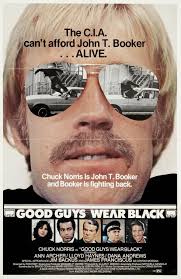
Good Guys Wear Black (1978)

GOOD GUYS WEAR BLACK

GOOD GUYS WEAR BLACK (1978) Two-and-a-half stars
The late Steve McQueen gave his friend Chuck Norris some advice for his motion picture career. McQueen said that Norris talked too much in GOOD GUYS WEAR BLACK and that, in the future, he should let his supporting actors do more talking, since it would have the effect of making what Norris says more important.

I quoted McQueen in a review of A FORCE OF ONE, Norris’ third feature. McQueen’s right about GOOD GUYS WEAR BLACK: Norris does talk too much and he should have allowed his talented supporting cast more of an opportunity to carry the speaking.

Norris stars in GOOD GUYS as John T. Booker and there’s Anne Archer as Booker’s romantic interest and smaller roles for James Franciscus, Dana Andrews, and Jim Backus. It is especially nice to see Andrews on the screen, because we remember him from classics like LAURA and especially THE BEST YEARS OF OUR LIVES. Backus deserved better, especially since, all things considered, he probably enjoyed C.H.O.M.P.S. more than what he did GOOD GUYS.

Because I saw the later film before the earlier one, GOOD GUYS’ plot reminded me of the 1985 Arnold Schwarzenegger vehicle COMMANDO. Booker’s surviving Vietnam War comrades are being systemically eliminated five years after the first scene in the movie when they survive a death trap set for them. We have a shady diplomat on the verge of becoming Secretary of State, who is blackmailed into pursuing the elimination of the Black Tigers, the elite group of CIA assassins headed by Norris’ Booker. This plot was written on the back of a much larger napkin than COMMANDO.

GOOD GUYS, like A FORCE OF ONE, exists as middle-of-the-road Norris, not quite as inspired as his best films CODE OF SILENCE and LONE WOLF McQUADE, but still better than his starring debut BREAKER! BREAKER! and THE OCTAGON, his fourth picture.

CODE OF SILENCE and LONE WOLF are his best pictures mainly because they have the best supporting casts. They also have their fair share of exciting moments.

I mean, who could ever forget that classic scene in LONE WOLF when David Carradine’s treacherous villain buries Norris alive in his super-charged Dodge Ramcharger. After coming to and pouring beer on himself, Norris and his Dodge rise up out of the ground and he gets out and guns down several of Carradine’s anonymous henchmen. Capping it all off, Norris tells his young partner to get him a beer. Epic.

There’s just one scene in GOOD GUYS that even approaches that great LONE WOLF scene.

Booker faces down an assassin, who just blew up the plane carrying Archer’s reporter character and Booker’s romantic interest Margaret, and eventually Booker takes out this formidable foe with a flying kick through the bad guy’s windshield as he attempts to run over Booker. This moment alone is worth the price of a rental or a more long-term purchase, and it could play as the front end of a highlight reel with LONE WOLF.

Unfortunately, the rest of GOOD GUYS does not live up to that incredible flying kick, reportedly performed by Norris’ brother Aaron, but it still has a certain value, especially in seeing Norris portray a college professor and a race car driver in addition to being a cold-blooded assassin. Boy, that Norris sure could do anything.

NOTES: In 2017, a 22-year-old John T. Booker, from Topeka (Kansas), was sentenced to 30 years in prison for his vehicle bomb detonation attempt at Fort Riley. Booker wanted to kill American soldiers and assist the Islamic State of Iraq and al-Sham (ISIS) in their fight against the United States.

There’s also a Dr. John T. Booker who’s an Associate Professor of French at the University of Kansas. His teaching and research focus on the French novel of the 19th and 20th centuries.

Kansas seems to have the market cornered on the John T. Booker name.

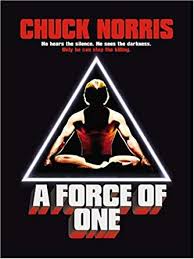
A Force of One (1979)

A FORCE OF ONE

A FORCE OF ONE (1979) Two-and-a-half stars
We should all thank Steve McQueen (1930-80) for the acting career of Chuck Norris, because it was McQueen who encouraged Norris to get into acting.

After all, without Norris’ acting career would there ever have been “Chuck Norris Facts?” Or the lever on “Conan?”

So, thank you, Steve McQueen.

McQueen also had some important advice for Norris after GOOD GUYS WEAR BLACK (1978).

“They said I was the worst thing in 50 years,” Norris said in a 1983 New York Times article. “Well, I wasn’t good, but my feelings were hurt. I said, ‘I’m not trying to be Dustin Hoffman; I just want to project a strong positive hero image on the screen.’ I went to Steve, and he said, ‘In GOOD GUYS, you talk too much. Too much dialogue. Let the character actors lay out the plot. Then, when there’s something important to say, you say it, and people will listen. Anyway, you’ll get better as an actor. You should have seen me in THE BLOB.’”

McQueen seemed to be onto something regarding the quality of Norris movies, because Norris’ best pictures LONE WOLF McQUADE and CODE OF SILENCE both rely on strong casts around Norris: David Carradine, Barbera Carrera, Leon Isaac Kennedy, Robert Beltran, L.Q. Jones, Dana Kimmell, R.G. Armstrong, Sharon Farrell, and William Sanderson (LONE WOLF); Henry Silva, Bert Remsen, Molly Hagan, Dennis Farina, Mike Genovese, and Ralph Foody (CODE OF SILENCE).

A FORCE OF ONE, alas, features a decent supporting cast around Norris — Jennifer O’Neill (she actually receives top billing), Clu Gulager, Ron O’Neal, and Charles Cyphers — and they handle the awfully generic material rather well. We should be grateful for a good supporting cast because. …

I mean, how many times have we seen this plot filmed on TV or even in the movies? We’ve all been here many, many, many times before, sitting through cops, drugs, cop killers, drug lords, et cetera.

Screenwriter Ernest Tidyman’s credits include SHAFT, THE FRENCH CONNECTION, and HIGH PLAINS DRIFTER, heavy duty action credentials.

Tidyman (1928-84), however, was not impressed by A FORCE OF ONE, called it his least successful effort, and said that he only wrote the script to buy his mother a house.

I understand Tidyman’s disappointment with his script.

That said, I enjoyed most of A FORCE OF ONE because it combines a standard issue cops and criminals plot acted out by a good cast with martial arts and a “very subtle” anti-drug message that plays like one of those infamous 1980s TV commercials, only featuring roundhouse kicks.

Wish they would have showed A FORCE OF ONE in D.A.R.E.

Oops, never mind, since all us kiddos are supposed to resist violence.

A FORCE OF ONE loses points and a positive review because of two negative elements.

Dick Halligan’s music hits the viewer like a roundhouse upside the head. I would love to make a joke here referencing either “blood,” “sweat,” or “tears” because Halligan founded the jazz-rock band Blood, Sweat & Tears and played in that group from 1967 through 1972. I just don’t have it today.

All plot roads lead to a final karate showdown between Norris and the main heavy. This is what we wait for all 80 minutes.

Unfortunately, the final karate showdown quickly devolves into slow motion and distorted / echoed vocal effects, plus Halligan’s music returns with a vengeance.