Revenge of the Creature (1955)

REVENGE OF THE CREATURE (1955) **1/2
Once upon a time, Universal Studios took more time between sequels: The Bride of Frankenstein four years after Frankenstein, Dracula’s Daughter five after Dracula, The Invisible Man Returns seven after The Invisible Man, and The Mummy’s Hand eight after The Mummy.

Universal threw all that right out the window during the 1940s and churned out four Mummy, three Invisible Man, four Frankenstein, two Dracula, and five Wolf Man pictures, although the studio mashed just about every monster it had for bashes like House of Frankenstein, House of Dracula, and Abbott and Costello Meet Frankenstein so my numbers might be a slight bit inaccurate.

Creature from the Black Lagoon premiered Feb. 12, 1954, and it became a box office success. Of course, that meant two sequels, Revenge of the Creature in 1955 and The Creature Walks Among Us in 1956, and the latter sequel closed out a 31-film run of horror movies for Universal that began with 1925’s The Phantom of the Opera and continued through Dracula, Frankenstein’s Monster, The Mummy, The Invisible Man, and The Wolf Man.

Revenge of the Creature will seem awful familiar to first time viewers, and not only because it’s a sequel to a legendary horror film. No, when I watched it for the first time, I thought about how much fellow Universal production Jaws 3 (1983) ripped off from Revenge. Both movies were made in 3-D and the later sequel borrowed and updated several plot elements from the earlier one, mainly a monster on the loose in an amusement park.

Revenge proves to be far more enjoyable and memorable than Jaws 3.

Clint Eastwood’s motion picture career had to start somewhere, and that somewhere happens to be Revenge. His one scene occurs somewhere about 10 minutes in. He plays college lab assistant Jennings, intended comic relief. Back to the Future Part III (another Universal sequel) worked in a nod to both Revenge and Tarantula, Eastwood’s second appearance in an Universal creature feature / monster movie from 1955 directed by Jack Arnold. Eastwood plays the jet squadron leader in Tarantula, and Mr. Eastwood helps blow up the title character real good in a preview of his future action hero glory. I recommend Tarantula over Revenge of the Creature, but they do make a suitable double feature, sharing not only Arnold (and Eastwood) but producer William Alland, actors John Agar and Nestor Paiva, and Henry Mancini stock music.

At this point, I should mention that protagonists Professor Clete Ferguson (Agar) and Helen Dobson (Lori Nelson) spend most of the second half of Revenge locked in suck face embrace. Holy cow, why didn’t they just get a room … or a romantic comedy or something. I have not seen two love birds like Clete and Helen since Rod Arrants’ Tom Rose and Joanna Kerns’ Marilyn Baker in the 1976 anti-classic Ape. In all honesty, I wanted The Gill Man to come in and break up Clete and Helen sooner rather than later … and it just doesn’t happen soon enough.

I certainly don’t believe that Agar and Nelson are improvements from previous leads Richard Carlson and Julie Adams, and I don’t recall Creature bludgeoning us over the head with their romance. Revenge shows that our horny Gill Man does not discriminate in the hair color of leading ladies, loving and lusting after both brunette (Adams) and blonde (Nelson). How progressive! Nelson naturally spends a lot of her screen time scantily clad, in swimsuit and even her lingerie in one scene much to the delight of the Gill Man and likely millions of teenage boys of all ages in 1955. Here we are 65 years later and I’m not complaining, just merely stating actual factual information.

Yeah, anyway, Revenge takes its sweet time in getting to the good parts again once it gets the Gill Man into captivity and for that very reason, it ranks below not only Creature from the Black Lagoon and Tarantula but also The Incredible Shrinking Man, the 1957 science fiction classic from Universal directed by Arnold.

Revenge possesses some of the same virtues as Creature, especially sensational underwater photography, and it’s nice they at least brought Nestor Paiva’s enjoyable Lucas character back for the sequel without killing him off in his early appearance. I am looking forward to watching The Creature Walks Among Us and finishing the Universal Classic Monsters series.

Kill and Kill Again, Firecracker, Circle of Iron

KILL AND KILL AGAIN, FIRECRACKER, CIRCLE OF IRON

In his 1981 TV review of the South African martial arts spectacular KILL AND KILL AGAIN, Roger Ebert predicted action movie stardom for James Ryan and invoked the names Eastwood, Bronson, and Bruce Lee.

Well, in this business and life in general for that matter, you win some, you lose some.

James Ryan, who? Yeah, not exactly a household name.

Describing the plot, I would like to just string together a bunch of random words: martial arts champion for hire undercover government agent top secret rescue mission kidnapped scientist recruit colleagues alternative energy source megalomaniac uniformed cult mind control world domination bar fight mushy romance mushy talk middle-of-nowhere fight storming fortress explosions fisticuffs flips plot revelations not particularly revelatory.

There you go. KILL AND KILL AGAIN, the sequel to KILL OR BE KILLED, in a nutshell.

KILL AND KILL AGAIN works predominantly because it has a good sense of humor and it finds just the right tone to pull off being a successful action comedy.

There’s one especially fun supporting character and supporting performance, the diabolical genius’ assistant and (significant other) Minerva played by Marloe Scott-Wilson. She looks like she drifted over from ROCK ‘N’ ROLL HIGH SCHOOL or THE DECLINE OF WESTERN CIVILIZATION, especially with that ridiculous Day-Glo hairdo. She’s a lot of fun in every scene, especially when she calls residential madman Marduk (Michael Mayer) by these absolutely ridiculous pet names. She comes up with a fresh one every single time. And it rankles Marduk, because good old Minerva says her little terms of endearment right in front of everybody. At one point, Marduk tells her, “I said don’t call me Popsicle.” This running gag even has an explosive payoff in the end.

Guess we should mention that South African beauty queen Anneline Kriel — Miss World 1974 — does her own stunts in the movie. She has to overcome playing a character named “Kandy Kane.” I almost wish they would have named her character “Susan Alexander Kane” or “Emily Kane,” for all us CITIZEN KANE fans in the audience. Now, that would have been an impressive stunt.

Impressive stunts are at the heart of FIRECRACKER, especially during the film’s last 30 minutes.

We’re talking about topless kickboxing and what must surely be one of the weirdest love scenes ever committed to celluloid.

Two sicko creeps pursue our heroine Susanne Carter, played by the luscious Jillian Kesner, and they eventually shed her of her top and bra. She then proceeds to kick their asses viciously. Meanwhile, in the background, we have “Rack Master” boxes. Perfect!

“Rack Master” should have been Carter’s martial arts name and it also should have been a title for FIRECRACKER.

That’s not too much of a stretch, especially since FIRECRACKER traveled as NAKED FIST in Australia.

FIRECRACKER director Cirio H. Santiago plagiarized this topless kickboxing scene from his earlier New World Pictures extravaganza TNT JACKSON.

Now, let us consider that weird love scene. Oh Susanna and her love interest Chuck Donner (Darby Hinton) consummate their relationship, but not before they remove each other’s clothes stitch-by-stitch with a knife. Kinky. Chuck Donner and his incredible mustache, especially his incredible mustache, just scream “Creepy seducer of the ladies who killed Susanna’s sister.” Of course, Susanna does not learn of this fact until after their lovemaking.

Susanna exacts her revenge against Chuck in the ring and we all can be sure that he will never look at another woman ever again.

Kesner passed away in 2007 and she and her late husband Gary Graver (1938-2006) became known for their efforts to preserve the work and legacy of legendary director Orson Welles. I do believe it is time for another reference to CITIZEN KANE.

CIRCLE OF IRON attempts to be something bigger, greater than KILL AND KILL AGAIN and FIRECRACKER. It wants to be a transcendent exploitation film.

We are given the only clue we need as soon as the following title card appears on screen: “Prior to the death of the legendary Bruce Lee he helped to create a movie story that might capture not only the spirit of martial arts but a part of the Zen philosophy he lived by. He was aware that a film with these dynamics would cause controversy, particularly among those unfamiliar with Zen beliefs. But it was this very uniqueness that he believed wound enthrall the moviegoer. Bruce set the story in a land that never was and always is. It is to Bruce Lee that this film is posthumously dedicated.”

I was definitely not enthralled by CIRCLE OF IRON. Not very often.

It certainly did not help that Captain Hairdo, er, Jeff Cooper plays the lead character Cord and this character and performance never quite resonated with me because I kept seeing Roger Daltrey instead and I pretended it was TOMMY.

I kept waiting for Cooper’s cord to break out into song, “Listening to you, I get the music / Gazing at you I get the heat / Following you I climb the mountain / I get excitement at your feet!” and “See me, feel me, touch me, heal me.”

It never happened and I felt extremely disappointed.

David Carradine plays about four roles too many in CIRCLE OF IRON. Okay, I’ll say three roles too many, because we get one of the film’s most entertaining scenes when Carradine assumes the guise of “Monkeyman.” At one point, Carradine’s wig came off and I thought shit like that only happened in SAMURAI COP.

Christopher Lee passed on THE LEGEND OF THE 7 GOLDEN VAMPIRES, a joint venture between Hammer Studios and the Shaw Brothers, because he did not want to play Dracula for the millionth time … but he plays what turns out to be a role that sucks even more in CIRCLE OF IRON, Zoltar, er, Zetan. This is one of those quest movies where you’ll become irritated after hearing a certain name — Zetan, maybe — many, many, many, many, many, many times.

Orson Welles asked me not to reference a certain movie during this review of CIRCLE OF IRON. I must respect his wishes.


KILL AND KILL AGAIN ***; FIRECRACKER ***; CIRCLE OF IRON **

The Mighty Peking Man (1977)

THE MIGHTY PEKING MAN

THE MIGHTY PEKING MAN (1977) ***

The Shaw Brothers (Runme 1901-85 and Run Run 1907-2014) have rarely ever let me down and they provided some of the greatest entertainments of all-time, like THE ONE-ARMED SWORDSMAN, FIVE FINGERS OF DEATH, INFRA-MAN, THE 36TH CHAMBER OF SHAOLIN, and CLAN OF THE WHITE LOTUS.

The Shaw Brothers did not (and still do not, in death) cheat us.

For example, in THE MIGHTY PEKING MAN, their 1977 spin on King Kong, Mighty Joe Young, and Tarzan (not to mention Godzilla) that’s not quite peak but still good Shaw Brothers, we don’t have to wait very long whatsoever to see the title character. No, life is short, time is precious, so director Ho Meng-hua gives us our first monster encounter in the first minute of screen time. Okay, to be exact, it’s 1:45 into the movie, but that still beats most every other entry in this distinguished genre.

That establishes a tone for a very generous entertainment package. Find a copy and buy it for somebody, and it’s the gift that keeps on giving.

THE MIGHTY PEKING MAN not only provides a sympathetic monster in the grand tradition, but also (in no particular order) a plucky explorer hero (Danny Lee) who’s been betrayed by his lover with his playboy brother so he’s drowning his sorrows in booze when he’s recruited for a jungle mission, a scantily-clad leading lady (Evelyne Kraft, a regular Swedish Fay Wray) who’s grown up with the animals in the jungle after her parents died in a plane crash (she’s been raised by the Mighty Peking Man, in fact), an earthquake, elephants, tigers and leopards (oh my!), a fight between a leopard and a snake, quicksand, vine swinging, flashbacks to key moments in both the hero’s and the leading lady’s life, callous and shady businessmen, heartless authority figures, mucho destruction of miniatures galore, and a grand finale that boggles the mind even after everything that came before.

My favorite scene, however, begins around the 33-minute mark.

It involves the Semi-Obligatory Lyrical Interlude, a term made famous by the late Roger Ebert. Here’s the definition from Ebert: “Scene in which soft focus and slow motion are used while a would-be hit song is performed on the sound track and the lovers run through a pastoral setting. Common from the mid-1960s to the mid-1970s; replaced in 1980s with the Semi-Obligatory Music Video.”

The Simon and Garfunkel songs in THE GRADUATE epitomize the Semi-OLI.

The one in THE MIGHTY PEKING MAN rates below Louis Armstrong singing “We Have All the Time in the World” over George Lazenby and Diane Rigg in ON HER MAJESTY’S SECRET SERVICE and the foreboding use of Roberta Flack’s “The First Time Ever I Saw Your Face” in Clint Eastwood’s PLAY MISTY FOR ME. Ebert himself said Eastwood filmed the first Semi-OLI that works.

In THE MIGHTY PEKING MAN, our hero and leading lady embrace and lock lips for the first time (watch her eyes after this first kiss) and they unleash the awesomely banal love song “Could It Be I’m in Love, Maybe.”

This is one helluva old-fashioned love song and one helluva Semi-OLI.

I mean, I believe it’s the only Semi-OLI in the history of motion pictures to incorporate a leopard.

Not only that, but the leading lady seems more interested in the leopard than our poor, poor hero. You really sympathize for this guy even more after this scene.

Let’s get back to those lyrics for a second here.

“The love you gave me then showed me a thing or two / I guess I saw it in your eyes / And the look of love upon your face is too hard to disguise / Maybe just a smile will say [cannot make out, even after watching this scene 500 times] / Could it be I’m in love (Maybe? Baby?)” (To hell with it, I already chose “Maybe.” Why does life have to be so difficult?)

“I can’t begin to say what makes me feel like this / I never knew what love could do / But if this is love, it’s here to stay / [Don’t want to make this part out] / So all I have to hear is I’ll give it all to you.”

There’s more lyrics, but we all catch the drift and there’s not any need to drown in banality.

It all totals about 3:30 of pure junk food cinema bliss.

I definitely love it because it’s so utterly ridiculous.

Then again, utterly ridiculous describes THE MIGHTY PEKING MAN.

I should end this review with a consideration of the ending of THE MIGHTY PEKING MAN. Just imagine the ending of KING KONG times 10 times 10.

Code of Silence (1985)

CODE OF SILENCE

CODE OF SILENCE (1985) Three-and-a-half stars

CODE OF SILENCE and LONE WOLF McQUADE are the best Chuck Norris movies.

They are the ones for people who otherwise grunt and groan at the possibility of watching a Chuck Norris movie. You know, individuals who go, “Ugh, I don’t like Chuck Norris, his movies are so dumb and stupid. They’re ridiculous and redneck.” Then, there’s other people who only want to watch Norris on “Walker, Texas Ranger” re-runs 24 hours a day 365 days a year because they have little tolerance for movie violence and vulgarity.

Let’s get a few things straight: I don’t especially care for Norris’ ultra-conservative politics (he predicted 1,000 years of darkness if Obama won a second term). I hate those darn infomercials that he did with Christie Brinkley plugging exercise machines. I cannot stand “Walker, Texas Ranger,” except for when clips were used for the “Walker, Texas Ranger Lever” on Conan O’Brien. I hate that he sued “Chuck Norris Facts” author Ian Specter because “Mr. Norris is known as an upright citizen to whom God, country, and values are of paramount importance” and “Mr. Norris also is concerned that the book may conflict with his personal values and thereby tarnish his image and cause him significant personal embarrassment.” I often dislike the use of slow motion in many Norris pictures, like, for example, at the end of A FORCE OF ONE and I cannot decide if that ridiculous echoed voice-over in THE OCTAGON is the worst or the funniest thing I have ever heard. Finding all his voice-overs compiled into a 4-minute, 20-second YouTube video, I vote for the latter. I will one day write a review of THE OCTAGON in the style of that voice-over; I remember Richard Meltzer’s review of the Creedence album PENDULUM with a built-in echo. For whatever reason, Norris’ inner monologues in THE OCTAGON call to mind Ted Striker’s cockpit moment when he hears echo and Manny Mota pinch-hitting for Pedro Borbon. THE OCTAGON voice-over is even funnier than the one in AIRPLANE! I understand that I like watching old Norris movies for their camp and nostalgic value. I’d rather watch one than listen to a Ted Nugent album (or song). I apologize for (possibly) coming on so defensive about Carlos.

In the pantheon of action stars, Norris rates below Clint Eastwood, Steve McQueen, Jackie Chan, Bruce Lee, Arnold Schwarzenegger, and Sylvester Stallone. He’s never made a movie quite at the level of THE GOOD, THE BAD AND THE UGLY, THE GREAT ESCAPE, DRUNKEN MASTER, ENTER THE DRAGON, the first two TERMINATOR movies, and ROCKY. Norris belongs in the second tier of action stars.

Back to CODE OF SILENCE (and LONE WOLF McQUADE).

Both movies have good supporting casts — for example, CODE OF SILENCE surrounds Norris with quality character actors like Henry Silva, Bert Remsen, Dennis Farina (before he became a full-time actor), Ralph Foody, Ron Dean, and Joseph F. Kosala.

Andrew Davis directed CODE OF SILENCE, his first action picture, and his later credits include ABOVE THE LAW, THE PACKAGE, UNDER SIEGE, THE FUGITIVE, CHAIN REACTION, and COLLATERAL DAMAGE. THE FUGITIVE, one of the best films of 1993, was nominated for seven Academy Awards, including Best Picture, and good old grizzled Tommy Lee Jones won an Oscar for Best Supporting Actor. He’s a good director, certainly the best of any Norris movie.

At this point in his career, Norris wanted to distance himself somewhat from his karate and become a more polished, all-purpose action star. If all his subsequent movies were more like CODE OF SILENCE, he would have been onto something, but, alas, Norris returned to third- and fourth-rate product like FIREWALKER and MISSING IN ACTION III before finding his greatest commercial success on TV.

In CODE OF SILENCE, Norris plays Chicago policeman Eddie Cusack, who finds himself in the middle of a gang war all while he’s alienated himself from his fellow officers (barring one, his former partner) for breaking the “code of silence” by standing and testifying lone wolf like against a veteran officer (Foody) accused of killing an unarmed teenager.

Norris enlists Prowler on his side for the final confrontation, Prowler a police robot with a tremendous arsenal that kills bad guys good.

We do see one particularly rare scene in any Norris movie: He gets knocked around real good by a group of thugs. That’s not happened often to Norris since he took on Bruce Lee late in WAY OF THE DRAGON.

Between his work in CODE OF SILENCE, ABOVE THE LAW, and THE FUGITIVE, Davis showed himself to be a master of scenes involving the ‘L,’ Chicago’s elevated train rapid transit system that we have seen on many films and shows. There’s a chase and fight scene on top of the ‘L’ in CODE OF SILENCE that belongs with Norris’ flying kick through a windshield in GOOD GUYS WEAR BLACK and driving his super-charged Dodge Ramcharger out of the grave in LONE WOLF McQUADE as the best Norris moments.

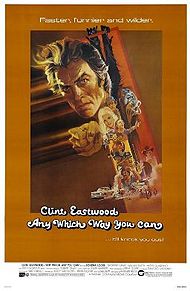
Any Which Way You Can (1980)

ANY WHICH WAY YOU CAN

ANY WHICH WAY YOU CAN (1980) Three stars
If I believed in feeling any guilt whatsoever about feeling pleasure, I might call ANY WHICH WAY YOU CAN a guilty pleasure.

It’s another one of those sublimely ridiculous movie packages that I can’t help but not to like. I mean, it could play on a double bill with ROAD HOUSE.

We all have “guilty pleasures,” and they form one of the most rewarding experiences that we can have at the movies.

If you describe ANY WHICH WAY YOU CAN as a movie with a little bit of everything, that’s still selling it short. I mean, it’s not every day that you have Clint Eastwood in a comedic role, an orangutan named Clyde (played by Buddha and C.J., although there’s no screen credit) who steals every scene that he’s in, a concluding fight scene that can go head-to-head with the later ROCKY sequels and THEY LIVE, a buffoonish motorcycle gang, Ruth Gordon (1896-1985) in what can only be called the “Ruth Gordon” role, and a country song played seemingly every few seconds.

This is the only motion picture that starts with an Eastwood and Ray Charles duet on a little ditty over the opening credits named “Beers for You.”

Personally, I feel the movie could have used more Clyde scenes — more “Right Turn Clyde,” more flipping the bird, more smashing cars, et cetera — and fewer scenes between Eastwood and his real-life partner at the time Sondra Locke. Locke generally became the weak link in Eastwood’s films of the period, and both EVERY WHICH WAY BUT LOOSE and ANY WHICH WAY YOU CAN dramatically prove that as Eastwood demonstrates better chemistry with the orangutan than Locke.

Back to Clyde and Buddha and C.J. Buddha and C.J. assumed the Clyde role for the sequel since Manis — who alone played the role in EVERY WHICH WAY BUT LOOSE — apparently had grown too much between films. Manis returned to his act in Las Vegas.

Reports have it Buddha alone played the role in ANY WHICH WAY YOU CAN and C.J. came on in publicity because Buddha was caught stealing doughnuts on the set near the end of filming and he was brought back to his training facility and beaten for 20 minutes, according to the book “Visions of Caliban: On Chimpanzees and People” by Jane Goodall and Dale Peterson.

Buddha then died soon after of a cerebral hemorrhage.

C.J. went on to star in Bo Derek’s TARZAN THE APE MAN and a NBC sitcom named MR. SMITH.

Executive producer Ed Weinberger said of C.J. in the Washington Post, “It’s a Buddha-like presence. He has wisdom about him. You have to know the animal; I’m in love with him. I’d have him in my house any time.”

MR. SMITH lasted all of 13 episodes from Sept. 22 through Dec. 16 in 1983 and finished a dismal 95th in the Nielsens.

So much for a talking orangutan and who knows if Weinberger had C.J. over at his house after the show flopped big time.

I remember loving ANY WHICH WAY YOU CAN as a young child. It was an affinity for Clyde. He’s what I remembered about the movie for many years before I revisited it decades later.

Not every movie I loved in childhood holds up revisited in adulthood. For example, CANNONBALL RUN, an entertainment I found to be an endurance contest several years back. (For the record, I recently watched SMOKEY AND THE BANDIT, another childhood favorite, again and it held up. I enjoyed Burt Reynolds, Sally Field, Jerry Reed, and Jackie Gleason.)

ANY WHICH WAY YOU CAN is not quite at the same high level as COMMANDO, LONE WOLF McQUADE, and ROAD HOUSE.

That’s because it’s a little flabby with a running time of 1 hour, 56 minutes. Granted, that concluding fight scene between Eastwood and William Smith eats up a good 10 percent of a nearly two-hour experience.

LONE WOLF McQUADE and ROAD HOUSE do have similar run times, but fewer bad scenes than ANY WHICH WAY YOU CAN.

The great director Howard Hawks (1896-1977), born the same year as Ruth Gordon, said that a good movie is “three great scenes and no bad ones.” Not sure that he had movies like ANY WHICH WAY YOU CAN in mind, which does have three great scenes but also some bad ones.

ANY WHICH WAY YOU CAN, though, is one of those sequels better than the original.