The Texas Chainsaw Massacre 2

THE TEXAS CHAINSAW MASSACRE 2 (1986) ***
I wanted to like The Texas Chainsaw Massacre 2 considerably more than I did, because of the way director Tobe Hooper (1943-2017) and screenwriter Kit Carson (1941-2014) mixed in satire and dark comedy with all the material that seems like a prerequisite for a sequel to only one of the most infamous movies ever made, 1974’s The Texas Chain Saw Massacre.

Unfortunately, though, leading lady Caroline Williams’ harried disc jockey Stretch — yes, even women from Texas have names that play right alongside Slim and Tex — spends a good 75 percent of her screen time screaming. Williams screams more than Fay Wray in The Most Dangerous Game and King Kong and Mystery of the Wax Museum combined, more than Jamie Lee Curtis in Halloween and The Fog and Prom Night and Terror Train and Halloween II combined, and more than all the heroines combined who have faced Jason and Freddy and Michael over the last couple decades. Williams probably wishes they paid her by the scream.

All that infernal screaming begins to bog Massacre 2 down in the middle stretches of a film that both starts and finishes rather strongly.

Massacre 2 also features a Dennis Hopper performance that rates a distant fourth behind River’s Edge, Blue Velvet, and Hoosiers in the unofficial Hopper-portrays-an-epic-burnout-not-totally-unlike-himself (though, to be fair to Hopper, his Blue Velvet character goes beyond, way beyond, the pale of the normal cinematic psychopath) in 1986 competition.

Since Hopper (1936-2010) portrays former Texas Ranger and Sally and Franklin Hardesty-Enright’s uncle Lt. Boude ‘Lefty’ Enright and Cannon Films released Massacre 2, wouldn’t it have been absolutely fantastic if Cannon action hero Chuck Norris played the ranger pursuing vigilante justice against the ripped, twisted, absolutely positively deranged (not to mention cannibalistic) Sawyer family.

Both Chainsaw movies start with narration and an opening crawl.

The original: The film which you are about to see is an account of the tragedy which befell a group of five youths, in particular Sally Hardesty and her invalid brother, Franklin. It is all the more tragic in that they were young. But, had they lived very, very long lives, they could not have expected nor would they have wished to see as much of the mad and macabre as they were to see that day. For them an idyllic summer afternoon drive became a nightmare. The events of that day were to lead to the discovery of one of the most bizarre crimes in the annals of American history, The Texas Chain Saw Massacre.

The sequel: On the afternoon of August 18, 1973, five young people in a Volkswagen van ran out of gas on a farm road in South Texas. Four of them were never seen again. The next morning the one survivor, Sally Hardesty-Enright, was picked up on a roadside, blood-caked and screaming murder. Sally said she had broken out of a window in Hell. The girl babbled a mad tale: a cannibal family in an isolated farmhouse … chainsawed fingers and bones … her brother, her friends hacked up for barbecue … chairs made of human skeletons … Then she sank into catatonia. Texas lawmen mounted a month-long manhunt, but could not locate the macabre farmhouse. They could find no killers and no victims. No facts; no crime. Officially, on the records, The Texas Chainsaw Massacre never happened. But during the last 13 years, over and over again reports of bizarre, grisly chainsaw mass-murders have persisted all across the state of Texas. The Texas Chainsaw Massacre has not stopped. It haunts Texas. It seems to have no end.

Made on an estimated $80-140,000 production budget, the original deserves such descriptive phrases as grainy and gritty. Gory, no. Disturbing, yes definitely, terrifying, for sure, with a more than macabre sense of humor, especially during the best dinner table scene this side of Tod Browning’s Freaks. I about lose it every time the family wants the 124-year-old Grandpa Sawyer to end Sally’s life with one crushing blow of a hammer and this cannibalistic codger just can’t find the strength to do it, ultimately giving Sally the opportunity for escape.

More than a decade later, Hooper wanted Massacre 2 to be a dark comedy, accentuating those elements from the original. Meanwhile, naturally, Cannon desired a finished product more along the lines of The Texas Chainsaw Massacre or at least its shocking reputation.

The finished product plays more like a compromise.

Both films are reflective of the times they were made. The original, released on the first day of October 1974, came out in the midst of Richard Nixon’s resignation speech, the Watergate scandal that brought Nixon down, the final year of the Vietnam War, the Oil Embargo 1973-74, and general discord in the land. The sequel, released on Aug. 22, 1986, gives us cannibals with ‘family values’ a few months before former Hollywood actor turned politician Ronald Reagan’s speech centered around the family unit and giddy excess in every single frame to produce a bigger but not better Texas Chainsaw Massacre.

The original has this insidious way of getting underneath our skin and dominating our thought patterns, and none of the slicker sequels, remakes or imitations even come remotely close to its power to provoke.

NOTE: The parody of The Breakfast Club earns the film’s poster four stars.
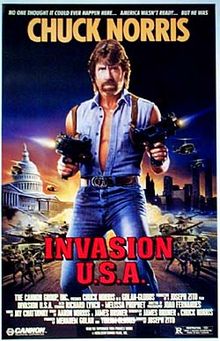
Invasion U.S.A. (1985)

INVASION U.S.A. (1985) *
Joseph Zito made a logical progression from directing mad slasher films The Prowler and The Final Chapter (Jason Voorhees’ third screen entry) to Chuck Norris action spectaculars Missing in Action and Invasion U.S.A for the Cannon Films Group, one of the ultimate purveyors of schlock all through the ’80s.

Their schlock includes Ninja III: The Domination and Breakin’ 2: Electric Boogaloo, both from 1984 and directed by Sam Firstenberg.

Anyway, I digress, which is something that I will invariably do whenever discussing Invasion U.S.A. Yes, I admit upfront this review will be filled with digressions.

The plot: Multinationals with guns (sometimes with subtitles, sometimes without) invade the United States, actually Florida but Invasion Florida doesn’t quite ring the same liberty bell, and one-man army Chuck Norris stops them with bloody ballyhoo. Named Matt Hunter in a fit of poetic fancy, perhaps by one of the writers of this garbage, Norris could have killed ’em all with denim.

Basically, Invasion U.S.A is Red Dawn dumbed down even more and it substitutes teeny bopper Commie scum killers Patrick Swayze, Charlie Sheen, C. Thomas Howell, Jennifer Grey, and Lea Thompson for Norris, who laughably tells us that he works alone. No joke, we know this after ’bout 50 Norris films where his character informs us that he kills scumbags all on his lonesome. I mean, wasn’t one of Norris’ better movies even called Lone Wolf McQuade for crying out loud?

The best Norris pictures have strong supporting characters and casts, who make up for the sometimes personality deficient Norris. Alas, Invasion U.S.A gives us one of the worst characters in not only a Norris movie but all movies in general — an apparent photojournalist named McGuire (Melissa Prophet) who probably should have been named Molly Magsnarl instead. She’s not the least bit grateful for Hunter saving her, and I would have let her meet her ultimate demise after the first time she snarls at me Cowboy. She blows out the tires on Invasion U.S.A every time she’s on screen.

Seeing her camera made me laugh, though, because I thought about how it was John Rambo’s assignment to only take photos of the POWs — not to rescue them — in Rambo: First Blood Part 2.

Speaking of First Blood Part 2, released a few months before Invasion U.S.A, it and Arnold Schwarzenegger’s Commando (released just after Invasion U.S.A) both blow away Invasion U.S.A in the great 1985 One-Man Army Movie Sweepstakes.

I also found a worse movie than Star Trek V: The Final Frontier that includes characters singing Row, Row, Row Your Boat.

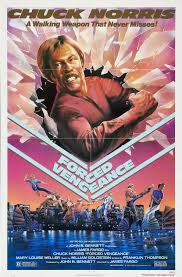
Forced Vengeance (1982)

FORCED VENGEANCE (1982) **1/2
Slow motion’s absolutely vital to understanding the cinematic and TV work of the one and only Carlos Ray Norris.

Slow motion’s everywhere, in action movies, sporting events, movie musicals, etc. To the point that we don’t even realize how everywhere it’s become.

Over the decades, for example, slow motion became a customary tool in violent scenes, from Arthur Penn’s Bonnie and Clyde and Sam Peckinpah’s The Wild Bunch to The Matrix and beyond. Sometimes, I think Gee whiz, that’s awesome and very artfully done, but mostly I just think That’s super lame. I take off points for the obligatory and cheap use of slow motion.

Let’s see, off the top of my head, I deducted from The Lion King and Teen Wolf and Young Guns for their abuse of slow motion late in their motion picture spreads, while Kickboxer 2 flogs viewers with slow motion until it’s like receiving a slow motion roundhouse upside the head. For crying out loud, though, it’s slow motion, super slow even, and that gives us a greater chance to duck out of the way and to see all the cheap audience manipulation at play. I mean, I ducked the Kickboxer 2 roundhouse and found the Siskel & Ebert review playing alongside the movie inside my head esp. Ebert imitating the sounds of slow motion. It was more entertaining that way.

That brings us full roundhouse back to Norris, one of the foremost slow motion abusers.

A former co-worker said that his ears were ringing for a long time after he watched the Who play one of the Day on the Green concerts at Oakland-Alameda County Coliseum. He talked about being whacked upside the head by their incredible Wall of Noise. I soaked up this conversation.

“In 1976, the Who entered the Guinness Book of World Records for performing the loudest concert in history at the time during their concert at England’s Charlton Athletic Grounds with 76,000 watts at 120 decibels. This record would stand for nearly a decade.”

You can bet they used the Rock-o-meter from Rock ‘N’ Roll High School.

Anyway, now I will make the case for something that’s louder than any rock concert or sporting event, any plane taking flight, any hyena’s laugh, and any howler monkey.

For a couple months, I visited my Grandma for her bingo dominance Tuesday and Thursday. After the bingo hour, we’d return to her room and she’d turn her TV back on. Naturally, it would be Walker, Texas Ranger on Hallmark. Of course. At 3 every day, every single TV in the nursing home would simultaneously be turned on full volume and tuned in to Walker, Texas Ranger. That’d be probably close to 100 TVs. Yeah, we’ll go with 100 for the sake of hyperbole.

I’ve never in my life heard anything louder than 100 full blast TVs simultaneously reverberating Walker slow motion roundhouse kicks.

Guinness, book it.

I deducted a half-star from Forced Vengeance because it broke through my pain threshold for slow motion consumption early on during the final act leading toward a grand finale.

You have been forewarned.

Once again, though, a poster for a Norris spectacular earns four stars.

An Eye for an Eye (1981)

AN EYE FOR AN EYE (1981) ***
An Eye for an Eye is one of the better Chuck Norris movies and that’s because it fits the bill for what helps define a better Chuck Norris movie — the quality of the supporting cast, something it has in common with Lone Wolf McQuade, Code of Silence, The Delta Force, and Silent Rage.

Let’s see, we have Christopher Lee, Richard Roundtree, Matt Clark, Mako, Maggie Cooper, Rosalind Chao, Professor Toru Tanaka, Stuart Pankin, Terry Kiser and Mel Novak, and they’re basically all good in their standard hero and villain roles.

Lee (1922-2015) enjoyed a truly marvelous career that intersected with Sherlock Holmes, Dracula, James Bond, Star Wars, Ichabod Crane, Kharis, Victor Frankenstein, Gandalf, and Hercules. Never mind acting alongside Slim Pickens and Toshiro Mifune in Steven Spielberg’s 1941. Often playing the villain, Lee had the ability to maximize his minimal screen time and An Eye for an Eye benefits from his presence.

Roundtree made his fame as the title character in Shaft and sequels Shaft’s Big Score and Shaft in Africa, and so I must admit to being somewhat amused that he’s played a cop so often throughout his career. It was both amusing and frustrating to watch his police superior character bust Norris’ chops. I told my wife during An Eye for an Eye, ‘At least he’s not killed by a winged serpent in this movie.’

Cooper plays Norris’ obligatory romantic interest and she gets a rare female nude scene in a Norris movie. Writing on Silent Rage, I noted that it was refreshing to see somebody’s chest other than Norris and I second that emotion after An Eye for an Eye.

Tanaka’s dossier begins, ‘Was an American professional wrestler, professional boxer, college football player, soldier, actor, and martial artist.’ What did the Professor earn his degree in? Judging by An Eye for an Eye and the vast majority of his filmography and his professions, it’s safe to say Tanaka earned a doctorate in pain. Like others in the An Eye for an Eye cast, he’s good at maximizing minimal screen time and in his case, minimal dialogue. Norris vs. Tanaka proved to be one of the film’s greatest highlights.

Before she went to sleep, I told my wife that Norris’ partner will be dead very shortly and it did not help the character’s survival odds being played by Terry Kiser, an actor best known for playing a corpse. Bernie from Weekend at Bernie’s and Weekend at Bernie’s II ring any bells? Yeah, I still argue that dead Bernie still shows more life than nominal leads Andrew McCarthy and Jonathan Silverman. For a man later hacked and whacked by Jason Voorhees, Kiser’s character died spectacularly in An Eye for an Eye — shot in the chest, crushed between not one but two cars, and caught on fire. His death haunts Norris’ Sean Kane during two flashback scenes.

An Eye for an Eye director Steve Carver died in January 2021 of complications from COVID-19 and he was 75. Carver also directed arguably Norris’ best picture, Lone Wolf McQuade, and the infamous 1974 Roger Corman / New World Productions films The Arena and Big Bad Mama. No doubt that Pam Grier and Angie Dickinson, as well as William Shatner, prepared Carver for Chuck Norris.

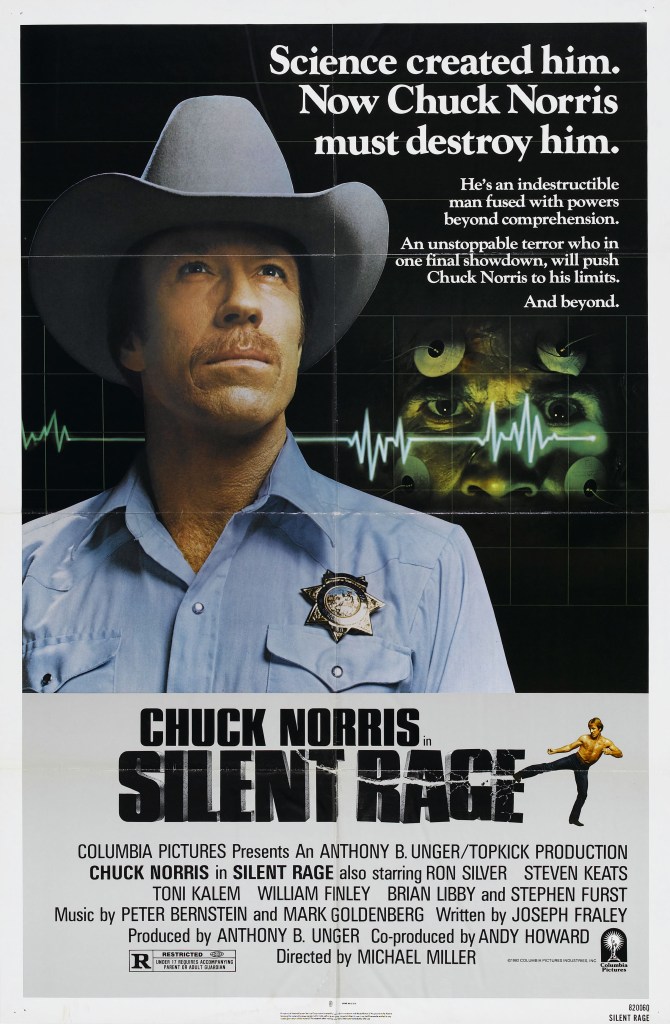
Silent Rage (1982)

SILENT RAGE (1982) ***
Michael Miller’s 1982 feature Silent Rage combines several American movie hallmarks into one barely coherent package: Chuck Norris, a small Texas town (never sleepy when Norris plays Sheriff), a madman killer, mad scientists, shots borrowed straight from John Carpenter’s Halloween, two love scenes, Stephen Furst basically playing his character from Animal House again, bar fights, roundhouse kicks, biker gangs, breasts (inc. Norris but not Furst), and a schizophrenic musical score, not in any particular order.

We also have at least five wildly different acting styles for the price of one. We’ve already covered Norris and Furst, then there’s Ron Silver and he’s playing it straight in easily the best dramatic acting that one can find in anything starring Chuck Norris. Silver plays the voice of reason and let’s do the right thing scientist, whereas his colleagues played by Steven Keats and William Finley are variants on Universal horror archetypes updated for a new generation. Keats, of course, wants to push science further than any one ever before even when it’s not prudent and Finley, best known for his roles in Brian De Palma and Tobe Hooper films Phantom of the Paradise and Eaten Alive, occupies the middle ground between Silver and Keats. Brian Libby’s madman killer continues in the proud screen tradition of Frankenstein’s Monster and Michael Myers, especially after our mad scientists flat out turn him posthumously into an indestructible killing machine whose stalking does all the talking. I wanted Dr. Loomis to show up and say THIS ISN’T A MAN. Bummer that it didn’t happen.

Norris battles the mad killer and later the virtually indestructible mad killer in the opening and concluding scenes. Otherwise, he alternates between mentoring and supporting unsure and unsteady rookie cop Furst, rekindling his romance with a former lover played by Toni Kalem, and questioning Silver and Keats. For Norris fans, apparently the scariest parts of Silent Rage involved Kalem’s bare breasts and Norris favoring jazz music because our favorite roundhouse specialist returned to only love scenes between men for the rest of his career, barring his rolling around in the mud with the sultry Barbara Carrera in the 1983 Walker, Texas Ranger precursor Lone Wolf McQuade. I for one like Silent Rage because it’s nice to see more chests on display than just Chuck’s for a change.

Silent Rage unfortunately drags at two main points. The death of Silver’s wife literally feels like it takes forever, like one of the filler killings in a Friday the 13th sequel. Ditto for the bar fight, which are drags both in real life and in the movies. A couple moments in this otherwise humdrum bar fight sequence redeem it, just barely though. If you’ve seen Silent Rage, you know exactly what I mean.

The poster for Silent Rage rates with Breaker! Breaker as the best Norris film poster. There’s really no arguing with a mini-Norris roundhouse cracking the movie’s title and the promotional hype Science created him. Now Chuck Norris must destroy him. He’s an indestructible man fused with powers beyond comprehension. An unstoppable terror who in one final showdown, will push Chuck Norris to his limits. And beyond.

Once upon a review, I believe I wrote that I wanted to see Chuck Norris vs. Jason Voorhees and Silent Rage is the closest that I will ever get to seeing that dream come true.

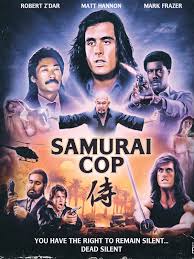
Samurai Cop (1991)

SAMURAI COP

SAMURAI COP (1991) ***

An outtake is defined as “a scene or sequence filmed or recorded for a movie or program but not included in the final version.”

Blown lines and stunts, we all know the routine by now.

Hal Needham and Jackie Chan may have made outtakes for the end credits a cinematic institution, but Iranian “jack of all trades and master of none” Amir Shervan (1929-2006) directed SAMURAI COP, a feature movie solely comprised of outtakes.

Shervan trumped such legendary figures as Dwain Esper, William “One Shot” Beaudine, Bert I. Gordon, Bill Rebane, Ray Dennis Steckler, and even Ed Wood in absolute sheer incompetence.

Like a select few bad movies, SAMURAI COP is so, so, so bad in so, so, so many marvelous ways that it passes all the way through bad into good. It belongs filed next to Efren C. Pinon’s THE KILLING OF SATAN and Claudio Fragasso’s TROLL 2.

— Mathew Karedas, a.k.a. Matt Hannon, stars as Joe Marshall. Most people, though, just call him “Samurai Cop.” Joe must be the least convincing samurai in all history, cinematic and otherwise. For one, Joe’s entire look screams more Fabio and Kato Kaelin than, let’s say, Toshiro Mifune and his most dangerous weapon brandished is that damn speedo he spends what feels like the entire second half of the movie in. Anyway, for somebody allegedly well-versed in the Japanese vernacular, he sure does struggle pronouncing the name “Fujiyama.” When asked by his partner Frank Washington (Mark Frazer) what “katana” means, Joe snaps back “It means Japanese sword.” You don’t say, you don’t say.

— Samurai Cop arguably spends more time being a ladies man than anything else. No, seriously, he beds three, er, two women and he even blatantly talks about the beauty of another woman in the presence of his lover. Smooth, real smooth. Late in the 96-minute spread, he tells his future conquest, “Let’s just say … I can read eyes.” I wish that you couldn’t read dialogue.

Here’s a dialogue exchange from the Planet-X:


Nurse: Do you like what you see?

Joe Marshall: I love what I see.

N: Would you like to touch what you see?

JM: Yes. Yes, I would.

N: Would you like to go out with me?

JM: Uh, yes I would.

N: Would you like to fuck me?

JM: Bingo.

N: Well, then let’s see what you’ve got …

[Nurse investigates Joe’s bulge]

N: Doesn’t interest me. Nothing there.

JM: Nothing there? Just exactly what would interest you, something the size of a jumbo jet?

N: Have you been circumcised?

JM: Yeah, I have, why?

N: Your doctor must have cut a large portion off.

JM: No, uh, he was a, he was a good doctor.

N: Good doctors make mistakes too, that’s why they have insurance.

JM: Hey … don’t worry. I got enough. It’s big.

N: I want bigger.

[Nurse walks away]


I doubt that any screen lothario has ever partaken in dialogue that bad and the sound that we just heard is Rudolph Valentino saying “Thank you” for having made only silent movies.

That dialogue plays like a combination of a porno movie and “Dick and Jane” (most of the rest of the movie belongs to knocking off LETHAL WEAPON) and it belongs alongside the SHARK ATTACK 3: MEGALODON interchange in the anals, er, annals of cinematic history:


Cataline Stone: I’m exhausted.

Ben Carpenter: Yeah, me too. But you know I’m really wired. What do you say … I take you home and eat your pussy.


Boy, that’s just about as great as the whole “Fini can water you” debacle from YES, GIORGIO.

— Lead actor Matt Hannon thought he was done with the picture and got himself a short haircut. Several months later, Shervan looked up Hannon and informed him they were going to reshoot scenes. Unfortunately, Hannon still had short hair. I say unfortunately because Hannon wears one of the least convincing wigs ever made during SAMURAI COP. It does not help that Hannon’s wig flies off during a late fight scene and the actor also displays his obvious displeasure having to wear his wig. Yeah, it’s that bad.

— The chase scenes alternate between moving incredibly slow (nothing like slow-moving cars …) and being artificially sped up (… except for cars that zip along unnaturally). Yes, there are times when the action in SAMURAI COP plays like a silent film projected at the wrong speed.

— Not sure that I want to spend that much more time and space on SAMURAI COP, because I don’t want to risk writing a dissertation. Yes, over 750 words feels like I have been writing on this movie for a long time. However, there’s so many more things wrong but right about SAMURAI COP that we could be here all day, ironic for a movie that lasts a meager 96 minutes. Just imagine SAMURAI COP at GONE WITH THE WIND length.

— In a review long ago, I wrote that the 1979 Chuck Norris action vehicle A FORCE OF ONE combines a standard issue cops and criminals plot acted out by a good cast with martial arts and a “very subtle” anti-drug message that plays like one of those infamous 1980s TV commercials, only featuring roundhouse kicks.

On that note, we can end this review with a public service announcement from SAMURAI COP: “Now I’m telling these son-of-a-bitches that we respect the Japanese of this country, who are honest businessmen. And yeah, this is the land of opportunity for legitimate business, not for death merchants who distribute drugs to our children through schools and on the streets. Now I’m telling these motherfuckers that if they continue killing our children to make their precious millions that they deposit in their secret Swiss bank accounts, counselor, before your lawsuit even gets off the court clerk’s desk, I’ll have their stinking bodies in garbage bags and ship them back to Japan for fertilizer.”

Beautiful, absolutely beautiful, and it makes me want to pop a top on an ice cold one and blast Alice Cooper’s “I Love America.”

The Octagon (1980)

THE OCTAGON

THE OCTAGON (1980) *1/2

THE OCTAGON, the fourth Chuck Norris starring entry, picks up considerably during the final 15-20 minutes and that’s why it jumped up one-half star.

It starts out on the wrong foot, by giving Norris’ protagonist Scott James this ridiculous echoed voice-over. I guess I can best describe it as a whisper doused in reverb. Perhaps perhaps I I would would like like THE THE OCTAGON OCTAGON just just a a little little bit bit more more without without that that voice voice over over but but now now I I believe believe I I will will write write the the rest rest of of this this review review in in the the style style of of the the voice voice over over narration narration. Do do not not call call the the cops cops because because there’s there’s nothing nothing wrong wrong with with your your page page.

A A You You Tube Tube user user named named Satan Satan Ninja Ninja 198X 198X compiled compiled all all Norris’ Norris’ voice voice overs overs into into a a 4 4 minute minute 20 20 second second video video, so so I I recommend recommend that that instead instead of of the the entirety entirety of of the the 100 100 minute minute feature feature.

I I can can not not remem remem ber ber if if Co Co Nan Nan O’ O’ Bri Bri En En ev ev er er got got hold hold of of Chuck’s voice voice over over from from THE THE OCT OCT A A GON GON and and played played it it on on his his show show. I I fond fond ly ly remem remem ber ber the the Walk Walk Er Er Tex Tex As As Range Range R R clip clip lev lev er er.

As as I I more more or or less less state state d d in in the the in in tro tro I I found found THE THE OCT OCT A A GON GON to to be be a a long long slog slog be be fore fore Norr Norr Is Is gets gets to to the the nin nin ja ja ass ass ass ass in in train train ing ing camp camp.

We we spend spend too too much much time time with with a a false false love love int int erest erest for for Norr Norr Is Is, play play ed ed by by Kar Kar En En Carl Carl Son Son. Their their scenes scenes are are def def initely initely a a wash wash.

Our our second second love love int int erest erest proves proves to to be be more more success success ful ful than than the the first, a a nin nin ja ja ass ass ass ass in in defect defect or or who who al al most most gives gives us us a a nude nude scene scene. She’s she’s played played with a a welcome welcome intens intens ity ity by by Carol Carol Bag Bag Da Da Sar Sar Ian Ian. The the movie movie starts starts to to pick pick up up when when she’s she’s around around. Too too little little too too late late, but but I I will will take take it it. Glad glad I I al al ready ready learned learned that that less less on on.

The Last Dragon (1985)

THE LAST DRAGON

THE LAST DRAGON (1985) Three stars

Gene Siskel included THE LAST DRAGON among his “Guilty Pleasures” in a 1987 “Siskel & Ebert” show and he gave it one of his funniest reviews, highlighted by “I’m a sucker for glowing fingers. Roger, I see glowing fingers in a movie, I tend to like the movie. … Just one finger (in E.T.), that’s how much I like it. In this one, you get 20. Two men, Roger, 20. Can you imagine the ads? ‘20 times the entertainment value of E.T.’” Siskel gave it three-and-a-half stars in his 1985 print review.

Roger Ebert gave it a mixed negative review and two-and-a-half stars, “THE LAST DRAGON turns into a funny, high-energy combination of karate, romance, rock music and sensational special effects. It’s so entertaining that I could almost recommend it … if it weren’t for an idiotic subplot about a gangster and his girlfriend, a diversion that brings the movie to a dead halt every eight or nine minutes. … They’ve been borrowed from a hundred other movies, they say things that have been said a hundred other times, and they walk around draining the movie of its vitality. They’re tired old cliches getting in the way of the natural energy of Taimak, Vanity and the Shogun character.”

I find myself occupying the middle ground between Siskel and Ebert. They both agreed on the strengths and the weaknesses of THE LAST DRAGON, but Siskel found the strengths to be stronger and Ebert the weaknesses to be weaker. LAST DRAGON co-stars Taimak, Vanity, and Julius J. Carry III are the strengths and Chris Murney as comic gangster Eddie Arkadian and Faith Prince as his aspiring singer girlfriend Angela Viracco are the weaknesses.

Taimak (full name Taimak Guarriello) stars as Leroy Green, who’s inspired by the works of Bruce Lee to such a degree that he’s called “Bruce Leroy.” He’s in pursuit of “The Glow,” referenced memorably by Siskel — see, only a true martial arts master can exhibit “The Glow” over his entire body and that’s Leroy’s No. 1 goal. Scenes like “Don’t think, feel! It’s like a finger pointing away to the moon. Do not concentrate on the finger or you will miss all of the heavenly glory” from ENTER THE DRAGON undoubtedly warmed the heart of Mr. Leroy … and possibly Motown mogul Berry Gordy, whose Motown Productions sponsored THE LAST DRAGON.

He’s opposed by Sho’nuff (Carry III), a.k.a. “The Shogun of Harlem,” who sees Leroy in his way for ultimate martial arts mastery. Sho’nuff interrupts a showing of the sacred text ENTER THE DRAGON in an urban theater and he throws down the gauntlet, “Well well, well. If it ain’t the serious, elusive Leroy Green. I’ve been waiting a long time for this, Leroy. I am sick of hearing these bullshit Superman stories about the — Wassah! — legendary Bruce Leroy catching bullets with his teeth. Catches bullets with his teeth? Nigga please.” Leroy counters with two platitudes that he might have gleaned from the “Kung Fu” TV show, then Sho’nuff throws it down again, “See, now it is mumbo jumbo like that, and skinny little lizards like you thinkin’ they the last dragon that gives kung fu a bad name. Get up, Leroy, I got somethin’ real fo’ yo’ ass in these hands.” Carry III (1952-2008) undoubtedly prepared for his role as Sho’nuff by playing in both DISCO GODFATHER, his debut feature, and THE FISH THAT SAVED PITTSBURGH.

All roads lead to a final showdown between Leroy and Sho’nuff when, sure enough, they both have “The Glow.” Leroy, though, finally exhibits true martial arts mastery.

Bruce Leroy also becomes the protector of television personality Laura Charles (Vanity) against them comic gangsters. She tells Leroy, “I thought that maybe it would be a great idea if I got myself a bodyguard. You know, like someone to guard my body? What girl could do worse than to have her own real life kung fu master?”

THE LAST DRAGON is a lot of fun, especially for viewers who are fans of martial arts spectaculars, particularly Bruce Lee. During the 1985 episode they reviewed THE LAST DRAGON, Siskel and Ebert lamented the lack of quality martial arts entertainment in a special “X-ray segment.” They singled out three “better” martial arts films that predated THE LAST DRAGON: ENTER THE DRAGON, THE OCTAGON starring Chuck Norris, and THE KARATE KID, the surprise blockbuster from 1984. I felt bad for Siskel and Ebert, because it seemed like they missed a great many great martial arts films like DRUNKEN MASTER and THE 36TH CHAMBER OF SHAOLIN, for example, and instead they made several “Dogs of the Week” (their picks for worst movie each episode until September ‘82) from seeing obviously inferior martial arts imports with lousy prints and horrific dubbing. It would be difficult for anybody not to form a negative opinion about martial arts films from seeing only the mass-produced bargain-basement rip-offs that almost immediately came in the wake of Bruce Lee’s death in 1973.

Thankfully, through ventures like the Dragon Dynasty, we can see classics like THE 36TH CHAMBER, KING BOXER (a.k.a. FIVE FINGERS OF DEATH), THE ONE-ARMED SWORDSMAN, FIST OF LEGEND, MAD MONKEY KUNG FU, FIVE DEADLY VENOMS, and EIGHT DIAGRAM POLE FIGHTER in quality prints and not dubbed in dodgy English. Films like these have provided me a ridiculous amount of enjoyment over the years.

Code of Silence (1985)

CODE OF SILENCE

CODE OF SILENCE (1985) Three-and-a-half stars

CODE OF SILENCE and LONE WOLF McQUADE are the best Chuck Norris movies.

They are the ones for people who otherwise grunt and groan at the possibility of watching a Chuck Norris movie. You know, individuals who go, “Ugh, I don’t like Chuck Norris, his movies are so dumb and stupid. They’re ridiculous and redneck.” Then, there’s other people who only want to watch Norris on “Walker, Texas Ranger” re-runs 24 hours a day 365 days a year because they have little tolerance for movie violence and vulgarity.

Let’s get a few things straight: I don’t especially care for Norris’ ultra-conservative politics (he predicted 1,000 years of darkness if Obama won a second term). I hate those darn infomercials that he did with Christie Brinkley plugging exercise machines. I cannot stand “Walker, Texas Ranger,” except for when clips were used for the “Walker, Texas Ranger Lever” on Conan O’Brien. I hate that he sued “Chuck Norris Facts” author Ian Specter because “Mr. Norris is known as an upright citizen to whom God, country, and values are of paramount importance” and “Mr. Norris also is concerned that the book may conflict with his personal values and thereby tarnish his image and cause him significant personal embarrassment.” I often dislike the use of slow motion in many Norris pictures, like, for example, at the end of A FORCE OF ONE and I cannot decide if that ridiculous echoed voice-over in THE OCTAGON is the worst or the funniest thing I have ever heard. Finding all his voice-overs compiled into a 4-minute, 20-second YouTube video, I vote for the latter. I will one day write a review of THE OCTAGON in the style of that voice-over; I remember Richard Meltzer’s review of the Creedence album PENDULUM with a built-in echo. For whatever reason, Norris’ inner monologues in THE OCTAGON call to mind Ted Striker’s cockpit moment when he hears echo and Manny Mota pinch-hitting for Pedro Borbon. THE OCTAGON voice-over is even funnier than the one in AIRPLANE! I understand that I like watching old Norris movies for their camp and nostalgic value. I’d rather watch one than listen to a Ted Nugent album (or song). I apologize for (possibly) coming on so defensive about Carlos.

In the pantheon of action stars, Norris rates below Clint Eastwood, Steve McQueen, Jackie Chan, Bruce Lee, Arnold Schwarzenegger, and Sylvester Stallone. He’s never made a movie quite at the level of THE GOOD, THE BAD AND THE UGLY, THE GREAT ESCAPE, DRUNKEN MASTER, ENTER THE DRAGON, the first two TERMINATOR movies, and ROCKY. Norris belongs in the second tier of action stars.

Back to CODE OF SILENCE (and LONE WOLF McQUADE).

Both movies have good supporting casts — for example, CODE OF SILENCE surrounds Norris with quality character actors like Henry Silva, Bert Remsen, Dennis Farina (before he became a full-time actor), Ralph Foody, Ron Dean, and Joseph F. Kosala.

Andrew Davis directed CODE OF SILENCE, his first action picture, and his later credits include ABOVE THE LAW, THE PACKAGE, UNDER SIEGE, THE FUGITIVE, CHAIN REACTION, and COLLATERAL DAMAGE. THE FUGITIVE, one of the best films of 1993, was nominated for seven Academy Awards, including Best Picture, and good old grizzled Tommy Lee Jones won an Oscar for Best Supporting Actor. He’s a good director, certainly the best of any Norris movie.

At this point in his career, Norris wanted to distance himself somewhat from his karate and become a more polished, all-purpose action star. If all his subsequent movies were more like CODE OF SILENCE, he would have been onto something, but, alas, Norris returned to third- and fourth-rate product like FIREWALKER and MISSING IN ACTION III before finding his greatest commercial success on TV.

In CODE OF SILENCE, Norris plays Chicago policeman Eddie Cusack, who finds himself in the middle of a gang war all while he’s alienated himself from his fellow officers (barring one, his former partner) for breaking the “code of silence” by standing and testifying lone wolf like against a veteran officer (Foody) accused of killing an unarmed teenager.

Norris enlists Prowler on his side for the final confrontation, Prowler a police robot with a tremendous arsenal that kills bad guys good.

We do see one particularly rare scene in any Norris movie: He gets knocked around real good by a group of thugs. That’s not happened often to Norris since he took on Bruce Lee late in WAY OF THE DRAGON.

Between his work in CODE OF SILENCE, ABOVE THE LAW, and THE FUGITIVE, Davis showed himself to be a master of scenes involving the ‘L,’ Chicago’s elevated train rapid transit system that we have seen on many films and shows. There’s a chase and fight scene on top of the ‘L’ in CODE OF SILENCE that belongs with Norris’ flying kick through a windshield in GOOD GUYS WEAR BLACK and driving his super-charged Dodge Ramcharger out of the grave in LONE WOLF McQUADE as the best Norris moments.

The Delta Force (1986)

THE DELTA FORCE

THE DELTA FORCE (1986) Three stars

Watching THE DELTA FORCE for the first time in 30 years, it surprised me in three ways.

First, it accumulates a running time of 2 hours, 5 minutes.

Second, the heavy action does not kick in until about 1 hour, 15 minutes in.

Third, it’s more thoughtful than expected, given that it is a Golan-Globus production starring Chuck Norris and featuring a cast of many highlighted by hostages Martin Balsam, Joey Bishop, Lainie Kazan, George Kennedy, and Shelley Winters, actors who initially suggest the movie would quickly become AIRPORT ‘86.

About that running time, let’s see here, RAMBO: FIRST BLOOD PART II and COMMANDO, both from 1985, clock in at approximately 96 and 92 minutes, respectively. Then again, Norris’ previous cinematic crusade against terrorism, INVASION U.S.A., lasts 110 minutes.

Once the action does kick in, it kicks in real good in THE DELTA FORCE and it especially delivers the goods with shit blown up real good just like an old school action movie should. Of course, I hope the demolition experts were paid real good.

The action truly begins with a chase: Major Scott McCoy (Norris) and his Delta Force colleague are pursued by Lebanese terrorists through Beirut and one terrorist vehicle crashes into a poor defenseless fruit cart and melons fly everywhere. Ah, yes, this is one of the better fruit cart scenes in history because they used both slow motion and big melons. I say the bigger the melons, the better the fruit cart scene.

I have argued the best Chuck Norris movies are the ones with the best supporting casts and THE DELTA FORCE definitely upholds that argument. Other cast members include Robert Forster, Hanna Schygulla (it’s a long way from Rainer Werner Fassbinder melodramas to Chuck Norris action spectaculars), Susan Strasberg, Bo Svenson, and Robert Vaughn. The great Lee Marvin (1924-87) also plays a key role in his final movie performance. Of course, Marvin brings his association with THE DIRTY DOZEN.

This is Norris’ best supporting cast, though I still rate THE DELTA FORCE slightly below LONE WOLF MCQUADE and CODE OF SILENCE overall.

Palestine born Menahem Golan (1929-2014) wrote, produced, and directed the film, which takes an undeniable pro-Israeli, pro-Jewish position. Golan served in the Israeli Air Force as a young man, long before he and his younger cousin and business partner Yoram Globus attempted to conquer the international film market.

Call me a fool and slap me silly, but it seems that Golan paid a lot more attention and dedicated more craft to THE DELTA FORCE than the average run-of-the-mill Cannon production, like, for example, Norris’ other 1986 film, FIREWALKER. Granted, J. Lee Thompson directed that one, but it’s doubtful that Golan would have evinced any passion in a watered down third-rate Indiana Jones retread like he did for THE DELTA FORCE.

THE DELTA FORCE ripped its plot from the real-life hijacking of Trans World Airlines Flight 847 on June 14, 1985. There’s a real-life Delta Force who have engaged in Operation Eagle Claw, Operation Enduring Freedom, the Iraq War, Operation Inherent Resolve, and Operation Kayla Mueller, among many other specialized missions incorporating counter-terrorism, hostage rescue, and direct action.

THE DELTA FORCE began production in July 1985 and filming in September 1985. The shoot lasted until early November. The filming took place in predominantly Israel. THE DELTA FORCE opened February 14, 1986, 245 days after the hijacking.

We have about the same number of passengers and crew members in the movie as in real life, the same number of terrorists behind the hijacking, a purser based on flight service manager Uli Derickson, the singling out of the Jewish passengers and the Navy divers and the eventual murder of one of them, and a similar flight pattern.

In real life, though, diplomats brought about the release of the hostages, not the Delta Force. Of course, that’s not what anybody wants to see in an action movie. I mean, you don’t cast Chuck Norris and Lee Marvin for that.

THE DELTA FORCE can be a wish fulfillment fantasy particularly for those who feel the United States perpetually takes a soft position on international terrorism and that we should go right into the heart of the Middle East and “Kill all the A-rabs” once and forever. Never mind that all our prior and ongoing efforts in the Middle East have seemingly only compounded matters and created more terrorists. One just might be left to conclude the War on Terrorism will never end, just like the War on Drugs.

The Arab characters in THE DELTA FORCE, terrorists one and all, earned their place in Jack G. Shaheen’s book “Reel Bad Arabs: How Hollywood Vilifies a People.” Vincent Canby of the New York Times wrote, “[DELTA FORCE] will be the 1986 film all others will have to beat for sheer, unashamed, hilariously vulgar vaingloriousness.”

Subaru customized a motorcycle just for Norris’ late picture heroics. Gene Siskel wrote in his one-star review for the Chicago Tribune, “The action in Beirut is more appropriate for a bad James Bond film than for a subject that has been all too real lately. Norris gets off shooting rocket launchers from his specially built motorcycle, and we sit there stunned at the movie industry’s ability to make money off of any tragedy.”

Israeli filmmaker Rafi Bukai said that he hated films like THE DELTA FORCE because they do not show Arabs as human beings.

Veteran character actor Robert Forster (1941-2019) plays the main terrorist Abdul Rafai. Forster was born in Rochester, New York, to parents of Italian, English, and Irish descent. His father trained elephants for the Ringling Bros. and Barnum & Bailey Circus. File this casting alongside John Wayne as Genghis Khan in the 1956 THE CONQUEROR. Along this same line, how many ethnicities and nationalities have character actors like Alfred Molina and Armand Assante played over the years?

I give THE DELTA FORCE a positive review because I enjoy it as a big, dumb, and even stupid action movie and it is an effective time capsule piece with Golan-Globus, Cannon Films, Chuck Norris, Lee Marvin, and all those older character actors. Not because it is a sobering, thoughtful, and balanced consideration of Middle East politics and international terrorism. Thankfully, I have read several books just like that on those subjects.